How to Start a Career in Safety: What to Do Next

There will be a moment, often early in a career, when you look around the site, the office, or the factory floor and realise: someone has to keep this place safe. Not just from falling objects or faulty wiring, but from the silent hazards that lurk in the culture, the paperwork, the pressure to “just get on with it.” If you’re reading this, you’re probably considering being that someone. So, you want a career in safety: what next?
Why Safety? Why Now?
Safety isn’t just about high-vis vests and hard hats. It’s about people: their lives, their livelihoods, and their right to go home at the end of the day in the same condition they arrived, if not better. It’s about creating environments where people can do their best work without fear, whether that fear is of physical injury or the silent grind of stress and burnout.
The world is waking up to the reality that safety is more than compliance. It’s a culture. It’s leadership. It’s the core foundation of every successful business. And in a post-pandemic world, where uncertainty is the only constant, the demand for skilled, passionate safety professionals has never been greater.
The Roadmap: From Curiosity to Career
You have the dream, the goal and the passion, so how do you get started? Here’s your no-nonsense guide to building a career in safety: stripped of jargon, packed with practical steps, and grounded in real-world experience. This piece is the motivation and the mindset. If you want the step-by-step mechanics of qualifications and entry routes, read our guide on getting into safety alongside it.
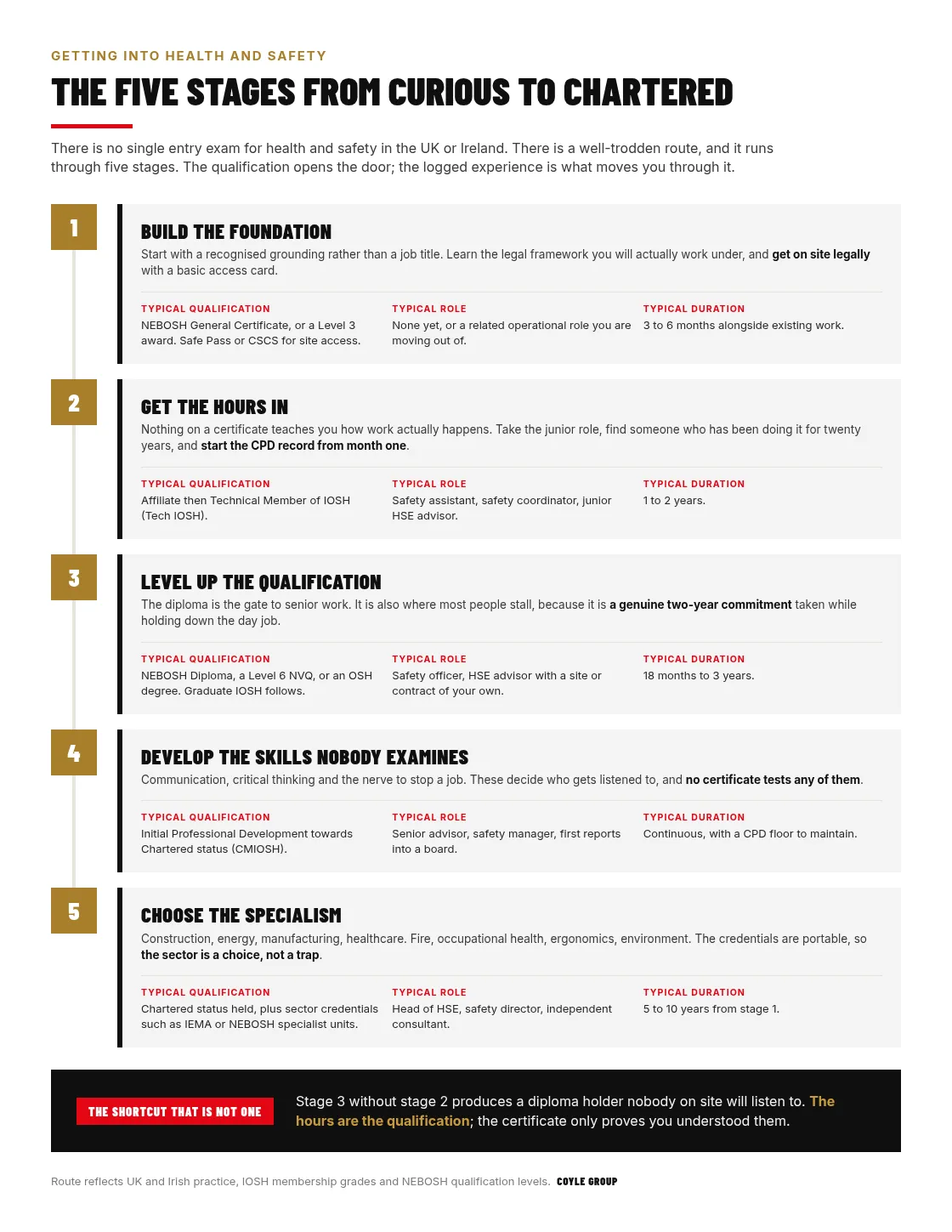
1. Build Your Foundation
You don’t need to have been born wearing a hard hat. Most safety professionals start with curiosity and a willingness to learn. The first step is education, and not just the formal kind.
- Entry-Level Courses: Begin with a basic grounding in health and safety principles. Consider courses like the Level 3 Technical Certificate in Occupational Health and Safety or similar entry-level qualifications. If you are unsure where to start, our advice on choosing a course matches the options to your goals.
- Understand the Law: Get to grips with the laws and regulations that govern workplace safety in your region. In Ireland, for example, the Safety, Health and Welfare at Work Act 2005 is essential reading.
- Certifications: Look for certifications relevant to your industry: in the UK and Ireland that usually means NEBOSH and IOSH, with sector-specific credentials added as you specialise.
2. Get Your Hands Dirty
Courses are great, but nothing beats real-world experience. Safety isn’t learned in a classroom alone.
- Start in Junior Roles: Roles like Health and Safety Assistant or Coordinator are your entry points. Here, you’ll support senior colleagues, learn the ropes, and see first-hand how safety is managed (or sometimes, mismanaged) on the ground.
- Find a Mentor: If you’re lucky, you’ll find someone who’s been around the block, someone who can show you not just what to do, but why it matters. Mentorship is gold in this field.
- Volunteer or Intern: If jobs are scarce, look for internships or volunteer opportunities. Even shadowing a safety officer for a week can open your eyes to the realities of the role.
3. Level Up: Advance Your Qualifications
Once you’ve got your feet on the ground, it’s time to deepen your expertise.
- Diplomas and Degrees: Consider a higher diploma or bachelor’s degree in Occupational Safety and Health. For those eyeing specialist roles, degrees in Environmental Health or Emergency Management are valuable.
- Specialist Certifications: As you progress, certifications like the NEBOSH Diploma, ProQual Level 6 NVQ or IEMA Environmental Sustainability credentials can set you apart.
- Continuous Learning: Safety is a moving target. Regulations change, technology evolves, and new risks emerge. Stay sharp by attending workshops, webinars and industry conferences.
4. Develop the Skills That Matter
Safety isn’t just about knowledge: it’s about influence, communication and leadership.
- Communication: You need to speak the language of the boardroom and the break room. Translate regulations into action. Listen as much as you talk.
- Critical Thinking: Every site, every shift, every day brings new challenges. Learn to assess risks, spot patterns, and think on your feet.
- Empathy and Integrity: People need to trust you. They need to know you’re not just there to enforce rules, but to protect them, sometimes from themselves, sometimes from the pressures of the job.
5. Choose Your Path: The Many Faces of Safety
The beauty of a safety career is its diversity. You can work in construction, manufacturing, healthcare, energy or even tech. You can specialise in fire safety, environmental health, ergonomics or mental health.
- Entry-Level Roles: SHE/HSE Representative, Health and Safety Coordinator, Safety Assistant.
- Mid-Level Roles: Safety Officer, Safety Specialist, Environmental Health Officer.
- Senior Roles: Health and Safety Manager, Safety Director, Training Personnel, Compliance Lead.
Each step up brings more responsibility, not just for ticking boxes, but for shaping culture and leading change.
The Realities: What They Don’t Tell You
Let’s be honest. Safety isn’t glamorous. You’ll face resistance. You’ll be the “no” person in meetings. You’ll see corners cut and sometimes, you’ll be the only one standing between a worker and a life-changing injury.
But you’ll also be the reason someone gets to go home safely to their family. You’ll be the voice that says, “We can do better.” And in those moments, the job is worth every late night, every hard conversation, every uphill battle.
The Culture Challenge
Just as with mental health in construction, the biggest battles are often cultural. You’ll encounter the “we’ve always done it this way” mindset. You’ll see the pressure to get the job done, no matter the cost. Your job is to challenge that: respectfully, persistently and with evidence.
The False Solutions
Beware the tick-box mentality. Safety isn’t about paperwork for its own sake. It’s about real change, real protection and real leadership. Don’t be seduced by quick fixes: two-day courses, flashy posters, or endless toolbox talks that never get to the root of the problem.
Leadership in Safety: More Than a Title
Leadership in safety isn’t about job titles. It’s about courage. It’s about being the person who asks the uncomfortable questions, who stands up when it’s easier to sit down, who listens when others dismiss concerns.
True safety leaders create psychological safety as well as physical safety. They make it okay for people to speak up, to admit mistakes, to ask for help. They know that the best safety systems in the world are useless if people are too afraid to use them.
The Business Case: Why Safety Matters
Let’s not kid ourselves: safety is good business. Accidents cost money, reputation, and sometimes, lives. But beyond the balance sheet, investing in safety means investing in people. It means building trust, loyalty and pride in the workplace.
A safe workplace is a productive workplace. Mentally healthy workers are safer, more focused and more engaged. The evidence is clear: organisations that treat safety as a core value, not a compliance exercise, outperform those that don’t.
The Path Forward: Practical Steps
Ready to take the plunge? Here’s your action plan:
- Assess Your Motivation: Why do you want a career in safety? Be honest with yourself. The best safety professionals are driven by a genuine desire to protect people.
- Research Your Options: Look at the industries, roles and qualifications that align with your interests and strengths.
- Get Qualified: Start with entry-level courses and build up. Don’t rush, as experience is as valuable as paper qualifications.
- Find Experience: Take any opportunity to get on site, observe and learn. Volunteer, intern or shadow if you have to.
- Network: Join professional bodies, attend events, and connect with others in the field. The safety community is tight-knit and supportive. Once you are established, our steps for advancing your career show how networking and CPD keep the momentum going.
- Stay Curious: Safety is always evolving. Read, ask questions, and never stop learning.
- Be Patient: Progress can be slow. Culture change takes time. But every small win matters.
Two sources are worth bookmarking before you spend money on anything. The National Careers Service profile for a health and safety adviser sets out the recognised UK entry routes and what employers actually ask for, and the Health and Safety Authority’s guidance for the Irish construction sector covers the duty-holder roles you will meet on your first site south of the border. Work the list in order, and you will find the first three steps take months while the last three take years.
Conclusion: Building More Than Compliance
A career in safety is a calling and a purpose. It’s a commitment to making a difference, one day, one site, one conversation at a time. It’s about more than rules and regulations: it’s about people, culture and leadership.
If you’re ready to step up, to challenge the status quo, and to be the person who makes a difference when it matters most, then welcome to the world of safety. It won’t always be easy, but it will always be worth it.
As we say in the industry: safety isn’t a job. It’s a responsibility. And if you’re willing to take it on, you’ll find a career that’s as rewarding as it is demanding.
So, you want a career in safety? Now you know what’s next. The rest is up to you.
And if you are reading this from the other side of the desk, with a vacancy rather than an ambition, we work the same market from the employer end: hire a safety officer in 48 hours from a bench of qualified people across construction and energy.
Frequently Asked Questions
How do you start a career in health and safety?
The usual starting point is either the NEBOSH General Certificate (broad, sector-agnostic) or a sector qualification like Safe Pass or CSCS if you are entering from a construction background. Combine that with an entry-level role (safety assistant, junior officer, HSE advisor) and start building the CPD trail from month 1. Chartered status is a 5 to 10 year path from that point.
What personal qualities matter in a safety career?
Beyond the technical knowledge, the qualities that separate strong safety people are courage (the willingness to stop unsafe work in the room where the decision is being made), curiosity (about how work actually happens, not how the paperwork says it happens), and the ability to communicate the same idea to a boardroom and a site cabin with equal clarity.
Is a safety career worth the effort?
For the right person, yes. The work carries real weight (people go home safely because of your decisions), the credentials are portable across sectors and countries, and the compensation is stable through downturns because safety is not the first budget to be cut on regulated work. It is not glamorous, but it is meaningful, and it pays.
What qualifications do you need to work in health and safety?
There is no single mandatory qualification. In practice most UK and Irish employers ask for the NEBOSH National General Certificate as a floor for a first safety role, plus a site access card such as CSCS or Safe Pass where the work is construction. Senior posts expect the NEBOSH Diploma, a Level 6 NVQ or an occupational safety degree, alongside IOSH membership.
How long does it take to get into health and safety?
The certificate itself takes roughly three to six months part time, so you can be applying for junior roles inside a year. Reaching safety officer with your own site typically takes two to three years of logged experience, and Chartered status is realistically a five to ten year path from a standing start. The qualifications are quick; the experience is not.
How hard is it to become a health and safety officer?
The entry qualification is achievable alongside a full-time job, and the sector has a persistent shortage of experienced people, so getting in is not the hard part. The difficulty is the diploma stage, which most people attempt while working, and the day-to-day reality of holding an unpopular line with managers who are under programme pressure.
Can you get into health and safety without experience?
Yes, though rarely straight into an advisory role. The common route is sideways: you already work in construction, energy, manufacturing or logistics, take the General Certificate, and move into a safety assistant or coordinator post with the same employer. If you have no sector background at all, expect to start in a junior support role and build the operational credibility from there.