Health and Safety Career Progression: 6 Steps to CMIOSH

The path to success in any field can be complicated, but the right approach, hard work and dedication make a difference. Whether you are starting out in the safety profession or looking to further a career you already have, the decisions that move you forward are rarely the obvious ones.
This article is aimed at people already working in safety who want to advance, so the focus is on momentum: continuing professional development, networking and staying current rather than breaking in for the first time.
One thing worth settling before you plan anything. The IOSH grade ladder changed. Graduate Member is gone, replaced by Certified (CertIOSH), and a route to Chartered mapped out from an article written before that change is a route to a rung that no longer exists. Everything below assumes the current structure.
The Route to CMIOSH, and What Each Rung Asks For
Career progression in safety is unusual in that the ladder is published. IOSH sets out its grades, the qualification and experience each one requires, and the two routes to Chartered. That makes it possible to plan against something concrete rather than against a vague sense that you should probably do another course. If you have not yet made the first appointment and are looking at getting into safety rather than moving up inside it, start there instead and come back to this ladder once you are in post.
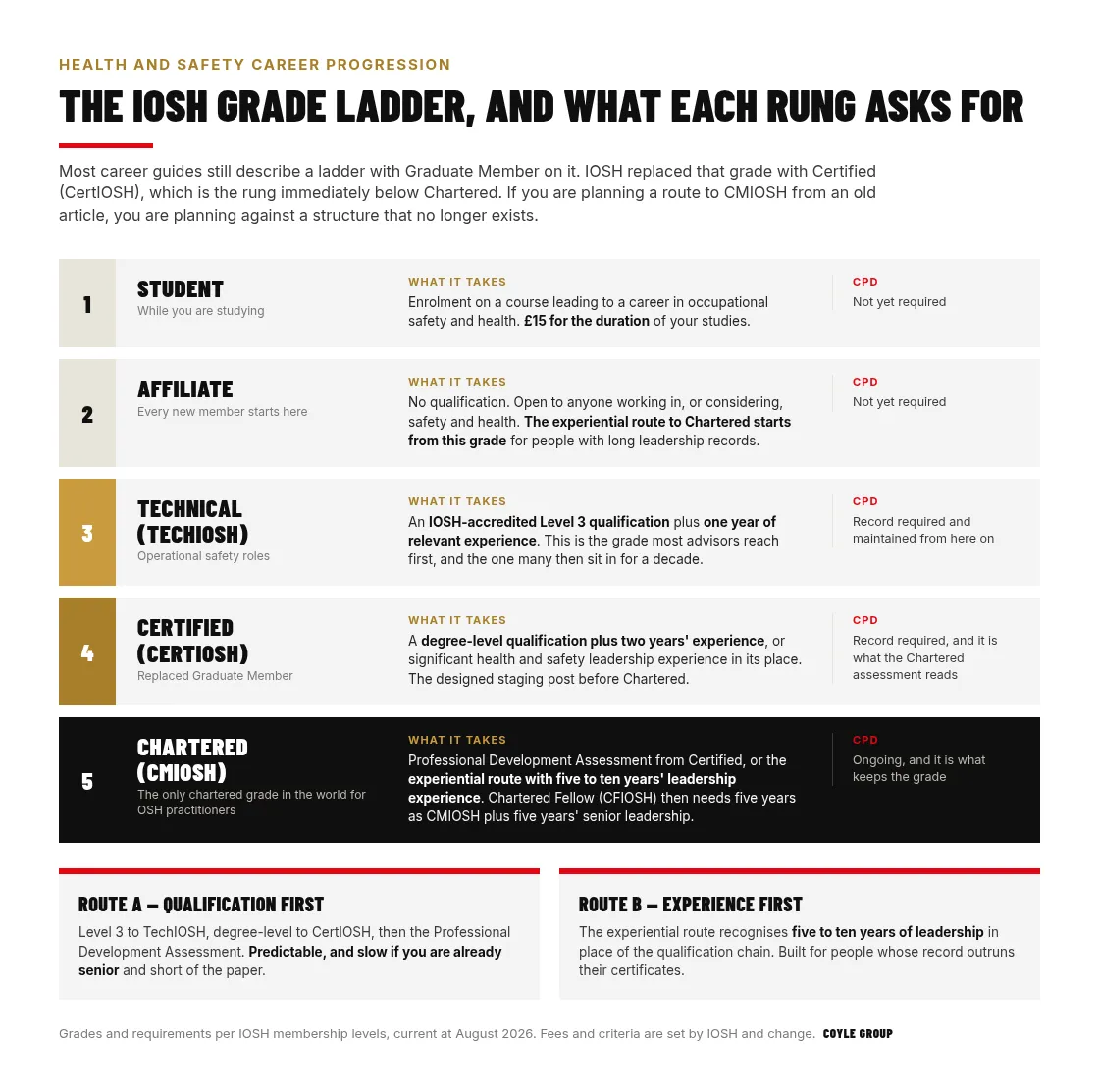
Two details in that ladder catch most people out. The first is that CPD becomes a requirement at Technical grade and never stops, and the record you keep from that point is the evidence the Chartered assessment reads years later. Starting it properly at Technical is cheaper than reconstructing it at Certified.
The second is the experiential route. It recognises five to ten years of health and safety leadership in place of the qualification chain, and it is under-used because people assume the paper route is the only one. If your record has outrun your certificates, that is the route built for you. The Government’s own career framework for the health and safety profession maps the same progression onto public-sector grades, which is useful if you want to see what each level is expected to be able to do rather than what it is called.
The 6 Steps That Move a Safety Career Forward
Knowing the ladder is not the same as climbing it. The six steps below are the ones that consistently separate people who move from people who stay put, and only two of them involve a qualification. Grades are the scoreboard; these are the plays.
1. Research where the roles actually are
Look at job titles, job descriptions, and the qualifications and skills each one demands. Look at salaries and outlook, and at which industries hire safety professionals, because construction, manufacturing, healthcare and energy ask for very different things under the same job title. Useful starting points are the Health and Safety Executive, the Health and Safety Authority in Ireland, IOSH, RoSPA and the British Safety Council.
Doing this properly narrows the field. It tells you which grade a target role actually needs, which is the difference between studying with a purpose and collecting certificates.
2. Meet people in person
Job fairs and sector events are where you learn what a role is really like, which is information no job description carries. Employers attend to meet candidates, and recruiters and hiring managers are there to be spoken to.
Meeting people face to face also builds the relationships that surface roles before they are advertised. A large share of safety appointments never reach a job board.
3. Join a professional body and turn up
Professional bodies provide training, education, networking events and job listings, and a platform to share experience. IOSH, RoSPA, the British Safety Council and the International Institute of Risk and Safety Management all run active memberships.
Joining is the easy part. The value comes from committee work and speaking, because those are what put your name in front of people who make hiring decisions.
4. Volunteer where the risk is real
Volunteering at community events builds genuine experience in safety management and risk assessment. Helping to plan a festival or a charity walk means real crowd, traffic and temporary-structure risk, and the planning that goes with it.
It also gives you something specific to talk about at interview. “I wrote the traffic management plan for an event with four thousand attendees” outperforms a certificate every time.
5. Take the qualification the next grade needs
A degree or certification demonstrates you have the knowledge and skills to perform safety tasks, and it is what moves you between IOSH grades. A degree in safety management or occupational health and safety covers safety management, risk assessment, incident investigation and emergency planning.
Pick the qualification the next rung requires rather than the next available course. To choose the right one for where you are now, see our guide to choosing a course, and check the pay bands and role definitions in our roundup of the best safety jobs before you commit the fees.
6. Stay current, and be seen to be
Staying up to date on regulation, publications and industry developments is what keeps advice worth paying for. Read industry publications and regulator updates, attend conferences, join industry groups, take part in professional forums, and follow the people setting direction in your sector.
The visible half matters as much as the reading. Prospects’ profile of the safety adviser role sets out the skills employers screen for, and most of them are demonstrated in public rather than on a transcript.
What Actually Stalls a Safety Career
Most careers do not stall for lack of effort. They stall at Technical grade, because the person is good at the operational job, the employer is happy, and nothing forces the next step. Years pass and the CPD record is thin, which makes the Certified application harder than it needed to be.
The other common stall is breadth. Someone spends a decade in one sector managing one risk profile, and then finds that the senior roles want somebody who has handled several. Deliberately taking on an unfamiliar risk, even on a small project, is worth more than another course in a subject you already know.
Neither is fixed by working harder at the job you already have. They are fixed by treating progression as its own piece of work with its own plan, in the way you would treat any other project with a deadline.
Where Employers Look When They Need This Skill Set
It is worth knowing what the other side of the table sees, because it changes what you put on a CV. Employers hiring safety people screen for grade, for sector experience, and for evidence that the person has personally handled the risk on their site rather than read about it.
They also hire under time pressure. When a site needs cover, the shortlist is drawn from people who are already known and already verified, which is why the networking and visibility steps above pay off in a way that is hard to see until they do. Our note on what a strong safety professional actually demonstrates covers the same ground from the employer’s side.
The practical implication is simple. Keep your grade current, keep the CPD record real, and stay findable.
Plan the Next Grade, Not the Next Course
Progression in safety is not mysterious. The ladder is published, the two routes to Chartered are both open, and the six steps above are the ones that move people. What separates the professionals who reach CMIOSH from the ones who stay at Technical is usually that they decided which rung they were aiming at and worked the evidence backwards from it.
If you are on the other side of this and need that skill set in your business rather than in your career, we place chartered and operational safety people into live projects across construction, energy and manufacturing. Hire a safety officer in 48 hours and we will match the grade to the risk on your site rather than to the job title on the requisition.
Frequently Asked Questions
How do you keep a safety career moving forward?
The three things that reliably compound are networking through professional bodies and sector events, continuing professional development, and staying current with regulator publications. Any two of those without the third eventually stalls a career, because safety is a discipline where relationships, credentials and current knowledge all matter. Progression also depends on the breadth of risk you have personally managed, not only on time served.
What is the difference between TechIOSH, CertIOSH and CMIOSH?
Technical membership needs an IOSH-accredited Level 3 qualification plus one year of relevant experience, and suits operational safety roles. Certified membership needs a degree-level qualification plus two years of experience, or significant safety leadership experience in its place, and is the designed staging post before Chartered. Chartered membership is reached through the Professional Development Assessment or the experiential route, and is the only chartered grade in the world for safety practitioners.
Is Graduate Member of IOSH still a grade?
No. IOSH restructured its professional grades and Certified membership, CertIOSH, now occupies the rung immediately below Chartered where Graduate Member used to sit. Plenty of careers advice and job adverts still ask for Grad IOSH, so it is worth naming your current grade precisely on a CV rather than translating it into the old label and leaving a recruiter to guess.
How important is chartered status for a safety career?
Chartered status separates advisory-level and director-level safety careers from operational ones. It signals a documented track record, an ethical framework and independent peer review, which is why it appears as a requirement on senior job specifications and on tender pre-qualification questionnaires. It is not the only path, but for most people it is the fastest way to reach senior roles and independent consulting work.
How much CPD should a safety professional do?
IOSH requires a maintained CPD record from Technical membership upward, and that record is what the Chartered assessment actually reads. The useful benchmark beyond the minimum is a mix: at least one substantial course a year, monthly reading of regulator updates, and regular attendance at sector events. Recording CPD is easy. Applying what you learn on site is the harder half of the job.
Can you become CMIOSH without a degree?
Yes, through the experiential route, which recognises five to ten years of health and safety leadership experience in place of the qualification chain. It exists precisely for people whose record has outrun their certificates, which is common among practitioners who came up through operations rather than through a safety degree. The evidence bar is high because the assessment tests the same competences either way.
What is the highest paying health and safety job in the UK?
Head of HSE and safety director roles sit at the top of the salary range, followed by senior consultants working independently and specialists in high-hazard sectors such as energy, rail and construction. Sector matters as much as title: the same job title pays materially more where the consequence of failure is higher. Chartered status is close to a precondition at that level.