Offshore Wind Ireland: 7 Relevant Projects, 5 GW by 2030
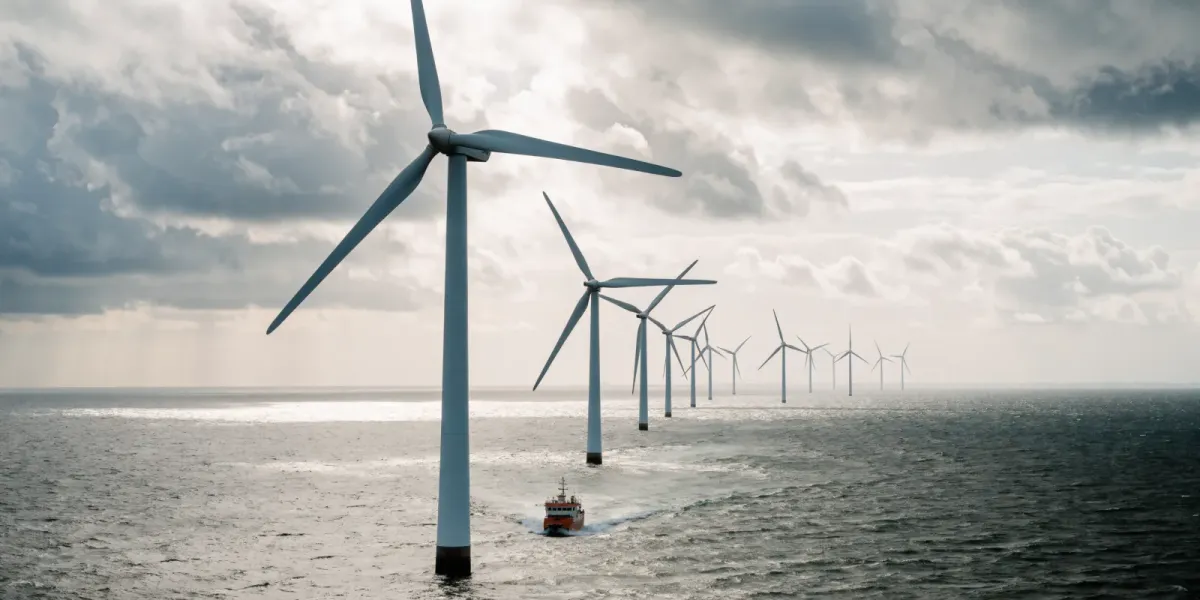
Offshore wind is one of the most reliable sources of power available to Ireland. Stronger and more consistent than wind on land, emission-free at the point of generation, and sitting in an Exclusive Economic Zone roughly seven times the size of the landmass.
The pipeline that will deliver it is small, specific and frequently mis-reported. Depending on which article you read, Ireland’s first tranche of offshore wind is seven projects, or six, or four. All three numbers are correct, and this piece explains why, then gives the current status of each one.
That matters beyond trivia. Every count refers to a different stage of the same pipeline, and knowing which stage a project has reached is what tells you whether construction work is years away or imminent.
The Seven Relevant Projects, Four Years On
Under the transitional provisions of the Maritime Area Planning Act 2021, a first group of seven offshore projects that had advanced under the old Foreshore regime were designated Relevant Projects and invited to apply for a Maritime Area Consent. Applications opened in April 2022 and closed that June.
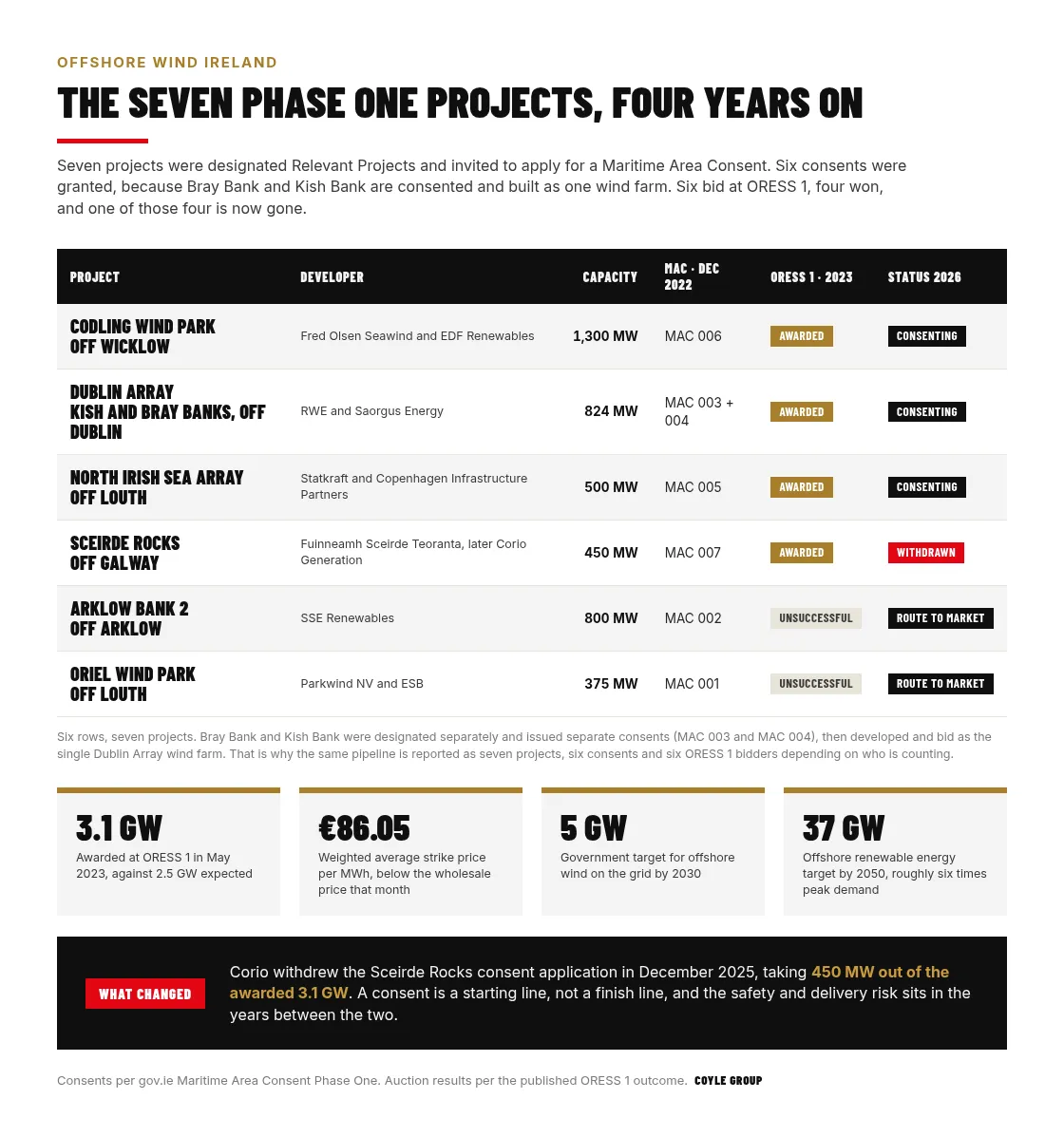
The three counts resolve like this. Seven projects were designated, because Bray Bank and Kish Bank were designated separately. Six consents were granted on 23 December 2022, because those two banks were consented together and are built as the single Dublin Array wind farm. Six projects bid at ORESS 1 in 2023 for the same reason, and four of them won. The same pipeline runs through our wider energy sector work, from consenting-stage advisory to construction-phase coordination.
Codling Wind Park
The largest of the seven at an indicative 1,300 MW, sited off the Wicklow coast and developed by a joint venture of Fred. Olsen Seawind and EDF Renewables. It holds MAC 006 and took the biggest single award at ORESS 1. It is now working through development consent, and on capacity alone it sets the pace for the whole tranche.
Kish Bank
One half of what is built as the Dublin Array wind farm, roughly 10 km off the Dublin coast. It was designated in its own right and carries MAC 004, which is the first reason the count of projects and the count of consents differ.
Bray Bank
The other half of Dublin Array, carrying MAC 003, immediately south of Kish Bank off the Wicklow coast. Bray and Kish were consented in a single document by the Minister, which is why gov.ie records six consents against seven designated projects. Together the two banks are a single RWE and Saorgus Energy scheme of up to 824 MW across 39 to 50 turbines, and the planning application went in during February 2025.
North Irish Sea Array
A 500 MW Statkraft project off the Louth and Meath coast, holding MAC 005 and awarded a contract at ORESS 1. It sits in the same shallow east-coast water as Codling and Dublin Array, which is a large part of why all three cleared the auction.
Sceirde Rocks
The only Phase One project on the west coast, at 450 MW off the Galway coast under MAC 007 and developed by Corio Generation. It won at ORESS 1 and is the one project of the seven that is no longer live: the consent application was withdrawn in December 2025. The section below covers what that removed from the pipeline.
Arklow Bank Wind Park 2
An SSE Renewables scheme of around 800 MW off the Wicklow coast under MAC 002, extending the site of Arklow Bank Wind Park 1, which has been generating since 2004 and remains Ireland’s only operating offshore wind farm. It bid at ORESS 1 and did not clear, and SSE has stated it remains committed to the project.
Oriel Wind Park
A 375 MW project off the Louth coast, jointly owned by ESB and Parkwind, holding MAC 001 as the first consent issued in the batch. It was the second of the two unsuccessful ORESS 1 bidders. It has a planning application lodged, and if it is permitted and built it would be the first new Irish offshore wind farm since Arklow Bank in 2004.
Every project on that list holds a consent to occupy part of the maritime area. None of them holds planning permission on the strength of it. gov.ie’s own record of the Phase One consents is explicit that a project with a MAC still has to obtain all requisite consents and permission, and that assessment sits with the planning commission rather than the Minister.
What ORESS 1 Actually Delivered
Ireland’s first offshore auction ran in May 2023 and cleared better than expected on both volume and price. Four of the six bidders secured long-term contracts of up to 20 years, guaranteeing revenue and making the projects financeable.
The awarded capacity came to 3.1 GW against 2.5 GW expected, the largest volume of renewable energy ever awarded at auction in Ireland. The weighted average strike price of €86.05 per MWh landed below the €105 per MWh wholesale price recorded that month, which is the number that turned the auction from a policy milestone into a consumer argument.
Two projects did not clear: Oriel Wind Park and Arklow Bank Wind Park 2. Both sponsors stated they remained committed and were reviewing routes to market. That is a materially different position from being cancelled, and it is worth keeping them on the map.
What Changed Since, and Why It Matters
Nothing in this pipeline has been static. In December 2025 Corio Generation withdrew the consent application for Sceirde Rocks off the Galway coast, and An Coimisiún Pleanála confirmed the withdrawal in January 2026. Challenging site conditions were cited for a project reported at around €1.4 billion.
That single withdrawal took 450 MW out of the 3.1 GW awarded, and it left the surviving Phase One pipeline almost entirely on the east coast, where the water is shallower and the grid connection is nearer. It is a useful reminder that a consent is a starting line rather than a finish line, and that the delivery and safety risk sits in the years between the two.
Set against the 2023 position, this is what has actually moved:
- Sceirde Rocks is out. Corio Generation withdrew the consent application in December 2025 and An Coimisiún Pleanála confirmed the withdrawal in January 2026, taking the awarded capacity from 3.1 GW to roughly 2.65 GW.
- The tranche is now an east-coast programme. With the only western project gone, every surviving Phase One site sits in the Irish Sea, off Wicklow, Dublin or Louth.
- The consenting body changed name and form. Applications that were lodged with An Bord Pleanála are now decided by An Coimisiún Pleanála, which replaced it in 2024.
- Consents moved to a regulator. The Minister granted the Phase One batch personally under the transitional provisions; the Maritime Area Regulatory Authority has handled Maritime Area Consents since it became operational in 2023.
- Dublin Array entered planning. RWE lodged the development consent application for the Kish and Bray Banks scheme in February 2025.
- A second auction has been and gone. ORESS 2.1 cleared in November 2025 on a new site off Waterford rather than on any Phase One project, which is covered below.
For anyone planning resource against this pipeline, the practical read is that east-coast construction is where the work will be, and that the west-coast schedule assumptions made in 2023 no longer hold.
The Wider Target and What Sits Behind It
Phase One is a first tranche rather than the plan. The Government target is 5 GW of offshore wind on the grid by 2030, with a further 2 GW of floating offshore wind in development by the same date. Beyond that, the Department of Enterprise, Tourism and Employment puts Ireland’s offshore renewable energy ambition at least 37 GW by 2050, which is roughly six times current peak electricity demand.
Ireland is already the global leader in onshore wind, drawing around 40% of its electricity from wind. Offshore build-out is lower, which is precisely the point: the headroom is offshore, and so is the industrial opportunity in ports, supply chain and eventually hydrogen export.
The constraint on all of it is delivery capacity rather than ambition, and a large part of delivery capacity is competent people. That is where the safety question stops being abstract.
Phase Two: Tonn Nua and the Auction After ORESS 1
Phase One was a transitional arrangement for projects that had already advanced under the old Foreshore regime. Everything after it works the other way round: the State picks the site first, then runs an auction for it.
That switch produced ORESS 2.1, held on the Tonn Nua site off the Waterford coast. Tonn Nua was identified by the South Coast Designated Maritime Area Plan, Ireland’s first spatial plan for offshore renewable energy, and the auction procured 900 MW of fixed-bottom capacity when it concluded in November 2025. A joint venture of Ørsted and ESB took the provisional rights on a partially indexed 20-year contract for difference at €98.719 per MWh, with commercial operation targeted for the middle of the 2030s.
Two things in that result are worth reading carefully if you are planning work rather than following policy. The strike price came in above the €86.05 per MWh weighted average of ORESS 1, which reflects a harder financing market rather than a worse site. And the timeline is explicitly mid-2030s, which puts Tonn Nua a full development cycle behind the Phase One projects. Nothing on the south coast competes for people with the Irish Sea build-out this decade.
The practical consequence is that Phase One remains the near-term work. If your resourcing horizon is the next five years, the east coast is the pipeline that matters, and Tonn Nua is the reason to keep a south-coast capability rather than to build one now.
The Safety Work Behind the Pipeline
Offshore wind construction combines lifting at a scale few sites ever see, working at height in weather that changes inside an hour, vessel transfer, confined-space work inside towers and nacelles, and a contractor population operating a long way from shore-based rescue. The plan written for construction rarely survives contact with the operations phase, when the same asset is maintained by small crews instead of built by large ones.
Coyle Group provides technical consultancy and operational support across that lifecycle. Our onshore wind farm case studies at Evishagaran and Douglas West show the same permit and coordination logic applied on land, and the risks on a generating asset carry across too, as our guide to power plant safety sets out for thermal plant.
The pipeline is also drawing experienced people across from other sectors, and our note on the move from oil and gas into renewables covers how those skills map onto wind and where the gaps usually sit.
Seven Projects, One Real Constraint
Ireland’s first offshore tranche is seven designated projects, six consents, six bidders and four winners, one of which has since gone. That is the honest state of the pipeline in 2026, and it is more useful than any single headline number.
What decides whether the rest of it reaches 5 GW by 2030 is not policy. It is consenting throughput, grid, ports and people, and the last of those is the one that quietly sets the pace on every project once construction starts.
If you are resourcing against this pipeline, talk to a wind-sector safety specialist before the mobilisation date rather than after it, because competent offshore people are booked months ahead of the vessels.
Frequently Asked Questions
How many offshore wind projects does Ireland have in development?
Seven projects were designated Relevant Projects and invited to apply for a Maritime Area Consent under the transitional provisions of the Maritime Area Planning Act 2021. Six consents were granted in December 2022, because Bray Bank and Kish Bank were consented separately but are developed as the single Dublin Array wind farm. Six of those projects then bid into Ireland's first offshore auction in 2023.
Which projects won Ireland's first offshore wind auction?
Four projects secured contracts in ORESS 1 in May 2023: Codling Wind Park at 1,300 MW off Wicklow, Dublin Array at 824 MW off Dublin, North Irish Sea Array at 500 MW off Louth, and Sceirde Rocks at 450 MW off Galway. The combined 3.1 GW exceeded the 2.5 GW expected, and the weighted average strike price of €86.05 per MWh came in below the wholesale electricity price that month.
Why did the Sceirde Rocks wind farm not go ahead?
Corio Generation withdrew the consent application for Sceirde Rocks in December 2025, and the withdrawal was confirmed by An Coimisiún Pleanála in January 2026. Challenging site conditions off the Galway coast were cited. The withdrawal removed 450 MW from the capacity awarded at ORESS 1 and left the remaining Phase One pipeline concentrated on the east coast, where the water is shallower and the grid is closer.
When will Ireland's offshore wind farms be operational?
Timelines vary by project. The successful ORESS 1 projects hold long-term contracts of up to 20 years and are working through development consent with An Coimisiún Pleanála before construction can begin. The stated national targets are 5 GW of offshore wind on the grid by 2030, a further 2 GW of floating offshore wind in development by 2030, and at least 37 GW of offshore renewable energy by 2050.
What is a Maritime Area Consent and why does it matter?
A Maritime Area Consent is the State consent to occupy a part of the maritime area, created by the Maritime Area Planning Act 2021 as the first step in the new offshore planning process. It is not planning permission. A project that holds a MAC still has to obtain development consent, and the Maritime Area Regulatory Authority now handles applications rather than the Minister who granted the Phase One batch.
What are the main safety considerations for offshore wind projects?
Offshore wind construction combines lifting operations at scale, working at height in poor weather, marine and vessel transfer, confined-space work inside towers and nacelles, and a large contractor population working far from shore-based rescue. Competent safety planning, permit-to-work systems and verified crew training are central. The risk profile also shifts between construction and operations, so the plan written for the build rarely fits the maintenance phase.
How does offshore wind in Ireland differ from onshore wind?
Offshore turbines are larger, the wind resource is stronger and more consistent, and the consenting route is entirely different because the seabed is State property and the Maritime Area Planning Act applies. The safety profile is also different: access depends on vessels and weather windows, rescue is slower, and the same maintenance task that takes a morning onshore can consume a day offshore before anyone touches the turbine.