Office Hazards: 6 Common Risks and How to Control Them

The office isn’t always the healthiest or safest of places. Workplace hazards, big and small, can put your business and employees at risk. It’s critical to recognise the potential risks in a workplace so steps can be taken to mitigate them, both for employees’ health as well as financial losses.
From trip hazards and electrical issues to air quality concerns and combustible materials, there are a variety of unseen dangers that might be lurking in your workspace. Some are easy to spot if you know what to look for. Others are difficult to identify, which is what makes it worth working through the office in a fixed order rather than trusting a walk-around to surface them.
Working in an environment without proper safety processes puts workers at risk of physical and emotional injuries, health issues and reduced productivity. Identifying the risks that exist in your work environment is the first step towards creating a secure workspace for yourself and everyone else in the building.
Employers and employees both need a clear picture of office safety, because it protects people and property at the same time. This article covers the six hazard categories that account for almost everything an office inspection finds, the one control that closes each of them, and a checklist you can walk the floor with.
The 6 Common Office Hazards
Almost every hazard an office inspection turns up falls into one of six categories. Grouping them this way matters for a practical reason: a category has one primary control, so you can work through six controls and know what is left uncovered, rather than working through a list of thirty individual observations and hoping the pattern emerges.
1. Slips, trips and falls
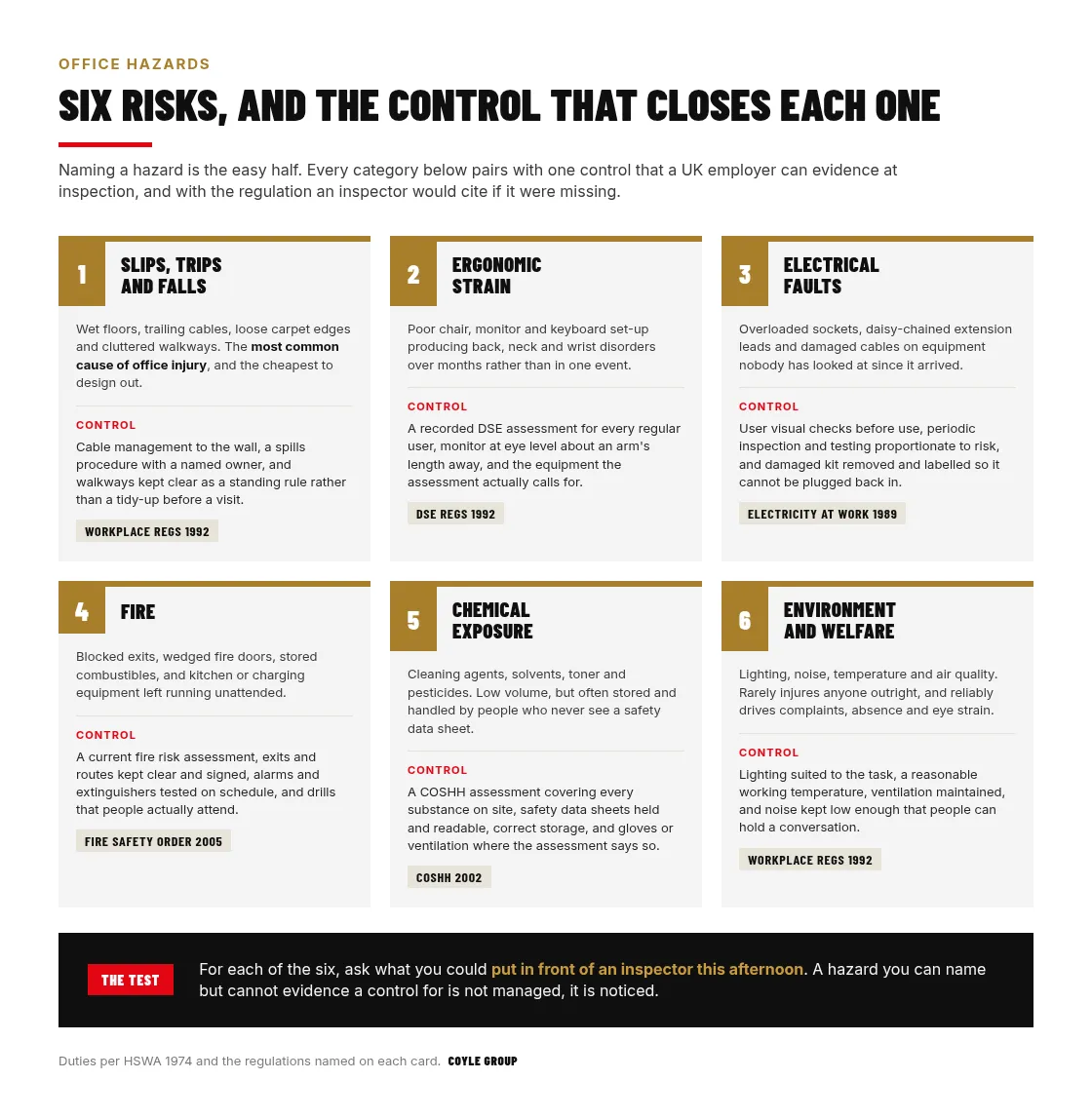
Slips, trips and falls are the most common office hazard by some distance. They occur through wet floors, loose carpets or cords, cluttered walkways and uneven surfaces, and they produce a disproportionate share of the injuries that turn into absence.
How to control it: Route cables to the wall rather than across the floor, run a spills procedure with a named owner rather than a general expectation, and keep walkways clear as a standing rule. Sustained good housekeeping removes more of this category than any single intervention.
2. Ergonomic strain
Ergonomic hazards cause discomfort and musculoskeletal disorders, including carpal tunnel syndrome, back pain and neck strain. They come from prolonged sitting, awkward postures, repetitive motions and poor workstation design, and they build over months rather than arriving in one event.
How to control it: Carry out a display screen equipment assessment for every regular user and record it. Provide adjustable chairs with back support, position the monitor at eye level about an arm’s length away, and keep the keyboard and mouse close so the wrists stay straight. The HSE’s guidance on display screen equipment sets out what the assessment has to cover and when eye tests become an employer duty.
3. Electrical faults
Electrical hazards come from faulty wiring, overloaded circuits, damaged equipment and improper use of outlets and extension cords. They cause shock, burns and fires, and they concentrate in the equipment nobody has looked at since the day it arrived.
How to control it: Keep to the Electricity at Work Regulations 1989. Carry out visual checks of plugs, cables and sockets, arrange periodic inspection and testing where the risk justifies it, and avoid daisy-chaining extension leads. Take damaged equipment out of use straight away and label it so no one plugs it back in.
4. Fire
Fire hazards arise from electrical faults, improper storage of flammable materials, smoking and cooking appliances. This is the category where the consequence is worst and the control is best understood, which is precisely why it drifts.
How to control it: Hold a current fire risk assessment, keep exits and routes clear and signed, test alarms and extinguishers on schedule, and run drills that people actually attend. Wedged-open fire doors are the single most common finding, and the cheapest to fix.
5. Chemical exposure
Chemical hazards come from cleaning agents, solvents and pesticides, and can cause irritation, respiratory problems or long-term health effects. Volumes are low in an office, which is exactly why the assessment tends not to exist.
How to control it: Run a COSHH assessment covering every substance kept on site, hold the safety data sheets somewhere people can read them, store products correctly, and provide gloves or ventilation where the assessment calls for them. That applies to contract cleaners’ products as much as your own.
6. Environment and welfare
Physical and environmental hazards cover poor lighting, noise, vibration and extreme temperatures. They cause eye strain, hearing loss, musculoskeletal disorders and thermal discomfort, and they show up as complaints and absence long before they show up in an accident book.
How to control it: Match lighting to the task rather than to the ceiling grid, maintain a reasonable working temperature, keep ventilation serviced, and keep noise low enough that people can hold a conversation across a desk. The University of Essex’s staff guidance on office environment hazards is a good public example of how a large employer documents this category.
Work through those six and you have covered most of what an inspection finds. What the list does not tell you is which of them is currently a problem in your building, and that only comes from looking.
Strategies for Spotting Office Hazards
Maintaining a safe workplace means finding hazards before they find someone. Four habits do most of the work here, and none of them requires a consultant in the building. What they share is that they produce a record, which is the difference between managing hazards and noticing them.
1. Identify the hazards that are actually present
Work the six categories above against your own floor rather than against a generic list. Common findings include wet or slippery floors, frayed cords or damaged equipment, blocked exits or walkways, and poor lighting. Write down what you find, including the things you decide are acceptable, because an assessment that only records problems reads as incomplete.
2. Inspect on a schedule
Inspections should happen on a regular cycle, cover every area including the ones without desks in them, and be documented with the hazards identified and the corrective actions taken. Annual is the floor rather than the target. A quarterly walk with a fixed route surfaces drift that a yearly one misses entirely.
3. Involve the people who work there
Employees are usually the first to spot a hazard and the last to be asked. Regular safety meetings, training, and a culture where raising something is normal will surface more than any inspection, because the people at the desks see the office every day rather than once a quarter.
4. Provide training and resources
Give people the knowledge and tools to identify and prevent hazards: safety training matched to their actual role, the equipment their DSE assessment identified, accessible safety resources, and drills. Training that never changes behaviour on the floor is a cost rather than a control.
These four are cheap and they compound. The reason they fail is almost never the method. It is that nobody owns the follow-up, so findings accumulate and the next inspection reads like the last one.
Office Risk Assessment Checklist
A short, repeatable checklist keeps office inspections consistent between people and between quarters. Work through each area and record what you find, including the areas that are fine.
- Floors and walkways: clear of trailing cables and clutter, no trip hazards, spills cleaned promptly.
- Workstations and DSE: chairs adjustable, monitors at eye level, and a recorded DSE assessment for every regular user.
- Electrical safety: plugs and cables in good condition, sockets not overloaded, damaged equipment removed and labelled.
- Fire safety: exits clear and signed, extinguishers in date, alarms tested, flammable materials stored correctly, fire doors not wedged.
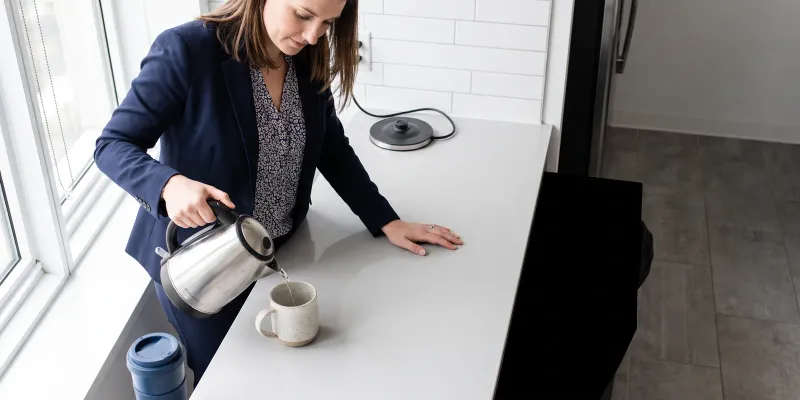
- Kitchen and break areas: appliances maintained, and safe handling of hot drinks to prevent hot spillages.
- Lighting and environment: adequate lighting, comfortable temperature, noise kept to a reasonable level.
- Remote and hybrid staff: home-workstation risks covered in your remote working assessments.
Seven areas, and the seventh is the one most offices still have not written down. For a formal, independent review, our audits and inspections service benchmarks your office against current HSE expectations and gives you the corrective actions in priority order.
Reporting Hazards: The Part That Keeps It Working
An inspection tells you what one person saw on one day. A working reporting process tells you what everyone sees, all the time, and it is the only mechanism that scales past the size at which one person can walk the whole floor.
Encourage open communication
Create a culture in which people report hazards without fear of being blamed for them. Establish clear lines of communication and provide several channels: anonymous routes, a named person, and a standing item in team meetings.
Provide the means to report
Make sure people have what they need to report: a clear process, more than one channel, and training on how to recognise and describe a hazard. A process that requires someone to find a form on an intranet will collect very little.
Follow up in a visible timescale
Once a hazard is reported, investigate it, take corrective action, and tell the person who raised it what happened. The last step is the one that gets skipped, and it is the one that determines whether anyone reports the next thing.
Reporting rates are a health signal rather than a problem. A quiet inbox in a busy building usually means people have stopped telling you, not that the office got safer.
Office Hazards Are Cheap to Fix and Expensive to Ignore
Hazards in the office pose a real threat to employee health, and almost all of them are cheap to close once someone has written them down. Six categories, one control each, a checklist you can walk in twenty minutes, and a reporting route that people trust. That is the whole system.
If you want that system built and documented properly rather than assembled from a template, we can help. Get expert RAMS & compliance support and we will start with the walk-around, then leave you with an assessment your own managers can maintain.
Frequently Asked Questions
What are common office hazards?
The most common office hazards are slips, trips and falls; ergonomic strain from poor workstation set-up and display screen equipment (DSE); electrical faults from overloaded sockets and damaged cables; fire; and chemical exposure from cleaning products. Poor lighting, noise and temperature add further risk. Slips, trips and falls account for the largest share of reported office injuries in the UK.
How do you do an office risk assessment?
Walk the office and identify hazards, decide who might be harmed and how, evaluate the risks and the controls already in place, record your findings, and set a date to review. The HSE's five-step approach applies, and DSE workstation assessments should form part of it. Record the assessment in writing if you employ five or more people.
What are the 10 most common workplace hazards?
Across all workplaces, the usual ten are slips and trips, falls from height, manual handling, electrical faults, fire, hazardous substances, machinery and moving vehicles, noise, ergonomic strain, and work-related stress. An office carries a subset: slips and trips, ergonomic strain, electrical faults, fire, chemicals from cleaning products, and environmental factors such as lighting, noise and temperature.
Do office workers need a DSE assessment?
Yes, if they are a display screen equipment user, meaning they use DSE daily for continuous periods of an hour or more. The Health and Safety (Display Screen Equipment) Regulations 1992 require the employer to assess the workstation, reduce any risks found, provide eye tests on request, and give information and training. Home and hybrid workstations count.
Who is responsible for health and safety in an office?
The employer holds the legal duty under the Health and Safety at Work etc. Act 1974, and it cannot be delegated away. Managers and supervisors carry it operationally for their own areas. Employees have a duty under section 7 to take reasonable care and to co-operate with the arrangements. Naming a health and safety officer does not move the duty off the employer.
How often should an office risk assessment be reviewed?
Review it whenever something material changes and at least annually. Material changes include a move or refit, new equipment, a change in headcount or shift pattern, a new hybrid working arrangement, an accident or near miss, and any enforcement contact. An assessment that has not moved in three years usually describes an office that no longer exists.
What is the difference between a hazard and a risk in an office?
A hazard is the thing with the potential to cause harm, such as a trailing extension lead. The risk is the likelihood that someone is harmed by it and how badly. Two offices can share the same hazard and carry very different risks depending on footfall, lighting and whether anyone has secured the cable.