Workplace Health and Safety on a Budget: 6 Steps

Balancing safety and cost-efficiency can be a challenge, but it is far from impossible. Many people assume that achieving safety in the workplace requires a hefty budget, and while cost is a real consideration, there is also a great deal a business can do that costs little beyond staff time.
Safety on a budget comes down to sequence: prioritise the controls that address your most significant risks first, and the rest of the spend takes care of itself. A good starting point is understanding the regulations that apply to your industry, then working through a combination of risk assessment, training, process improvements and targeted equipment upgrades. Get the order right and it is possible to maintain a genuinely safe working environment while keeping costs under control.
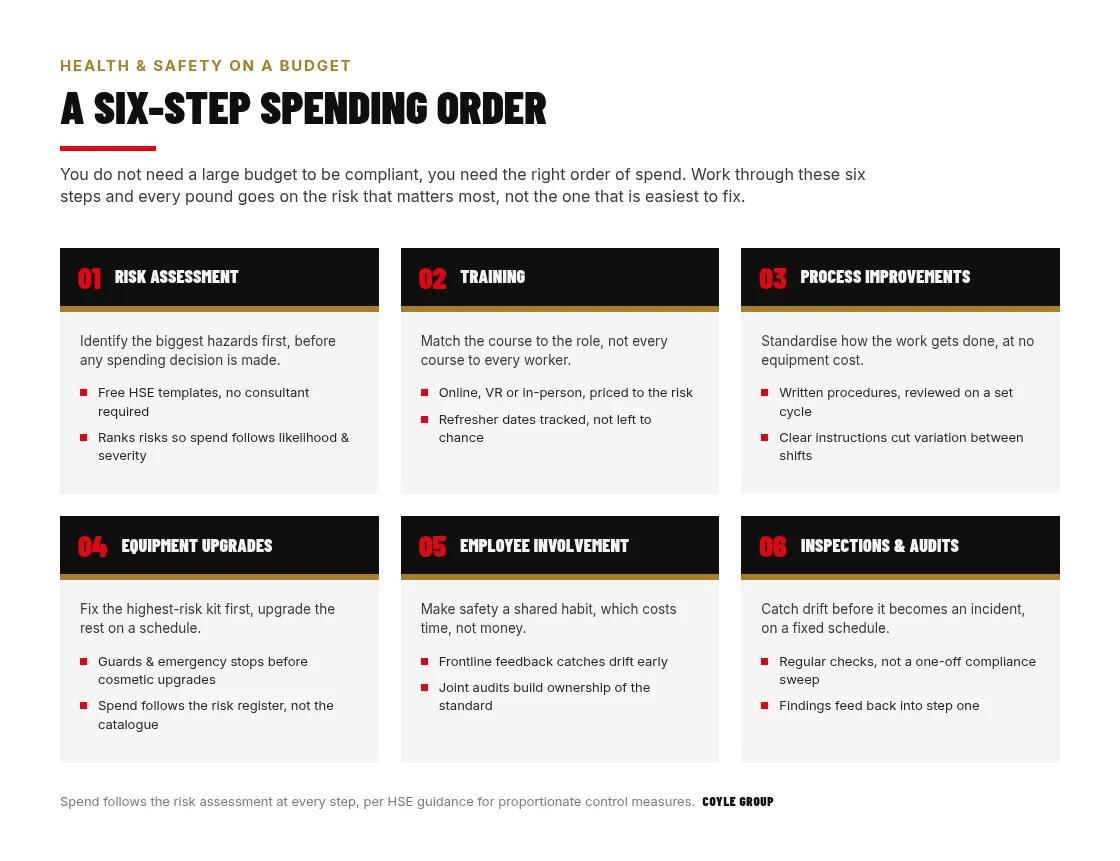
A Six-Step Spending Order for Health and Safety on a Budget
Achieving health and safety on a budget requires a strategic, systematic approach rather than an even spread of spend across every category. The six steps below are the order in which we ask clients to prioritise, so that the first pound spent goes on the risk that matters most.
1. Risk Assessment
Conduct a thorough risk assessment before any spending decision, not after. This is what identifies the most critical hazards in your workplace and ranks them by likelihood and severity, so that the areas needing attention first are obvious rather than guessed at. Our RAMS guide walks through the process step by step, and HSE’s risk assessment templates cover most small workplaces without needing a consultant at this stage.
2. Training
Invest in safety training matched to the role rather than a blanket course for everyone. Someone working at height needs different training from someone handling chemicals, and pricing the course to the actual risk avoids paying for cover you do not need. This can be delivered through online courses, virtual reality simulations, or in-person sessions, whichever suits the hazard and the budget.
3. Process Improvements
Standardise how work gets done. Written procedures, clear instructions, and a set review cycle reduce the risk of accidents at no equipment cost at all, because most incidents come from inconsistent practice rather than missing kit. Regularly reviewing and updating procedures keeps them matched to how the work actually happens on site, not how it was designed on paper.
4. Equipment Upgrades
Where equipment spend is genuinely needed, fix the highest-risk kit first and schedule the rest. Installing safety guards, adding emergency stop buttons, or upgrading to safer tools and machinery all reduce the risk of accidents, but the risk register should decide the order, not the supplier’s catalogue.
5. Employee Involvement
Encourage a culture of safety by involving employees in the process and recognising their contribution to a safe working environment. This costs time rather than money: providing incentives for safe practices, encouraging frontline feedback, and involving employees in safety audits and inspections all surface problems earlier than a top-down inspection alone.
6. Regular Inspections and Audits
Conduct regular safety inspections and audits to identify potential hazards before they become incidents, then feed the findings back into step one. This is where a business earns the confidence that its safety measures are actually working, rather than assuming they are because nothing has gone wrong yet. When we run audits and inspections for clients, the same six-step order is what we check spend against. For a longer-term view of the numbers across a full year rather than a single spending decision, it helps to build a solid safety budget that plans this cycle in advance.
Keeping Workplaces Safe Without Overspending
Your business’s health and safety does not have to cost a lot of money. Achieving safety on a budget takes time and a clear order of priorities, but it is one of the more straightforward parts of running a compliant business once the risk assessment is done.
Smaller employers in particular benefit from this sequence: our tips for SMEs cover the same six steps applied at a smaller scale. Gov.uk’s guidance for employers sets out the baseline legal duties this all sits on top of, and Gavin Coyle covers the same six-step approach in more depth in his book, Workplace Safety on a Budget.
With the risk assessment done and the spending order set, get expert RAMS & compliance support and we will help you work out exactly where your next pound of safety spend should go.
Frequently Asked Questions
How much does workplace safety cost?
There is no fixed figure; it depends on your industry, size and risk profile. Many core duties such as risk assessments, clear procedures, training and good housekeeping cost little beyond staff time, so a business can meet its legal duties on a modest budget by targeting its biggest risks first.
Can small businesses afford safety compliance?
Yes. The HSE expects control measures to be reasonably practicable, meaning proportionate to the risk. Small firms can stay compliant by prioritising the highest risks, using free HSE guidance and templates, and spending on equipment only where a risk assessment shows it is needed.
How do you make a health and safety budget?
Start with your risk assessment, not a spreadsheet. List the significant hazards it identifies, then cost the controls each one needs, in order of risk. Add a fixed allowance for training refreshers and PPE replacement, plus a smaller contingency for anything the assessment missed, and review the figures every year rather than only after an incident forces the issue.
What are the 5 C's of health and safety?
The 5 C's are competence, control, co-operation, communication and culture, the behavioural framework HSE inspectors look for when judging how seriously a business takes its duties. None requires significant spend: competence means the right training for the task, control means clear procedures, and culture means safety gets discussed rather than filed away.
What are the key areas to budget for in workplace health and safety?
The core spend areas are risk assessment and review, statutory training, PPE and equipment maintenance, first aid provision, and health surveillance where work exposes staff to noise, vibration or hazardous substances. Most cost far less than a serious accident, and a good risk assessment tells you which of these matter most for your particular workplace.
Is there a template to help plan a safety budget?
HSE publishes free risk assessment templates and guidance for small businesses that double as a starting point for budgeting, since the hazards a risk assessment identifies are what a sensible budget should fund first. There is no single official spreadsheet, but building your figures around the risk assessment keeps the budget proportionate rather than guesswork.