How to Build an Effective Workplace Safety Programme
A workplace safety programme is the system that turns your good intentions into what actually happens on the floor every day. It is more than a policy in a drawer. It is the joined-up set of duties, controls, training, and checks that keeps your people safe and keeps you on the right side of the Health and Safety at Work Act 1974.
Plenty of businesses have some of the pieces, a policy here, a bit of training there, but the pieces do not talk to each other. A safety management system brings them together so that hazards get spotted, controls get applied, incidents get learned from, and the whole thing keeps improving. The building blocks below are the ones the Health and Safety Executive expects to see, whatever your size or sector.
The Seven Core Elements at a Glance
Before working through them one by one, it helps to see the whole programme on a single page. Seven elements make it up, and each produces something specific you can hand to an inspector, a client or an insurer.
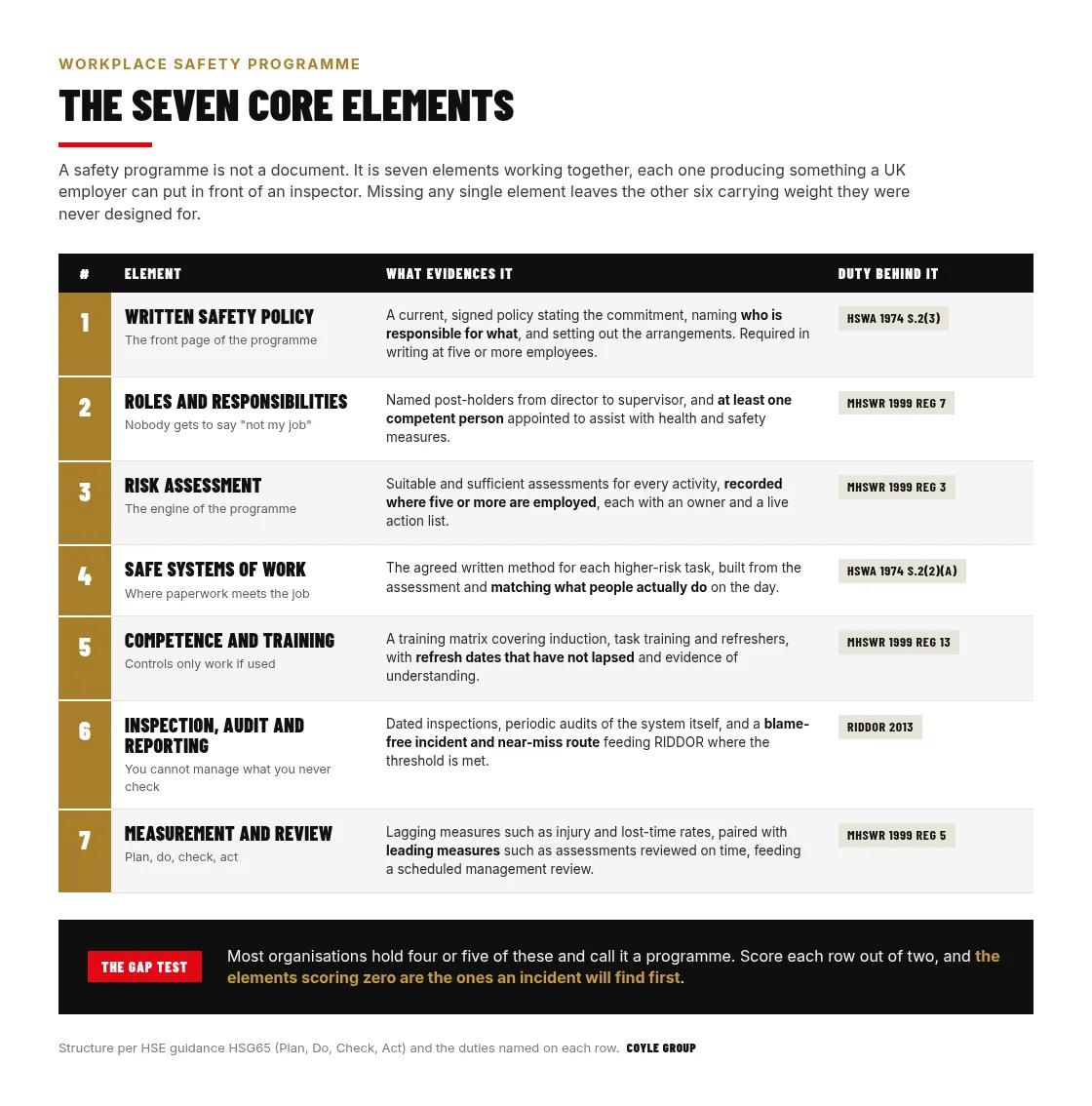
Score yourself out of two on each row before you read on. Most organisations comfortably hold four or five, and the rows scoring zero are reliably the ones an incident finds first.
1. Start With a Written Safety Policy
Every programme starts with a written health and safety policy. If you employ five or more people, a written policy is a legal requirement under section 2(3) of the Health and Safety at Work etc. Act 1974. It should state your commitment to safety, name who is responsible for what, and set out the arrangements you use to control risk. Keep it short, keep it current, and make sure people can actually find it. A policy nobody reads protects nobody, so treat it as the front page of the programme rather than a box to tick. If you need a hand drafting one, our safety policy development service can help.
2. Assign Clear Roles and Responsibilities
A programme needs owners. Directors set the tone and provide resources, managers apply controls in their areas, and every worker has a duty to work safely and report problems. Larger organisations may build a dedicated health and safety team, while smaller firms often appoint a competent person to lead. Whatever the structure, the point is that nobody can say safety is someone else’s job. Naming who does what, in writing, is what makes the rest of the programme stick.
3. Assess the Risks
Risk assessment is the engine of the programme. A suitable and sufficient risk assessment identifies the hazards of each task, judges how serious they are, and sets the controls needed to reduce harm. Record it once you reach five employees, and revisit it whenever the task, the equipment or the people change. Everything downstream in the programme inherits its quality from this element, which is why a generic assessment downloaded from a template site quietly weakens six other things.
4. Build Safe Systems of Work
The controls an assessment produces then become your safe systems of work: the agreed, written way each higher-risk job is carried out. This is where the programme meets reality, because it turns paperwork into the actual steps a worker follows. Our guide to how safe systems of work operate covers what separates a method statement people follow from one they sign and ignore. Treat this as a separate element from assessment: plenty of organisations assess well and then never convert the findings into an instruction anyone can work to.
5. Train for Competence
Controls only work if people understand and use them. A safety programme sets out who needs what training, from induction and toolbox talks to formal qualifications for supervisors and safety leads. Training is not a one-off. Refreshers, on-the-job coaching, and clear supervision keep competence current as tasks, equipment, and people change. Investing in your safety professionals pays back many times over in fewer incidents.
6. Inspect, Audit, and Report
You cannot manage what you do not check. Regular workplace inspections catch hazards early, while periodic audits and inspections test whether the programme itself is being followed. Alongside these, a simple, blame-free system for reporting incidents and near misses gives you the raw data to find patterns and fix root causes before they lead to a serious event, and it is also how you catch the events that must go to the enforcing authority under RIDDOR. Encourage reporting, act on what comes in, and close the loop by telling people what changed.
7. Measure With KPIs and Review Regularly
Finally, a programme should be measured and reviewed. Track a mix of lagging indicators, such as injury rates and lost time, and leading indicators, such as the share of risk assessments reviewed on time, near misses reported, and training completed. Leading indicators tell you whether the programme is working before anyone gets hurt.
The HSE sets out this cycle as plan, do, check, act in its management guidance, HSG65, and the duty to review sits in regulation 5 of the Management of Health and Safety at Work Regulations 1999. Feed the results into a scheduled management review, decide what to change, and start the cycle again. That loop is what turns a safety programme from a document into a habit.
Turning the Seven Into One Programme
Seven elements sound like seven projects. In practice they are one, because each element feeds the next: the policy names the owners, the owners commission the assessments, the assessments produce the safe systems, the systems set the training, the inspections test all of it, and the review decides what changes. Work them in order and the sequence carries itself. Work them separately and you get seven folders instead of a programme.
Building all of this from scratch takes time and know-how. If you want a structured programme designed around your risks rather than a template, get expert RAMS & compliance support and we will build it with you.
Frequently Asked Questions
What is a workplace safety programme?
A workplace safety programme is the structured system an organisation uses to manage health and safety: its policy, the roles and responsibilities of each person, the risk assessments and controls in place, the training given, and the way incidents are reported and reviewed. It turns legal duties and good intentions into consistent daily practice.
What are the 7 core elements of a safety programme?
A written safety policy, clearly assigned roles and responsibilities, risk assessment, safe systems of work, competence and training, inspection and audit with incident reporting, and measurement with management review. Each element produces evidence an inspector can ask for, and a programme missing any one of them leaves the other six carrying weight they were never designed for.
What are the elements of a safety programme?
The main elements are a written safety policy, clearly assigned responsibilities, ongoing risk assessment, competence and training, safe systems of work, inspections and audits, incident and near-miss reporting, and a regular management review that feeds improvements back into the programme.
Is a workplace safety programme a legal requirement in the UK?
The programme as a whole is not named in law, but almost every part of it is. A written health and safety policy is required at five or more employees, risk assessments must be recorded at the same threshold, a competent person must be appointed, training must be provided, and reportable incidents must go to the HSE. Meet those duties properly and you have a programme.
Can you give an example of a safety programme?
A mid-sized contractor might run a signed policy reviewed each year, a named director and site supervisors with written responsibilities, task risk assessments feeding method statements, a training matrix with refresh dates, monthly site inspections, a quarterly system audit, a near-miss reporting route, and a management review that tracks both injury rates and assessments completed on time.
How do you measure a safety programme?
Use a mix of lagging indicators, such as injury and lost-time rates, and leading indicators, such as the percentage of risk assessments reviewed on time, near misses reported, or training completed. Leading indicators are the more useful because they show whether the programme is working before someone gets hurt.
How often should a safety programme be reviewed?
Review it at least annually and whenever something material changes: new equipment or premises, a change in headcount or working pattern, a new activity, an accident or near miss, or any contact from an enforcing authority. Individual risk assessments follow the same rule. A programme that has not moved in three years usually describes an organisation that no longer exists.