What Does a Safety Professional Do? Roles & Duties

It is reassuring to think about the strides that have been made regarding the roles and responsibilities of today’s safety professionals. In the 40 plus years since the International Social Security Association (ISSA) initiated the standards, which the European Network of Safety and Health Professional Organisations (ENSHPO) took the reins of, safety officers and safety professionals have created safety solutions through qualifying and certifying individuals, to make a positive impact on workplace culture for employees and consumers worldwide.
We can add to the definition of safety professionals someone who has, through knowledge and certification, proved by established training, through academia or hands-on experience, to be a person both competent and ethical.
This is someone who can evaluate and develop a safety plan intended to secure the people within and associated with an organisation. This safety professional must be proactive to the potential dangers, and establish methods to prepare the organisation in the event that hazards befall the team, as well as teaching the members to react in a positive manner when unexpected circumstances do occur. That plan is only ever as good as the risk assessment sitting underneath it.
Expectations of a Safety Professional
In industry and manufacturing, we have come to expect safety professionals to contribute in several ways. We trust safety professionals to conduct accident investigations, and to apply proven techniques in manufacturing sites and to the products and users.
Because of their training and experience, we have faith in our safety professionals to implement safety training that establishes an adaptable safety programme conducive to finding safety solutions that are accommodating to all persons.
Our safety professionals and safety officers are expected to create an observable atmosphere, by means of electronic surveillance, physical safety team walks, or by design through engineering controls. The safety professional will establish safety solutions for the organisation that are implementable, and ones that the team can grow with. Where the organisation is large enough, that expectation is shared across a health and safety team rather than carried by one person.
The Six Duties Behind the Many Hats
Strip away the job titles and the same six duties recur in every sector. Each one produces something tangible, which matters more than it sounds: a duty you cannot evidence is a duty an auditor, an inspector or a client will treat as undischarged.
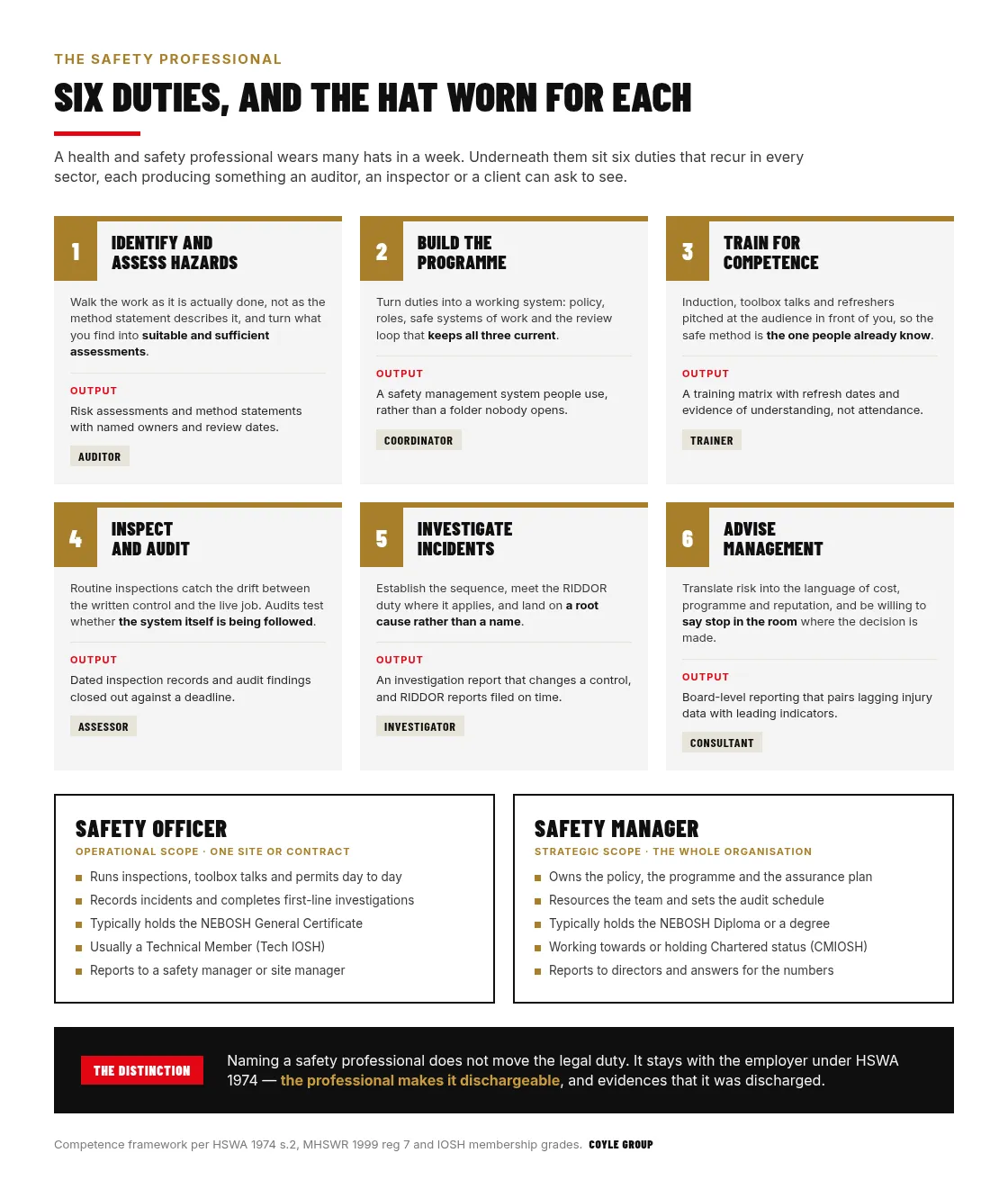
The comparison at the foot of the graphic is the one candidates and hiring managers get wrong most often. An officer runs the controls on a site; a manager owns the system across the organisation. Both are safety professionals, and the salary gap between them is mostly a question of scope rather than technical knowledge.
Identify and Assess the Hazards
The first duty is to know what the work can do to the people doing it. That means walking the job rather than reading about it, then recording the hazards and the controls in a risk assessment that a supervisor can actually use. The hat here is auditor, and the output is a current assessment for every significant activity, not a folder of assessments written when the site opened.
Build and Run the Safety Programme
Assessments on their own change nothing. The second duty is assembling them into a working safety programme: the policy, the assigned responsibilities, the safe systems of work, and the review cycle that keeps all of it current. The hat is coordinator, and the output is a system that survives the departure of the person who built it.
Train for Competence
The third duty is making sure people can do the job safely, which is a different question from whether they have been told how to. Inductions, toolbox talks, refreshers and a training matrix with real expiry dates all sit here. The hat is trainer, and the output is a record showing who is competent for which task, and when that competence needs renewing.
Inspect and Audit
Inspections catch hazards on the floor; audits test whether the programme itself is being followed. Both are needed, because a site can pass every inspection while the system behind it quietly decays. The hat is assessor, and the output is a finding with an owner and a date. Formal audits and inspections are also where an outside eye earns its fee, since familiarity is what stops people seeing their own site.
Investigate Incidents and Near Misses
When something goes wrong, the fifth duty is finding out why rather than who. That covers the reporting route, the RIDDOR duties for reportable events, and a root-cause accident investigation that produces a change rather than a file. The hat is investigator, and the output is a corrective action that closes.
Advise Management
The last duty is the one that decides whether the other five have any effect. The safety professional has to give directors and managers advice they can act on, in commercial language, early enough to matter. The hat is consultant, and the output is a decision made differently because the advice was heard.
One point holds regardless of which role you fill. Appointing a safety professional does not move the legal duty, which stays with the employer under the Health and Safety at Work etc. Act 1974. The professional is what makes that duty dischargeable, and evidences that it was discharged.
Safety Solutions
Safety solutions are created by the safety officer from hands-on experience on the manufacturing floor, and through product based knowledge. They are built from within the organisation, or implemented from research, to be tailor-made answers to the challenges occurring in the industry. Four inputs do most of the work:
- Floor-level experience. Time on the line, watching how the task is really performed rather than how the method statement says it is.
- Product and equipment knowledge. Understanding what the plant can do when it is used correctly, and what it does when it is not.
- Evaluated comments from the safety team. The observations that come back from walks and toolbox talks, assessed rather than simply filed.
- Case study review. Reading what has gone wrong elsewhere on comparable equipment, which is how a professional predicts a mishap instead of investigating one.
The last of those deserves its own note. Reviewing case studies educates the safety professional on the best uses of equipment and of products, which enables them to understand applications and predict potential mishaps associated with the common equipment and the company’s production portfolio. Done consistently, it turns the safety professional into a genuine consultant to the management team rather than an inspector of it.
The payoff shows up in two places at once: overall employee and consumer safety, and bottom line savings that reach the year-end review.
Finally, the safety professional must be a trainer to their targeted audience. For this reason, our safety professional can always set the standard for others, leading by example. This person should be professional and approachable, so everyone feels comfortable coming forward with questions for clarification, or safety solutions they cultivate in the field. These qualities make the safety professional a strong leader in the organisation by providing skills at developing, structuring, and applying training. In most organisations they do not work alone, but as the driving force within a wider health and safety team.
How to Become a Safety Professional in the UK
If the role appeals, there is a well-trodden path into it in the UK and Ireland. Most people start with a recognised qualification and build experience alongside it.
- NEBOSH National General Certificate: the standard entry-level qualification, covering risk management, common hazards, and the legal framework. It is the qualification most employers ask for in a first safety role.
- IOSH membership: the Institution of Occupational Safety and Health is the professional body for the sector. Members progress from Technical Member (TechIOSH) through to Chartered status (CMIOSH), which is the mark of a fully competent professional.
- NEBOSH National Diploma or a degree: for managers and consultants, a diploma or a degree in occupational health and safety opens the door to senior and chartered roles.
- Sector experience: qualifications matter, but so does time on the floor. Real competence comes from applying the theory to the hazards of your own industry, whether that is construction, energy, or manufacturing.
Chartered Safety and Health Practitioner is a regulated profession in the UK, and the NHS publishes a plain description of the safety officer role that is worth reading before you commit to a course. A strong safety professional is central to any effective safety programme, and if you are an employer looking to bring that expertise in, our HSE recruitment service places qualified safety staff.
Summarising the Safety Professional
Overall, the safety professional wears many hats: coordinator, auditor, officer, trainer, assistant, consultant, manager, and leader. To be effective they must be open in their relationships within the organisation. Versatility is key, evaluating a must, and assuring reliability every day is critical.
The safety professional and safety officer must be trusted and learned in government regulations as they apply to safety and employee rights. This person must be a reliable member of the management team to be successful in the organisation and for themselves.
If you need that capability now rather than after a hiring round, we can supply it. Get expert RAMS & compliance support and put a competent person behind your duties from next week.
Frequently Asked Questions
What does a safety professional do?
A safety professional identifies workplace hazards, builds and runs the safety programme, delivers training, investigates incidents, and advises management. In practice they wear many hats, acting as coordinator, auditor, trainer, consultant, and leader, all with the aim of keeping people safe and the business compliant.
What qualifications does a safety professional need in the UK?
The usual route is the NEBOSH National General Certificate, followed by the NEBOSH National Diploma for more senior roles. Membership of IOSH, the professional body for the sector, is the recognised mark of competence, progressing from Technical Member (TechIOSH) to Chartered status (CMIOSH).
What is the difference between a safety officer and a safety manager?
A safety officer usually focuses on day-to-day tasks such as inspections, toolbox talks, and reporting on site. A safety manager takes a broader, strategic role, owning policy, resourcing the team, and answering to directors. Many managers began their careers as officers.
Is IOSH or NEBOSH better?
They do different jobs, so the comparison is misleading. NEBOSH awards the qualifications that prove you have the knowledge, from the General Certificate through to the Diploma. IOSH is the professional body that recognises competence through membership grades and requires ongoing CPD to keep it. Most UK safety professionals hold a NEBOSH qualification and an IOSH grade at the same time.
What jobs can you get with IOSH membership?
Membership grade tends to track the role rather than unlock it. Technical Membership sits comfortably with safety officer, HSE advisor and coordinator posts. Graduate and Chartered grades are what employers look for in safety manager, head of HSE and consultant roles, and Chartered status is frequently a stated requirement on public-sector and framework contracts.
What is a competent person in health and safety?
A competent person has sufficient training, experience and knowledge to help an employer meet its health and safety duties. Every UK employer must appoint at least one under regulation 7 of the Management of Health and Safety at Work Regulations 1999. Competence is judged against the risks of your actual work, so a competent person in an office is not automatically competent on a construction site.
Do you need a degree to work in health and safety?
No. Most UK safety professionals enter through the NEBOSH General Certificate rather than a degree, often moving across from an operational role in the same sector. A degree or diploma becomes relevant later, when you want senior or chartered roles, and an occupational safety and health degree can shorten the route to Chartered status.