Best Safety Jobs: UK Health and Safety Salary Ranges

The safety field rewards the people who keep work safe, and it pays better than most outside it assume. What follows is the ladder as employers actually recruit it: five named roles, the broad UK band each one commands, the sectors hiring hardest, and what a shortlist has to show before anyone gets an interview.
Pay moves with sector, location and whether the post is permanent or contract, so treat every figure here as a range rather than a rate.
Best Safety Jobs in High Risk Sectors
The safety industry is a field that often does not receive the recognition it deserves, until it is too late. Yet opportunities are abundant for those who want to participate in making work environments safe. As local and global economies grow, the need to properly staff these fields, whether with a corporate giant or a small startup, requires knowledge of what you are looking for and where the best jobs are.
The best jobs, theoretically, are the ones that allow the applicant to put their best foot forward and create a climate that has their signature all over it, one that employees feel comfortable working in. The best opportunities, those that seem to be most abundant, tend to be in the high risk sectors of the employment field, specifically the manufacturing and construction sectors.
Because these fields tend to give more freedom to their workers, being outdoors with less hands-on supervision than more typical jobs is normal. They also usually require more of a technical aptitude, which makes it necessary to employ competent health and safety managers so that the processes created are able to limit or warrant necessary controls.
That is why the highest-risk sectors also carry the best prospects. Where the hazards are real and the supervision is light, competent safety people are genuinely worth paying for, and the salary bands reflect it.
Named Safety Roles and UK Salary Ranges
If you are weighing up the best health and safety jobs, it helps to see the common roles side by side with the pay you can expect.
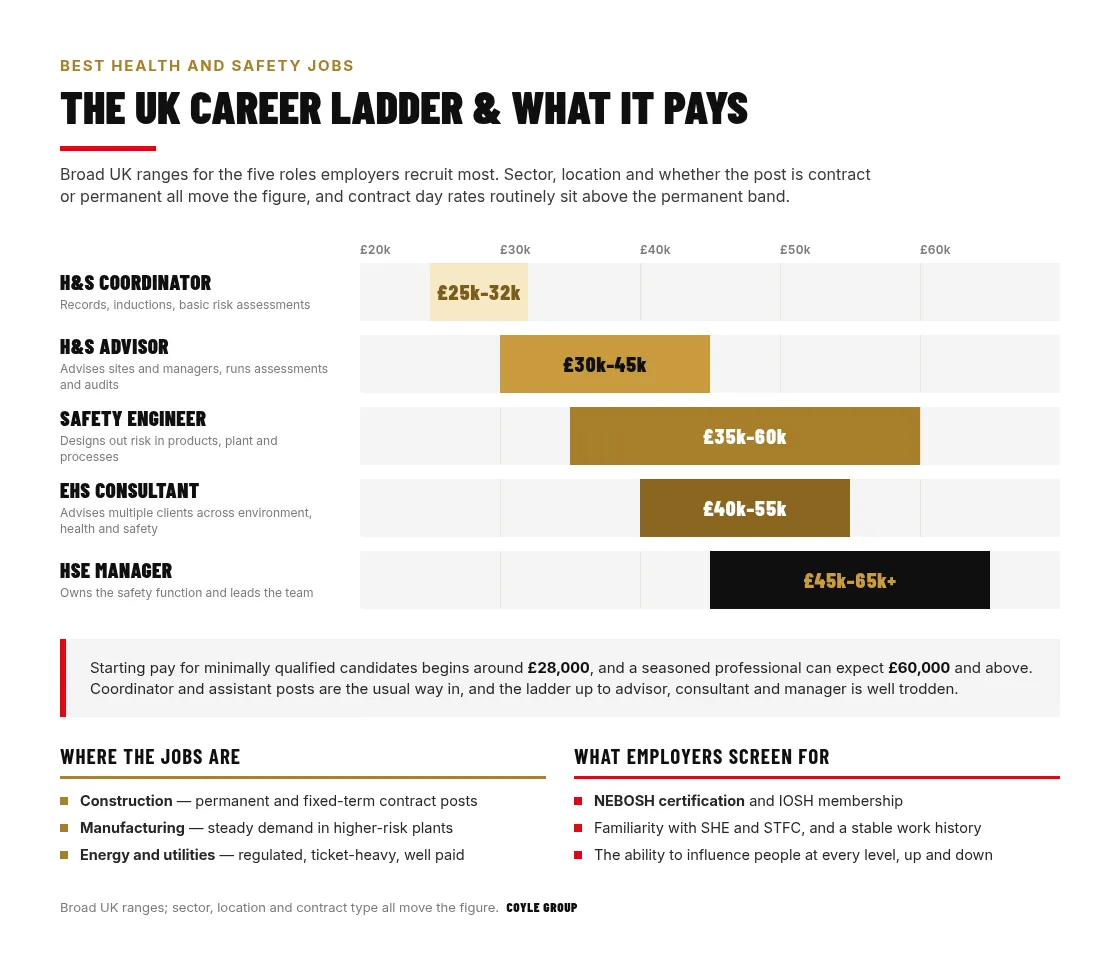
Read from the bottom up, that is the route most people take:
- Health and Safety Coordinator, £25,000 to £32,000. Entry-level support: records, inductions and basic risk assessments. The usual way in, alongside assistant posts.
- Health and Safety Advisor, £30,000 to £45,000. Advises sites and managers, runs assessments and audits. The first role where you own an outcome rather than a task.
- Safety Engineer, £35,000 to £60,000. Designs risk out of products, plant and processes. The widest band on the ladder, because the ceiling depends on the sector.
- EHS Consultant, £40,000 to £55,000. Advises multiple clients across environment, health and safety, which builds range faster than any single-site post.
- Health, Safety and Environmental Manager, £45,000 to £65,000 and above. Owns the safety function and leads the team.
For an independent cross-check on the entry-level figures, the National Careers Service publishes a safety adviser profile with its own salary data, and the career profile on Prospects covers the graduate entry routes in more detail than most employer-side guides bother with.
The ladder up to advisor, consultant and manager is well trodden, and there is more than one way onto the first rung. If you are still deciding whether this is the field for you, our guide to starting out covers the practical first moves.
Expectations
Companies and institutions are looking and paying well for health and safety advisors, EHS consultants and health and safety coordinators. There is also a need for trainers, auditors and assistants. Employers hiring have certain expectations of these positions, which include a stable work history, a clean driving record, and an education suited for the job at hand. Certification through NEBOSH, IOSH membership and an understanding and familiarity with SHE and STFC are often needed qualifications.
Education gives the candidate the wherewithal to manoeuvre through regulations and establish protocols that meet the requirements of government agencies, and it is worth being deliberate about which safety qualification you invest in first. Additionally, companies are requiring that the best suited candidates for these sought-after health and safety jobs have the ability to motivate people. The best person for the job should be comfortable with engaging and supporting the team upward to management and downward to include the workforce. The ability to communicate to all levels makes projects successful.
Communication skills are strongly sought after by agencies and by the company itself. The ideal candidate will also have experience in developing policies and implementing standard operating procedures. Risk management experience is included in the preferred qualifications. Identifying, assessing and prioritising risks associated with tasks is important at any level, and coupled with these high risk positions in industry, the importance of risk management is utmost in an employer’s priorities.
Read together, the qualifications get you shortlisted and the people skills get you hired. Employers are screening for someone who can carry a room, not only complete an assessment.
The Best Jobs
Several factors come into play when deciding what the best jobs are. Because they are in abundance, candidates in this field believe these opportunities make them the best jobs. Because qualified individuals have the ability to mould policy and procedure and establish a reputable name for themselves, they too will consider these some of the best jobs available. The common factor between all jobs, of course, is pay scale. Current positions that are open and in demand in the health and safety sector cover a wide range. Starting pay for minimally qualified individuals begins at £28K, while a more seasoned professional can expect to demand upwards of £60K. This invites many people to explore the possibilities in this high risk, high reward job field. Financial rewards like these make positions very sought after.
The market in construction fields and some manufacturing plants is offering permanent positions, as well as fixed term contract employment. Among the basic benefits some employers include within job benefits are car allowances.
The number of jobs in the high risk sectors, with the potential for growth and development and pay versatility, make jobs like health, safety and environmental manager, advisors, assistants and consultants some of the best jobs in the health and safety field today.
Hiring Rather Than Job Hunting?
If you are reading this from the other side of the table, the same bands are what your shortlist is benchmarking against, and our guide to safety recruitment sets out what to screen for at each level.
When a site cannot wait out a long search, we place these roles across construction and energy at short notice. Hire a safety officer in 48 hours and we will put forward people already screened against the band and the tickets the role needs.
Frequently Asked Questions
Which safety jobs pay the most?
Senior and specialist roles pay the most: health, safety and environmental managers, safety directors and safety engineers in high-risk sectors such as construction, energy and process typically sit at the top, commonly £55,000 to £70,000 and above. Contract and interim roles often pay more again through day rates.
What qualifications do I need for a safety job?
For most entry roles a NEBOSH National General Certificate plus IOSH membership is the expected baseline. Advisor and manager roles increasingly want the NEBOSH Diploma and Chartered status (CMIOSH), and specialist posts may add sector tickets such as CDM, construction or process-safety training.
How much does a health and safety officer earn in the UK?
Broad bands run from 25,000 to 32,000 pounds for a coordinator, 30,000 to 45,000 for an advisor, 35,000 to 60,000 for a safety engineer, 40,000 to 55,000 for an EHS consultant, and 45,000 to 65,000 and above for an HSE manager. Sector and location move these figures more than job title does, with construction, energy and manufacturing paying at the upper end.
How do I get into health and safety with no experience?
The usual route in is a coordinator or assistant post alongside the NEBOSH National General Certificate, which is the qualification most employers treat as the baseline. Sector experience counts for as much as the certificate, so getting onto a site in any capacity and taking on hazard reporting and inductions builds the evidence an advisor role will ask for.
Is health and safety a good career?
It pays above the average for the qualifications required, demand holds up across construction, energy and manufacturing because the legal duties do not go away in a downturn, and the ladder from coordinator to manager is well defined. The trade-off is that the job involves telling people things they do not want to hear, so influence matters as much as technical knowledge.
Do safety contractors earn more than permanent staff?
Day rates usually work out higher than the equivalent salary, which is what makes contract work attractive to experienced advisors and managers. The comparison is not straight, though, because contract posts carry no holiday pay, pension contribution or notice protection, and the work arrives in project-shaped blocks rather than continuously.