CCGT Outage Safety Management: The 5-Phase Plan
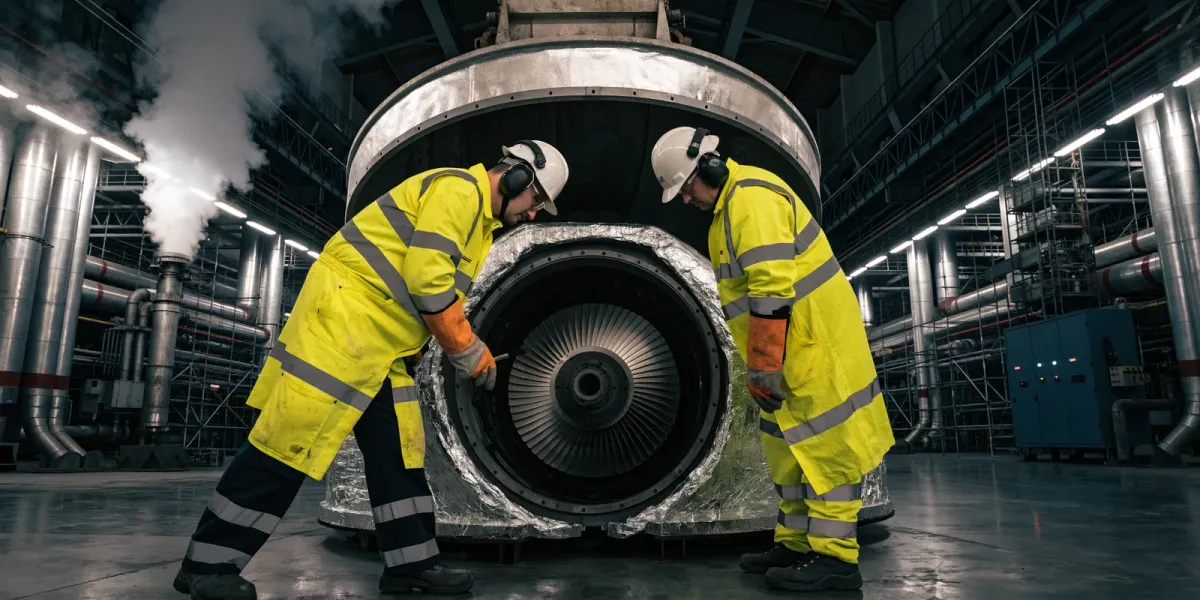
A CCGT outage is the one period in a power station’s year when almost everything happens at once. The gas turbine comes apart for its major inspection, the heat recovery steam generator opens up for internal inspection, and a steam turbine overhaul often runs in parallel, all inside a programme that is measured in weeks rather than months. CCGT outage safety is what keeps that compressed timetable from becoming a compressed set of hazards, and it has very little in common with the safety management a CCGT plant needs on a normal operating day.
The difference is scale and simultaneity. A plant that might run for a year with a skeleton maintenance crew suddenly takes on several hundred contractors, opens confined spaces that are normally sealed, and runs lifting, hot work and work at height activities side by side rather than one at a time. Getting CCGT outage safety right means planning for that surge before it arrives, not managing it as it happens.
Scoping safety cover for an upcoming outage? Request a utilities safety consultation and our chartered team will help you plan staffing against the actual outage programme.
Request A Utilities Safety Consultation
What a CCGT Outage Actually Involves
A planned CCGT outage is really 3 overlapping jobs sharing one fence line and one outage window. The gas turbine major inspection strips the hot gas path, combustion hardware and bearings for inspection and replacement. The heat recovery steam generator inspection opens drums, headers and tube banks that are confined spaces for the rest of the year. Where the programme includes it, a steam turbine overhaul lifts casings and rotors that need lifting plans most sites use only once every few years.
Each of those jobs would be manageable in isolation. Run together, on a fixed outage window with liquidated damages attached to every extra day, they compete for the same cranes, the same confined-space entry slots and the same permit-issuing authority. That is the scheduling pressure that makes CCGT outage safety a planning discipline in its own right, not an extension of day-to-day plant safety. Our guide to the wider hazard picture on generation sites, including the power plant hazards that apply outside an outage as well as during one, sets out the baseline controls an outage plan then has to intensify.
Why Outages Are the Highest-Risk Period at a Power Station
Every generating station carries risk on a normal operating day, but an outage multiplies the number of people and activities exposed to it at the same time. Confined-space entry into the HRSG and boiler, work at height on the turbine hall structure and stack, lifting on heavy rotating components, and hot work on pipework that was pressurised and hot the week before, can all be scheduled in the same shift. A contractor population that might be a dozen people on a normal week can run into several hundred during a major outage.
That surge is managed through a permit-to-work system, the formal document that states exactly what work is authorised, by whom, and under what verified conditions, before a contractor picks up a tool. Fatigue adds a layer most outage plans underweight: 24-hour shift coverage over several weeks degrades judgement in exactly the roles, permit issuers and isolation authorities, where a lapse has the furthest-reaching consequences. A fatigue management plan belongs in the outage schedule from the first planning meeting, not as an afterthought once shift patterns are already fixed. Where staffing cannot be covered from an existing team, bringing in contract safety officers with outage experience is usually faster than carrying a gap through the programme.
The 5 Phases of Outage Safety Planning
Treating a CCGT outage as 5 distinct safety phases, rather than one long event, is what keeps each control in the right place at the right time. Pre-outage planning, running from roughly 6 weeks out, is where the scope is confirmed, RAMS and lift plans are reviewed against the actual job list, and confined-space and hot-work permits are drafted before a single contractor arrives on site.
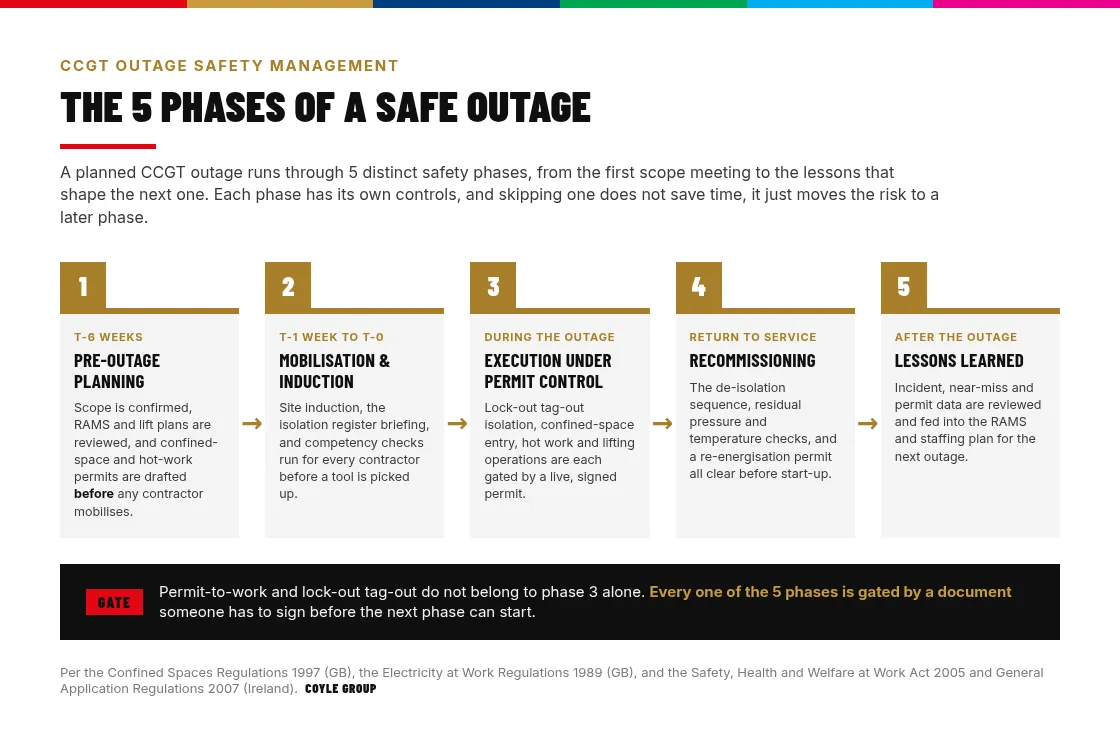
Mobilisation and induction follows in the final week before the outage starts, covering site induction, the isolation register briefing and competency checks for every contractor before work begins. Execution under permit control is the outage itself, where lock-out tag-out isolation, confined-space entry, hot work and lifting are each gated by a live, signed permit rather than a general site pass. Recommissioning reverses that sequence on the way back to service: the de-isolation sequence, residual pressure and temperature checks, and a re-energisation permit all have to clear before start-up. The lessons-learned phase closes the loop, feeding incident, near-miss and permit data into the RAMS and staffing plan for the next outage rather than letting it sit in a report nobody reopens.
Isolation, Permits, and the Controls That Gate the Work
Isolation and the permit that authorises work against it are 2 different things, and an outage plan that treats them as interchangeable has a gap. Isolation is the physical act, locking out an energy source, draining residual pressure, earthing a circuit, and proving it dead or safe before anyone relies on it. The permit is the paperwork that authorises a named task against that verified isolation, and it is what makes the work traceable if something goes wrong.
In Great Britain, the Confined Spaces Regulations 1997 apply directly to HRSG drums, headers and boiler entries, requiring a safe system of work, atmospheric testing and a proven rescue plan before entry, and the Electricity at Work Regulations 1989 set the isolation and proving-dead duties for any electrical isolation the outage depends on. In Ireland, the equivalent duties sit under the Safety, Health and Welfare at Work Act 2005 and its General Application Regulations, and the Health and Safety Authority’s confined space entry guidance is blunt that most confined-space fatalities include a would-be rescuer who went in without breathing apparatus. Hazardous atmospheres do not announce themselves, so testing before entry and continuously during it is not optional on either side of the Irish Sea, whatever the permit says about who approved the entry.
Contractor Numbers, Statutory Roles, and Getting Safety Officers on Site
A CCGT outage brings statutory duties that a normal maintenance week does not. In Ireland, appointing more than one contractor on a site is, by itself, enough to trigger the duty to appoint a Project Supervisor Construction Stage under the Construction Regulations 2013, and a multi-contractor outage crosses that line immediately regardless of how long the programme runs. Our PSCS guide sets out the 3 triggers in full, and where the outage includes design-stage decisions, such as a modification to plant that was not in the original design, the parallel duties covered in our PSDP guide apply as well. Ireland’s General Application Regulations 2007 add the lifting and work-equipment duties that sit underneath both roles on an outage site carrying crane and MEWP activity.
Coyle Group has supplied contract safety officers for CCGT outages at generating stations operated by tier-one Irish energy companies including ESB and Energia, matched against turbine OEM experience rather than general industrial cover. That match matters more on an outage than almost anywhere else on a generating station: a safety officer who already knows what a gas turbine major inspection looks like, what a permit for HRSG entry should contain, and what a verified isolation on a steam turbine actually involves, starts contributing from day one instead of learning the plant while the clock runs. Where the internal team cannot absorb the outage surge, that kind of specialist cover is usually available faster than carrying the gap through the programme and hoping it holds.
Already building the outage programme and need the permit and isolation controls checked before mobilisation? Request a utilities safety consultation and we will test the plan against the phase it actually sits in.
Request A Utilities Safety Consultation
That conversation is most useful before the outage programme is locked, while staffing and permit decisions can still move.
Planning the Next Outage Before the Current One Closes
The outages that run safely are the ones where the plan existed before the first contractor arrived, not the ones improvised once the plant was already open. That means confirming scope and permit drafts at 6 weeks out, running a genuine induction and competency check at mobilisation rather than a formality, keeping isolation and permit control separate and both verified through execution, and closing the loop with a lessons-learned review that actually changes the next outage’s RAMS rather than repeating the last one unread.
CCGT outage safety is a staffing problem as much as a procedural one, and the 2 do not solve each other automatically. A permit system with nobody qualified to issue it, or a RAMS nobody updated since the last outage, both fail the same way: quietly, until an inspection or an incident exposes the gap. If your next outage needs chartered oversight brought in against the actual programme rather than a generic checklist, request a utilities safety consultation and we will start with the phase you are in now.
Frequently Asked Questions (FAQs): CCGT Outage Safety Management
These are the questions outage managers and HSE leads ask most often when a CCGT outage safety plan is being scoped against the regulations an inspector will actually quote.
What is a CCGT outage?
A CCGT outage is a planned shutdown of a combined cycle gas turbine power station to carry out maintenance that cannot be done while the plant is running. It typically covers a gas turbine major inspection, a heat recovery steam generator inspection, and often a steam turbine overhaul, scheduled together because the plant has to be offline for any one of them. Coyle Group supplies contract safety officers for this type of outage work across Ireland and the UK.
Why is a CCGT outage the highest-risk period at a power station?
Risk concentrates during an outage because the contractor population multiplies while the plant is opened up for inspection. Confined-space entry into the HRSG and boiler, work at height on the turbine hall structure, lifting operations on heavy rotating components and hot work can all be scheduled in the same week, sometimes the same shift. Coyle Group treats outage safety as a staffing and sequencing problem, not a single hazard to control.
What is a permit-to-work system and why does it matter during an outage?
A permit-to-work system is a formal document that states exactly what work is authorised, by whom, and under what conditions, and it is the control that gates confined-space entry, hot work, lifting and isolation during an outage. Without a live, signed permit tied to a verified isolation, a contractor should not start the task. Coyle Group reviews permit systems as a core part of outage safety management.
Is a permit-to-work system a legal requirement?
There is no single regulation in the UK or Ireland that names permit-to-work systems directly, but the general duty to control risks to a safe level under the Health and Safety at Work etc. Act 1974 in Great Britain and the Safety, Health and Welfare at Work Act 2005 in Ireland effectively requires one wherever isolation, confined spaces or hot work are involved. Coyle Group treats a documented permit system as a baseline expectation on any outage site.
How many safety officers does a CCGT outage need?
The right number depends on the contractor headcount, the number of simultaneous work fronts, and how many confined-space and permit-controlled activities are running at once, so there is no single ratio that fits every outage. Coyle Group scopes staffing against the outage programme itself and can have contract safety officers with turbine OEM experience on site within 48 hours once the scope is confirmed.
What is the difference between isolation and a permit to work?
Isolation is the physical act of making equipment safe: locking out an energy source, draining residual pressure, or earthing a circuit, then verifying it before work starts. A permit to work is the paperwork that authorises a specific task once that isolation is proved, naming who may carry it out and any extra precautions. One without the other leaves a gap, since a verified isolation with no permit has no record of who is working under it. Coyle Group treats both as mandatory on every outage.
Does Coyle Group provide safety officers for CCGT outage work specifically?
Yes. Power generation, including CCGT outages, is one of Coyle Group's named industry specialisms, alongside utilities, wind energy and engineering. Safety officers placed on outage work arrive with documented turbine OEM experience and an understanding of permit-to-work and isolation practice specific to a generating station, rather than general industrial site cover. Coyle Group can typically confirm a placement within 48 hours of the outage scope being agreed.