Power Plant Safety: 6 Major Hazards and Their Controls
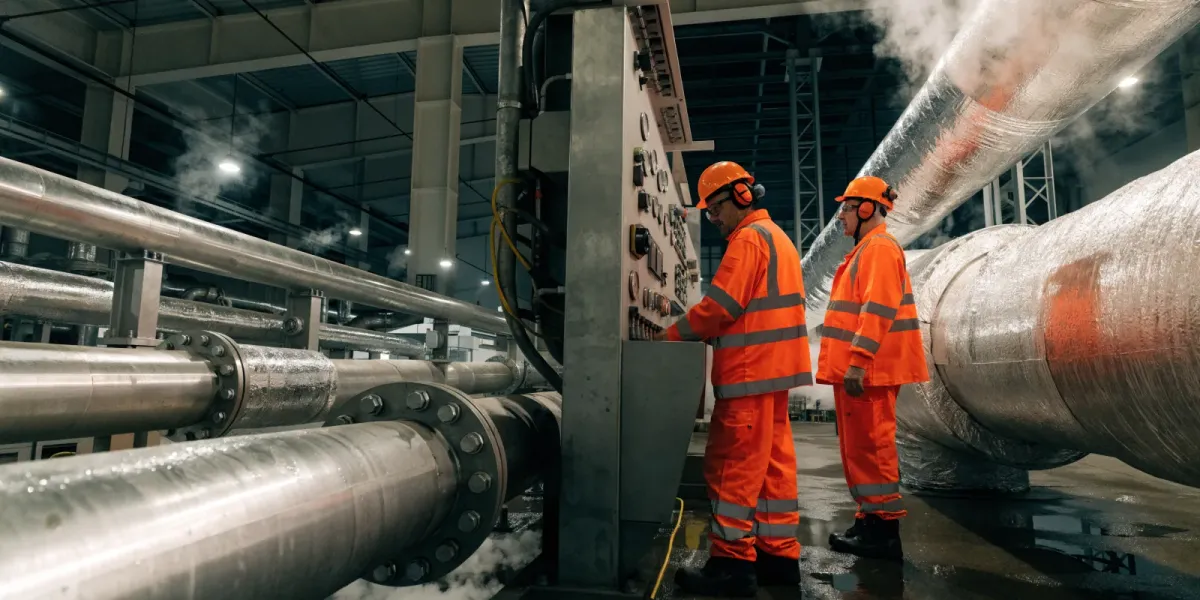
A power station concentrates more stored energy in one building than almost any other industrial site. High voltage, high pressure, high temperature and considerable height, often within a few metres of each other, and much of it worked on by contractors who arrived last week.
That combination is what makes power plant safety a systems problem rather than a housekeeping one. The hazards themselves are well understood and have been for decades. What varies between a good site and a poor one is whether the control for each hazard is gated by a document that somebody has to sign before work starts.
Almost every page ranking for this subject is written to American practice, which is a problem if you operate in the UK or Ireland: the duties, the terminology and the enforcing authority are all different. This guide sets out the six hazards, the control for each, and the gate that holds it, under UK and Irish law.
The 6 Power Plant Safety Hazards
Six categories cover the overwhelming majority of what a generating station carries. Grouping them this way is useful because each category maps to one primary control and one authorisation document, so you can audit six things rather than three hundred.
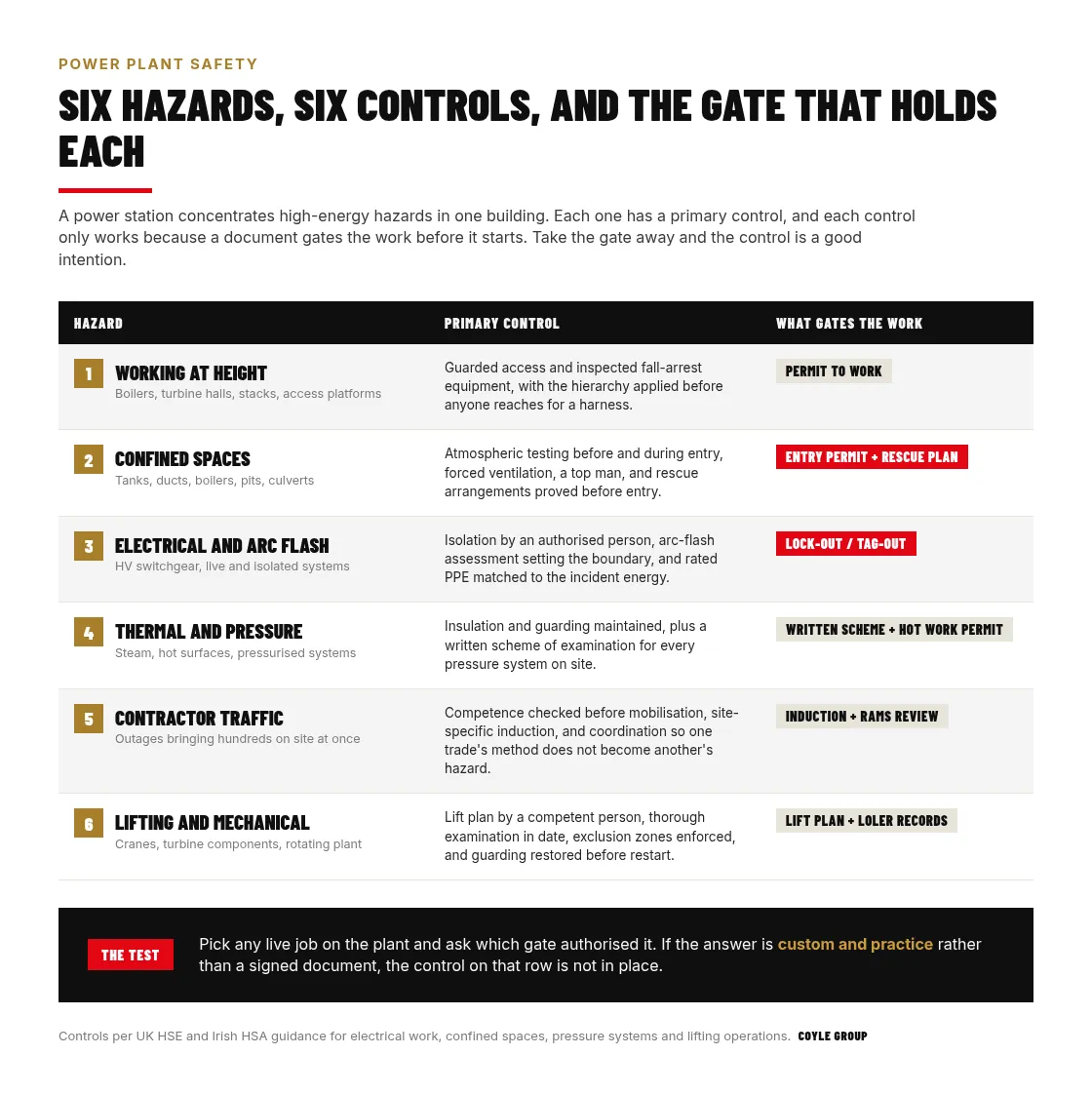
Reading down the third column is the fastest way to audit a plant. Pick a live job, ask which document authorised it, and if the answer is custom and practice rather than a signed permit, the control on that row is not actually in place regardless of what the safety management system says. Our guide to how safe systems of work operate covers the mechanics of building that gate properly.
1. Working at height
Boilers, turbine halls, stacks and access platforms put a large share of routine maintenance above ground level, and the exposure is constant rather than occasional. The Work at Height Regulations 2005 apply to any height where a fall could cause injury, which on a generating station includes plenty of work that nobody would describe as working at height when asked.
How to control it: Apply the hierarchy properly before anyone reaches for a harness. Guarded access and fixed platforms first, then work restraint, then fall arrest as the last resort rather than the default. Inspect fall-arrest equipment on schedule and record it, and gate the task with a permit to work so someone competent has looked at the access route before the job starts.
2. Confined spaces
Tanks, ducts, boilers, pits and culverts are all confined spaces under the Confined Spaces Regulations 1997, and this is the category with the highest fatality rate relative to how often the work happens. The Health and Safety Authority’s guidance on confined spaces is blunt about why: most confined-space deaths include a would-be rescuer who entered without breathing apparatus.
How to control it: Test the atmosphere before entry and continuously during it, ventilate mechanically, and post a top man who does nothing else. The entry permit is only valid where the rescue arrangements have been proved rather than named, which means the rescue team, the equipment and the extraction route all exist before the first person goes in.
3. Electrical and arc flash
High-voltage switchgear carries enough stored energy that the consequence of an error is measured in incident energy rather than in shock. This is also the category where the UK duty is most specific: the Electricity at Work Regulations 1989 require that work on or near conductors is only carried out where it is unreasonable for them to be dead, and that suitable precautions are taken.
How to control it: Isolate through lock-out tag-out, prove dead rather than assume dead, and earth where required. An arc-flash risk assessment sets the approach boundary and the incident energy at each point, and that calculation is what determines the PPE rating. Rated PPE chosen without it is a guess, and it is the most common gap we find on audit.
4. Thermal and pressure
Steam systems, hot surfaces and pressurised plant sit within touching distance of walkways on most stations, and the risk rises during start-up and shutdown rather than during steady running. The Pressure Systems Safety Regulations 2000 place the duty on the user, not on the contractor who last worked on the system.
How to control it: Keep insulation and guarding maintained rather than reinstated after each outage, and hold a current written scheme of examination for every pressure system on site with the examinations in date. Gate hot work with its own permit covering the fire watch, the isolation of adjacent systems and the period after the work stops.
5. Contractor traffic
An outage can take a site from dozens of people to several hundred inside a week, most of whom have never walked the plant before. The hazard is not any individual contractor but the volume of unfamiliar people working simultaneously in a plant that has been opened up.
How to control it: Check competence before mobilisation rather than at the gate on the first morning. Run a site-specific induction that covers the isolation and permit systems actually in use here, and review each contractor’s risk assessments and method statements against the real job rather than accepting a generic pack. Coordinate the programme so one trade’s method does not become another’s hazard.
6. Lifting and mechanical
Cranes, turbine components and rotating plant produce the heaviest loads on site, and lifts are concentrated into the outage window when the pressure to keep moving is highest. LOLER requires thorough examination of lifting equipment and accessories at set intervals, and an expired certificate takes the equipment out of service regardless of its condition.
How to control it: Have a competent person write the lift plan, confirm the thorough examination is in date before the lift rather than after it, and enforce the exclusion zone with a person rather than with tape. Restore guarding on rotating plant before restart, which is the step that gets dropped when a job finishes at the end of a shift.
Power Plant Risk Management: Controls That Hold
Managing these risks well comes down to a few disciplined systems rather than one-off fixes, and to the discipline holding when the schedule is tight. Every one of the failures worth studying happened on a site that had the right procedure written down.
Lock-out tag-out isolates energy sources before work starts, and only works if the isolation is proved rather than assumed. Permit-to-work controls high-risk tasks such as hot work, confined-space entry and electrical work, and only works if the issuing authority is genuinely competent to refuse. Regular audits and inspections confirm the controls are being applied, and incident reviews feed what they find back into the risk assessment rather than into a filing cabinet.
Sitting over all of it is the culture, which decides what happens when a control collides with a deadline during an outage. A site where a permit gets waived to recover half a shift has a paperwork system, not a safety system.
Outages: Where the Risk Concentrates
Everything above is harder during an outage, and that is when most of the serious work happens. The plant is opened up, the isolations multiply, and the workforce on site can go from dozens to several hundred in a week.
The specific failure mode is interaction. A confined-space entry, a hot-work task and a lift can all be individually well controlled and still combine badly if nobody is sequencing them against each other. That coordination is a full-time job during an outage and it is routinely given to someone who already has one.
Outages on Irish sites carry a second question that plant managers often miss. Where the work is construction work under the Construction Regulations 2013, and a major overhaul usually is, the client has to appoint a PSCS before anyone starts, and having more than one contractor on site is enough to trigger it on its own.
Plan the outage as a safety programme with its own resourcing rather than as a maintenance programme with safety attached, and the interaction risk drops sharply. It is the highest-return decision available to a plant manager on this list.
Where Outsourced Safety Management Fits
Occupational health and safety is a key component of a plant’s successful operation, and many operators run into the same problem: the cost of a full-time H&S professional exceeds what the site can justify. That does not reduce the legal duty, which is to have competent advice available rather than competent advice on the payroll.
Coyle Group provides that function to operators across the energy sector, including clients such as Abowind and RWE. The engagement typically covers strategic safety advice, safety culture assessment, audits and gap analysis, accident and incident reviews, safety documentation, and ISO 45001 reviews. Our work on electrical infrastructure specifically sits under utilities and electric, where the arc-flash and isolation questions above are the day-to-day content.
The reason we take that view rather than selling headcount is set out plainly enough by our founder:
My passion for supporting businesses to be efficient, compliant and safe is infinite. I enjoy seeing our clients succeed in their markets, and to see Coyle Group people contributing to that success gives me great belief and enjoyment and motivates me to ensure we deliver beyond their expectations. If our company can engage with your company with a common goal to be safe, successful and consistent, then that’s why we should connect.
Gavin Coyle, CEO
The test of whether it is working is not how many documents exist. It is whether a supervisor on shift at two in the morning can get a competent answer to a question about an isolation, and whether the answer is the same one they would have got in daylight.
Measuring the Culture Underneath the Controls
Controls are visible and culture is not, which is why culture is usually assessed by anecdote. In 2023 we commissioned research and safety experts to look at what an excellent safety culture consists of and how a company can reach it.
Three things came out of it. There is good research in this area, most of it concentrated on oil and gas or aviation rather than power generation. The assessment tools that exist are broad and generic. And almost none of them capture what workers actually experience, which is the only data that tells you where the culture will fail first.
That gap is what our safety culture survey was built to close: first-hand worker responses that are specific enough to act on, benchmarking and reporting included, and priced so a single site can run it without a corporate programme behind it.
Six Hazards, Six Gates, One Question
Power plant safety comes down to a short list. Six hazard categories, one primary control each, and a document that has to exist before the work starts. Everything else on a generating station is a variation on those, including the outage programme where they are hardest to hold.
The question worth asking on your own site is the one in the third column of that table: for each of the six, what gates the work, and who is allowed to say no. Related risk sits across the wider portfolio too, from offshore wind construction to the people moving across from oil and gas into renewables, and the same permit logic applies to all of it.
If you would rather have that audited than assumed, talk to a wind-sector safety specialist and we will walk the permits with you before we write anything down.
Frequently Asked Questions
What are the main safety risks on power plants?
The main risks are working at height on boilers and turbine halls, confined-space entry into tanks and ducts, electrical and arc-flash energy on high-voltage systems, thermal and pressure hazards from steam and pressurised plant, the volume of contractors on site during outages, and lifting operations on heavy rotating components. Each needs a specific control such as permit-to-work, lock-out tag-out or a documented lift plan.
What are the safety measures in a power plant?
The core measures are lock-out tag-out isolation before any work on energised systems, a permit-to-work system gating high-risk tasks, confined-space entry procedures with atmospheric testing and rescue arrangements, arc-flash assessment setting boundaries and PPE, a written scheme of examination for pressure systems, and contractor competence checks before mobilisation. Audits and incident reviews then confirm the measures are being followed rather than merely written down.
How do you manage electrical and arc-flash risk on power plants?
Isolate through lock-out tag-out before work starts, gate the task with a permit-to-work, and let only competent authorised people work on live or isolated electrical systems. An arc-flash risk assessment sets the approach boundary and the incident energy at each point, which is what determines the PPE rating. Rated PPE chosen without that calculation is a guess, and it is the most common gap found on audit.
What are the 5 main electrical hazards?
Electric shock, burns from contact or arcing, arc flash and arc blast, fire started by faults or overloads, and explosion where an arc ignites a flammable atmosphere. On a generating station the first three dominate because of the energy available at high voltage, and all five are controlled by the same sequence: isolate, prove dead, earth where required, and work only under a permit issued by an authorised person.
Does a power plant need a full-time health and safety manager?
Not necessarily. Many operators meet their legal duties through outsourced safety management, which provides strategic advice, audits, incident reviews and ISO 45001 support without the cost of a permanent hire. What matters legally is that competent advice is available to the employer, not that the competent person is on the payroll. Sites with large permanent contractor populations usually do justify a full-time appointment.
How do you manage contractor safety during a plant outage?
Check competence before mobilisation rather than at the gate, run a site-specific induction covering the isolation and permit systems in use, and coordinate the programme so one trade's method does not create a hazard for another working nearby. Review each contractor's risk assessments and method statements against the actual job rather than accepting a generic pack. Outages concentrate risk because the plant is opened up while the workforce multiplies.
Which regulations apply to power plant safety in the UK and Ireland?
In the UK the framework is the Health and Safety at Work etc. Act 1974 with the Electricity at Work Regulations 1989, the Confined Spaces Regulations 1997, the Pressure Systems Safety Regulations 2000, LOLER and the Work at Height Regulations 2005. Ireland runs the equivalent duties under the Safety, Health and Welfare at Work Act 2005 and its General Application Regulations, enforced by the Health and Safety Authority rather than the HSE.