PSCS Duties in Ireland: The 30-Day Appointment Rule

Search for PSCS and the first result explains what the initials stand for. The next several sell you a one-day course. Almost none of them answer the question the People Also Ask box asks twice: under what conditions must a PSCS actually be appointed.
That gap matters because the answer is not one threshold, it is three separate triggers, and two of them have nothing to do with how long the job runs. Clients who know the 30-day rule and nothing else routinely miss the appointment on short projects that crossed the line on day one.
This guide sets out the three triggers, the notification thresholds, the duties the appointment carries, and the two failures that surface at audit. Everything below is taken from S.I. No. 291 of 2013 directly rather than from a summary of it.
When a PSCS Must Be Appointed
The appointment duty sits with the client, and Regulation 6(5) is the provision that turns it on. It lists three conditions, joined by “or” rather than “and”, which is the single most misread word in the regulations.
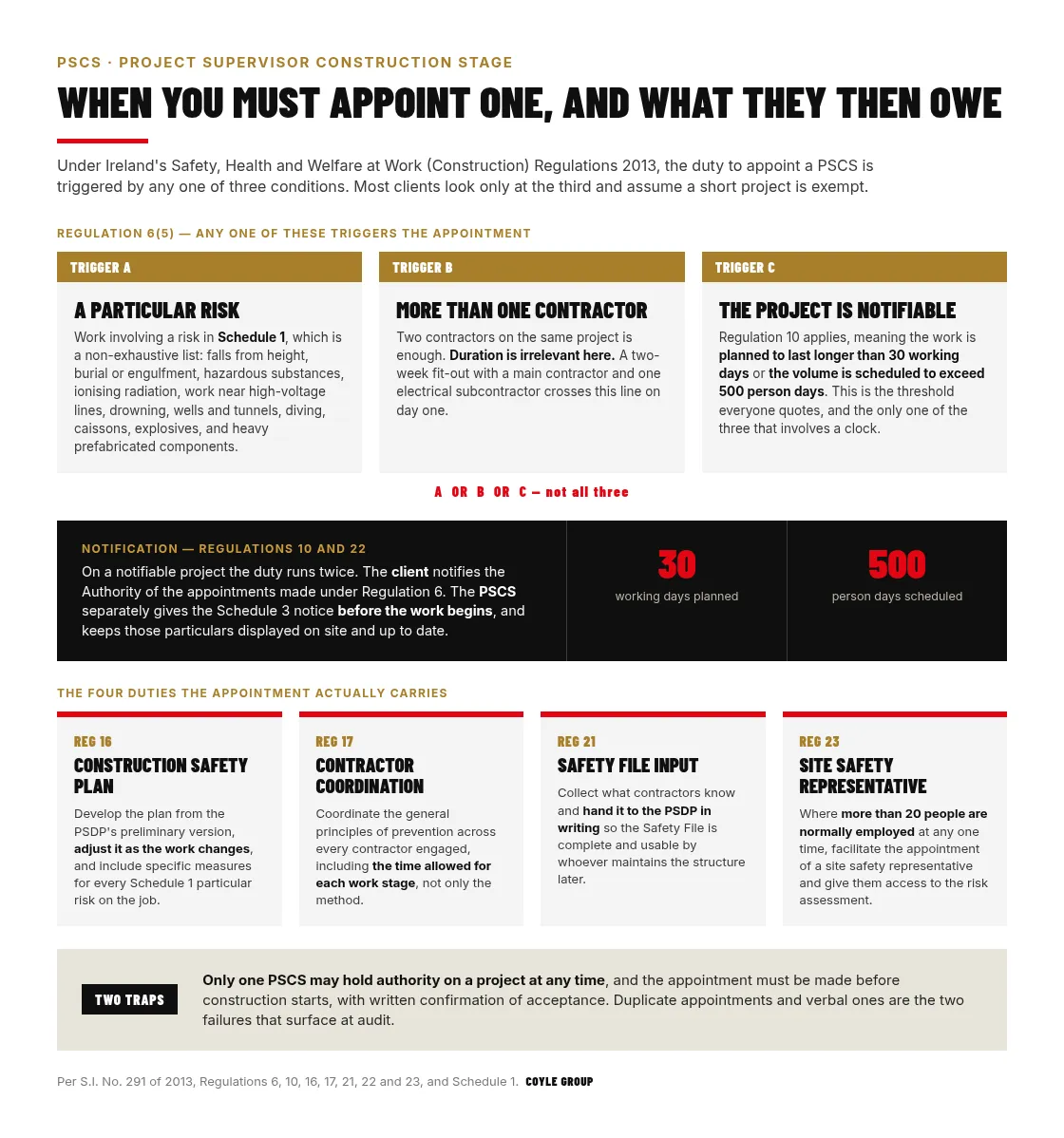
Trigger B is the one that catches people. Two contractors on the same project is enough on its own, and duration is irrelevant to it. A two-week office fit-out with a main contractor and one electrical subcontractor needs a PSCS from the start, and the fact that nobody would call that a construction project in ordinary conversation makes no difference to the regulation.
Timing is fixed as well. Regulation 6(3)(b) requires the PSCS to be appointed before commencement of the construction work, and Regulation 6(1) requires the client to obtain written confirmation that the appointment has been accepted. A verbal understanding reached in week two is not an appointment, and it is not repairable after the fact.
None of this is limited to what people picture as a building site. The definition of construction work in the 2013 Regulations reaches fit-out, commissioning, maintenance, demolition and the installation of mechanical, electrical and telecommunications services, so a substation upgrade or a plant-room refit inside our construction and engineering work sits under the same duty-holder chain as a new build.
The 30 Working Days and 500 Person Days Thresholds
The notification thresholds are where the “30-day rule” comes from, and they do more work than most people realise, because crossing them turns on Trigger C as well as creating a separate notification duty.
Regulation 10 requires the client to give written notice to the Health and Safety Authority where construction work is planned to last longer than 30 working days, or the volume of work is scheduled to exceed 500 person days. The notice covers the particulars of the appointments made under Regulation 6.
Regulation 22 then puts a second, separate duty on the PSCS: on the same threshold, give the Authority written notice containing the particulars listed in Schedule 3 before the work begins, and keep those particulars clearly displayed on the construction site and updated as they change. Two notifications, two duty holders, one threshold. Sites that assume the client’s notice discharges the PSCS duty are half-notified.
Note the wording on both: planned to last longer than 30 working days, and scheduled to exceed 500 person days. The test is the plan at the outset, not the outturn. A job scoped at 28 days that overruns does not retrospectively become notifiable, and a job scoped at 35 days that finishes early was notifiable throughout. Both provisions sit in S.I. No. 291 of 2013, at Regulations 10 and 22 respectively.
The Four Duties the Appointment Carries
Being appointed is the start of the obligation rather than the discharge of it. Four regulations carry the substance of what a PSCS then owes, and they are worth reading as four deliverables rather than as a general duty of care.
Regulation 16, the Construction Safety Plan
The PSCS develops the plan from the PSDP’s preliminary version, keeps adjusting it to reflect the progress of the work and any changes, includes specific measures for work involving a Schedule 1 particular risk, and makes sure the plan and its rules are in writing and brought to the attention of every contractor affected. A plan that has not changed since mobilisation is not being maintained.
Regulation 17, Contractor Coordination
Where more than one contractor is engaged, the PSCS coordinates the implementation of the general principles of prevention across technical and organisational decisions, and specifically when estimating the time required for completing the work or work stages. That clause is easy to skim and hard to comply with, because it makes programme compression a safety decision rather than a commercial one.
Regulation 21, the Safety File
The PSCS coordinates arrangements among contractors so the information the PSDP needs reaches it in writing, monitors that those arrangements are working, and takes corrective action where they are not. The Safety File is the document the building’s future owner relies on, and it is assembled from information that only exists while the trades are still on site.
Regulation 23, the Site Safety Representative
Where more than 20 people are normally employed at any one time at any stage of the project, the PSCS facilitates the appointment of a site safety representative and gives them access to the risk assessment, reportable accident information and the preventive measures taken.
Read together, those four are a coordination role rather than an inspection role. The common failure is appointing someone who audits the site well and coordinates nothing, which leaves the interfaces between contractors uncovered, and interfaces are where construction incidents happen. The Health and Safety Authority’s own page on the construction stage duty holder puts the same emphasis on coordination rather than supervision.
The Two Failures That Surface at Audit
Most PSCS problems found on a live site are not exotic. They are one of two administrative failures that were baked in before the first delivery arrived.
The Duplicate Appointment
Only one PSCS may hold authority on a project at any time, and where two entities have both been appointed, the statutory chain is broken and both the client and the contractor carry exposure. One of our chartered consultants found exactly this on a client site during a separate assignment, resolved it through a managed stakeholder process inside a week, and the client then ran a nationwide review that caught the same error across its wider portfolio. Our PSCS and PSDP advisory work carries that portfolio-level check as standard for the same reason.
The Appointment Made Late or Never Put in Writing
Regulation 6 is specific on both points, the writing and the timing, and neither is fixable retrospectively. What usually happened is that a project grew past a trigger, most often by adding a second contractor, and nobody re-tested the appointment duty against the new shape of the job.
Both are cheap to prevent and expensive to find. A single register of active appointments, re-checked whenever scope changes, closes them.
How This Compares With UK CDM 2015
Contractors working across both jurisdictions often assume the frameworks map onto each other. They rhyme, but they do not translate cleanly, and the assumption is a reliable source of gaps.
Ireland runs PSCS and PSDP under the Construction Regulations 2013 and answers to the Health and Safety Authority. The UK runs Principal Contractor and Principal Designer under CDM 2015 and answers to the Health and Safety Executive. The notification thresholds, the documentation and the terminology all differ, and a Construction Phase Plan written to CDM is not a Construction Safety Plan written to the 2013 Regulations. Our CDM advisory engagement covers the UK side of that split for clients running both.
What does carry across is the underlying risk-assessment discipline. The method statements and assessments themselves are portable, and our guide to writing a RAMS document applies on either side of the Irish Sea. It is the duty-holder architecture that has to be built twice.
Get the Appointment Right Before the Work Starts
The three triggers are the whole test: a Schedule 1 particular risk, more than one contractor, or a notifiable project past 30 working days or 500 person days. Any one of them, and a competent PSCS has to be appointed in writing, before construction starts, with written acceptance on file.
Everything after that is coordination: a Construction Safety Plan that keeps moving with the job, contractor interfaces managed including the programme, Safety File information captured while the trades are still there, and a site safety representative once the headcount justifies it. None of it is onerous on a well-run project, and all of it is unrecoverable if the appointment itself was defective.
If you would rather have the appointment tested than assumed, request a utilities safety consultation and we will start with the register of who currently holds what.
Frequently Asked Questions
What does PSCS mean?
PSCS stands for Project Supervisor Construction Stage, the duty holder appointed by the client to coordinate safety and health during the construction phase of a project in Ireland. The role is created by the Safety, Health and Welfare at Work (Construction) Regulations 2013 and enforced by the Health and Safety Authority. It can be held by a competent individual or by an organisation, and only one PSCS may hold authority on a project at a time.
When must a PSCS be appointed?
Regulation 6(5) sets three triggers and any one of them is enough. The work involves a particular risk listed in Schedule 1, or more than one contractor is involved, or the project is notifiable under Regulation 10 because it is planned to last longer than 30 working days or the volume is scheduled to exceed 500 person days. The appointment must be made before construction work commences.
What are the main duties of a PSCS?
The PSCS develops the Construction Safety Plan from the PSDP's preliminary version and adjusts it as work progresses, coordinates the general principles of prevention across every contractor engaged, provides the PSDP with the information needed to complete the Safety File, and notifies the Health and Safety Authority before work begins on a notifiable project. Where more than 20 people are normally employed on site, the PSCS also facilitates a site safety representative.
What is the difference between PSCS and PSDP?
PSDP is the Project Supervisor Design Process, appointed for the design stage, and PSCS is the Project Supervisor Construction Stage, appointed for construction. The PSDP prepares the preliminary safety and health plan and identifies foreseeable hazards at design stage. The PSCS develops that plan into the Construction Safety Plan and runs coordination on site. One competent individual or organisation may hold both roles on the same project.
What counts as a particular risk under Schedule 1?
Schedule 1 gives a non-exhaustive list of ten categories: risk of falling from height, burial under earthfalls or engulfment in swampland, chemical or biological substances requiring health monitoring, ionising radiation needing controlled or supervised areas, work near high-voltage power lines, risk of drowning, work on wells and underground earthworks and tunnels, diving with an air supply system, work in a caisson with compressed air, use of explosives, and assembly or dismantling of heavy prefabricated components.
Who can be appointed as PSCS, and what happens if two are appointed?
Either a competent individual or a competent organisation may be appointed, and the client must verify competence before appointing in writing and obtain written confirmation of acceptance. A client may also self-appoint if competent. Two entities holding PSCS authority at the same time is a regulatory breach: the chain of statutory accountability is broken and both the client and the contractor carry exposure if an incident occurs.