Risk Assessment & Method Statement (RAMS) Guide for UK Employers
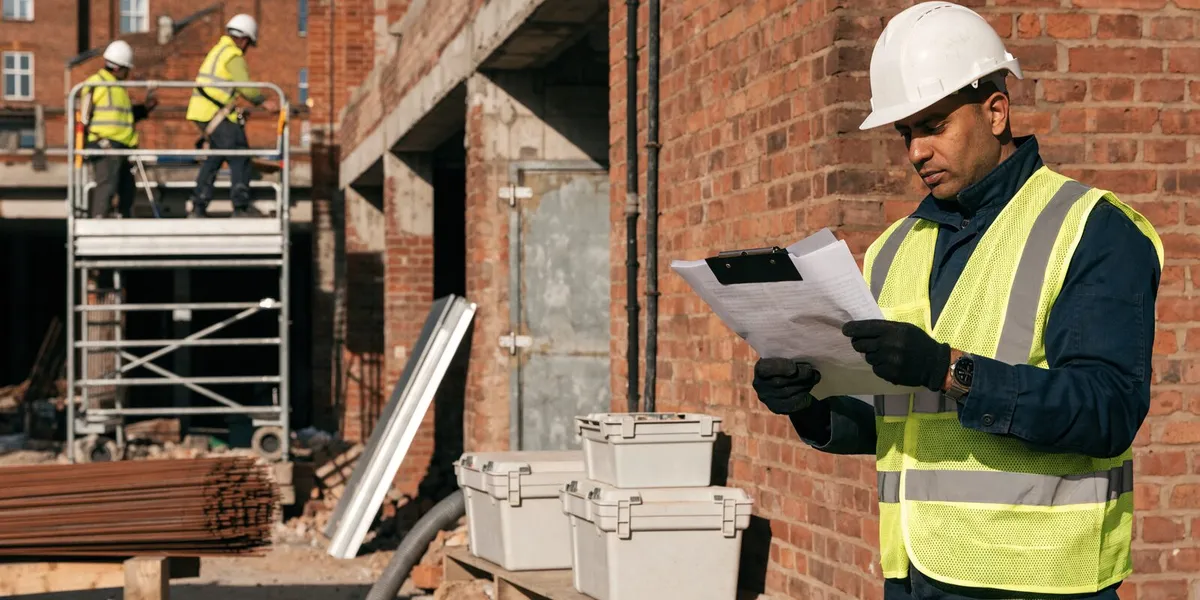
Risk Assessment and Method Statements are two different documents that ultimately serve the same purpose of ensuring safety in a workplace.
It is widely known, especially within the safety industry, that an employee can pursue injury claims for accidents that occur in the workplace or during their employment, if their employer has been negligent or breached their statutory duties.
A Stratford-upon-Avon company, Sibbasbridge Limited, faced exactly this scenario. In July 2024, one of its bricklayers fell more than two metres through an unguarded gap in a balustrade while replacing steps at a property in Leamington Spa, suffering head trauma and a stroke that left him with lasting speech, memory, and mobility problems. The Health and Safety Executive found the firm had produced no task-specific risk assessment or method statement for the work. Sibbasbridge pleaded guilty to breaching the Work at Height Regulations 2005 and was fined £16,000 plus £7,638 in costs.
Now, if you are new to risk management or health and safety policy, you may not be familiar with the safe-system-of-work documents that are referred to as RAMS. And if you are already familiar with them, the Sibbasbridge fine shows how directly the courts treat missing RAMS as a breach of duty rather than a paperwork slip.
In this article, we set out what the law asks of you and provide guided steps on how to prepare and complete a RAMS document.
What Are RAMS?
RAMS stands for Risk Assessment and Method Statements, and they are important health and safety documents that companies file at the end of completing a risk assessment. These documents contain detailed information about a hazard whose risk has been assessed and offer specific step-by-step guides to working around that hazard that all employees, contractors, and others can easily follow.
Both halves of the pack sit on a statutory footing. Regulation 3 of the Management of Health and Safety at Work Regulations 1999 puts the risk assessment duty on every employer in the country, and section 2 of the Health and Safety at Work etc. Act 1974 requires you to provide a safe system of work, which the method statement is the standard way of setting out. On construction sites, CDM 2015 adds a duty to plan, manage and monitor the work before anyone starts.
RAMS documents serve the same overall purpose: to ensure workplace safety. But for all their similarities, Risk Assessments and Method Statements are still two different documents with a few unique qualities and motivations of their own.
The 5 Steps of the Risk Assessment Process (Simplified)
Before you start the risk management process, you should know that certain specifics may vary across industries; however, the overall process is still the same.
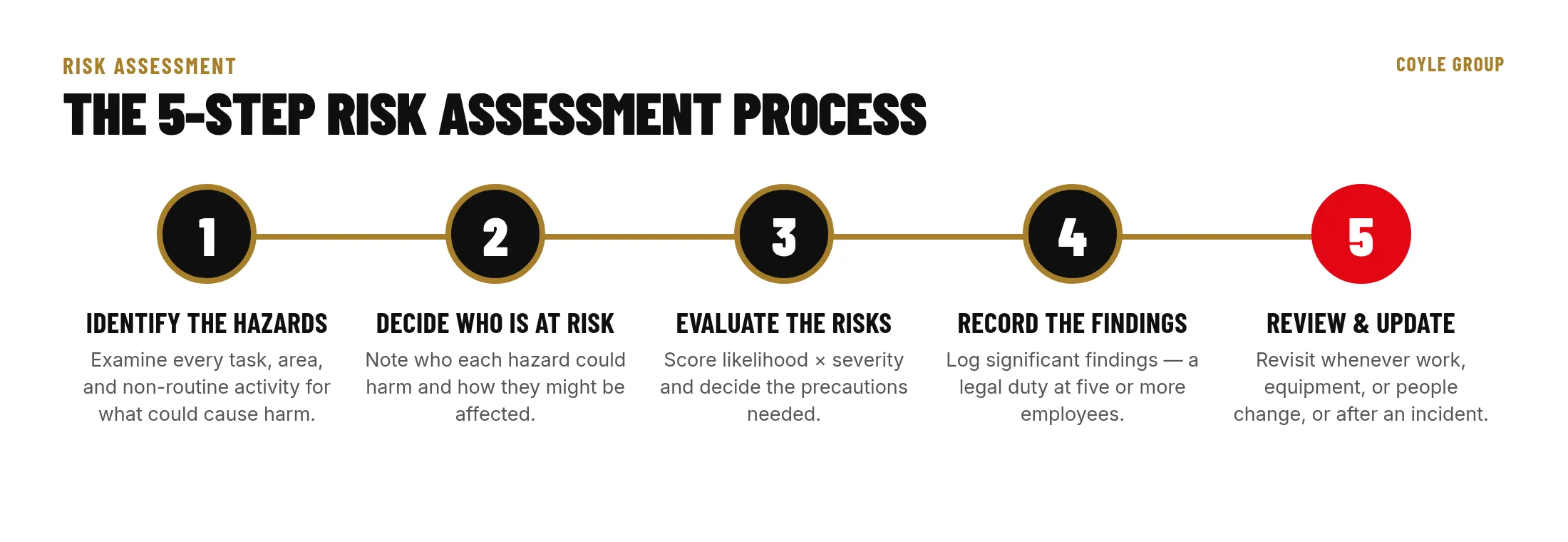
Step 1: Identify the Hazards
The first step to starting a risk assessment for any activity is to ascertain what hazards your employees face or exist within the premises and operations of your business. Thoroughly examine your workplace and look out for what operating procedures or activities could potentially cause harm. Be mindful to include all aspects of the workplace operations, even remote workers and non-routine activities like repair and maintenance.
Common safety hazards to consider:
- Natural disasters (flooding, earthquakes, fire, etc.)
- Biological hazards (pandemic diseases, foodborne illnesses, etc.)
- Workplace accidents (slips and trips, transportation accidents, structural and mechanical breakdowns)
- Intentional acts (labour strikes, demonstrations, bomb threats, robbery, arson, etc.)
- Technological hazards (lost internet connection, power outage, etc.)
- Chemical hazards (asbestos, cleaning fluids, etc.)
- Mental hazards (excess workload, bullying, etc.)
- Interruptions in the supply chain
Step 2: Determine Who Is at Risk and How They Might Be Harmed
Whoever is most at risk of harm from every identified potential hazard in the first step should be made a note of.
Step 3: Evaluate the Risks and Decide on Precautions
At this stage, you will need to calculate the likelihood of the identified potential hazards occurring. You will also have to quantitatively evaluate the severity of the consequences where any associated hazard occurs. This evaluation helps determine which major hazards to prioritise first.
Step 4: Record Significant Findings
Once you have completed the first three steps, record your significant findings. Carrying out the assessment is a legal duty whatever your headcount; writing the significant findings down is the part that becomes a legal requirement at five or more employees, and smaller firms are still expected to be able to show how the risks were judged. Recording your findings is a separate duty from reporting certain injuries and dangerous occurrences under RIDDOR, which applies to every employer regardless of headcount.
The record (or the risk assessment plan) should show that the following took place:
- Conducted a proper check of your workspace
- Determined who would be affected
- Controlled and dealt with obvious hazards
- Initiated precautions to keep risks low
- Kept your staff involved in the process
Step 5: Review Assessment and Update Where Necessary
Finally, review your assessment and update if necessary. Over time, continual review and revision may be necessary to stay on top of any new or emerging hazards when conditions change or based on feedback from the team completing the activity.
Scoring Risk with a Risk Matrix
Step 3 asks you to weigh how likely a hazard is against how badly it could hurt someone. A simple 5 by 5 risk matrix turns that judgement into a score so you can rank hazards and decide what to control first. Multiply likelihood by severity to get a risk rating.
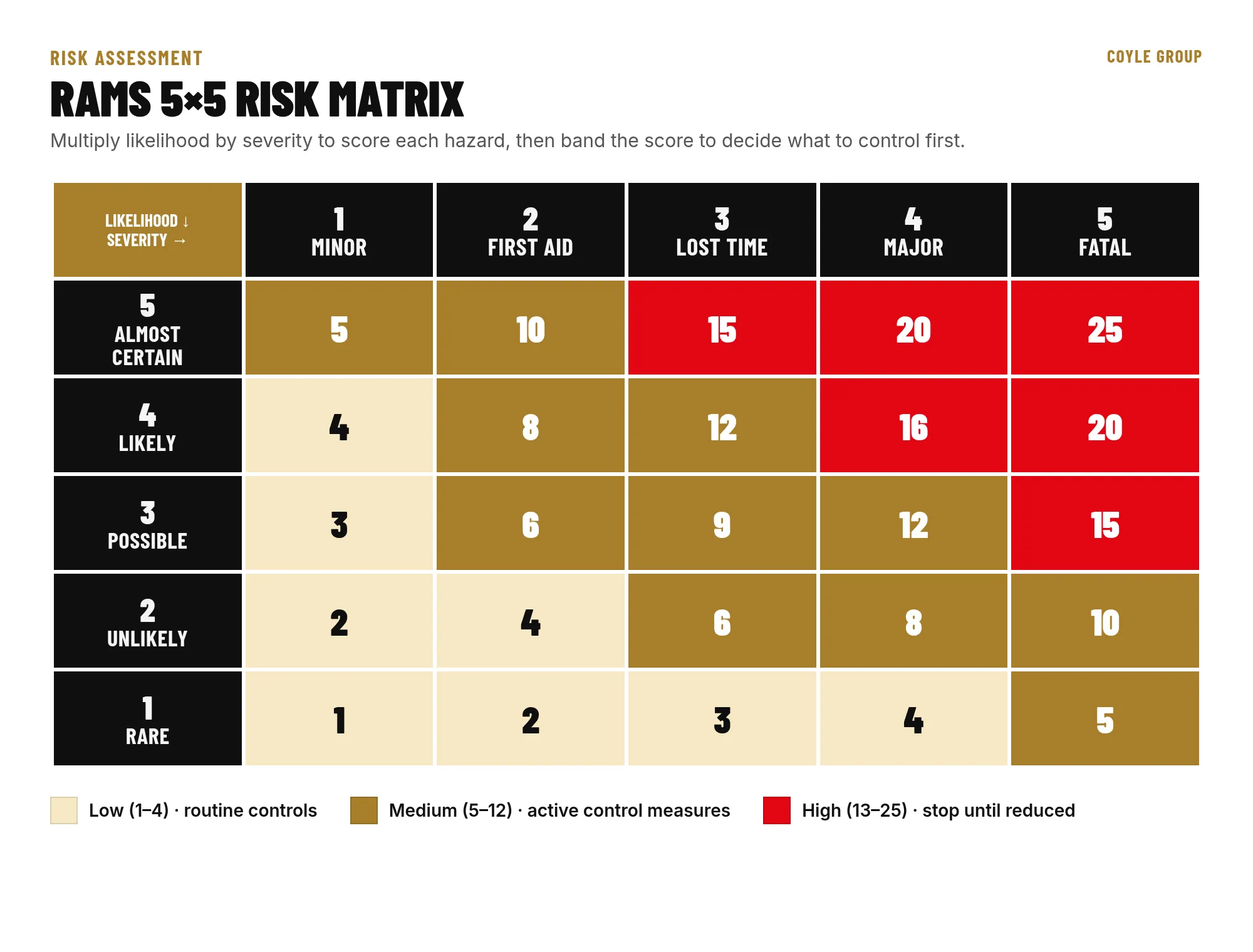
Use the rating to band each hazard:
- Scores 1 to 4 are low risk, acceptable with routine controls.
- Scores 5 to 12 are medium and need active control measures.
- Scores above 12 are high risk, and the task should not go ahead until you have reduced the score.
Where you track these scores across a project, log them in a risk register so nothing slips through the net.
A Worked RAMS Example: Working at Height
To see how the two documents fit together, picture a small team clearing a blocked gutter from a mobile scaffold tower.
- Hazard identified: a fall from height while working on the tower.
- Who is at risk: the two operatives on the platform, plus anyone passing below.
- Risk rating: severity 5 (fatal), likelihood 3 (possible) before controls, giving a score of 15 (high).
- Control measures: trained tower erectors, a tower built to the manufacturer’s instructions, guard rails and toe boards fitted, an exclusion zone below, and a harness where edge protection cannot be completed.
- Residual rating: with controls in place the likelihood drops to 1 (rare), bringing the score to 5 (medium and acceptable).
The method statement then spells out the sequence: inspect the tower components, erect the tower with the base fully braced, fit the platform and guard rails, complete the work, and dismantle in reverse order. Anyone can pick up that document and carry out the task the same safe way every time. The statutory duties sitting behind that example are mapped regulation by regulation in our guide to the height regulations for Ireland and the UK.
Three Action Steps for Preparing an Effective Method Statement
Method statements, which are referred to as a Safe System of Work, follow risk assessments. They build on the information outlined in risk assessments and go on to detail how specific activities can be conducted safely. If you are starting from a blank document, our guide to the free RAMS template covers where to download one and which fields only the site can answer.
Action 1: List Hazards and Outline Safety Responses
As you begin your method statement, describe any procedures related to Personal Protective Equipment (PPE), environmental considerations, and quality controls. Also, list the precise course of action project team members need to take to mitigate the associated risks.
Action 2: Write Step-By-Step Instructions
This is the most important section of your method statement. It requires you to list the exact step-by-step instructions that will be required for everyone to safely complete tasks. Instructional diagrams can be added to ensure comprehension.
Action 3: Revise Statements for New Locations, Equipment, and Guidelines
Review and adjust your method statements to account for every aspect of your business that can affect your established guidelines, like a new location in an additional territory. Regularly update your method statements to reflect changes in reporting procedures, clean-up procedures, and project phases.
The Benefits of Using RAMS Documents
When they are prepared and followed properly, RAMS documents pay off in ways that reach well beyond simply ticking a compliance box. Here are the main benefits they bring to a business:
- Supports Safe Decision Making: When workers run into project roadblocks and must make quick decisions, RAMS can guide the safest choice of action without having to wait for formal approval.
- Prevents Misunderstandings: Method statements formalise the necessary processes with a clear, safe, step-by-step system of work which eliminates confusion caused by verbal or informal instructions.
- Improves Productivity and Efficiency: With a step-by-step guide in place, any qualified or trained worker can complete a task efficiently, which enhances productivity.
- Reduce Absence Due to Sickness: RAMS detail how to implement safety measures and eliminate risks associated with prolonged exposure to harmful biohazards, reducing sick leave and associated costs.
- Reduce the Risk of Fines and Other Legal Penalties: Overall improvement in safety compliance and risk management legislation supported by RAMS reduces the risk of fines or legal penalties.
- Protects Your Business’ Reputation: By effectively protecting both employees and clients from harm, RAMS can help to improve or remedy your company’s reputation.
Getting RAMS Right the First Time
As seen in the Sibbasbridge case, one of the main consequences of incomplete RAMS is that it can lead to serious injuries in the workplace, and it can be costly dealing with the fallout from failing to have the necessary controls in place.
Ready to get it right the first time? Coyle Group can help your organisation with the arrangement and completion of all necessary requirements for an effective RAMS document, as well as provide additional compliance consultancy services.
Frequently Asked Questions (FAQs): RAMS
Before you draw up your next risk assessment and method statement, here are the questions site managers and safety advisers raise most often about what RAMS are, who writes them, and how they are reviewed.
What are RAMS documents?
RAMS is a pair of documents. The risk assessment identifies the hazards of a task and how likely and how serious the harm is, while the method statement sets out, step by step, how the work will be carried out safely. Together they show a client or principal contractor that a job has been planned to control its risks.
What does RAMS stand for?
RAMS stands for Risk Assessment and Method Statement. The two are usually combined into a single pack for a specific task or project.
Are RAMS legally required?
Yes. Regulation 3 of the Management of Health and Safety at Work Regulations 1999 requires every employer to carry out a suitable and sufficient risk assessment, and to record the significant findings where there are five or more employees. The method statement is how you set down the safe system of work that section 2 of the Health and Safety at Work etc. Act 1974 obliges you to provide, and on construction work CDM 2015 and the Work at Height Regulations 2005 require the job to be planned before it starts. RAMS is the industry name for that pack, and the duties it evidences are enforceable by the HSE.
What is the difference between a risk assessment and a method statement?
A risk assessment identifies the hazards of a task and rates how likely and how severe the harm could be. A method statement takes those findings and sets out, step by step, how the work will actually be carried out safely. In short, the risk assessment says what could go wrong, and the method statement says how you will stop it going wrong.
Who is responsible for writing RAMS?
The employer or contractor carrying out the work is legally responsible for making sure suitable RAMS are in place. In practice they are usually written by a competent person, such as a site manager, supervisor, or health and safety adviser, who understands both the task and the site conditions. On larger projects the principal contractor will often review and approve each subcontractor's RAMS before work begins.
How often should RAMS be reviewed?
Review RAMS whenever the work, the location, the equipment, or the people involved change, and after any incident or near miss. Even where nothing obvious has changed, it is good practice to check them regularly so the document keeps reflecting how the job is really being done rather than becoming a tick-box exercise.
How do you score risk on a risk matrix?
A risk matrix scores each hazard by multiplying likelihood by severity, usually on a 5 by 5 grid. A low score means routine controls are enough, a medium score calls for active control measures, and a high score means the task should not go ahead until the risk has been reduced. Scoring this way lets you rank hazards and decide what to control first.