Safe Systems of Work: 4 Components + Industry Examples
Are you looking for ways to improve safety in your workplace? One of the most effective ways to do this is by implementing safe systems of work. Safe systems of work are essential procedures and guidelines designed to minimise the risks associated with specific work tasks or operations. They help ensure that employees are able to perform their job duties safely and without undue risk to their health and wellbeing.
This guide explains how a safe system of work actually operates: what one is, the four components that make it effective, and how the same structure adapts across high-risk industries such as construction, chemicals, and healthcare. It also walks through a standard document template you can adapt for your own tasks and answers the questions employers ask most often. By the end you will know how to build, run, and review a safe system of work that stands up to scrutiny.
What Is a Safe System of Work?
A safe system of work is a formal, step-by-step procedure that comes from examining a task, identifying its hazards, and then defining the safest method to carry it out. Under the Health and Safety at Work etc. Act 1974, employers have a legal duty to provide safe systems of work for their staff. In practice it sets out how a job should be done, which controls are in place, and who is responsible for each step. It is often the outcome of a risk assessment and sits at the heart of any well-run safety programme.
Key Components of Safe Systems of Work
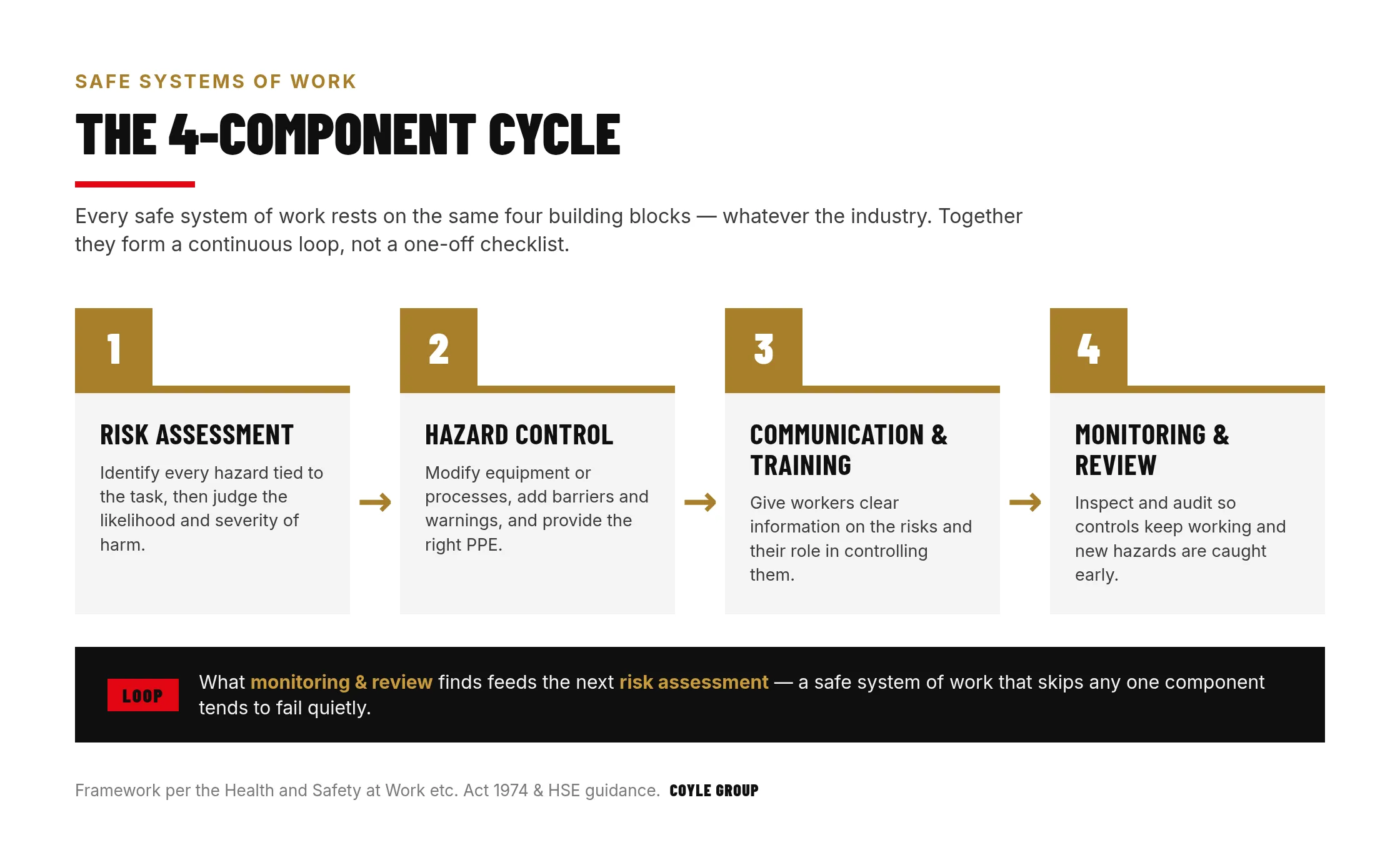
Every safe system of work rests on the same four building blocks, whatever the industry. Work through them in order and you move from understanding a task’s risks to controlling them, communicating them, and keeping them in check over time. The four components below are what turn a written procedure into a system people actually follow.
1. Risk Assessment
The first step in implementing a safe system of work is to conduct a thorough risk assessment. This involves identifying all potential hazards associated with a particular task or operation, evaluating the likelihood and severity of harm, and deciding on measures to eliminate or control those risks, in line with the HSE’s risk management guidance. Assessments should be repeated regularly, and especially when new equipment or processes are introduced.
2. Hazard Control
Once potential hazards have been identified, the next step is to implement hazard control measures. This may involve modifying equipment or processes to reduce the risk of injury or harm, providing personal protective equipment (PPE), or creating barriers or warning systems to prevent access to hazardous areas. Hazard control measures should be regularly reviewed and updated as needed.
3. Communication and Training
Effective communication and training are essential components of safe systems of work. Employees should be provided with clear and concise information on the hazards associated with their job duties and the measures in place to control those risks. Regular training sessions should be provided to ensure that employees understand their role in maintaining a safe working environment.
4. Monitoring and Review
The final component of safe systems of work is monitoring and review. Regular inspections and audits should be conducted to confirm that hazard controls are working effectively and that any new hazards are identified and addressed promptly. Reviews also feed your reporting duties: where an incident meets the threshold under RIDDOR, it must be logged and reported to the HSE. Where you track findings across a project, a risk register keeps every action and owner in one place.
Taken together, these four components form a loop rather than a checklist: you assess, control, communicate, then monitor, and what monitoring finds feeds the next assessment. A safe system of work that skips any one of them tends to fail quietly, which is why the strongest programmes treat all four as continuous rather than one-off tasks.
Examples of Safe Systems of Work
The four components look different in practice depending on the hazards a workforce faces. The three industries below are among the most heavily regulated in the UK, and each shows how the same structure of assessment, control, protection, and review adapts to very different risks. Use them as a reference point for the level of detail your own systems should reach.
1. Construction Industry
The construction industry is one of the most hazardous industries, with a high risk of accidents and injuries. Safe systems of work include:
- Conducting a site-specific risk assessment before starting any work
- Implementing control measures, such as barriers or signage, to prevent access to hazardous areas
- Providing PPE, such as hard hats and safety harnesses, to employees
- Regularly monitoring and reviewing safety measures, including regular safety briefings and toolbox talks
2. Chemical Industry
The chemical industry involves handling potentially hazardous materials. Safe systems of work include:
- Conducting a hazard analysis to identify potential risks and control measures
- Developing a written safety programme that outlines procedures for handling hazardous materials
- Providing employees with PPE, such as respirators and chemical-resistant clothing
- Regularly monitoring and reviewing safety procedures
3. Healthcare Industry
The healthcare industry involves potential hazards such as exposure to infectious diseases or lifting and moving patients. Safe systems of work include:
- Conducting a site-specific risk assessment to identify potential hazards
- Providing employees with training on proper lifting and moving techniques
- Developing procedures for handling hazardous materials, such as sharps or biohazardous waste
- Providing PPE, such as gloves and masks
- Regularly monitoring and reviewing safety procedures
Across all three sectors the pattern holds: a site-specific assessment comes first, controls and PPE follow, and nothing is treated as finished until it has been reviewed. The industry changes the hazards and the equipment, but not the discipline behind the system.
Impact of Safe Systems of Work on Safety
A safe system of work is only worth the effort if it changes outcomes, and a well-run one does so on more than one front. Beyond the obvious drop in injuries, employers consistently report knock-on gains in morale and cost that are easy to overlook when safety is treated purely as compliance. The three effects below are the ones businesses notice first.
1. Reduction in Workplace Accidents
One of the primary benefits of safe systems of work is a reduction in workplace accidents. By identifying potential hazards, implementing control measures, and providing employees with training and PPE, the risk of accidents and injuries can be minimised.
2. Improved Employee Morale
Safe systems of work can also have a positive impact on employee morale. When employees feel that their employer is committed to their safety, they are more likely to feel valued and motivated to do their job well, resulting in improved job satisfaction and reduced turnover rates.
3. Cost Savings
Implementing safe systems of work can result in significant cost savings for organisations by reducing the number of accidents and injuries. Employers can save on medical expenses, workers’ compensation costs, and lost productivity.
A Standard Safe System of Work Template
Most safe systems of work follow the same core structure, so you can start from a standard template and adapt it to the job in front of you. There is no single legally mandated format, as the HSE cares that a system is suitable and sufficient rather than that it uses a particular form, but the following sections appear in almost every well-written document:
- Task and scope — what the work is, where it takes place, and who it covers.
- Hazards identified — the specific hazards drawn from the risk assessment.
- Control measures — the steps, equipment, and PPE that reduce each risk, in the order they apply.
- Sequence of work — the safe method itself, written as clear, numbered steps.
- Responsibilities — who supervises the work, who carries it out, and who signs it off.
- Emergency arrangements — what to do if something goes wrong, including first aid and reporting.
- Review and sign-off — the date, the author, and the point at which the document must be checked again.
Can you modify it? Yes, and you should. The headings above are a standard starting point, but the content under each one must be specific to your task, your site, and your team. A template copied word for word from another job is one of the most common reasons a safe system of work fails an audit, because it describes hazards and controls that do not match the work actually being done. Treat the structure as fixed and the detail as bespoke. The same split applies to a RAMS template, where 6 of the fields can only be answered by the site itself.
Building Safer Workplaces With Safe Systems
Safe systems of work are the backbone of a healthy safety culture. By carrying out risk assessments, putting hazard controls in place, training people properly, and reviewing everything on a regular cycle, employers create a workplace where the safest way to do a job is also the standard way.
Building that from scratch, or fixing a system that keeps slipping, takes time and specialist judgement that most teams do not have to spare. If you would rather get it right the first time, get expert compliance support: Coyle Group’s safety consulting service helps UK organisations design, document, and review safe systems of work that protect their people and stand up to inspection.
Frequently Asked Questions (FAQs): Safe Systems of Work
A few of the questions employers and supervisors ask most often when they set up or review a safe system of work.
What is a safe system of work?
A safe system of work is a formal, step-by-step procedure for carrying out a task in the way that best controls its risks. It comes from examining the task, identifying the hazards, and defining the safest method, then setting out the controls, the sequence of steps, and who is responsible for each part.
Is a safe system of work a legal requirement?
The document itself is not named in law, but the duty behind it is. Section 2 of the Health and Safety at Work etc. Act 1974 requires employers to provide and maintain safe systems of work so far as is reasonably practicable, so for any task with significant risk a safe system of work is effectively a legal expectation.
What is the difference between a safe system of work and a method statement?
A safe system of work is the broad procedure that keeps a task safe, covering hazards, controls, responsibilities, and review. A method statement is the part that spells out the sequence of steps in detail. On many jobs the method statement sits inside the wider safe system of work, alongside the risk assessment.
When do you need a safe system of work?
You need one whenever a task carries a risk that cannot be removed by design or equipment alone and instead has to be managed by how the work is carried out. Higher-risk activities such as work at height, confined-space entry, and hot works almost always require a documented safe system of work, often supported by a permit to work.
Who is responsible for creating a safe system of work?
The employer holds the legal duty, but in practice a competent person writes the system, usually a manager, supervisor, or health and safety adviser who understands both the task and the site. On larger projects a principal contractor will often review and approve each contractor's safe systems before work starts.
How often should a safe system of work be reviewed?
Review a safe system of work whenever the task, the equipment, the location, or the people involved change, and after any incident or near miss. Even when nothing obvious has changed, a regular scheduled review keeps the document matching how the job is really being done.