How to Build a Safety Budget for UK Employers
Budget decisions are never simple to make, and many businesses are still adjusting to life and business at this point. Employees’ safety should be the greatest priority during the planning process, even if employers are looking for ways to cut costs where revenue has been impacted.
Employees will face new challenges every day as the nature of work changes. Unfortunately, injury risks are as high as they’ve ever been, and failing to develop a proactive workplace safety strategy would almost certainly result in excessive expenditure down the road.
Safety should never be overlooked. If safety is not prioritised, employees and managers will not be able to produce a safe work environment. It’s improbable that the necessary preparations have been made if the budget (and, indeed, the entire project) hasn’t been planned around safety. When creating a budget for a project, safety must be taken into account from the beginning.
Things to Address While Planning a Solid Safety Budget
A solid safety budget starts with a clear picture of what the business is trying to achieve and what its work actually costs to do safely. Before you assign a single figure, it helps to work through the factors below, because each one shapes how much room you have and where the money needs to go. Get these right and the numbers that follow are far easier to defend.
1. Align your safety objectives with the organisation’s
Take note of the following factors as you design your safety budget:
- Staffing levels: Can your facilities remain at their present staffing levels, and if so, what adjustments will be necessary to maintain production?
- Forecasted revenue/income: These figures will define how much leeway you have in your budgeting process.
- New investments: Is your company looking to diversify its revenue sources or incorporate new technology?
- Benchmarks for safety: Determine your objectives for incident rates, employee turnover, compensation claims, and lost productivity.
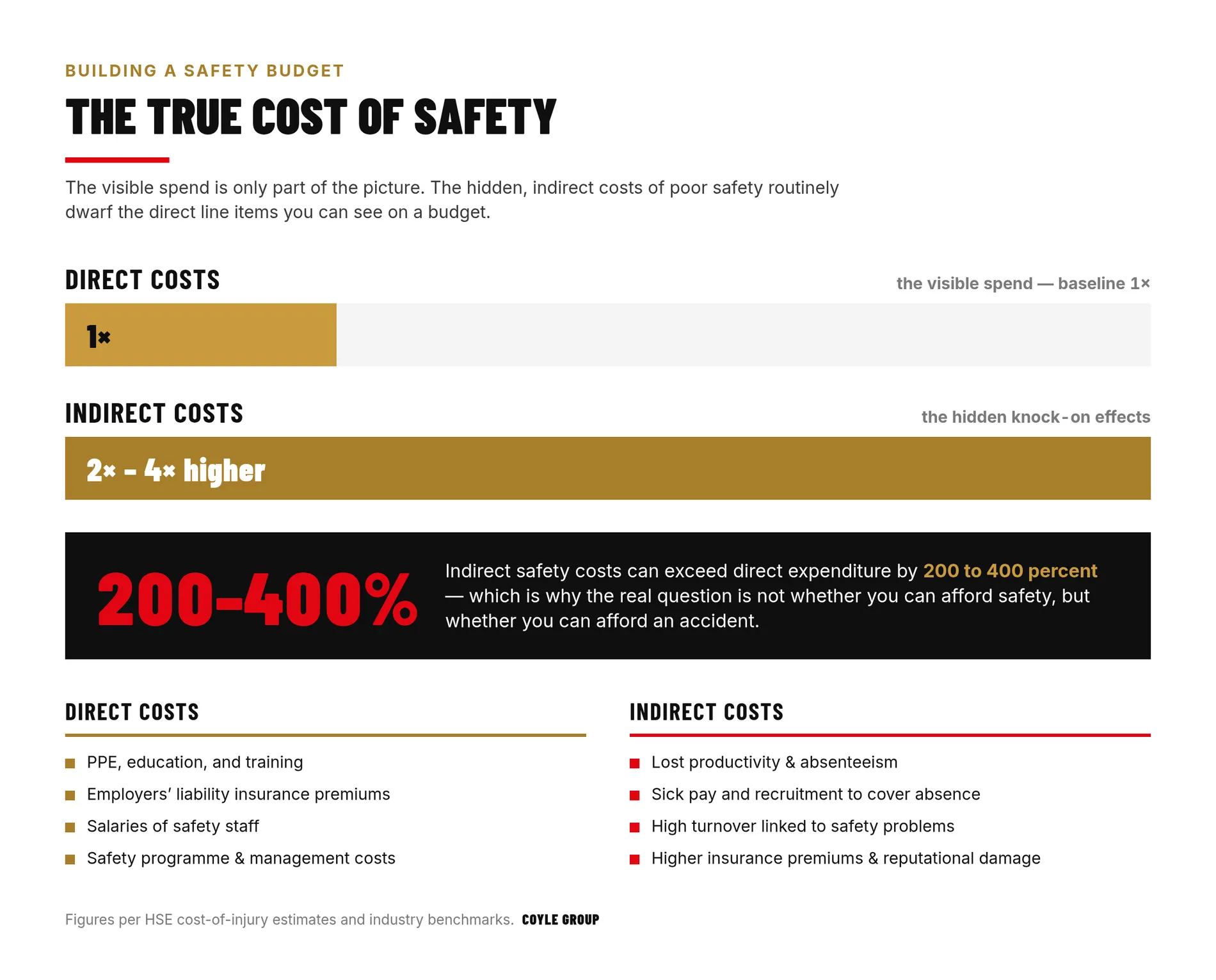
2. Determine the direct and indirect costs of safety
Direct cost considerations include:
- Personal protective equipment (PPE), education, and training
- Employers’ liability insurance premiums, compensation claims, and the salaries of safety staff
- Safety programme and management costs
Indirect costs can exceed direct expenditure by 200-400%. Indirect cost drivers include:
- Absenteeism, weariness, or chronic pain among workers resulting in lost productivity
- Low productivity and low morale
- High turnover linked to safety problems
3. Prioritise budget options based on functionality and safety risk
Determine which procedures, departments, and safety initiatives are most important for your facilities’ safe operation. The same probability-and-impact scoring you would use in a risk register works well here: defer spending for low-risk areas and focus on investing in and preserving your operations’ most safety-critical components.
4. Partnerships
Budget options should be prioritised based on functionality and safety risk. Determine which procedures, departments, and safety initiatives are most important for your facilities’ safe operation, and where a specialist partner can cover a gap more cheaply than an in-house hire.
Taken together, these four considerations turn a blank spreadsheet into a budget grounded in how your organisation really operates. Align the objectives, cost the risks honestly, and prioritise by hazard, and you have a plan that protects people without wasting money on the wrong things.
Building a Safety Budget
With your objectives set and your costs mapped, the next job is to translate them into a working budget for the project in front of you. That means pinning down the practical questions of equipment, time, and inspection before the work starts, rather than discovering the gaps once it is under way. The questions below are a useful starting checklist.
Important questions to consider:
- What equipment and PPE will be required?
- Is the current project, as well as the deadlines, secure?
- Do employees require additional man-hours to ensure their safety?
- When should inspections be completed?
Answering these questions early stops safety spending from becoming a series of last-minute surprises. Cost them into the project from the outset and the budget stays realistic, the deadlines stay achievable, and the controls are in place before anyone is exposed to the risk.
What If Safety Is Too Expensive?
Many organisations find themselves cutting shortcuts on safety because they believe it is too costly. The truth is that safety is as costly as it needs to be. Safety is not a choice. It is an unavoidable cost.
Furthermore, safety provides a better return on investment than many firms believe. A single accident can cost a corporation millions in equipment and medical expenditure, lost productivity, and a tarnished reputation.
Viewed that way, the real question is not whether you can afford safety but whether you can afford an accident. Spend where the serious exposures are, control them properly, and the cost of prevention will almost always look small next to the cost of getting it wrong.
Benefits of Making a Budget for Safety
Workplace safety is a never-ending effort, and foresight in the shape of a well-run safety programme pays off in the form of drastically cheaper costs. Musculoskeletal disorders and stress-related ill health remain among the biggest causes of lost working time in Britain, and the Health and Safety Executive estimates that workplace injury and new cases of ill health cost the country billions of pounds and millions of lost working days every year. Preventing a single serious injury usually costs far less than dealing with the fallout, which is exactly why a good risk assessment should drive your spending.
Benefits of safety budgeting:
- Employees are safer and happier as a result of the changes
- The budget will be more realistic
- A single, substantial expense is less likely to deplete the budget
- Projects are less likely to be delayed
The Role of Safety Management Software
By investing in safety management software, organisations can reduce their risk in exchange for a low, predictable cost. The right platform pulls incident reports, inspections, training records, and risk assessments into one place, so nothing slips through the gaps between spreadsheets and email. Real-time data also turns safety from a paperwork exercise into a source of insight: you can see which sites or tasks generate the most near misses, track whether corrective actions are actually closed out, and spot trends early enough to act on them before they become claims.
Standards such as ISO 45001, the international benchmark for occupational health and safety management, are built around exactly this kind of continual monitoring and improvement. Software will not replace competent people or sound procedures, but for a modest recurring cost it makes both far easier to sustain, which is why it increasingly earns a line of its own in the safety budget.
9 Ways to Reduce the Risk of Worker Injuries
A safety budget is ultimately judged on whether it keeps people from getting hurt, and much of that comes down to everyday practice rather than big-ticket spending. The nine steps below are practical, mostly low-cost habits that stretch a safety budget further by preventing the incidents that drain it. Work them into how your teams operate and the return on every pound you spend improves.
- Hire Smarter: carefully screen individuals to verify necessary abilities and experience.
- Train: include employee training in safety expenditure.
- Prioritise Maintenance: maintaining facilities and systems in good working order prevents accidents.
- Request Safe Practices at Work: always allow time to complete things safely.
- Provide the right tools and equipment: without proper tools, workers take shortcuts.
- Demonstrate that you value a job done safely: reward safety suggestions, not zero-injury reporting.
- Look for ways to get jobs done more safely: brainstorm with employees.
- Keep in mind there are plenty of right responses: safety is relative, not absolute.
- Plan for Prevention, not Reaction: creating a safety budget should prevent accidents rather than rectify them.
Why a Safety Budget Pays Off
Building a workplace safety plan that focuses on smart, proven investment rather than the cheapest quick fix equips your company to move forward with a workforce that is genuinely protected. Get the balance right and the benefits show up as lower injury rates, lower organisational costs, and a stronger safety culture, especially when you empower people to be owners and stewards of safety through education and engagement. The companion workplace safety on a budget guide walks through the same principles in more depth.
Building and costing a safety programme that stands up to scrutiny is rarely a job to take on alone. If you want to get it right the first time, get expert compliance support: Coyle Group’s safety consulting service helps UK organisations plan, budget for, and maintain the health and safety systems that protect their people and satisfy their legal duties.
Frequently Asked Questions (FAQs): Safety Budgets
The questions finance leads and safety managers raise most often when they set a budget for health and safety and have to justify the spend.
How much should a safety budget be?
There is no fixed percentage that fits every business. The right figure depends on your industry, the hazards you carry, your headcount, and your legal duties. Rather than starting from a number, build the budget bottom-up from your risk assessment: cost the controls, training, equipment, and competent advice each significant risk demands, then set that against forecast revenue.
What is the cost of workplace safety?
Direct costs include PPE, training, safety staff, and equipment. Indirect costs, which are often two to four times larger, include lost productivity, sick pay, recruitment to cover absence, and higher insurance premiums. The Health and Safety Executive estimates that workplace injury and ill health cost Britain billions of pounds every year, most of which falls on employers and workers rather than the state.
Why should safety be part of the budget from the start?
Because safety designed in early is far cheaper than safety bolted on after an incident. Planning controls, training, and equipment into the budget from day one avoids the emergency spending, downtime, and claims that follow an accident, and it signals to your workforce that their wellbeing is not a line item to be trimmed when money is tight.
What is the difference between direct and indirect safety costs?
Direct costs are the visible spend: PPE, training, safety staff, equipment, and insurance premiums. Indirect costs are the hidden knock-on effects of poor safety, such as lost productivity, sick pay, recruitment to cover absence, and reputational damage, and they routinely run two to four times higher than the direct costs they follow.
How do you justify a safety budget to senior management?
Frame safety as an investment with a measurable return rather than a cost. Set out the direct spend against the far larger indirect cost of a single serious incident, tie each item back to a specific risk in your risk assessment, and show the productivity, retention, and insurance benefits that a well-run programme delivers over time.
Can you cut a safety budget without cutting safety?
You can prioritise, but you cannot safely cut. Defer or scale back spending in genuinely low-risk areas, negotiate better rates on equipment and training, and use technology to work more efficiently, but never remove the controls a significant risk demands. Safety is as costly as it needs to be, and the controls that protect people are not the place to look for savings.
How often should a safety budget be reviewed?
Review the budget at least once a year as part of your normal planning cycle, and again whenever your operations, headcount, or risk profile change. A budget that is set once and left alone drifts out of step with the hazards the business actually faces, so treat it as a living figure that moves with the work.