Sustainable Business Leadership: 4 Pillars for Founders

Think about the entrepreneurs you admire most. Chances are, they did not just build successful companies, they built businesses that lasted. The difference between a flash-in-the-pan startup and a sustainable enterprise often comes down to one overlooked factor: the founder’s own sustainability.
How many hours did you spend on your business strategy last week? Now ask yourself this: how many hours did you dedicate to the engine that powers it all, yourself?
As entrepreneurs, we are obsessed with optimising our operations, marketing and financials. But we often neglect the most critical factor in our business’s success, our own wellbeing. Here is the truth that is often overlooked: your business can never be healthier than you are.
Founder Wellbeing: The Foundation of Sustainable Leadership
Founder wellbeing is not a soft topic, it is the thing that decides whether the whole venture lasts. When you constantly push yourself to the brink, you are not just risking your health, you are building a business on shaky ground. Consider this: when you are exhausted, stressed or unhealthy, every aspect of your business reflects that instability.
Your decision-making suffers. Your team feels the tension. Your creative problem-solving diminishes. Most importantly, you are modelling unsustainable practices that become embedded in your company culture.
The truth is, sustainable businesses are built by sustainable leaders.
Four Pillars of Sustainable Business Leadership
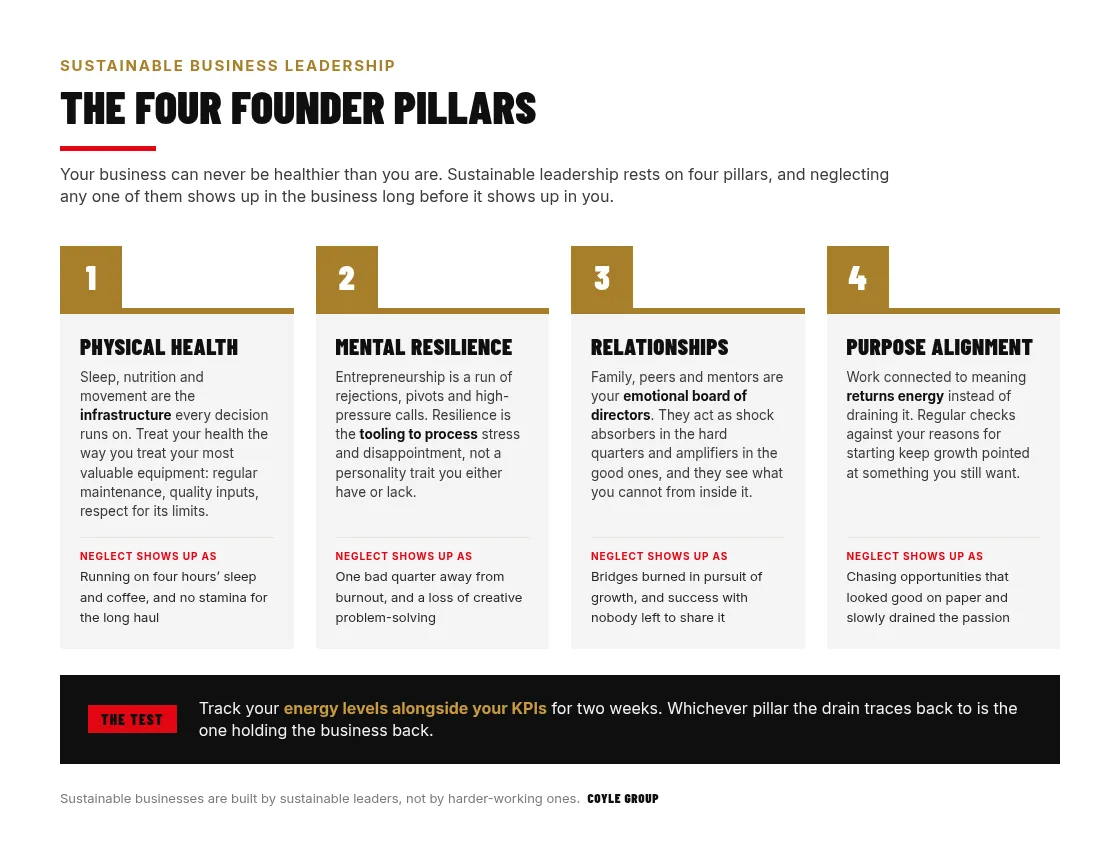
Building a business that lasts requires a foundation of personal sustainability across four key areas. Neglect any one of them and it surfaces in the business long before it surfaces in you.
Physical Sustainability
Your body is your first business asset. Without adequate sleep, proper nutrition and regular movement, you are operating on borrowed time. Physical energy is not just about feeling good, it is about having the stamina for the long haul. Think about it: every major decision you make, every crisis you navigate, every opportunity you seize requires physical energy as its foundation. When you are running on four hours of sleep and living on coffee, you are essentially asking a worn-out engine to perform at peak capacity.
The most successful entrepreneurs I know treat their physical health the way they treat their most valuable equipment, with regular maintenance, quality inputs and respect for its limits. They understand that a healthy body is not a luxury; it is the non-negotiable infrastructure that supports everything else they want to build.
Mental Resilience
Entrepreneurship tests your mental limits daily. The entrepreneurial journey is essentially a series of rejections, pivots and high-pressure decisions that would break most people. Without mental resilience, you are one bad quarter or failed product launch away from complete burnout.
I have seen brilliant founders with amazing ideas crumble because they never developed the mental tools to process stress, disappointment or even success. The irony is that the same drive that makes us start businesses can also be our downfall if we do not learn to manage it. Investing in your mental health is not about being weak, it is about being smart enough to maintain the clarity and emotional stability your business needs from you. It is also worth reading the HSE’s work-related stress guidance as a founder rather than as an employer, because the six causes of work stress it names apply to the person at the top as squarely as to anyone on the payroll.
Relationship Durability
No sustainable business exists in isolation. Strong personal relationships, mentorship connections and peer support networks provide the external stability every entrepreneur needs. Your spouse, friends and family are not just your personal life, they are your emotional board of directors, offering perspective when you are too deep in the trenches to see clearly.
Fellow entrepreneurs understand your journey in ways others cannot, providing both practical advice and the simple relief of not feeling alone. Mentors who have walked this path before can help you avoid costly mistakes and see opportunities you might miss. These relationships act as shock absorbers during tough times and amplifiers during good ones. The entrepreneurs who burn bridges in pursuit of success often find themselves successful but utterly alone, and that is not sustainable for the business or the soul. The same logic applies to who you bring in early: your first hires set the load you carry personally for years afterwards.
Purpose Alignment
When your work connects to deeper meaning, it becomes energising rather than draining. Regular reflection on your “whys” keeps you aligned and prevents the burnout that derails so many ventures. It is easy to get caught up in the day-to-day fires and forget why you started this journey in the first place. Purpose is not just motivational poster material, it is the fuel that keeps you going when the money is not flowing, when the team is struggling, or when competitors are breathing down your neck.
Some entrepreneurs lose their way chasing opportunities that looked good on paper but slowly drained their passion. They ended up successful on the outside but empty on the inside, wondering how they built a prison instead of a dream. Regular purpose check-ins are not indulgent navel-gazing, they are strategic recalibrations that ensure your business growth aligns with your personal values and vision.
Read across all four and a pattern emerges: none of them fails loudly. Each degrades quietly over months, which is why the pillar you are neglecting is almost never the one you would name if asked.
Practical Steps to Personal Sustainability
None of this requires a retreat or a rebuilt morning routine. Five changes carry most of the benefit, and each one works by making the sustainable choice the default rather than the disciplined one.
- Schedule sustainability: Block time for health activities just as you would critical business meetings. Your workout is as important as your board meeting. I learned this the hard way: if it is not on the calendar, it does not exist in the entrepreneurial world where every minute feels claimed by urgent tasks. Treat these appointments with yourself as non-negotiable commitments, just as you would never casually skip a meeting with your biggest client.
- Create sustainable routines: Build healthy habits into your existing schedule. Walking meetings, standing desks and healthy office snacks make wellness automatic. Replace your afternoon coffee run with a walk around the block, swap your desk chair for a standing desk converter, and stock your office with nuts and fruit instead of sweets. These small environmental changes compound over time, creating sustainable health improvements without requiring constant mental effort.
- Set sustainable boundaries: Establish clear work hours and stick to them. When you model work-life balance, you give your team permission to do the same. This is not just about your health, it is about creating a company culture that attracts and retains top talent who value sustainability over burnout. Your boundaries teach others how to treat you and demonstrate that success does not require sacrificing everything else that matters.
- Measure what matters: Track your energy levels alongside your KPIs. Notice which activities drain versus energise you, then adjust accordingly. Keep a simple energy journal for two weeks, rating your energy before and after different types of tasks and meetings. You might discover that certain client calls consistently drain you while strategic planning sessions energise you, data that can inform how you structure your days. This self-awareness becomes a powerful tool for optimising not just your productivity, but your sustainability as a leader.
- Invest in support systems: Delegate tasks that drain you unnecessarily. Use that time for activities that restore your energy and clarity. The maths is simple: if you are spending hours on tasks someone else could do for a fraction of your rate, you are not just wasting money, you are depleting the energy you need for high-level strategic thinking. Start by listing everything you do in a week, identify what only you can do, and systematically delegate or automate the rest. Delegation is not about being lazy; it is about preserving your energy for what truly matters.
Sustainable success is not about working harder, it is about working sustainably. The most successful entrepreneurs understand that building a lasting business requires playing the long game with their health and wellbeing.
Worth naming plainly: burnout is not a character flaw or a phase. The World Health Organization classifies it as an occupational phenomenon in the ICD-11, defined by exhaustion, mental distance from your work, and reduced effectiveness. Those are the three things to watch for in yourself, and all three show up in your numbers eventually.
Your Sustainable Business Starts Today
The path to building a lasting business is not found in the latest growth hack or marketing strategy, it is found in the mirror. When you commit to your own sustainability, you are not being selfish; you are being strategic. You are ensuring that the vision you have for your business has a healthy, energised leader to see it through.
The businesses that thrive long-term are not built on the backs of burned-out founders, they are built by leaders who treat their wellbeing as a non-negotiable business asset.
Since you have read the article this far, I challenge you to make one concrete commitment to your personal sustainability. Maybe it is scheduling that overdue health check-up. Perhaps it is committing to a daily 20-minute walk. Or it could be as simple as setting a firm boundary around evening work emails.
Whatever you choose, remember: you are not taking time away from your business, you are investing in its foundation.
Your business needs you at your best, not your busiest.
Building a resilient business also means putting the right systems around it so the load does not all fall on you. Learn more about us, or talk to our safety consulting team about taking safety and compliance off your plate.
If you want a read on where the pressure is actually sitting before you change anything, start with your own organisation. Take the free Safety Culture Survey and you will see which parts of the load your team can carry and which ones are still resting on you alone.
Frequently Asked Questions
How do you build a sustainable business?
Build it on a sustainable leader. Protect your physical health, mental resilience, relationships and sense of purpose, then set boundaries and routines your team can follow, so growth does not depend on you burning out.
What are the pillars of founder wellbeing?
The four pillars are physical health, mental resilience, durable relationships and purpose alignment. Neglect any one for long and the others eventually suffer.
What are the signs of founder burnout?
Common signs include poor decision-making, loss of creativity, constant exhaustion and resentment towards work you once enjoyed. Tracking your energy alongside your KPIs helps you catch it early.
What is sustainable business leadership?
Leading in a way the business can keep running for years rather than quarters, which starts with the founder's own capacity. It rests on 4 pillars: physical health, mental resilience, relationship durability and purpose alignment. Neglect any one and the effect shows up in decision quality, team morale and eventually the numbers.
Is burnout a medical condition?
Not a medical condition, but it is formally recognised. The World Health Organization classifies burnout in ICD-11 as an occupational phenomenon, defined by 3 markers: exhaustion, mental distance from your work, and reduced professional effectiveness. Those 3 are the signs to watch for in yourself, because each one degrades the decisions the business depends on.
How do you prevent founder burnout?
Schedule health commitments with the same weight as client meetings, build recovery into existing routines rather than adding to them, set boundaries your team can see you keeping, track energy alongside your KPIs, and delegate the work that drains you. The pattern that matters is consistency: recovery treated as infrastructure rather than as a reward for finishing.