Positive Safety Culture: 5 Indicators for UK Employers

Safety culture refers to the shared values, attitudes, beliefs and behaviours related to safety in an organisation. It encompasses the organisation’s commitment to safety, the way safety is prioritised and integrated into daily operations, and the attitudes and behaviours of all employees towards safety. A positive safety culture is one in which safety is seen as a fundamental priority, and where all employees take ownership of safety and work together to continuously improve it.
Creating a positive safety culture in the workplace is no easy feat, but it can have huge benefits for business owners and employees alike. By creating an environment where everyone understands and follows safety protocols, you build a better working relationship between managers and employees while minimising potential hazards to health. In this article, we explore the 5 indicators that show whether a positive safety culture is real rather than stated, the benefits it delivers, and how to build one from a standing start.
Characteristics of a Positive Safety Culture
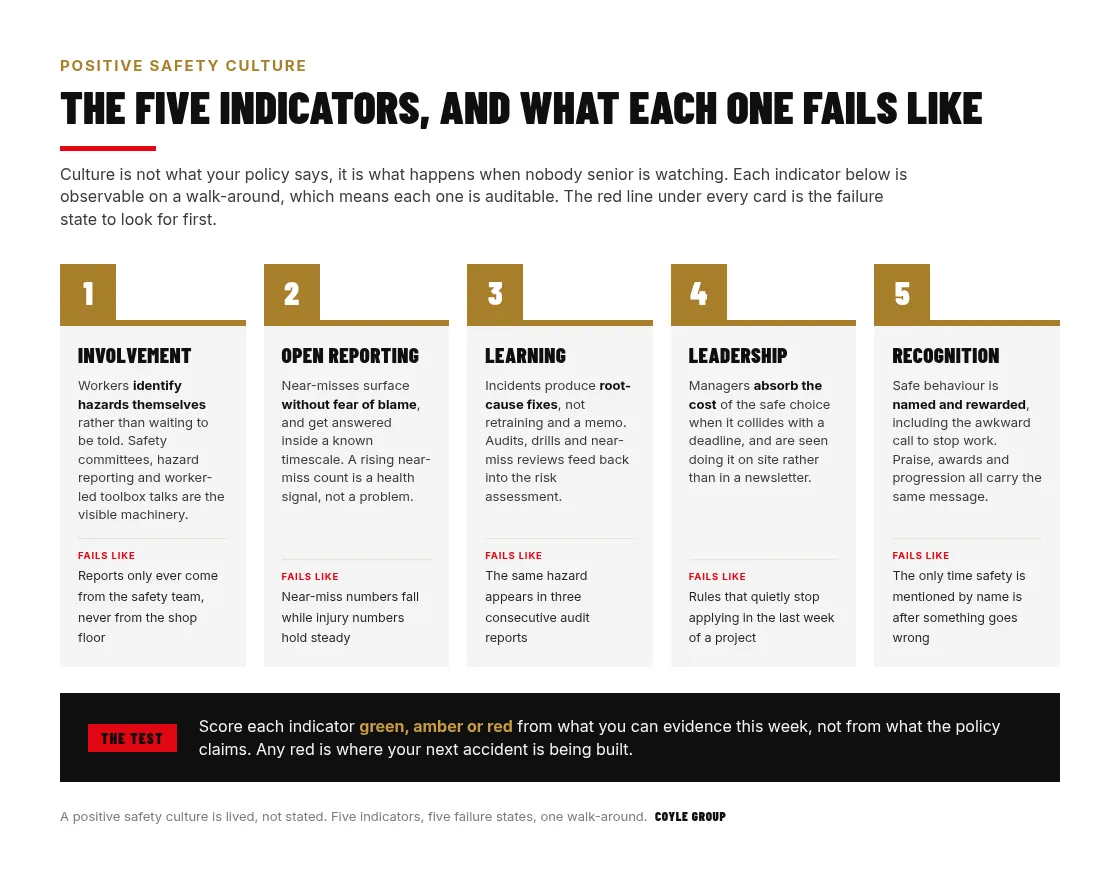
A positive safety culture goes beyond simply having the right tools and resources; it requires an overall commitment from employers and employees alike to promote safe practices throughout their organisation. Five characteristics carry most of the weight, and each one has a failure state that is visible long before it shows up in your injury figures.
1. Employee Involvement and Empowerment
A positive safety culture encourages employee involvement and empowers people to identify potential hazards and take an active role in improving safety in the workplace. Examples include safety committees, hazard reporting systems and safety training programmes. The failure state is easy to spot: every report that reaches you originates with the safety team, and none of it comes from the people doing the work.
2. Open Communication
Open and honest communication between employees and management means safety concerns are raised early and resolved inside a known timescale. Near-misses matter most here, because they are the only free information an organisation gets about its own risk. A falling near-miss count alongside a flat injury count usually means people have stopped telling you things, not that the work got safer.
3. Continuous Learning and Improvement
Continuous learning and improvement comes through ongoing training, education and feedback. This includes regular safety training, safety audits, near-miss reporting and safety drills. What separates learning from paperwork is whether findings change the risk assessment. If the same hazard appears in three consecutive audit reports, the system is recording problems rather than fixing them.
4. Strong Leadership and Commitment to Safety
Strong leadership means top management set an example by prioritising safety in all decisions and actions, including the decisions that cost something. The test arrives when a control collides with a deadline. Rules that quietly stop applying in the final week of a project tell your workforce exactly what the real priority is, whatever the policy says.
5. Recognition and Reward for Safe Behaviour
Recognition and reward for safe behaviour completes the loop. Forms of recognition include verbal praise, financial incentives, promotions, awards and certificates. The behaviour most worth rewarding is also the least comfortable one: the worker who stops a job. If safety is only ever named after something has gone wrong, recognition is not doing its job.
Taken together, these 5 characteristics are what makes culture measurable. The HSE’s guidance on organisational culture makes the same point in stronger terms, noting that culture can influence safety outcomes as much as the safety management system itself, which is why it deserves the same scrutiny as any other control.
Benefits of a Positive Safety Culture
The case for culture work is usually made on injury reduction alone, which undersells it. The returns show up across 7 areas, most of which land on the balance sheet rather than the accident book.
1. Reduced Accidents and Injuries
A positive safety culture leads to a reduction in accidents and injuries in the workplace, which in turn reduces compensation claims and associated costs.
2. Improved Productivity
When employees feel safe and secure in their work environment, they are more productive and engaged in their work.
3. Better Employee Morale and Retention
A happier and more engaged workforce results in better employee retention and reduced turnover, which cuts the cost of replacing experienced people.
4. Enhanced Reputation
A workplace with a positive safety culture earns a reputation for being a responsible and ethical employer, which can attract new talent and customers.
5. Cost Savings
By reducing accidents and injuries and improving productivity, a positive safety culture can result in significant cost savings for the organisation.
6. Legal Compliance
Organisations with a strong culture find it easier to comply with safety regulations and avoid legal penalties and fines, because the controls are already being followed rather than being produced for an inspection.
7. Peace of Mind
Employees can focus on their work without worrying about safety hazards, and directors can answer questions about their arrangements without having to check first.
The evidence for this is not confined to industry. NHS England’s work on patient safety culture defines a positive culture as one deliberately crafted and nurtured rather than left to form on its own, and links it directly to outcomes for the people the organisation serves. The same logic holds whether the risk sits on a construction site or a ward.
How to Build a Safety Culture
If you are wondering how to create a safety culture from a standing start, the work sits with leadership first and everyone else soon after. Key strategies and best practices include:
- Assessing and identifying areas for improvement
- Developing and implementing safety policies and procedures
- Providing ongoing training and education
- Regularly measuring and monitoring progress
- Encouraging and rewarding safe behaviour
Much of this depends on the people carrying it out, which is why a strong safety culture starts with a high-performing safety team. Shaping day-to-day habits also matters, and a behavioural based safety approach gives you a practical way to reinforce the safe choices you want to see repeated.
Sequence matters more than effort here. Measure first, because a baseline is what tells you which of the 5 indicators is actually weakest, and changing the wrong one is how culture programmes lose credibility in their first year.
Living a Positive Safety Culture
A strong safety culture is key to a successful business. A positive safety culture should not be something that is just talked about, but something that is actually lived and breathed by everyone in the organisation, from top to bottom.
If you need help managing your business’s health and safety, Coyle Group can help. We offer safety consulting services to businesses of all sizes, and we start by finding out which indicator is costing you the most.
Score the 5 indicators honestly and one of them will be amber or red. Take the free Safety Culture Survey and you will see which one your team would name, which is rarely the one management expects.
Frequently Asked Questions
What is a positive safety culture?
It is a workplace where safety is a shared value that everyone owns, not a rule imposed from the top. People report hazards freely, leaders lead by example, and safe behaviour is recognised and rewarded.
What are the 5 indicators of a strong safety culture?
Employee involvement, open reporting without blame, continuous learning from incidents, visible leadership commitment, and recognition of safe behaviour. Each one is observable on a walk-around, so you can score all 5 from evidence rather than from what your policy claims.
How do you create a safety culture?
Assess where you are now, set clear policies, train and involve employees, measure progress and reward safe behaviour. It takes visible commitment from leadership and consistency over time rather than a one-off campaign.
What are some examples of a positive safety culture?
A worker stopping a job over a hazard and being thanked rather than questioned. A near-miss report answered inside a week with a root-cause fix. A supervisor absorbing a schedule delay rather than waiving a control. A rising near-miss count treated as a health signal instead of a problem.
How do you measure safety culture?
Use leading indicators rather than injury counts alone: near-miss reporting rates, how quickly reports are closed out, repeat findings across consecutive audits, and anonymous staff surveys. Injury figures are lagging measures and tell you where the culture failed rather than where it is failing now.
What is the difference between safety culture and safety climate?
Culture is the deeper set of shared values and behaviours that persist over years. Climate is the current mood: how people feel about safety this month. Climate is easier to survey and shifts faster, which makes it a useful early warning that the underlying culture needs attention.
Why is safety culture important?
A strong safety culture reduces accidents and their costs, and it also lifts productivity, morale, retention and reputation. It helps you stay on the right side of health and safety law.