Why Your First Three Hires Matter More Than You Think

If you have ever thought about starting your own construction business, you will know it takes more than bricks, mortar and a few good tools. It takes the right people and the trust between you, and the first few decisions you make will either set you on a path to building something that lasts or teach you some very expensive lessons.
I have been in this game long enough to have seen both sides. I have had sleepless nights wondering if I would make payroll, and I have had good days when a finished project came together the way I had planned it. If I could give my younger self one piece of advice, it would be this: do not underestimate your first hires. The people you bring on at the start matter more than almost any other decision you make in those early days.
Here is what I have learned about the first three hires that make or break a construction business, not your tenth or twentieth, but your first three, because they are the people who help you move from just getting by to building something real.
Filling the seats that shape your culture?
Coyle Group’s HSE recruitment team sources the safety-critical hires a growing UK or Ireland construction business cannot afford to get wrong, matching chartered advisors, safety managers and site leads to the standards you are trying to set from day one.
Find The Right First Hires
Why Your First Hires Are Your Foundation
In construction, a solid foundation decides whether a building stands the test of time or ends up plagued by cracks and costly repairs. Your business works the same way. Your first hires are the base everything else is built on. They are not just extra hands, they help shape your company culture, set the standard for your work, and influence how clients and the wider industry see your business.
Choosing the right people early on is not just about filling roles, it is about finding people who share your vision and values. These hires will be with you through the unpredictable days, the big wins and the inevitable setbacks, and their attitude, work ethic and commitment will affect everything from team morale to client satisfaction.
Get these decisions right and you build a business that is resilient, respected and ready to grow. Get them wrong and you spend years patching up problems and fighting to maintain standards. That is why your first hires matter so much: they are the foundation the rest of the business is built on.
Who Should Your First Three Hires Be?
Your first hires shape your company’s culture, your reputation and your future. Three seats matter more than the rest, because the business cannot function without them once the phone starts ringing.
1. The Right Hand: Your Project Manager or Foreman
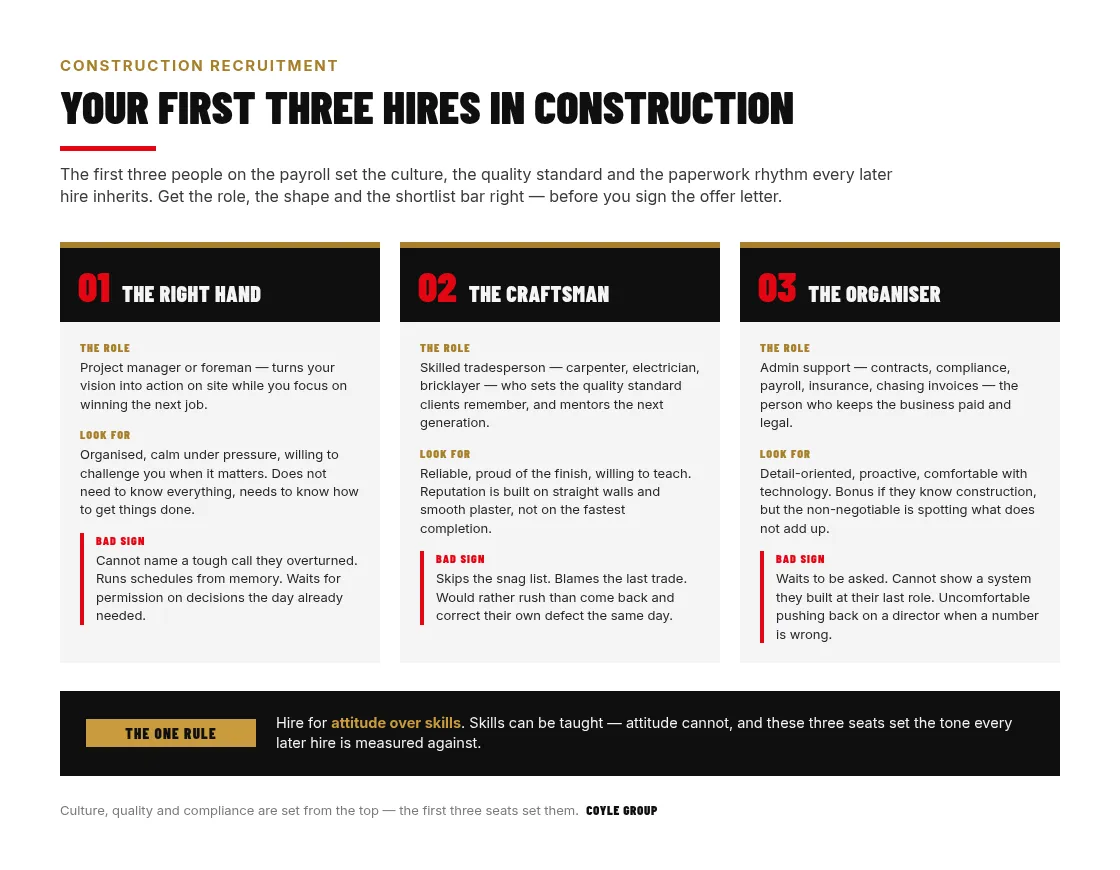
The first hire is your right hand. For some businesses that is a project manager, for others a foreman. The title matters less than the role: you need someone who can take your vision and turn it into action on site.
When you are just starting out, it can feel like you are spinning a hundred plates at once. You need someone who can keep things running smoothly when you are pulled in every direction, someone who can manage the schedule, coordinate the trades, talk with clients, and keep the job moving so you are not stuck micromanaging every detail.
You want someone organised, calm under pressure, and not afraid to challenge you when it matters. They do not need to know everything, but they need to know how to get things done. With the right person in this role, you get more time to focus on growing the business, rather than just keeping it afloat.
2. The Craftsman: Your Skilled Tradesperson
Next up is your craftsman. This is the person who sets the standard for quality on your sites. Maybe it is a carpenter, an electrician or a bricklayer. Whatever your specialty, you need someone who takes pride in their work.
Your reputation is built on the quality of your finished product. Clients remember details, the straightness of the walls, the smoothness of the plaster, how everything fits together. If your first tradesperson cuts corners, you will spend more time fixing mistakes than moving the business forward.
Look for someone reliable, who takes pride in their work, and who is willing to mentor others as your team grows. Do not hire the first person who walks through the door. Take your time, because the right craftsman becomes the anchor for your quality and your reputation.
3. The Organiser: Your Admin Support
The hire most people overlook is the admin. When you are starting out, admin can feel like a luxury, but you do not want to be chasing invoices, permits and paperwork at midnight. Construction is paperwork-heavy: contracts, compliance, payroll, insurance, and more. A good admin keeps you organised, legal, and paid on time.
I thought I could handle it all myself, but every hour spent on paperwork is an hour not spent on the business. When I brought in someone who thrived on details and could track everything from timesheets to insurance renewals, it changed how the business ran. I stopped lying awake wondering if I had missed a deadline or forgotten to pay a supplier.
Look for someone who is detail-oriented, proactive and comfortable with technology. Bonus points if they know the construction world, but what matters most is their ability to keep you organised and challenge you when something does not add up.
You might be wondering about estimators, HR or marketing. They matter, but in the early days you can usually outsource these roles or handle them yourself. Focus on the people who keep the business moving, keep the quality high, and keep the paperwork in order. The rest can come later.
Building a Culture, Not Just a Business
Your first hires do not just do the work, they set the tone for the whole business. They become the culture. If you hire people who care, who challenge you, and who share your vision, you attract more of the same, and before long you have a team pulling in the same direction.
I have always said there are people who get you, who understand how you tick as a person, and that matters as much as skill. It is about fit and trust, about building something together.
This is why those early decisions matter so much. The right people help you create an environment where problems are tackled head-on and success is shared, which puts you on the way to a sustainable business that does not depend on you carrying every load yourself. When your team feels that sense of belonging and purpose, it shows in the quality of your work, the loyalty of your clients, and the reputation you build in the industry.
Practical Tips for Making the Right Hires
So, how do you find these people? Here are a few things I have learned the hard way, alongside what UK employers are legally obliged to have in place before that first payroll run:
- Do not rush. Take your time. The wrong hire will cost you far more than waiting for the right one.
- Look for attitude, not just skills. Skills can be taught. Attitude cannot.
- Ask for stories, not just CVs. Get them talking about how they have handled tough situations, how they have solved problems, and what they are proud of.
- Trust your gut. If something feels off, it probably is.
- Be honest about your expectations. Lay it all out: what you need, what you expect, and where you are going. The right people will get excited. The wrong ones will walk away.
Before you make an offer, make sure the legal baseline is in place. UK employers are required to hold employers’ liability insurance from the moment they take on their first employee, and ACAS publishes a plain-English checklist for hiring someone that covers right-to-work checks, written statement of terms and probation practice. Getting these right at hire one is cheaper than fixing them at hire ten.
The tips above are the pattern. The hires themselves are the test, the point at which the pattern stops being a slide deck and starts being how the site actually runs.
What Are the Most Common First-Hire Mistakes in Construction?
The mistakes we see repeat across small UK construction businesses are rarely about picking the wrong CV. They are about the founder solving the wrong problem, or solving the right one too late, and then wearing the consequence for years.
Hiring a mate is the first pattern. The person you drank with on the last job may be the wrong person to run your first payroll, and the friendship rarely survives the correction. Hiring for the job you have this week is the second, because a lead who fits a two-crew site can be underwater at three, and the wrong scale of person costs more than the wrong skill. Skipping the admin hire is the third, and the one founders defend the longest, right up until a missed insurance renewal or a CIS deduction error eats the margin from a quarter’s work.
The fourth is treating the first hire like the tenth. The first hire earns a longer conversation, a slower probation and a clearer conversation about what the business is trying to become, because they are not filling a seat; they are helping define the seat every later hire will be measured against. Get that one right, and the next three are easier.
How Long Does It Take to Hire Your First Three?
Founders who ask this question are usually looking for permission to move faster than they should. Realistically, the first three hires take a UK construction business six to nine months from decision to all three in seat, and rushing that timeline is the single most reliable way to end up with the wrong people and a resignation letter inside the first year.
The right hand usually takes the longest, twelve weeks or more from job spec to signed offer, because the candidate pool at foreman or project-manager level moves slowly and the good ones are almost never actively looking. The craftsman is usually faster, four to eight weeks if the trade network is warm, and longer if the specialty is niche. The admin can land inside a month if the brief is honest about hours and remote flexibility, and it is the hire founders can start earliest even at part-time hours.
Sequencing matters as much as speed. Start the right-hand search first, because the pool is slowest. Line up the craftsman conversations during that search so an offer follows quickly once the pipeline builds. Bring the admin in as soon as the paperwork load justifies part-time hours, which is usually well before founders are willing to admit it.
How Coyle Group can help
Our HSE recruitment team helps growing UK and Ireland construction businesses fill the safety-critical seats a mis-hire would cost most, sourcing chartered advisors, safety managers and site leads whose attitude and standards match the culture you are trying to build.
Hire For The Seats That Matter
Build Your Foundation First
If you are just starting out, or feeling stuck and unsure how to move forward, take a hard look at your team. Are the people around you making you better, challenging you, and sharing your vision?
Do not be afraid to invest in these hires. The right project manager, tradesperson and admin give you the structure, the quality and the time you need to grow, and the other roles can wait.
Every successful project starts with groundwork that is done properly, and your business is no different. Put the right people in place early and you are not just building for today, you are setting up steadier growth and fewer problems down the line. When it comes to the safety-critical and specialist roles a growing construction business cannot afford to get wrong, our HSE recruitment team can help you find the right people for those seats.
Once the first three are in place, the question shifts from who to how well: is the culture landing the way you intended? Take the free Safety Culture Survey to benchmark what your first hires have built against comparable UK employers, before the next round of hiring bakes in whatever is already there.
Frequently Asked Questions
Who should your first three hires be?
A right hand (project manager or foreman) who turns your vision into action on site, a craftsman who sets the quality standard clients remember, and an admin who keeps you organised, legal and paid on time. Everything else, estimators, HR, marketing, can be outsourced or absorbed by the founder for longer. The three seats above are the ones the business cannot function without.
How do you hire for a construction business?
Hire for attitude over skills. Ask candidates for stories rather than CVs, listen for how they have handled tough calls, and trust your gut when something feels off. Be honest about what you expect, where you are going, and what the first year looks like. For safety-critical or specialist roles, a recruitment partner will save you from costly mis-hires you cannot afford at this stage.
Why do the first hires matter more than later ones?
The first three set the standard every later hire is measured against. Their attitude to safety, quality and paperwork becomes the default the tenth, twentieth and fiftieth hire assumes is normal. Later hires can be onboarded into a culture that already exists; the first three are the culture. A mis-hire in seat one, two or three costs the business years, not months, to correct.
Should you hire for skills or attitude in construction?
Attitude, with a floor on skills that is honest about what the job actually needs. Skills can be taught with time and money. A craftsman who cuts corners, a foreman who blames the last trade or an admin who waits to be asked cannot be trained out of those defaults at the pace a growing construction business needs. Pinpoint the qualification floor honestly, then hire for how they handle pressure.
When should a construction business make its first admin hire?
Sooner than most founders think. Once the paperwork load starts eating into the evenings, chasing invoices, renewing insurance, tracking timesheets and replying to CDM queries, the hours you save by not hiring are worth less than the deals you close with those hours back. A part-time detail-oriented admin usually pays for themselves inside the first quarter through cash flow alone.
How do first hires shape a construction business's safety culture?
The first hires either model safe behaviour or model shortcuts, and either becomes the site's default within weeks. The right foreman stops unsafe work without prompting; the right craftsman flags a hazard rather than walking around it; the right admin keeps CDM paperwork and training records current. Measure whether the culture you built lands as intended by benchmarking it against comparable UK employers early.