Mental Health as a Workplace Safety Issue: Duty of Care and the 4R System

Far too often, we focus workplace safety on the physical conditions we can see, and mental health in the workplace gets left until last. We fix the switch that is visibly broken, mop up the spill and teach people the right way to fit tab A into slot B. We can often diagnose a failing machine from the sound it makes. The harder job is recognising what is affecting the person operating it.
Mental health is a safety issue, and it sits inside the same duty of care as every physical hazard you manage. Every person’s mind works differently, and a worker who is exhausted, anxious or grieving carries that onto the site with them. Supporting mental health gives you a healthier workforce and a safer site.
Would a struggling colleague speak up on your site?
That comes down to your safety culture. Take the free Safety Culture Survey and see where your organisation stands in about 5 minutes.
Take The Free Safety Culture Survey
Why Mental Health Is a Workplace Safety Issue
Mental health is a safety issue because the mind makes every decision on site. A worker who has slept badly for weeks, or who is carrying anxiety into every shift, is more likely to miss a step in a permit, misread a risk or take a shortcut to get the job finished.
These errors rarely show up in an incident report as “mental health”. They get recorded as human error, lack of attention or failure to follow procedure. The underlying cause stays hidden, so the same pattern repeats.
That is why we treat mental health as part of a positive safety culture, where people feel able to say they are struggling before it turns into an incident. Culture decides whether a worker speaks up or keeps quiet.
The Cost of Poor Mental Health at Work
Lost working days are the easiest part of the bill to measure, and the regulators and health bodies track them closely.
In Great Britain, the HSE’s key figures estimate that 964,000 workers suffered from work-related stress, depression or anxiety in 2024/25. Stress, depression or anxiety accounted for 22.1 million of the working days lost to work-related ill health that year, with each affected worker taking around 22.9 days off on average. That is longer than the average absence for musculoskeletal disorders or workplace injuries.
Globally, the World Health Organization estimates that 12 billion working days are lost every year to depression and anxiety, at a cost of US$1 trillion in lost productivity. Absence is only part of the bill. People who come to work while unwell make more mistakes, and experienced staff who leave take their knowledge with them.
These numbers are likely to grow if employers wait for problems to surface on their own. Acting early, and in a way that respects the dignity and privacy of the people involved, costs far less than dealing with long-term absence.
How Common Are Mental Health Problems at Work?
Mental health problems are common in every workforce, including yours. The WHO’s mental health at work fact sheet estimates that 16% of working-age adults had a mental disorder in 2023. On a crew of 25, 16% works out at 4 people.
It is very likely you know someone who has lived with a condition like these, or you have lived with it yourself. Depression and anxiety are the most common. Colleagues may also be dealing with post-traumatic stress disorder (PTSD), bipolar disorder, eating disorders, obsessive compulsive disorder, postnatal depression or the weight of grief. Each of these can affect mood, concentration, sleep and decision-making at work.
The stigma around these conditions often does as much damage as the conditions themselves. People hide what they are going through because they fear being judged or losing work. A site where it is normal to talk about mental health removes that barrier.
Duty of Care for Mental Health at Work: What the Law Requires
Employers in both Ireland and Great Britain have a legal duty to manage the risks to mental health that arise from work. The law treats stress and other psychosocial hazards the same way it treats any other hazard: identify them, assess the risk and put controls in place.
Employer duties in Ireland
In Ireland, the Safety, Health and Welfare at Work Act 2005 requires employers to put systems of work in place that protect employees from hazards which could lead to mental or physical ill health. The Health and Safety Authority’s guidance on work-related stress states that employers must risk assess all known hazards, including psychosocial hazards that might lead to stress. Risk assessment for stress follows the same basic principles as for other workplace hazards.
The HSA also supports WorkPositive CI, a structured process for assessing psychosocial risks in Irish workplaces.
Employer duties in Great Britain
In Great Britain, the Management of Health and Safety at Work Regulations 1999 require every employer to carry out a suitable and sufficient risk assessment. The HSE is clear that employers have a legal duty to protect employees from stress at work by doing a risk assessment and acting on it.
The HSE’s Management Standards set out 6 areas of work design that, if not properly managed, are linked to poor health: demands, control, support, relationships, role and change. If your current risk assessment covers noise, dust and work at height but says nothing about workload or shift patterns, it has a gap.
In both jurisdictions, the duty is the same in practice. Assess the risks honestly, act on the findings and review them when the work changes.
Signs Someone May Be Struggling at Work
The early signs of poor mental health in the workplace are usually changes in behaviour. You are looking for a shift from how the person normally works, which is why supervisors who know their crew are best placed to spot it.
Common signs include:
- Withdrawing from the team, going quiet at toolbox talks or eating lunch alone
- Arriving late, taking more sick days or leaving early
- Missing steps in procedures, making more errors or being involved in more near misses
- Irritability, short temper or conflict with colleagues
- Looking tired, losing or gaining weight, or mentioning poor sleep
- A drop in the quality of work from someone who is usually reliable
No single sign proves someone is unwell, and some people show none at all. A cluster of these changes over a few weeks is a reason to have a quiet conversation, which is where the 4R system starts.
The 4R System for Supporting Employees
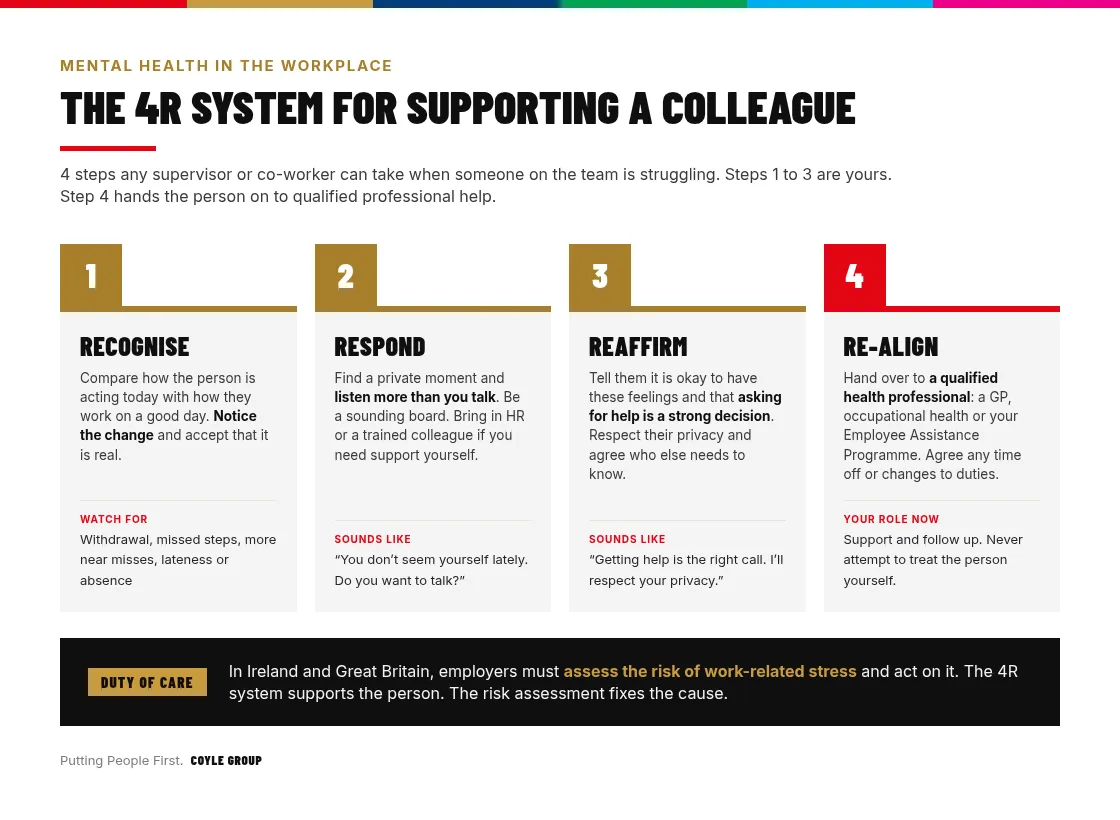
The 4R system gives managers and co-workers a practical way to help. It is hard to bring to the surface an issue someone is trying to hide, or has not yet admitted to themselves. The system breaks the job into 4 steps: recognise, respond, reaffirm and re-align.
Recognise
Recognise the behaviours the person is showing. From past experience you know how they act on a good day, when they are positive and attentive, so you have a bar to compare against. Recognising means accepting and acknowledging what you see. That makes the problem real, both for the person and for you.
Respond
Responding is more than a nod, whether you are a co-worker or a manager. Find a private moment and be a sounding board. If you need support to have the conversation, bring in HR or a trained colleague. The first step is always the hardest for the person struggling, and your response is what makes it possible.
Reaffirm
Reaffirming tells the person it is okay to have these feelings, and that getting help is a strong and confident decision. Respect their privacy, and agree with them who else needs to know. People open up when they trust the conversation will be handled with care.
Re-align
Re-aligning is the step you hand over. The help the person needs has to come from a qualified health professional, such as a GP, an occupational health provider or your Employee Assistance Programme. Never attempt to treat someone yourself. Re-aligning can mean time away from work, a change to duties or hours, or support that happens away from the site.
The 4R system supports the individual. It does not replace the risk assessment. If several people on the same project are showing the same signs, look at the work itself.
What Happens When Mental Health Goes Unaddressed
Leaving the signs alone can feel like the easy option. The effects build up over time, for the person and for the team. People whose mental health goes unaddressed tend to decline steadily in their work. You see more errors, poorer decisions, more conflict between colleagues and more absence.
The effects are physical as well. The HSE notes that prolonged stress can lead to both physical and mental ill health. Poor sleep, changes in weight and a weakened immune system can all follow, and over time that can mean long-term sickness, disability or early retirement.
In the most serious cases, social isolation and untreated mental illness can lead to substance dependency and suicide. Any support a colleague or manager offers makes a real difference. So does the absence of support, in the opposite direction.
Building Mental Health Into Your Safety Management
Treat mental health in the workplace like any other part of your safety management system. It needs a policy, a risk assessment, trained people and a way to measure whether it is working.
Start with 4 practical steps:
- Add psychosocial hazards such as workload, shift patterns, isolation and exposure to traumatic incidents to your risk assessments.
- Write your commitment into your safety policy, including who staff can speak to and what support is available.
- Train supervisors to recognise and respond. The WHO recommends manager training for mental health so managers can recognise and respond to workers in distress.
- Make sure everyone knows how to reach professional support, including any Employee Assistance Programme.
Leadership sets the tone for all of this. Our guide to founder wellbeing covers why the person at the top has to look after their own mental health first, and our wider safety leadership resources show how culture carries these habits from the office to the site.
If you want support putting this in place, our safety consulting team works with employers to build psychosocial risks into their assessments and policies. We start by finding out where your current arrangements stand.
Do your people trust that it is safe to raise a concern?
The 4R system depends on that trust. Measure it with the free Safety Culture Survey.
Take The Free Safety Culture Survey
Making Mental Health Part of Your Duty of Care
Help is available from many directions: your organisation, the law, health professionals and the people around you. Used together, they give every worker a better chance of getting support before a problem becomes a crisis.
If you think you, a family member, a friend or a co-worker may be living with a mental health condition, organisations such as the Mental Health Foundation can point you towards help. Your GP is always a good first call.
For employers, the starting point is knowing whether your people feel safe enough to speak up. Take the free Safety Culture Survey and you will see how your team rates that trust today.
Mental Health as a Safety Issue: Common Questions
Is mental health a workplace safety issue?
Yes. A distracted, exhausted or distressed worker is more likely to miss a step, misjudge a risk or skip a control, so poor mental health raises the chance of errors and incidents. That is why Coyle Group treats mental health in the workplace as part of an employer's duty of care, assessed and managed alongside the physical hazards on site.
What is an employer's duty of care for mental health at work?
In both Ireland and Great Britain, an employer's duty of care covers mental health as well as physical safety. Irish employers must protect workers from hazards that could lead to mental ill health under the Safety, Health and Welfare at Work Act 2005, and British employers must assess and act on work-related stress under the Management of Health and Safety at Work Regulations 1999. In practice, that means treating stress and other psychosocial hazards like any other risk: assess them, put controls in place and review them.
What are an employer's legal duties for mental health in Ireland?
The Safety, Health and Welfare at Work Act 2005 requires employers to put systems of work in place that protect employees from hazards that could lead to mental or physical ill health. The Health and Safety Authority states that employers must risk assess all known hazards, including psychosocial hazards that might lead to stress, using the same principles as for any other hazard.
What are an employer's legal duties for mental health in Great Britain?
The Management of Health and Safety at Work Regulations 1999 require a suitable and sufficient risk assessment, and the HSE is clear that this covers work-related stress. Its Management Standards give employers 6 areas to assess: demands, control, support, relationships, role and change. Employers must then act on what the assessment finds and review it when the work changes.
What is the 4R system for mental health at work?
The 4R system is recognise, respond, reaffirm and re-align. A manager or co-worker notices a change in behaviour, listens without judgement, reassures the person that asking for help is the right decision, then hands them on to qualified professional support such as a GP, occupational health or an Employee Assistance Programme. Coyle Group uses it as a simple script for supervisors.
Should a manager try to counsel a struggling employee?
No. The manager's job is to notice, listen, reassure and signpost. Diagnosis and treatment belong with a GP, an occupational health provider or a trained counsellor. A manager who tries to fix the problem alone risks making it worse and carries a load they are not trained for. Coyle Group advises supervisors to agree next steps with HR and follow up.
How can Coyle Group help with mental health in the workplace?
Coyle Group's chartered team helps employers build psychosocial hazards such as stress into their risk assessments and safety policies, so mental health sits inside the safety management system. The free Safety Culture Survey takes about 5 minutes and shows how willing your people are to raise concerns, which is the foundation any mental health support depends on.