Construction Phase Plan: What HSA and HSE Inspectors Check

A construction phase plan reads differently depending on which side of the Irish Sea the site sits. In the UK, the Principal Contractor writes it under Regulation 12 of CDM 2015 and the Health and Safety Executive is the body that audits it. In Ireland, the Project Supervisor Construction Stage develops it under Regulation 16 of the Construction Regulations 2013, and the Health and Safety Authority checks it instead. The two documents share a common ancestor and a similar shape, but the duty holder, the notification test and the schedule numbers an inspector will actually quote are not the same.
We write and review construction phase plans for tier-one contractors and engineering clients on both sides of the border, and the gaps we find during a site safety audit are rarely about writing quality. They are almost always about which jurisdiction’s rules the plan was written against, and whether anybody checked that match before the site opened.
Not sure your construction phase plan would hold up against an unannounced HSA or HSE site visit? Book a construction safety audit and our chartered team will check it against the regulations that apply to your site.
Book a Construction Safety Audit
What a Construction Phase Plan Actually Covers
In the UK, Regulation 12(2) of CDM 2015 requires the construction phase plan to set out the health and safety arrangements and site rules for the project, and to include specific measures for any work falling into one or more of the 10 categories in Schedule 3, ranging from aggravated falls from height and engulfment risk through to work with explosives and the assembly of heavy prefabricated components. The Principal Designer feeds in pre-construction information so the plan is grounded in what is already known about the site, not written from a blank page.
In Ireland, the equivalent document sits in Regulation 16 of the Construction Regulations 2013. The PSCS develops what the Regulation calls “the plan” from the preliminary safety and health plan the PSDP prepared at design stage, adjusts it as the job progresses, and includes specific measures for any work carrying a particular risk under Schedule 1, which lists the same 10 categories as the UK’s Schedule 3, just numbered differently. Practitioners commonly call this the Construction Safety Plan, though the Regulations themselves never use that exact phrase.
Regulation 12 means 2 different documents
In the UK, Regulation 12 of CDM 2015 is the Principal Contractor’s construction phase plan. In Ireland, Regulation 12 of the Construction Regulations 2013 is the PSDP’s preliminary safety and health plan, prepared at design stage. The Irish construction-stage plan that most people mean by “construction phase plan” is actually Regulation 16, and it belongs to the PSCS, not the PSDP. Quoting the wrong regulation number to the wrong duty holder is a fast way to lose credibility with an inspector.
Who Writes It and When It Has to Be Ready
The duty holder is not interchangeable between jurisdictions, and getting this wrong is one of the most common mistakes we see on cross-border projects.
In the UK, the Principal Contractor draws up the construction phase plan, or arranges for someone to draw it up, during the pre-construction phase and before the construction site is set up. On a single-contractor project, that duty falls to the contractor directly. The plan then has to stay current: Regulation 12(4) requires it to be reviewed, updated and revised throughout the project so that it continues to reduce risk so far as is reasonably practicable.
In Ireland, the client appoints the PSCS in writing before construction work commences, under Regulation 6(3)(b). The PSCS then develops the safety and health plan from the PSDP’s preliminary version, and Regulation 16(b) requires adjustments to reflect the progress of the work and any changes that occur. Appointing the PSCS late, or only verbally, is not something that can be fixed after the fact, a point our PSCS guide covers in more depth, alongside the parallel duties the PSDP carries under the Regulations, which our PSDP guide sets out separately.
When a Project Becomes Notifiable
Both jurisdictions set a notification duty, but the test is not identical, and the difference catches contractors who assume the rules translate directly.
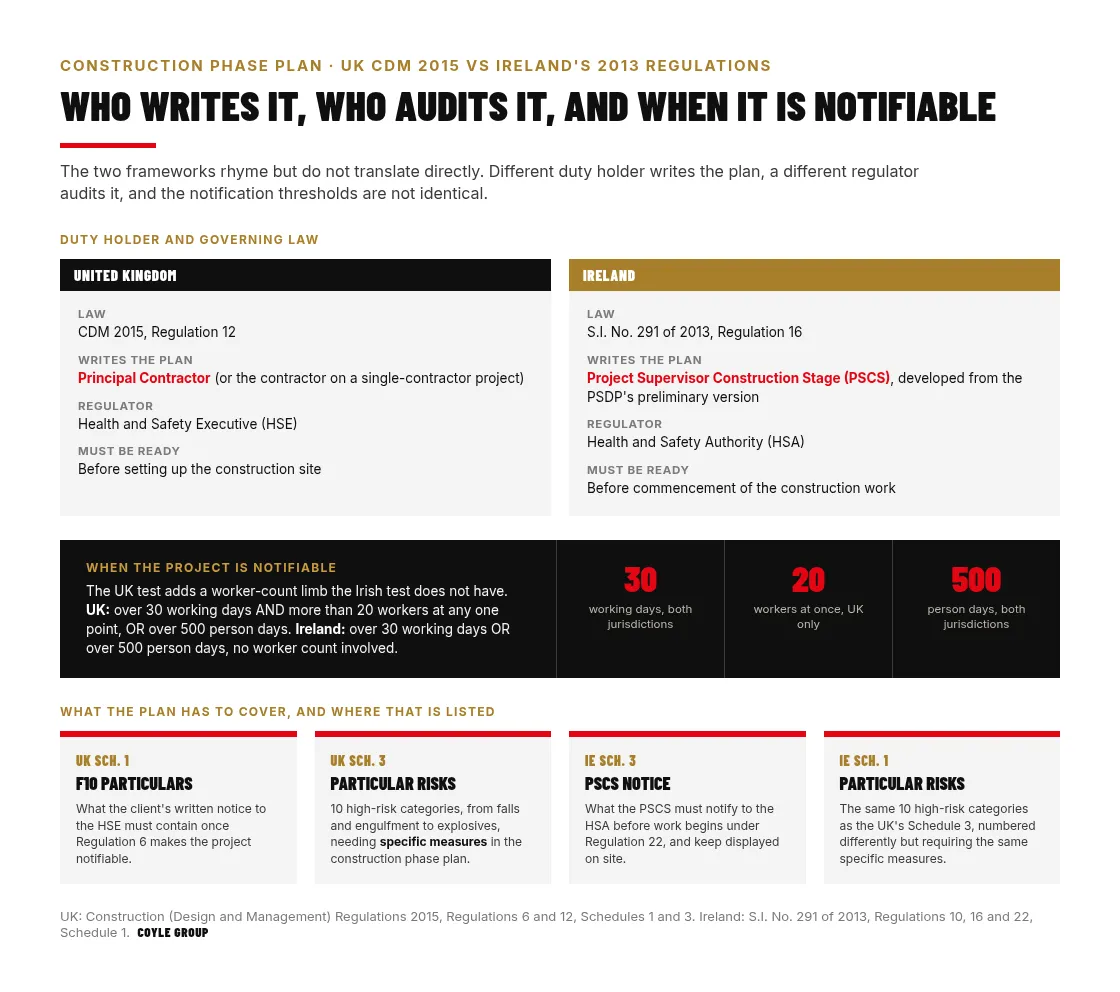
Regulation 6 of CDM 2015 makes a UK project notifiable where construction work is scheduled to last longer than 30 working days and have more than 20 workers working simultaneously at any point, or where the volume is scheduled to exceed 500 person days. Where either limb is met, the client gives written notice to the Health and Safety Executive, commonly called the F10 notification, as soon as is practicable before the construction phase begins. The notice contains the particulars listed in Schedule 1 and has to be displayed on site.
Ireland’s test, under Regulation 10 of the Construction Regulations 2013, drops the worker count entirely: a project is notifiable where work is planned to last longer than 30 working days or the volume is scheduled to exceed 500 person days. The client gives that notice to the Health and Safety Authority. A second, separate duty then falls on the PSCS under Regulation 22, which requires its own written notice before work begins, containing the particulars in Schedule 3, displayed on the construction site and kept current. Both jurisdictions require 2 separate notices, and the worker-count condition exists on only one side of the border.
What HSA and HSE Inspectors Actually Check
An inspector reading a construction phase plan is not grading the prose. They are checking whether the document still matches the site in front of them.
The questions that come up most often at audit are consistent across both jurisdictions. Has the plan been updated since the last significant change on site, or does it still read like the day the job mobilised? Does it include specific measures for every particular risk category that is actually present, rather than a boilerplate reference to Schedule 1 or Schedule 3 with nothing underneath it? Are the site rules written down and genuinely brought to the attention of every contractor, not just filed in an office drawer? And where a notice is required, is it the current version, displayed where a worker engaged in the work can actually read it?
We have found the same category of gap on a live Irish site before: a duplicate PSCS appointment that broke the statutory chain of accountability, resolved through a managed stakeholder process inside a week. The plan itself can be well written and still fail if the appointment underneath it was never valid.
The plan that never changed
The single most common finding on both sides of the border is a plan that has not moved since mobilisation. A construction programme changes constantly, new subcontractors arrive, sequencing shifts, a particular risk activity that was not scoped at tender turns up in month 4, and the plan has to track all of it. Regulation 12(4) in the UK and Regulation 16(b) in Ireland both put that obligation on the duty holder directly, and an inspector who finds a static plan against a visibly changed site treats it as a live finding, not a paperwork technicality.
The mismatched jurisdiction
The second recurring failure is a plan written against the wrong country’s Regulations, usually because a template or a previous project’s document was reused across the border without being rebuilt. The citations do not carry across: a UK plan that references Schedule 3 particular risks and the Principal Contractor will not satisfy an HSA inspector looking for Schedule 1 and a PSCS appointment, and the reverse is equally true. Our guide to writing a RAMS document covers the same cross-border citation trap in more detail, because it affects risk assessments and method statements just as much as the plan that sits above them.
Already mid-build and want a second opinion on the plan before the next inspection? Book a construction safety audit and we will test it against your actual site conditions, not a generic checklist.
Book a Construction Safety Audit
Getting the Plan Right for the Site You Are Actually On
A construction phase plan only works if it was written for the jurisdiction, the duty holder and the actual conditions on the site it covers. That means confirming early who owns the duty, UK Principal Contractor or Irish PSCS, checking which notification test applies and whether either threshold has been crossed, naming every particular risk category genuinely present rather than copying a Schedule reference, and treating the plan as a live document that changes every time the site does. The same discipline applies whether the build is a conventional site, an engineering fit-out, or a hyperscale data centre build, where the schedule pressure and the MEP density make an out-of-date plan even easier to miss.
We produce and review construction phase plans as part of our CDM advisory work in the UK and our PSCS advisory work in Ireland, chartered-authored for the jurisdiction the site actually sits in. If you want a plan tested against the regulations an inspector will actually quote, book a construction safety audit and we will start with the duty-holder chain.
Frequently Asked Questions (FAQs): Construction Phase Plans
These are the questions project directors and site managers ask us most often when a construction phase plan is due for an inspection on either side of the Irish Sea.
What is a construction phase plan?
A construction phase plan is the written document that sets out how health and safety will be managed while construction work is carried out on a site. In the UK it is defined by Regulation 12 of the Construction (Design and Management) Regulations 2015 and covers the health and safety arrangements, the site rules, and specific measures for any work in the Schedule 3 particular risk categories. Coyle Group produces and reviews construction phase plans for projects across Ireland and the UK.
Who writes the construction phase plan in the UK?
The Principal Contractor writes it, or the contractor directly where only one contractor is engaged. Regulation 12(1) of CDM 2015 requires the Principal Contractor to draw up the plan, or arrange for it to be drawn up, during the pre-construction phase and before setting up the construction site. The Principal Designer must hand over any pre-construction information that is relevant.
What is Ireland's equivalent of a UK construction phase plan called?
In Ireland the equivalent document is the safety and health plan for the construction stage, developed by the Project Supervisor Construction Stage (PSCS) under Regulation 16 of the Safety, Health and Welfare at Work (Construction) Regulations 2013. Coyle Group refers to it as the Construction Safety Plan in its PSCS guidance, matching how it is commonly described on Irish sites, though the Regulations themselves use the term safety and health plan.
When does a UK project need an F10 notification?
Regulation 6 of CDM 2015 makes a project notifiable, and triggers the F10 notification to the Health and Safety Executive, where construction work is scheduled to last longer than 30 working days and have more than 20 workers working simultaneously at any point, or where it is scheduled to exceed 500 person days. The client gives the notice, which must contain the Schedule 1 particulars, as soon as is practicable before the construction phase begins.
When is a project notifiable in Ireland?
Under Regulation 10 of the Construction Regulations 2013, a project is notifiable to the Health and Safety Authority where construction work is planned to last longer than 30 working days or the volume of work is scheduled to exceed 500 person days. Unlike the UK test, there is no separate worker count limb. The client gives this notice, and the PSCS gives a second, separate notice under Regulation 22 before work begins.
Does a construction phase plan have to be updated during the project?
Yes, in both jurisdictions. Regulation 12(4) of CDM 2015 requires the Principal Contractor to keep the plan appropriately reviewed, updated and revised throughout the project. Regulation 16(b) of the Irish Regulations requires the PSCS to adjust the plan to reflect the progress of the work and any changes. A plan that reads the same on the final day as it did on the first is the most common finding Coyle Group sees at audit.
Do construction projects that span Ireland and the UK need 2 separate plans?
Yes. The duty holder, the regulator, the notification test and the schedule numbers are different in each jurisdiction, so a single document cannot satisfy both sets of Regulations. Coyle Group prepares a jurisdiction-specific plan for each site rather than adapting one document, because the citations and the duty-holder chain do not carry across the border.