Construction Site Inspection Checklist (Ireland): 45 Items

A construction site inspection checklist is only as useful as the system behind it: who checks each item, how often, and what happens when something fails. Generic templates list conditions to glance at. A defensible construction site inspection checklist assigns every item to a competent person, a frequency and a closing date, so a finding becomes a tracked action rather than a line someone remembers to look at again next month.
We built the 45-item checklist below for tier-one contractors and engineering clients running sites in Ireland and Great Britain, grouped into 11 categories from site set-up through to the paperwork a PSCS or Principal Contractor has to keep current. Scaffolding and excavations carry a fixed statutory inspection interval on both sides of the Irish Sea. The remaining categories follow a risk-based schedule the site itself sets, and the table below shows both.
Want a chartered team to run this checklist against your actual site conditions rather than filling it in yourself? Book a construction safety audit and we will scope the visit on the first call.
Book a Construction Safety Audit
What a Construction Site Inspection Checklist Should Cover
The checklist below runs to 45 items across 11 categories, numbered straight through so every finding in a site report has its own reference. It covers everything from welfare facilities and housekeeping through to the safety and health plan a PSCS has to keep current, because a site that passes on work at height and fails on documentation is still not audit-ready.
| Category | Items | Item Numbers |
|---|---|---|
| 1. Site Set-Up and Welfare | 4 | 1 to 4 |
| 2. Access, Egress and Housekeeping | 4 | 5 to 8 |
| 3. Work at Height and Scaffolding | 5 | 9 to 13 |
| 4. Excavations | 4 | 14 to 17 |
| 5. Lifting Operations | 4 | 18 to 21 |
| 6. Plant and Vehicles | 4 | 22 to 25 |
| 7. Electrical and Temporary Supplies | 4 | 26 to 29 |
| 8. Hazardous Substances and COSHH | 4 | 30 to 33 |
| 9. Fire and Emergency | 4 | 34 to 37 |
| 10. PPE | 3 | 38 to 40 |
| 11. Documentation | 5 | 41 to 45 |
| Total | 45 | 1 to 45 |
Work through the 11 categories in order below, with scaffolding and excavations checked first because those 2 carry a fixed statutory inspection interval, and leave nothing unscored. If you want the full visit rather than the checklist on its own, our construction safety audit service runs this same construction site inspection checklist, scored and reported, across the whole site.
Who Inspects the Site, and How Often
A checklist only works if somebody owns each line and a frequency is attached to it. The table below sets out 8 representative categories from the full 45-item list, the competent person who signs each one off, how often it is due, and the regulation behind it in Ireland and in Great Britain.
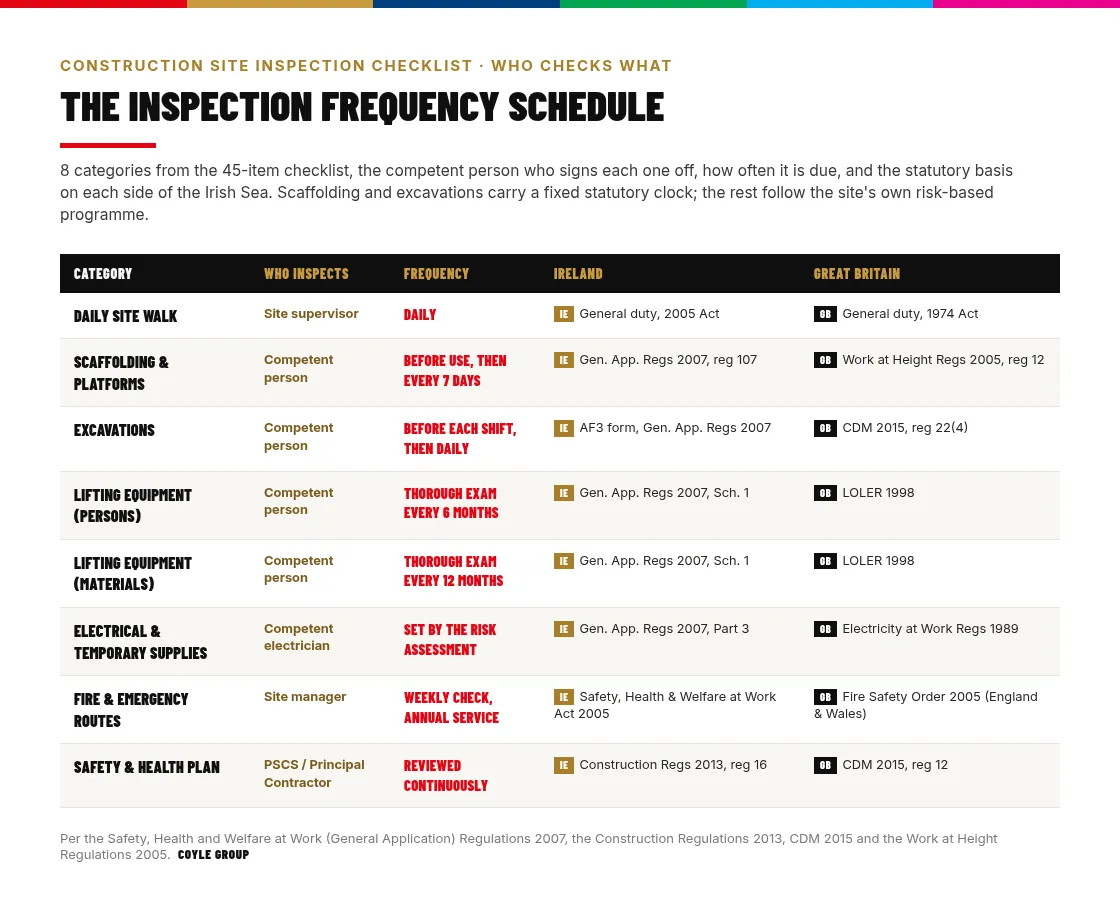
Scaffolding and excavations are the 2 categories with a hard statutory clock attached in both jurisdictions. Everything else on the schedule follows the site’s own risk assessment, which is why it needs a documented inspection programme to set the interval, rather than habit or memory.
Site Set-Up, Access and Welfare (Items 1 to 8)
Before any trade starts, the basics have to be confirmed in person on site, because tender drawings alone do not show what is actually there. The first 8 items cover the site compound, welfare facilities and the daily conditions that make a site either walkable or a hazard in its own right.
Site Set-Up and Welfare (Items 1 to 4)
- Site compound, hoarding and signage are in place and match the current phase of work.
- Welfare facilities, toilets, washing facilities, drinking water and a rest area, meet the headcount actually on site that day.
- Site induction records are complete and signed for every worker, contractor and visitor before they go beyond the gate.
- Emergency and first aid arrangements, a trained first aider, a stocked kit and a muster point, are current and known to the site team.
Access, Egress and Housekeeping (Items 5 to 8)
- Pedestrian routes are segregated from vehicle and plant movements and are kept clear of trip hazards.
- Material storage is tidy, stable and does not block an access route or a fire exit.
- Waste is segregated and removed at a sensible frequency rather than left to accumulate against a boundary fence.
- Lighting on walkways, stairs and working areas is adequate for the time of year and the hours being worked.
Most of these 8 items are visual checks a competent supervisor can complete on a daily walk, but each one still needs a dated record. A site that cannot produce last week’s housekeeping check has effectively never done one.
Work at Height, Scaffolding and Excavations (Items 9 to 17)
This is the category with the clearest statutory clock attached, in Ireland and in Great Britain alike. Scaffolding and excavations between them account for 9 of the 45 items, and both carry a fixed inspection interval rather than a judgement call left to the site team.
Work at Height and Scaffolding (Items 9 to 13)
- Every scaffold has a current inspection tag showing the date of its last check and the name of the competent person who carried it out.
- Guard rails, mid rails and toe boards are fitted to every edge where a fall of 2 metres or more is possible.
- Scaffolding is inspected before first use, after any event likely to affect its stability, and at least once every 7 days after that, in line with Ireland’s Safety, Health and Welfare at Work (General Application) Regulations 2007.
- Great Britain’s Work at Height Regulations 2005 set the same 7-day interval, so a site working across both jurisdictions cannot assume one inspection regime covers both.
- Ladders and stepladders in use are rated for the task, inspected before use and free of visible damage.
What Counts as a Competent Person for This Checklist
A competent person is defined by the task in front of them rather than by a fixed job title. It means someone with the training, knowledge and practical experience to judge the specific hazard being inspected, whether that is a scaffold tie, an excavation’s ground conditions or a lifting accessory’s wear. Ireland’s General Application Regulations 2007 and Great Britain’s equivalent duties both use this test, so a supervisor competent to inspect housekeeping can still need a specialist brought in to sign off a complex lift.
Excavations (Items 14 to 17)
- A competent person inspects every excavation before work begins at the start of each shift.
- Ireland’s Health and Safety Authority requires a daily inspection of any excavation where people are still working, recorded on an AF3 form.
- Great Britain’s CDM 2015 places the same before-each-shift duty on the competent person, and HSE’s excavation guidance adds a re-inspection after any event likely to affect stability, such as heavy rain or nearby plant movement.
- Shoring, battering or another support system is checked against the excavation’s actual depth and ground conditions on the day, because conditions tendered on paper can shift once the ground is opened up.
Both scaffolding and excavations are the categories most likely to drift out of compliance quietly, because the inspection tag or the AF3 form can lapse for weeks before anyone notices the gap. Building the interval into a site diary, rather than leaving it to a supervisor’s memory, is what keeps items 9 to 17 current.
Lifting Operations, Plant and Vehicles (Items 18 to 25)
Lifting equipment and site plant carry their own statutory examination cycle on top of the daily pre-use check a driver or operator completes, and the 2 are easy to conflate.
Lifting Operations (Items 18 to 21)
- A lift plan is in place for every lifting operation and is signed by a competent person before the lift starts.
- Lifting equipment used to lift or lower persons, and lifting accessories such as chains, slings and shackles, receive a thorough examination at least every 6 months.
- Other lifting machines used for materials only, including most cranes and hoists, receive a thorough examination at least every 12 months, under Schedule 1 of Ireland’s General Application Regulations 2007.
- Great Britain applies a matching 6 and 12-month cycle through the Lifting Operations and Lifting Equipment Regulations 1998, so a crane or hoist should carry proof of its last thorough examination regardless of which jurisdiction the site sits in.
Plant and Vehicles (Items 22 to 25)
- Every item of plant and every site vehicle has a documented daily pre-use check completed and signed before it moves.
- Reversing alarms, cameras and banksman arrangements are in place wherever plant operates near pedestrians.
- Defects found during a pre-use check are reported immediately, and the item is taken out of service until the defect is fixed.
- Operator competence cards and certificates are current and match the specific plant being operated that day.
Treat the 6 and 12-month lifting examination cycle as fixed and the daily plant check as the variable that actually changes week to week. A thorough examination certificate does not excuse a driver from the pre-use check on the days in between.
Electrical Supplies and Hazardous Substances (Items 26 to 33)
Temporary electrics and hazardous substances sit together here because both depend on a risk assessment the site reviews as conditions change, rather than a fixed statutory calendar like scaffolding carries.
Electrical and Temporary Supplies (Items 26 to 29)
- Temporary electrical distribution, cabling and site transformers are installed and inspected by a competent electrician.
- Portable appliances in use on site are tested at an interval set by the equipment’s risk category and use.
- Cable runs are routed and protected from vehicle movement, water and physical damage rather than left trailing across a walkway.
- Residual current devices are fitted and tested on every temporary supply used outdoors or in wet conditions.
Hazardous Substances and COSHH (Items 30 to 33)
- A COSHH assessment exists for every hazardous substance stored or used on site, and it is specific to the product and the task.
- Safety data sheets are on file and accessible to anyone using the substance, including on the working platform where the product is actually applied.
- Storage of flammable or hazardous substances meets the segregation and quantity limits set out in the assessment.
- Spill kits matched to the substances on site are in place, in date and known to the workforce.
Both categories fail most often on currency: a COSHH assessment or a portable appliance test that was correct 18 months ago but was never reviewed against what is actually on site now. Items 26 to 33 should be checked against the substances and equipment actually present on the day of inspection, because the original scope of works has usually moved on by the time of a site audit.
Fire, Emergency and PPE (Items 34 to 40)
Fire precautions and PPE are the categories most likely to look compliant at a glance and fail under closer questioning, because a fire extinguisher that is present still has to be in date to count.
Fire and Emergency (Items 34 to 37)
- Fire extinguishers are the correct type for the risk present, in date and accessible.
- An evacuation plan and muster point are displayed, current for the site’s layout, and known to every trade on site.
- Fire exits and escape routes are kept clear and are never used for material storage.
- A fire risk assessment is in place and reflects the current phase of work rather than the site’s condition at tender stage.
PPE (Items 38 to 40)
- The correct PPE for the task, including hard hat, hi-vis, safety boots and task-specific items such as eye or hearing protection, is being worn correctly by everyone on the task.
- PPE is in good condition, correctly fitted and replaced promptly when damaged.
- A record exists of PPE issued to each worker, so a missing item can be traced and replaced quickly.
Fire and PPE items are quick to check but easy to let slide once a site feels familiar to the people working on it. A weekly walk that includes extinguisher dates and PPE condition catches most of what an inspector would flag months later.
Documentation: Plans, Appointments and Permits (Items 41 to 45)
The last 5 items are paperwork, but they are the paperwork an inspector checks first, because a site that cannot produce them has already failed before anyone walks the floor.
Documentation (Items 41 to 45)
- The safety and health plan, called the construction phase plan in Great Britain, is current and reflects the site’s actual phase of work, as our construction phase plan article sets out in more detail.
- The PSCS appointment in Ireland, or the Principal Contractor and Principal Designer appointments in Great Britain, is documented in writing and was made before work started.
- Safe Pass cards in Ireland and CSCS cards in Great Britain are current for every worker on site and match the trade being carried out.
- Site-specific RAMS are in place for every significant task, reviewed and signed by the people actually doing the work, as our RAMS guide sets out.
- Permits to work cover hot works, confined space entry and any task that needs a sign-off beyond the RAMS itself, and an inspection register ties every statutory check above back to a single auditable record.
Already mid-build and want a second opinion before the next HSA or HSE visit? Book a construction safety audit and our chartered team will walk the site against this exact checklist.
Book a Construction Safety Audit
A site can pass every physical item on this checklist and still fail if item 42 is missing, because a duplicate or late PSCS appointment breaks the statutory chain the rest of the paperwork depends on.
Turning 45 Checklist Items Into a Repeatable Site Routine
A construction site inspection checklist only earns its name once it is run on a schedule, scored consistently and followed through to a closed-out action, rather than filled in once before a visit and left in a folder.
Run the 45 items on the frequency each category actually needs: daily for welfare and housekeeping, every 7 days for scaffolding, before each shift for excavations, and on the 6 or 12-month cycle for lifting equipment, and the checklist turns into a trend line rather than a one-off audit. Where a finding touches work at height or needs a wider gap analysis against the full regulatory picture, our audit checklist runs the same scoring method across all 71 points, covering every section beyond the 45 that are construction-specific. The same discipline applies on a conventional build, a hyperscale data centre fit-out, or a multi-contractor engineering project where the schedule pressure makes it easiest to let an inspection slip.
We run this exact checklist for tier-one contractors and engineering clients across Ireland and Great Britain, scored by a chartered team rather than self-marked. book a construction safety audit and we will tell you which of the 11 categories carries the most risk on your site before the next inspection does.
Frequently Asked Questions (FAQs): Construction Site Inspection Checklist
These are the questions project leads and site managers ask us most often when they are setting up an inspection regime for a new site in Ireland or Great Britain.
What is a construction site inspection checklist?
A construction site inspection checklist is a structured list of the conditions a competent person checks on site, covering welfare, access, work at height, excavations, lifting, electrics, fire and documentation. Coyle Group's version runs to 45 items across 11 categories, scored and dated rather than used as a generic tick list, so each finding carries a named owner and a date it has to be closed out by.
How often does a scaffold have to be inspected in Ireland?
Under the Safety, Health and Welfare at Work (General Application) Regulations 2007, a scaffold on an Irish site needs a competent person's inspection before it is first used, after any event likely to affect its stability, and at least once every 7 days after that. Great Britain's Work at Height Regulations 2005 set the same 7-day interval. Coyle Group treats this as a fixed statutory clock that the site team cannot adjust by its own judgement.
Who is allowed to carry out a statutory site inspection?
A statutory inspection has to be carried out by a competent person: someone with the training, knowledge and experience to identify the specific hazard being checked and judge whether the precautions in place are adequate. Coyle Group places chartered and competent safety officers on site specifically for this role, because a generic walk-round by an untrained supervisor does not meet the competent person test a regulator will apply at audit.
Does the same checklist work in Great Britain?
The categories stay the same, but the regulation behind each one changes. Scaffolding sits under the Work at Height Regulations 2005 in Great Britain rather than Ireland's General Application Regulations 2007, and excavations sit under CDM 2015 rather than the Irish construction rules. Coyle Group runs one inspection visit and attaches the citation that matches the jurisdiction the site actually sits in, rather than reusing an Irish form on a British project.
What happens if a finding from the checklist is not closed out?
An open finding stays live until it is fixed and verified, rather than until the next scheduled visit comes around. Coyle Group records every finding with a severity, a named owner and a target date, and treats an immediate risk to life as grounds to stop the task until it is resolved. A checklist that is filled in but never followed through does not protect the project or the people doing the work.
Does an inspection checklist replace a RAMS or method statement?
No. A RAMS or method statement sets out how a task will be done safely before it starts, while an inspection checklist checks whether the site still matches that plan once work is under way. Coyle Group treats the 2 as connected documents, so a finding that a scaffold has been altered without sign-off, for example, should send the team straight back to the RAMS that covers it.
How long should inspection records be kept?
Retention periods vary by document type, but as a practical minimum, Coyle Group recommends keeping inspection records, including scaffold and excavation registers, for the life of the project plus the statutory limitation period that applies to a personal injury claim. A complete audit trail of inspections is also the strongest evidence available if a regulator or an insurer later asks how a specific hazard was being managed on a given date.