Working at Heights Regulations: Ireland and UK Guide
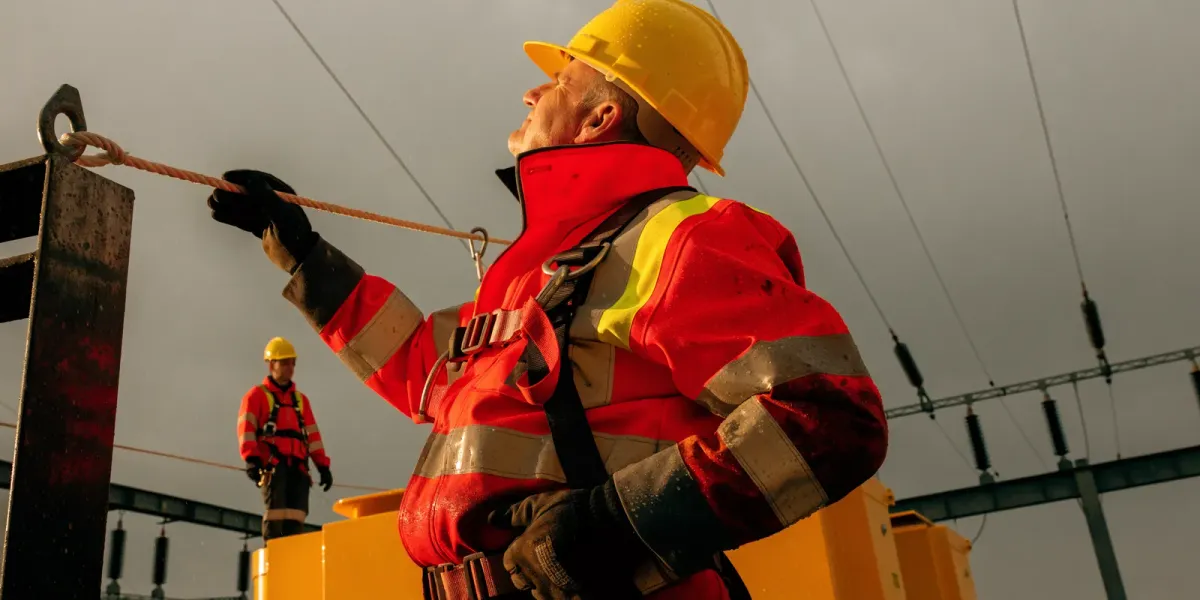
Working at heights regulations are enforced from 3 separate statutory instruments across Ireland, Great Britain and Northern Ireland, and the version that applies depends on where the work is, not where your company is registered. Cross-border programmes work under more than one rulebook for the same task. This guide maps all 3, regulation by regulation on the Irish side, and covers the rescue duty most method statements leave out.
Falls from height remain one of the largest single causes of workplace death in both jurisdictions. Our own work on this started with a fall: our founder was 18 and on a construction site when a young worker fell from height and died 2 days later. That event is why this company exists, and we treat the height regulations as an operational document rather than a filing requirement.
There Is No Minimum Height
A common misunderstanding on Irish and UK sites is that work under 2 metres is not work at height. It is, and the regulations are explicit.
Regulation 94 of the General Application Regulations 2007 defines work at height as work in any place, including a place reached in the course of obtaining access to or egress from it, other than by a staircase in a permanent place of work. No threshold appears anywhere in Part 4. The UK position is identical, and the HSE gives no minimum figure either.
The practical test
If a person can be injured by falling from where they are working, it is work at height. That covers a kick stool, an unguarded floor opening, the edge of an excavation, and the back of a flatbed.
The 2-metre figure people quote is a mix of older guidance and reporting thresholds. It has no bearing on whether the duties apply.
The Regulations That Apply in Ireland
Part 4 of the Safety, Health and Welfare at Work (General Application) Regulations 2007 (S.I. No. 299 of 2007) is headed WORK AT HEIGHT and runs from Regulation 94 to Regulation 119. It absorbed the earlier standalone Safety, Health and Welfare at Work (Work at Height) Regulations 2006 (S.I. No. 318 of 2006), which is why the 2006 instrument still ranks in search results and still gets cited in older method statements. Part 4 and Schedule 5 retranspose EU Directive 2001/45/EC.
Below is the whole of Part 4, with each regulation as it is headed in the instrument. Use these citations so a reviewer can locate the regulation quickly.
| Reg | Heading | What it governs in practice |
|---|---|---|
| 94 | Interpretation for Part 4 | The definition of work at height, with no minimum height |
| 95 | Organisation, planning and risk assessment | The duty to plan the work before it starts |
| 96 | Checking of places of work at height | Confirming a place is safe before anyone uses it |
| 97 | Weather conditions | Not proceeding when the weather makes the work unsafe |
| 98 | Avoidance of risks from work at height | Tier 1: do the work from the ground where you can |
| 99 | Protection of places of work at height | Making the workplace itself safe |
| 100 | Selection of work equipment for work at height | Choosing the right platform, MEWP, tower or ladder |
| 101 | Condition of surfaces for supporting structures | What the equipment stands on |
| 102 | Stability of supporting structure | Keeping it upright and loaded correctly |
| 103 | Guard-rails, toe-boards, barriers, etc. | The primary collective fall prevention measures |
| 104 | Stability of working platforms | Platform integrity under load and movement |
| 105 | Safety on working platforms | Working practice once a platform is in use |
| 106 | Loading of working platform and supporting structures | Not overloading the platform |
| 107 | Scaffolding, additional requirements | Erection, alteration, dismantling and inspection |
| 108 | Collective safeguards for arresting falls | Nets and airbags before personal systems |
| 109 | Personal fall protection systems | Harness-based systems and their anchorages |
| 110 | Work positioning systems | Systems that support a worker in position |
| 111 | Rope access or positioning technique | Rope access work, including IRATA-type operations |
| 112 | Fall arrest systems | Arresting a fall in progress |
| 113 | Work restraint systems | Preventing the worker reaching the fall edge |
| 114 | Ladders | When a ladder is the appropriate selection |
| 115 | Fragile surfaces | Roof lights, asbestos sheeting, cement roofs |
| 116 | Falling objects | Protecting people below the work |
| 117 | Danger areas | Excluding people from the zone at risk |
| 119 | Inspection of work equipment | Inspection regime and records |
The Regulations That Apply in the UK and Northern Ireland
In Great Britain the Work at Height Regulations 2005 came into force on 6 April 2005. The HSE states that their purpose is to prevent death and injury caused by a fall from height, and that they apply to employers and to anyone who controls work at height. The second category covers facilities managers and building owners who contract others to work at height, since they carry duties under the Regulations even though they are not the employer on site.
The core requirements are that work at height is properly planned, appropriately supervised and carried out by competent people, that the right equipment is used, and that risks are assessed first. Lower-risk, straightforward tasks require proportionately less planning effort. Employees carry their own duties to take reasonable care and to co-operate with their employer. HSE’s brief guide (INDG401) is the plain-English summary worth handing to supervisors.
Northern Ireland runs a parallel instrument, the Work at Height Regulations (Northern Ireland) 2005, enforced by HSENI. The duties are materially the same. The citation differs across the 3 jurisdictions, so a cross-border project needs the citation block swapped per site rather than a single set of references applied everywhere.
Avoid, Prevent, Minimise
Every one of the 3 regimes works down the same hierarchy, in order. You only move to the next tier once the one above it has been ruled out for the task in front of you.
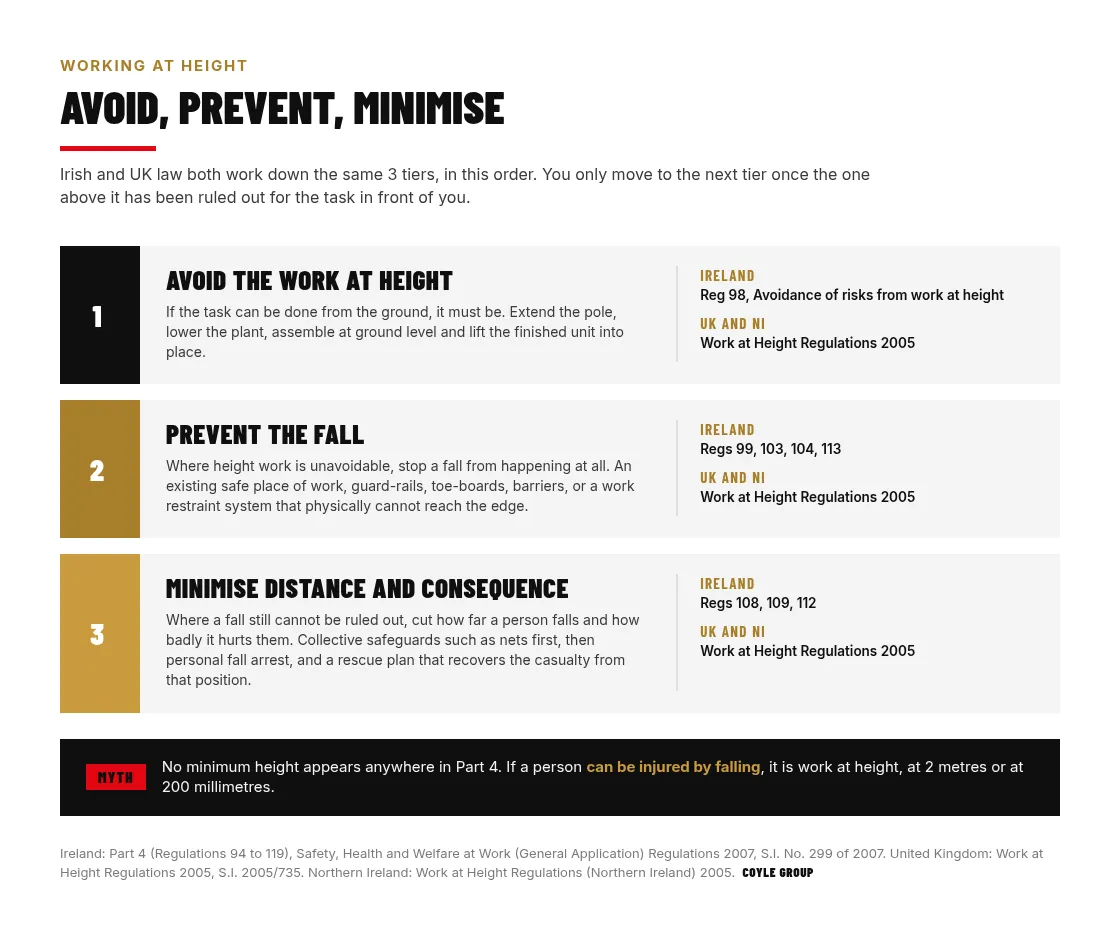
Regulation 98, “Avoidance of risks from work at height”, opens by requiring the employer to take account of the general principles of prevention in Schedule 3 to the Safety, Health and Welfare at Work Act 2005. That is the statutory basis for the hierarchy: the top tier has to be considered and ruled out before the next tier applies.
- Avoid. Extend the pole, lower the plant, assemble at ground level and lift the finished unit into place. Most height work that gets eliminated is eliminated at design stage, and the duty sits heaviest on whoever plans the job.
- Prevent. Where the work has to happen at height, stop the fall occurring. An existing safe place of work, guard-rails and toe-boards under Regulation 103, or a work restraint system under Regulation 113 that physically cannot reach the edge.
- Minimise. Where a fall still cannot be ruled out, cut the distance and the consequences. Collective safeguards under Regulation 108 come before personal systems under Regulation 109, and fall arrest under Regulation 112 is the last line rather than the default.
Harness-first design is the most common failure we see. A harness sits at the bottom of the hierarchy and only works if somebody can get the casualty down.
Rescue Is Part of the Plan
Rescue is the duty most method statements leave out, and the one we flag most often on review.
A fall arrest system arrests the fall and leaves a conscious or unconscious person suspended in a harness. Suspension can become life-threatening in minutes, well inside typical ambulance response times. A plan that ends at “call the emergency services” is not a rescue plan.
A usable plan names 3 things:
- The recovery method for that specific position.
- The equipment held on site to execute it.
- The people trained and rostered to do it.
If your RAMS carries a harness in the controls section and nothing in the rescue section, the pack is incomplete. Our RAMS template guide treats rescue arrangements as one of the 6 fields no template can fill in, for exactly this reason.
What We Changed on the HV Transformers
In 2017 one of our consultants was working on a customer’s high-voltage network in Ireland and observed network technicians working on HV transformers without adequate fall protection. That is a breach of the Safety, Health and Welfare at Work (General Applications) Regulations 2007, Part 4, Work at Heights, and it was happening as routine practice rather than as a one-off.
He joined the customer’s HV station working group, piloted a temporary horizontal lifeline anchored to the existing lifting eyes on the transformer housings, built the rescue plan to go with it, and drafted a national working procedure covering the method. The lifelines were deployed across the network nationwide, the rescue plan went in with them, and the procedure was approved and rolled out as standard. The transformer case study records the sequence.
Two things in that account matter more than the outcome. The anchorage used equipment already on the asset, which made national rollout affordable. And the rescue plan was built at the same time as the lifeline, not bolted on afterwards.
Where Height Duties Break on Live Projects
Regulations are more often breached by schedule pressure than by ignorance. In 2017 one of our Safety Officers on a wind construction project in Finland found a telehandler being used to lift 12.5te ballast trays against a 12te working load limit. The machine tipped forward when the load went dynamic. He stopped the work, held a safety time-out, and traced the root cause to speed being prioritised over the agreed plan, which had specified the rigging crane. The original plan was reinstated, the client issued a company-wide Safety Alert, and the project still finished on time. The Finland case study has the full account.
The recurring failures we find on height work are consistent across sectors:
- Equipment selected for availability rather than for the task, usually a ladder or a tower where a MEWP was specified.
- Anchorage points assumed rather than verified, with no rated capacity on record.
- Scaffolding altered by a following trade and not re-inspected before reuse.
- Fragile surfaces under Regulation 115 treated as walkable, particularly older cement roof sheeting.
- The exclusion zone below the work opened up to let another crew through.
- A rescue plan that names the emergency services and nothing else.
Height exposure concentrates in specific asset classes. Turbine nacelle, hub and tower work is covered on our wind energy page, and overhead line, gantry and substation work on our utilities and electric page.
Inspection, Records and the Paperwork That Proves It
The height regulations are heavy on evidence because the controls are physical and their condition changes.
Regulation 119 covers inspection of work equipment used for work at height. Regulation 107 adds specific requirements for scaffolding, so re-inspection matters after any alteration and at handover. Regulation 114 governs ladder selection, and Regulation 115 covers fragile surfaces. Personal fall protection needs a pre-use check by the user every time it goes on, plus a periodic detailed examination by a competent person.
Keep the records with the RAMS rather than in a separate system. Where the same hazards recur across a programme, carry the residual ratings into a risk register so an inspector can see the trend rather than a stack of individual assessments. If you are building the pack from scratch, our RAMS guide sets out how the risk assessment and method statement fit together, and the safe systems of work guide covers the wider cycle the paperwork sits inside.
Getting Height Work Signed Off Properly
Reading the regulations is straightforward. Applying them to a live asset with a schedule attached is where projects come unstuck, and that is the part we do.
Coyle Group has delivered over 1 million hours of safety work across wind, utilities, construction and data centre programmes, and our height work has produced procedures that customers adopted nationally. If you need a height-trained safety officer on site, we place industry-specific specialists and can have someone mobilised within 48 hours. If you need the method, the Lift Plan or the rescue arrangements developed and signed by a chartered practitioner, talk to us about compliance support.
Frequently Asked Questions (FAQs): Working at Height
These are the questions site supervisors and HSE managers put to our consultants most often, particularly on projects that run across the Republic, Northern Ireland and Britain at the same time.
What height is considered working at height?
There is no minimum height in Irish or UK law. Regulation 94 of the General Application Regulations 2007 defines work at height as work in any place, including a place reached in the course of obtaining access or egress, other than by a staircase in a permanent place of work. The practical test is whether a person could be injured by falling from where they are working. That includes standing on a kick stool, working beside an unguarded opening in a floor, and working next to an excavation. The 2-metre figure people quote comes from older guidance and reporting thresholds, not from the current regulations.
What are the working at heights regulations in Ireland?
Part 4 of the Safety, Health and Welfare at Work (General Application) Regulations 2007 (S.I. No. 299 of 2007) is headed Work at Height and runs from Regulation 94 to Regulation 119. It replaced the standalone Safety, Health and Welfare at Work (Work at Height) Regulations 2006 (S.I. No. 318 of 2006), which is why the older instrument still turns up in search results. Part 4 and Schedule 5 retranspose EU Directive 2001/45/EC on the use of work equipment for work at height.
Which regulations apply in the UK and Northern Ireland?
In Great Britain, the Work at Height Regulations 2005 (S.I. 2005/735) came into force on 6 April 2005. The HSE states they apply to employers and to anyone who controls work at height, which expressly includes facilities managers and building owners who contract others to work at height. Northern Ireland has its own parallel instrument, the Work at Height Regulations (Northern Ireland) 2005, enforced by HSENI. The substantive duties are materially the same across all 3 jurisdictions.
Are ladders still allowed under the regulations?
Yes. Ladders were never banned, and Regulation 114 of the Irish General Application Regulations deals with them directly. What the regulations require is that a ladder is the appropriate choice for that task, which usually means short-duration, low-risk work where setting up a platform would not be reasonable. If a crew is on a ladder for an hour with both hands occupied, the equipment selection is wrong, not the ladder itself.
Is a rescue plan legally required for work at height?
In substance, yes. Where you rely on personal fall protection, the arrangements have to include how a fallen person is recovered, because a harness that arrests a fall leaves a casualty suspended. Suspension trauma can become life-threatening within minutes, well inside any emergency service response time. Calling 999 and waiting is not a rescue plan. The plan has to name the recovery method, the equipment held on site, and who is trained to use it.
Who is competent to supervise work at height?
The regulations require work at height to be properly planned, appropriately supervised and carried out by competent people. Competence means training, knowledge and experience matched to the specific work, not a generic certificate. On higher-consequence height work such as HV structures, turbines and scaffolding handover, we place safety officers who hold current height and rescue competencies and who have worked that class of asset before.
How often must fall protection equipment be inspected?
Regulation 119 of the General Application Regulations covers inspection of work equipment used for work at height, and scaffolding carries additional requirements under Regulation 107. Personal fall protection also needs a pre-use check by the user every time and a periodic detailed examination by a competent person, at the interval set by the manufacturer and your risk assessment. Keep the records, because the inspection you cannot evidence is the one an inspector treats as not having happened.