Roles and Responsibilities of a Safety Engineer

A person performing the role of safety engineer has typically received formal education or specific training in occupational safety. As it occurs today, design engineers can complete college or university without taking a single health or safety course. In fact, it has been argued by management professionals trying to fill health and safety positions that a stronger focus is too often centred on maths courses such as calculus, and not enough on business management and international safety.
Functions of a Safety Engineer
The function of a safety engineer is significant, and the stakes are easiest to see in three points:
- When the job is done properly, few people notice.
- When a defect slips through uncorrected before implementation, the bungled results are on display for everyone to critique.
- Those complications can result in injury or death, either for the associates who do the work or the consumers who depend on an error-free job.
A capable safety engineer will most positively affect their environments through steps taken during the design process. Look at the Bic pen cap. International safety standards required companies to minimise the potential of choking hazards. People put the cap in their mouth to chew on, as a sort of compulsion. They hold it with their teeth to multi-task, and remove the cap with their teeth so they can function quickly and effortlessly. Inadvertently, a percentage of the users would swallow the cap. By redesigning the caps with an opening in the tip, as opposed to the closed end, a staple in the design process from its inception, the company is now compliant with international safety standards, and people’s lives have less likelihood of danger from this device.
A Safety Engineer’s 5-Step Design Process
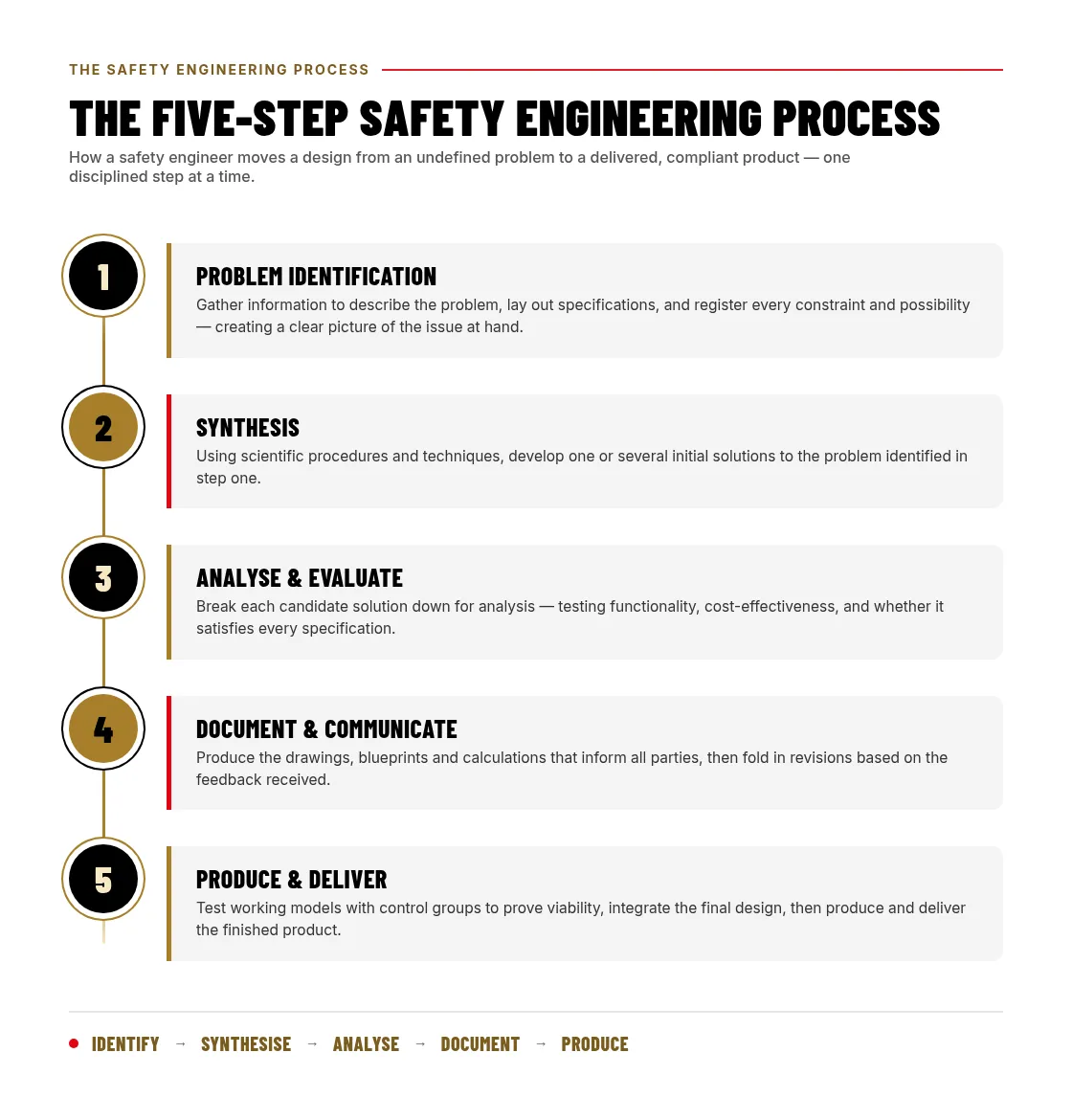
A trusted safety engineer will adopt 5 steps to achieve the goals set before them. The process turns a loose safety concern into a specified, tested control that other engineers can build to. It runs from the first description of the problem through to a delivered design, with review and feedback built into every stage. Each step feeds the next, so a weak problem definition at the start shows up as a poor control at the end.
-
Problem Identification: the engineer will gather information to properly describe the problem or situation. Specifications will be laid out. Constraints and possibilities will be registered, creating a clear description of the issue at hand.
-
Synthesis: the engineer will, through scientific procedures and techniques, develop initial solutions for the problem that was identified in step one. From here, one or several solutions will be considered.
-
Analyse and Evaluate: each solution from the synthesis step will be broken down for scientific analysis and specific evaluation. The overall outcome will address functionality, whether it is economical, and whether it satisfies all specifications.
-
Document and Communicate: this will include all drawings, blueprints and calculations to fully inform all parties participating. This will be reciprocated with revisions based in part on the feedback that is received.
-
Produce and Deliver: working models are developed and tested on control groups to ascertain viability. Final designs are integrated into what will become the final product. This will then be produced and delivered.
Importance of a Safety Engineer
Candidates most likely to work with, or develop into, a safety engineer role are chemical engineers, environmental engineers, design engineers or industrial engineers. This type of well-rounded attack on a common problem yields great results for everyone associated. The safety engineer plays a vital role in making our world a safe place for everyone to coexist in. Through incompetence or lack of understanding, they can cause insurmountable damage to people and things. With proper support and education, though, they will help in meeting compliance within systems and ergonomically fashion apparatus to meet the user’s needs.
Day to Day Duties of a Safety Engineer
The role is more hands-on than the design examples suggest. On a typical week a safety engineer will:
- Run hazard identification workshops and risk assessments on new and modified designs.
- Review drawings, specifications and method statements against relevant standards.
- Specify guarding, interlocks, ventilation and other engineering controls.
- Investigate incidents and near misses, then close the loop with design changes.
- Produce and maintain safety documentation, from HAZOP records to residual risk registers.
- Advise project teams on how a decision made now will affect the people who build, operate and maintain the asset later.
Much of this overlaps with the broader safety profession, so it is worth reading our guide to the best safety jobs to see where the engineer sits alongside advisors, coordinators and managers.
How to Become a Safety Engineer
There is no single route in. Two paths dominate in the UK and Ireland:
- The engineering route. Complete a degree in mechanical, chemical, electrical or civil engineering, then add safety competence through a NEBOSH National General Certificate or National Diploma. This suits people who already think in terms of design and controls.
- The safety route. Build a grounding in occupational safety, gain site experience, then specialise in design and process risk. IOSH membership and, in time, Chartered status (CMIOSH) signal that competence to employers.
Either way, sector work adds its own tickets. Construction roles often expect CDM knowledge, process industries want HAZOP and functional-safety training, and energy or nuclear employers look for sector inductions on top. If you are weighing up which qualification to start with, our advice on choosing a course walks through the options.
Safety Engineer Salary in the UK
Pay varies by sector, experience and whether the role is permanent or contract. As a rough guide:
- Junior or graduate safety engineer: around £35,000 to £42,000.
- Experienced safety engineer: around £45,000 to £55,000.
- Senior or principal safety engineer: £60,000 and above, higher again in process, offshore and nuclear work.
Contract day rates typically sit above the equivalent salaried figure, which is one reason many experienced engineers move into contract work.
Why the safety engineer role earns its keep
A safety engineer earns their keep long before anything goes wrong, by designing risk out of products, plant and processes at the stage where it is cheapest to fix. The five-step process, the mix of engineering and safety qualifications, and the £35,000 to £60,000 pay range all point to the same thing: this is a technical discipline that rewards competence and carries real responsibility for the people who build, operate and maintain an asset for years.
Whether you are weighing up the role as a career move or building a team that needs one, the value lies in getting the right person into the design conversation early, while decisions can still be changed on paper rather than on site.
If you are hiring for one of these roles, our HSE recruitment team places safety engineers across construction and energy, and our guide to health and safety recruitment covers what to screen for.
Frequently Asked Questions
What does a safety engineer do?
A safety engineer designs out risk before a product, plant or process reaches the workplace. Day to day that means running hazard identification and risk assessments, reviewing designs against safety standards, investigating incidents, and specifying controls so equipment and systems can be operated without harm.
What qualifications does a safety engineer need?
Most UK safety engineers hold an engineering degree or a recognised safety qualification such as the NEBOSH National Diploma, often backed by IOSH membership. Chartered status (CMIOSH) and CEng are common for senior roles, and sector work like construction or energy may add CDM or process-safety training.
How much does a safety engineer earn in the UK?
Pay commonly runs from around £35,000 for a junior safety engineer to £55,000 to £60,000 for an experienced one. Specialist process, nuclear and offshore roles can pay more, and contract day rates often sit above the equivalent salaried figure.
Is safety engineering a good career?
Safety engineering is a steady and well-paid career for people who enjoy solving design problems and reducing risk. Demand holds up across construction, energy, manufacturing and process industries, and the £35,000 to £60,000 pay range rewards competence. The work carries real responsibility, since good design decisions protect the people who build, operate and maintain an asset for years.
What is the difference between a safety engineer and a safety officer?
A safety engineer designs risk out of products, plant and processes, working mainly at the design and specification stage. A safety officer or health and safety advisor focuses on managing risk in day to day operations, such as inspections, training and compliance on site. The engineer shapes what gets built, while the officer keeps the workplace running safely once it is in use.
How do you become a safety engineer in the UK?
There are 2 common routes. You can complete an engineering degree and then add safety competence through a NEBOSH National General Certificate or National Diploma, or you can build a grounding in occupational safety, gain site experience and then specialise in design and process risk. IOSH membership and, in time, Chartered status such as CMIOSH signal that competence to employers.
What skills does a safety engineer need?
A safety engineer needs a solid grasp of engineering principles alongside knowledge of safety standards and risk assessment methods such as HAZOP. Strong analytical skills matter for evaluating designs, and clear communication is essential for documenting decisions and advising project teams. Sector knowledge, for example CDM in construction or functional safety in process work, adds further value.