Health and Safety Recruitment: A 6-Point Hiring Checklist

Employers today have so many other factors to deal with than their predecessors did in years past, before laws and bodies were created to implement and enforce health and safety in the workplace. The Health and Safety at Work etc. Act 1974, the HSE in Great Britain, the HSA in Ireland and pan-European networks such as ENETOSH, to name a few, came into being to standardise practice and identify common goals for their respective populations, and to reinforce one another to ensure a safer workforce. For this reason, recruiting the right person with specific health and safety experience for your organisation is of the utmost importance.
Health and safety recruitment today takes on a larger role, and with a newer set of expectations than it had in the past. The most common tasks identified by today’s professionals start with risk assessment.
The ability to create, follow up and document risk assessment is likely the most important function safety teams deal with on a daily basis. When considering health and safety recruitment, applicants are expected to understand and have background experience in performing cost benefit analysis and training of associates.
Education and Certification
Employers actively looking into health and safety recruitment for their companies have several avenues to explore for competencies. Online accreditations, and courses through government agencies, are available for students in primary school, university and business, by way of continuing education and certifications, and it is worth understanding what each safety qualification actually certifies before you set it as a requirement.
Qualification Is Not the Same as Competence
The HSE’s guidance on competence is a useful corrective here, because it defines competence as the combination of training, skills, experience and knowledge needed to apply all of it to a particular task. A certificate on its own does not meet that definition, which is why the checklist below separates qualification from competence.
Where Degree-Level Competence Matters
Specialty positions are the exception to the certificate route, so recruiters need to look at undergraduate and advanced degree recipients to fill them:
- Engineers. Industrial, design, chemical and mechanical backgrounds through to safety engineers all need to show competencies in design and controls.
- Industrial hygienists. Expected to show that they understand the effects on humans from environmental factors, the stress caused by these factors, and ultimately how to apply methods to reduce and eliminate those factors when possible.
The practical upshot is to treat the qualification as a floor and evidence of applied experience as the real test. A shortlist filtered on certificates alone will pass people who have never written a risk assessment that changed anything.
Health and Safety Recruitment Expectations
What type of person fits into the mould that most health and safety recruiters are looking for? Beyond the qualifications above, the ideal safety professional is expected to:
- Communicate openly and consistently with the management team.
- Promote high standards of health and safety for all, and deal with human error factors.
- Keep policy current and in place, and build a safety team around it.
- Bring working knowledge of musculoskeletal disorders and proficiency in record retention.
- Carry out inspection and investigation activities.
- Build rapport easily, because they will be training new employees and retraining tenured associates alike.
- Act as a point of contact for employees, and in some cases customers, vendors and health care providers, while serving as liaison to government and regulatory agencies.
That is a broad brief, and it explains why the strongest technical candidate is not always the right hire. Almost every duty listed above is discharged through other people.
Expectations of the Candidate
As with everything, a health and safety professional arrives with concerns and expectations of their own. Four come up more than any others:
- A competitive pay scale. Depending on the level of education, an early-career professional in Ireland will look to earn from about €27,000 up to around €47,000, with UK equivalents running from roughly £24,000 to £40,000. These are starting salaries, and more seasoned professionals will look to earn more, with experienced advisors and managers commonly reaching £45,000 to £65,000 or higher.
- Training that is genuinely theirs. Surveys consistently tell us that the greatest expectation aside from pay is training, especially training specific to their own ongoing education as well as that of the associates.
- The buy-in of management. Support for inspections and other remediation is an important consideration for the prospective hire, because without it the role becomes advisory in name only.
- A mandate to drive safety culture. Candidates want to hit the ground running on culture, so be sure the person you are considering bringing on board has a plan for making that happen.
If you are hiring into Ireland, read the HSA’s managing safety guidance alongside the HSE material, because the duties a candidate is expected to discharge are set out differently either side of the border and the role definition should reflect the jurisdiction the work sits in.
What management expects from its associates at all levels, and their own adoption of health and safety standards, is ultimately what drives the results. The person you hire can lead that work, but cannot carry it alone.
A Hiring Checklist for Safety Recruitment
Before you shortlist, get clear on what good looks like for the role in front of you. Work through these six in order, because most bad safety hires are not interview failures, they are definition failures.
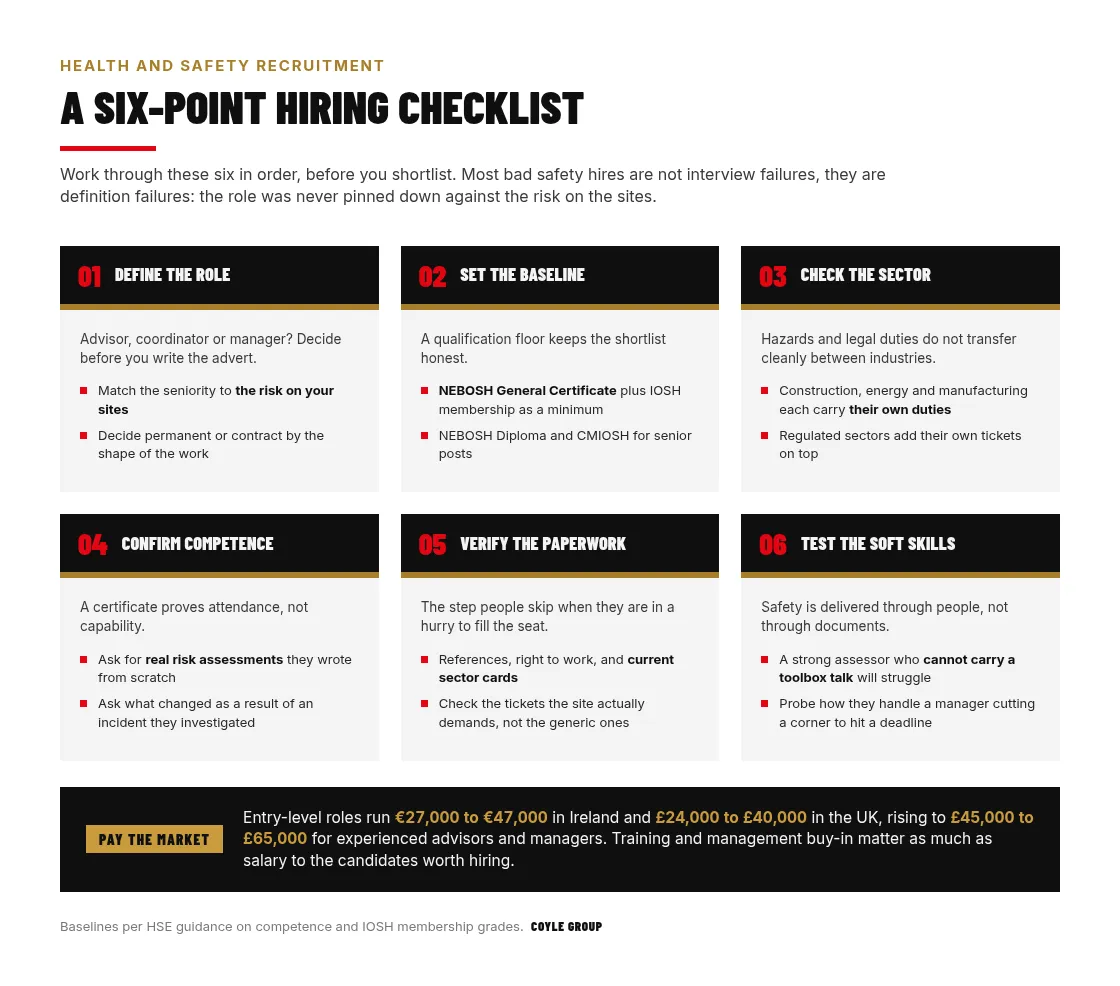
- Define the role first. Is this an advisor, a coordinator or a manager? Match the seniority to the risk on your sites.
- Set the qualification baseline. NEBOSH National General Certificate and IOSH membership as a minimum; NEBOSH Diploma and CMIOSH for senior posts.
- Check sector experience. Construction, energy or manufacturing each carry their own hazards and legal duties.
- Confirm competence, not just certificates. Ask for real examples of risk assessments written and incidents investigated.
- Verify the paperwork. References, right to work, and any sector cards or tickets the site demands.
- Test the soft skills. The best safety hires influence people; a strong assessor who cannot carry a toolbox talk will struggle.
It also helps to know what the candidate sitting opposite you is weighing up. Our rundown of the best safety jobs and what they pay is the same market intelligence your shortlist is working from.
Interview Questions Worth Asking
The right questions surface competence quickly. A few that consistently earn their place:
- Walk me through a risk assessment you wrote from scratch. What did you change as a result?
- Tell me about an incident you investigated. What was the root cause, and how did you close it out?
- How would you handle a manager who wants to cut a corner to hit a deadline?
- Which regulations apply to our type of work, and how do you keep current with changes?
- How do you get buy-in from a workforce that sees safety as a hindrance?
Listen for specifics rather than for confidence. A candidate who can name the assessment they wrote, the change it produced and the manager who pushed back is telling you something no certificate can.
Getting the Safety Hire Right
Definition is where safety recruitment is won or lost. The six checklist points, the five questions above and a realistic salary band all sit downstream of one decision: what this role is actually accountable for on your sites. Get that wrong and no amount of screening rescues it.
So treat the qualification as the floor, evidence of applied experience as the real test, and the soft skills as the thing that decides whether any of it lands with your workforce. Hire for competence rather than for certificates and the rest of the process gets easier.
When the role will not wait for a three-month search, we can move faster than that. Hire a safety officer in 48 hours and the person who reaches your interview room has already been screened against every point on the checklist above.
Frequently Asked Questions
What qualifications should we look for when hiring a safety professional?
The site-based baseline is a NEBOSH General or Construction Certificate plus current CSCS or Safe Pass. Roles carrying more accountability expect an IOSH-graded professional (TechIOSH, GradIOSH, working toward CMIOSH). Regulated sectors (wind, utilities, offshore) add their own tickets on top, and a chartered adviser (CMIOSH) is normal for senior appointments.
What does a safety officer earn in Ireland and the UK?
Entry-level safety roles in Ireland typically pay between €27,000 and €47,000, moving to €55,000 to €80,000 with 5 to 10 years' experience and a chartered qualification. UK ranges usually sit between £24,000 and £40,000 at entry, rising to £45,000 to £75,000 for experienced managers, with senior HSE Directors in tier-one contractors well above that.
Do we need a permanent safety officer or a contractor?
Permanent hires make sense for steady-state operational safety and long-term culture-building. Contract or interim safety officers are the better fit for project-shaped work: a construction programme, wind farm build-out, utility outage, or a peak the business will not sustain a full-time hire past. Getting the shape right saves both cost and continuity.
Should we use a health and safety recruitment agency or hire direct?
Hire direct when the role is permanent, the risk profile is stable and you have a competent person able to assess candidates properly. Use a specialist agency when the site cannot wait out a 3 month search, when the role is a fixed-term or contract post, or when nobody internally can tell a genuine competence claim from a certificate. The cost of a bad safety hire is usually larger than the fee.
What is the difference between a safety advisor and a safety manager?
An advisor works at site level: running risk assessments and audits, advising managers and owning specific outcomes. A manager owns the safety function itself, sets the strategy, carries the budget and leads the team. UK salary bands reflect the gap, with advisors commonly at 30,000 to 45,000 pounds and managers at 45,000 to 65,000 pounds and above.
How do you check a safety candidate is actually competent?
The HSE defines competence as training, skills, experience and knowledge combined with the ability to apply them, which a certificate on its own does not demonstrate. Ask for specific risk assessments the candidate wrote and what changed as a result, and for an incident they investigated end to end including the root cause and how they closed it out. Vague answers to those 2 questions are the reliable signal.