Common Safety Compliance Challenges for New Employers

If you are starting your own business, one of the most important parts of your responsibilities is doing your due diligence to get health and safety protocols right. Firstly, to ensure the safety of your employees and customers. Secondly, to make certain that you are abiding by the law. And finally, for the self-assurance that in the event of a safety incident happening, everyone knows how to manage it in the best way.
In this article we shall look at the five most common safety compliance issues that new businesses face and later how to overcome them, to help you prevent incidents that could potentially cost your starting business money and months of lost productivity.
5 Safety Compliance Challenges New Employers Face When Starting Out
Most of these hurdles show up in the first year, before you have any track record to lean on and while your systems are still taking shape. Recognising them early lets you build the right habits from day one rather than reacting after something goes wrong. Here are the 5 challenges we see most often with new employers.
Challenge #1: Identifying Risks and Hazards
For new businesses, often the biggest challenge is being unable to immediately identify all the risks in the workplace. Granted, you will find some risks remain fixed over time, such as in the handling of equipment. But as the business grows and expands, the changing work environment presents new risks, and existing risks change in nature.
A business that does not effectively manage to identify risks early enough in its initiation runs a risk of staying caught in a perpetual loop of playing catch-up to safety protocols, which is costly, time consuming and a dangerous way to operate.
Challenge #2: Investigating Workplace Incidents
In industries with the highest risk, workers are usually required to perform repetitive motions. Without prior tracking information of hazards and near-misses, along with previous incidents and injuries, safety investigations become difficult since such systems are often still nonexistent at the start.
Challenge #3: Lack of Knowledge on Safety Laws and Regulations
As a new business owner or safety professional, it might be overwhelming to understand all the often-complicated safety laws and regulations enforced by the HSE in Great Britain and the HSA in Ireland, let alone keep up with them. They are constantly changing and evolving to create safer workplaces. This creates a knowledge gap that may lead to non-compliance, whose consequences can be quite fatal for your employees and business.
Challenge #4: Poor Communication Between Roles
In new businesses, silos and communication gaps tend to arise between departments and roles when it comes to safety compliance. Without an effective safety management system in place to streamline communication within an organisation, safety procedures between different departments could clash in approach.
Challenge #5: Lack of Employee Training
Across most major safety regulatory bodies in the world, it is a standard requirement for employers to train their employees on existing workplace hazards, at least once annually. The challenges for new businesses here range from acquiring the services of proficient health and safety personnel as trainers, to documenting and updating training sessions.
None of these challenges are unusual, and none of them are permanent. The steps below turn each one into a manageable routine you can put in place straight away.
5 Simple Steps to Help New Businesses Maintain Safety Compliance
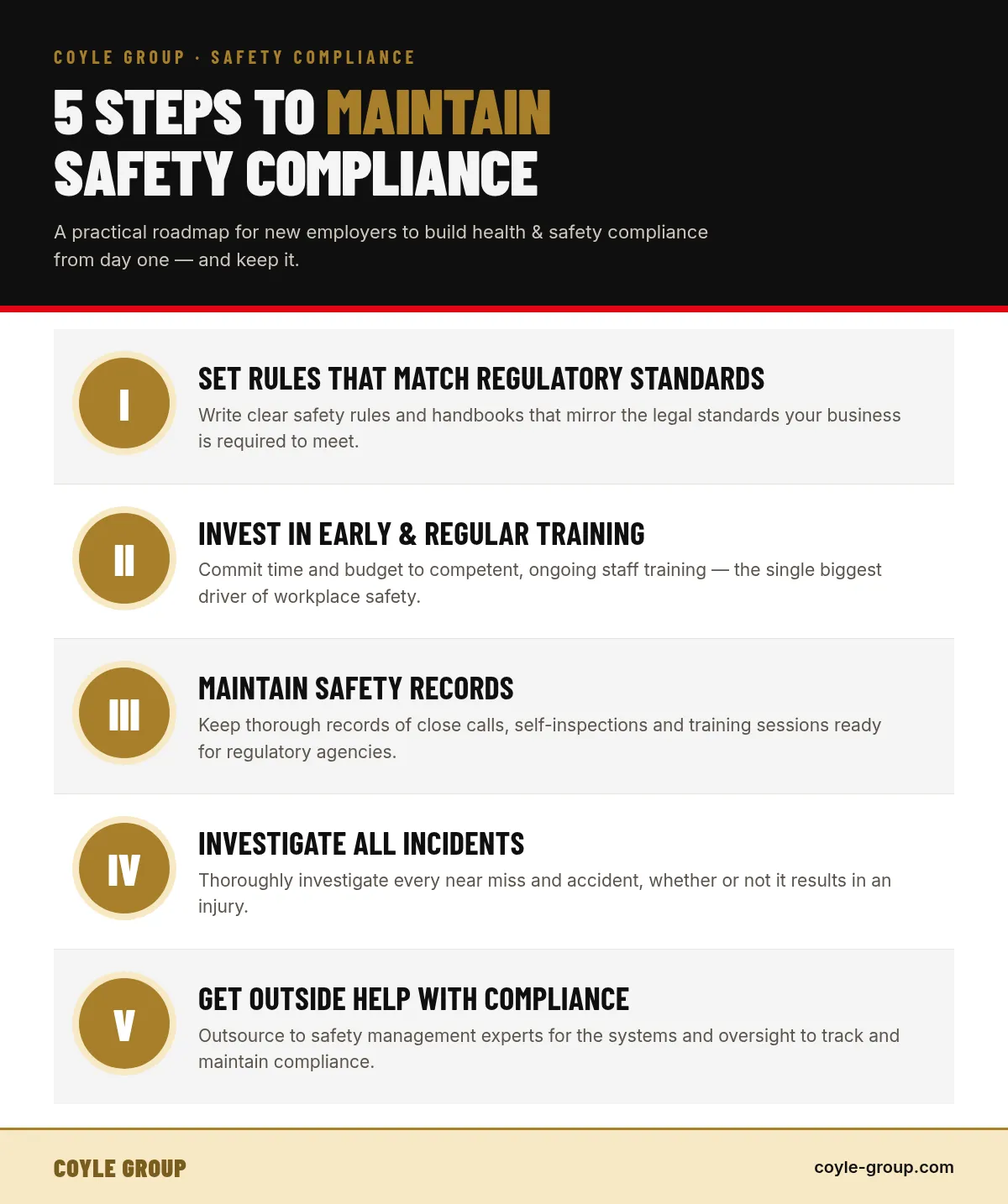
Staying compliant does not need a large team or a big budget to begin with. It comes down to 5 practical steps that build on each other, from setting clear rules through to bringing in outside expertise when you need it. Work through them in order and you will have the foundations of a safety programme in place.
Step 1: Set Rules That Match Regulatory Standards
The first step is setting clear safety rules and guidelines. The ideal approach is for safety handbooks to match the regulatory standards your business legally has to meet.
Step 2: Invest in Early and Regular Training
The most important thing any company can do to improve workplace safety and meet safety compliance is to invest early in training. A significant amount of both time and money must be devoted to training employees the right way with competent safety professionals. It helps to understand the safety training options available before you commit budget.
Step 3: Maintain Safety Records
Good record keeping habits of close calls, self-inspections, safety training, and anything else connected to occupational safety are vital when dealing with safety regulatory agencies.
Step 4: Investigate All Incidents
Regulatory bodies commonly require reports for all workplace accidents that result in an injury or fatality. New business owners should make it a common safety practice to thoroughly investigate every close call, near miss and accident, whether they result in an injury or not.
Step 5: Get Outside Help with Compliance Issues
The most viable way to keep up with compliance concerns is to outsource. Getting help from safety management system experts as a third party will present you with software solutions that can track, monitor, and maintain regulatory compliance in every aspect of your business’ workplace safety.
Taken together, these steps move you from reacting to problems to preventing them, which is exactly where a new employer wants to be. Get them working early and compliance becomes part of how the business runs rather than a source of stress.
Make Safety Compliance a Priority
Keeping up with current but ever-changing safety regulations can be a daunting task for today’s business owner, let alone one that is just starting out. If you run a smaller firm, our practical health and safety tips for SMEs pair well with the steps above. Workplace safety should be treated as a priority, not just for the sake of avoiding penalties from authorities and other direct business costs, but because it saves lives.
If you’re starting or buying a business and are keen on learning more about how to invest in and prioritise workplace safety and compliance today, give us a call.
Coyle Group can help your organisation with the arrangement of all documentation necessary for safety personnel recruitment and provide additional top-class compliance consultancy services.
Frequently Asked Questions
What are the main health and safety challenges for a new business?
The five most common are identifying hazards, investigating incidents without any historical data, keeping up with changing regulations, poor communication between roles, and providing adequate staff training.
What health and safety do you legally need when starting a business in the UK?
Every employer must manage health and safety risks. In practice that means carrying out a risk assessment, and if you have five or more employees, having a written health and safety policy and recording your significant findings.
Should a startup outsource health and safety?
For many new businesses, yes. Bringing in third-party expertise is often the most practical way to stay compliant while you focus on running the business, especially before you can justify a full-time safety hire.
What are the penalties for health and safety non-compliance in the UK and Ireland?
Penalties can be severe. In the UK, breaches of the Health and Safety at Work Act can lead to unlimited fines and, in serious cases, imprisonment, with sentencing guidelines linking the fine to company turnover. In Ireland, the Health and Safety Authority can issue fines and prosecutions under the Safety, Health and Welfare at Work Act, so the cost of getting it wrong far outweighs the cost of doing it properly.
What must a workplace risk assessment cover?
A risk assessment must identify the hazards present, decide who might be harmed and how, and evaluate the existing controls against what more is reasonably practicable. If you employ 5 or more people you must record the significant findings, and the assessment should cover physical, chemical, manual handling, fire and, increasingly, psychosocial risks.
How often should you review a risk assessment?
Review your risk assessment whenever something changes, such as new equipment, new processes, a new premises or a workplace incident, and at least once a year as good practice. Regular reviews keep the document accurate and show regulators that you are managing risk on an ongoing basis rather than treating it as a one-off exercise.
Do sole traders and small businesses need health and safety measures?
If you employ anyone, you have the same core duties as any larger employer, including carrying out a risk assessment and putting sensible controls in place. Genuine sole traders with no employees have lighter obligations, but you still have a duty not to put members of the public or contractors at risk through your work.