Health and Safety for Small Businesses: 1 vs 5+ Employees

Health and safety for small businesses in the UK is not something you can defer until you are bigger. The moment you take on your first employee, a set of legal duties applies, and more arrive once your team passes five people. A handful of duties apply to every business from day one, whatever your headcount.
We work with small and growing firms across the UK, and the same question comes up on almost every visit: which of these actually apply to us right now? This guide sets out the practical steps, in line with HSE guidance for smaller employers, including exactly where the legal thresholds sit.
Prioritising Health and Safety in the Workplace: Essential Tips for Small Business Owners
Investing in customer and employee well-being will strengthen a business reputation and network, ensuring stability for years to come.
Here are the key steps small business owners can take to ensure a safe and secure workplace:
1. Identify potential hazards in the workplace
A risk assessment is an essential component of any health and safety programme. It is the process of identifying and evaluating potential hazards in the workplace to determine the risk of injury or harm to employees, customers, or others. Identifying potential hazards is the first step in creating a safer and more secure work environment.
Examples of common hazards include slips, trips, and falls, fire risks, and exposure to hazardous substances. Conducting a risk assessment helps small business owners understand the risks in their workplace and take appropriate action to control these hazards.
In addition to identifying potential hazards, small business owners should also assess the level of risk associated with each hazard, taking into account the likelihood of an incident occurring and the potential consequences. If you are only getting started, it is worth reading up on the common compliance challenges that trip up new and growing firms.
2. Create a Health and Safety policy
A written policy can provide clarity and direction to employees, suppliers, and contractors about what is expected of them in terms of health and safety. It should include details on the company’s health and safety policy and procedures, risk assessments, and emergency procedures.
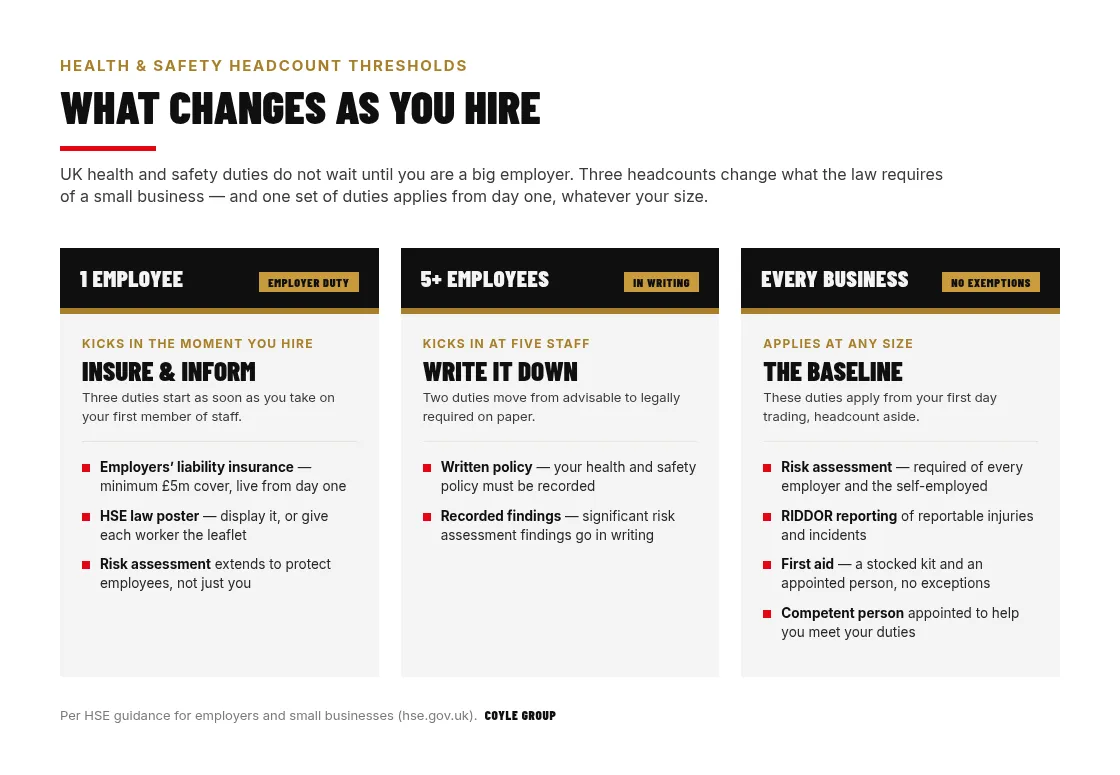
Exactly what this means in practice depends on how many people you employ. The duties are not the same for a sole trader as they are for a business with a growing team, and the point where a policy stops being optional and becomes compulsory is fixed by law rather than by judgement. The graphic below sets out what changes at one employee, at five or more, and the handful of duties that apply to every business regardless of size, checked against current HSE small business guidance.
The policy should include the following key elements:
- Company’s Health and Safety Policy: This section outlines the company’s commitment to health and safety, including its values, goals, and objectives.
- Procedures and Protocols: This section details the procedures and protocols that employees, suppliers, and contractors should follow to ensure a safe and healthy work environment, including risk assessments and emergency procedures.
- Risk Assessments: This section explains the company’s approach to identifying and mitigating workplace hazards, including how risk assessments are conducted, reviewed, and updated.
- Emergency Procedures: This section outlines the procedures to be followed in the event of an emergency, including how to evacuate the building, how to access emergency services, and who to contact for assistance.
If you have never employed anyone before, note that employers’ liability insurance becomes compulsory the day you take on staff, with only limited exceptions for close family members. It sits alongside the policy and risk assessment duties above rather than replacing them.
3. Provide training and awareness programmes
Training and awareness programmes aim to educate employees on how to identify and mitigate potential workplace hazards. These programmes cover various topics, such as fire safety, manual handling, and hazardous substances, to ensure that employees have the necessary knowledge to operate safely and prevent accidents in the workplace. It is worth weighing up the safety training options before you commit budget, so you pick the right level for your team.
Training and awareness programmes can help your small business:
- Meet legal requirements: Employers have a legal obligation to provide a safe working environment for their employees.
- Reduce accidents and incidents: By providing employees with the necessary knowledge and skills to identify and mitigate workplace hazards, training and awareness programmes can help reduce the number of accidents and incidents in the workplace.
- Improve safety culture: Regular training and awareness programmes can help build and maintain a safety-focused culture by reinforcing the importance of safety and encouraging employees to prioritise it in their daily work.
- Increase employee morale and engagement: When employees feel confident and informed about the safety procedures and protocols in their workplace, they are more likely to be engaged and motivated in their work.
4. Implement safety measures
Implementing safety measures involves taking proactive steps to ensure the safety of employees, suppliers, and contractors in the workplace. This includes installing appropriate safety equipment and putting emergency procedures in place to prepare for potential hazards.
- Safety equipment: Installing appropriate safety equipment such as fire alarms, smoke detectors, and fire extinguishers can help to quickly alert employees in the event of an emergency and reduce the risk of injury or harm.
- Emergency procedures: Having well-defined and tested emergency procedures in place can help organisations to respond effectively to emergencies, minimise the impact of any incidents, and protect the well-being of employees, suppliers, and contractors.
- Regular inspections: Regular inspections of the workplace can help to identify potential hazards, ensure that safety measures are functioning as intended, and take corrective action where necessary.
5. Keep up with industry trends and regulations
Staying up-to-date with industry trends and regulations is essential for maintaining a safe and healthy workplace. This involves continuously monitoring and updating health and safety policies and procedures to ensure that they are aligned with the latest regulations and industry trends.
- Regular review of policies and procedures: Regular review of health and safety policies and procedures ensures that they are up-to-date and in compliance with the latest regulations and industry trends.
- Compliance with regulations: Keeping up with regulations and legislation is important to ensure that your organisation is meeting the minimum standards for health and safety, including the current thresholds set out in HSE’s small business guidance and the cover required under employers’ liability insurance once you take on staff.
- Training and awareness programmes: Regular training and awareness programmes help employees stay informed and up-to-date on health and safety practices, trends, and regulations.
6. Make Health and Safety a priority
Making health and safety a priority involves regularly reviewing and assessing your health and safety policies and procedures to ensure that they are effective and that employees understand their responsibilities.
- Regular review of policies and procedures: Regular review helps to ensure that policies are effective and relevant to the workplace, including conducting risk assessments and addressing any identified hazards.
- Employee understanding: Ensuring that employees understand their health and safety responsibilities is key to promoting a safe and secure work environment, achievable through regular training and awareness programmes.
- Making health and safety a priority: By making health and safety a priority, small business owners can demonstrate their commitment to creating a safe and secure work environment. Rolling these habits into a single safety management system keeps the policy, the risk assessment and the training records in one place instead of three.
Taken together, these six steps are less a checklist to work through once than a cycle that repeats as the business changes. Steps 1 and 2 are where the legal thresholds bite, so they come first: the risk assessment applies from your first day of trading, and the written policy becomes compulsory the moment you employ your fifth person. Steps 3 to 6 are what turn that paperwork into something that actually protects people, and they are also what an inspector looks at when deciding whether your system is real or filed. Most small firms that run into trouble have not ignored health and safety altogether. They completed steps 1 and 2 two years ago, put them in a drawer, and never went back to them as the team grew.
Building a Safer Small Business
Small business owners have a lot on their plate, but health and safety shouldn’t be neglected. By following the steps above, and keeping an eye on the thresholds that change as your team grows, you can build a safer environment for your employees and customers without over-engineering it.
Coyle Group’s safety policy development service helps small businesses put a working, compliant policy in place rather than hand over a generic template. With over 25 years of experience in safety management, we have helped thousands of businesses get their health and safety basics right. Browse the rest of our safety consulting and compliance guides for more practical reading, or get in touch if you would rather talk it through first.
Not sure where your small business sits against these thresholds? Book a compliance consultation and we will map your duties against your exact headcount, no jargon, no upsell.
Frequently Asked Questions
What are the key health and safety steps for small business owners?
Six key steps: (1) Identify potential hazards via risk assessment, (2) Create a written health and safety policy, (3) Provide regular training and awareness programmes, (4) Implement safety measures (equipment, emergency procedures, inspections), (5) Keep up with regulations and industry trends, and (6) Make health and safety an ongoing organisational priority.
Do small businesses need a written health and safety policy?
If you employ five or more people, you must have a written health and safety policy by law. Businesses with fewer than five employees still have to manage risks and are wise to write the policy down, but it does not have to be a formal document.
How many employees before you legally need a health and safety policy?
Five. Once you have five or more employees, the Health and Safety at Work etc. Act 1974 requires a written health and safety policy and you must record the significant findings of your risk assessment.
Is a risk assessment a legal requirement in the UK?
Yes. Every employer and self-employed person must assess the risks in their business. If you have five or more employees you must also record the significant findings and note any groups of people especially at risk.
Where can small businesses get free health and safety help?
The HSE publishes free guidance aimed specifically at smaller employers, including simple risk assessment templates and example policies. For anything complex or higher-risk, it is worth getting professional advice.
Does a sole trader need a health and safety policy?
No. A written health and safety policy only becomes a legal requirement once you employ five or more people. As a sole trader, you still owe the same underlying duty to assess and manage risks to yourself and to anyone affected by your work, so it is worth writing your approach down anyway, even though the law does not demand a formal document at this stage.
Does HSE provide a free health and safety policy template for small businesses?
Yes. HSE publishes a free model policy aimed at small, low-risk businesses, which you can adapt with your own hazards, control measures and named responsibilities. It is a reasonable starting point if you employ fewer than five people, but treat it as a first draft rather than a finished policy, since a template cannot reflect the specific risks in your workplace.