Near Miss Investigation: 5 Steps for UK and Irish Sites
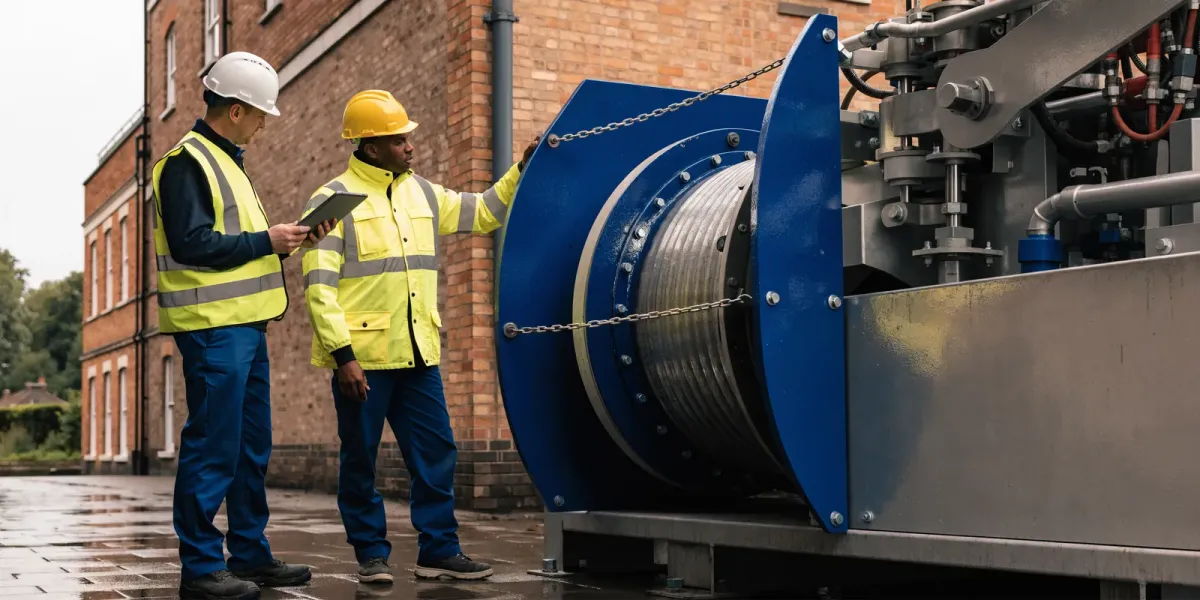
A near miss investigation is the structured follow-up to a close call, a dropped load, a near-collision, a guard left off a machine for 5 minutes, carried out whether or not the event meets the legal threshold for a reportable dangerous occurrence. Most near misses never reach that threshold. They still deserve the same discipline, because the hazard behind them has not gone anywhere just because nobody was hurt this time.
We run near miss investigations for clients across construction, energy and utilities sites in Ireland and the UK, and the pattern repeats everywhere: the report gets filed, the facts get gathered, and then the investigation stalls exactly at the point where it should turn into a fixed hazard and a closed loop. This guide sets out what a near miss actually is, how it differs from a statutory dangerous occurrence on each side of the Irish Sea, and the 5-step method that gets an investigation from a report to a verified fix.
Want a chartered team to set up a near miss investigation process your site will actually use? Book a compliance consultation and we will scope it on the first call.
Book a Compliance Consultation
What Counts as a Near Miss
A near miss is any event that did not cause injury, ill health or property damage but had a realistic potential to do so. A scaffold board that shifts underfoot but does not give way, a forklift pallet that slips but does not fall on anyone, a near-collision between a van and a pedestrian at a site gate. None of these produce an injury, which is exactly why they are easy to wave off, and exactly why they are the cheapest warning a site will ever get.
A dangerous occurrence is a different, narrower thing. It is a specific category of event that the law requires you to report to a regulator regardless of whether anyone was hurt, because the event’s potential severity is judged serious enough on its own. In Great Britain, the list sits in Schedule 2 of RIDDOR and includes events such as the collapse or failure of a crane, hoist or other lifting equipment, the accidental release of a biological agent, or the unintended collapse of a building or structure under construction. HSE’s own guidance describes these as the events reportable “where an injury does not occur but could have done,” which is the clearest line between the 2 terms: every dangerous occurrence is a near miss, but very few near misses are dangerous occurrences.
Ireland draws the same distinction under different numbering. The Safety, Health and Welfare at Work (General Application) Regulations define a dangerous occurrence as an event listed in Schedule 15, and the HSA’s reporting guidance confirms that a non-fatal accident or a Schedule 15 dangerous occurrence must be reported to the HSA within 10 working days of the event. Our RIDDOR guide sets out the UK reporting duty in full, and the same discipline that applies to a full accident investigation applies here, scaled to the hazard rather than to the outcome.
The practical test we apply with clients is simple: ask what could plausibly have happened if the circumstances had been very slightly worse. If the honest answer is a lost-time injury or a fatality, the near miss gets the same investigation rigour as an accident, reportable or not.
Why Near Misses Go Unreported and Uninvestigated
Near misses are chronically under-reported, and the reason is rarely that workers do not notice them. It is that reporting a near miss takes effort, carries a perceived risk of blame, and, on too many sites, produces no visible response. Workers who report a hazard and watch nothing change learn a fast lesson: stop reporting.
HSE’s own guidance on its Accident and Near-miss Tool frames near misses as “valuable indicators of weaknesses in processes, safeguards or culture,” and sets out the Safety Triangle, also called Heinrich’s Triangle, as a widely used framework showing that for every serious incident there are many more minor accidents, and even more near misses underneath them. HSE is careful not to attach fixed ratios to that shape, and so are we. The exact numbers behind the original 1930s research have been challenged for decades, but the underlying logic still holds: the near misses sitting under a serious incident are the cheapest, earliest warning a site gets, and ignoring them is how a pattern turns into an accident.
The second reason near misses go uninvestigated is organisational rather than cultural. A report lands with nobody clearly accountable for acting on it, so it sits in a log that gets reviewed, if at all, at the next scheduled safety meeting rather than within days of the event. By the time anyone looks at it, the scaffold has been struck, the machine has been moved on, and the facts that would have supported a proper root cause analysis are gone. Treating a near miss investigation as a scheduled, named responsibility rather than an optional extra is what keeps the facts available long enough to use them.
The 5-Step Near Miss Investigation Method
A near miss investigation that stops after the facts are written down produces a record, not a fix. The method below runs through 5 steps, each with a named owner and a target timeframe, so the investigation ends in a verified corrective action rather than a filed form. It borrows its structure from HSE’s HSG245 guidance on investigating accidents and incidents, which sets out gathering information, analysing it, identifying risk controls and implementing an action plan as the core of any workplace investigation, adapted here for the shorter, lower-stakes near miss case.
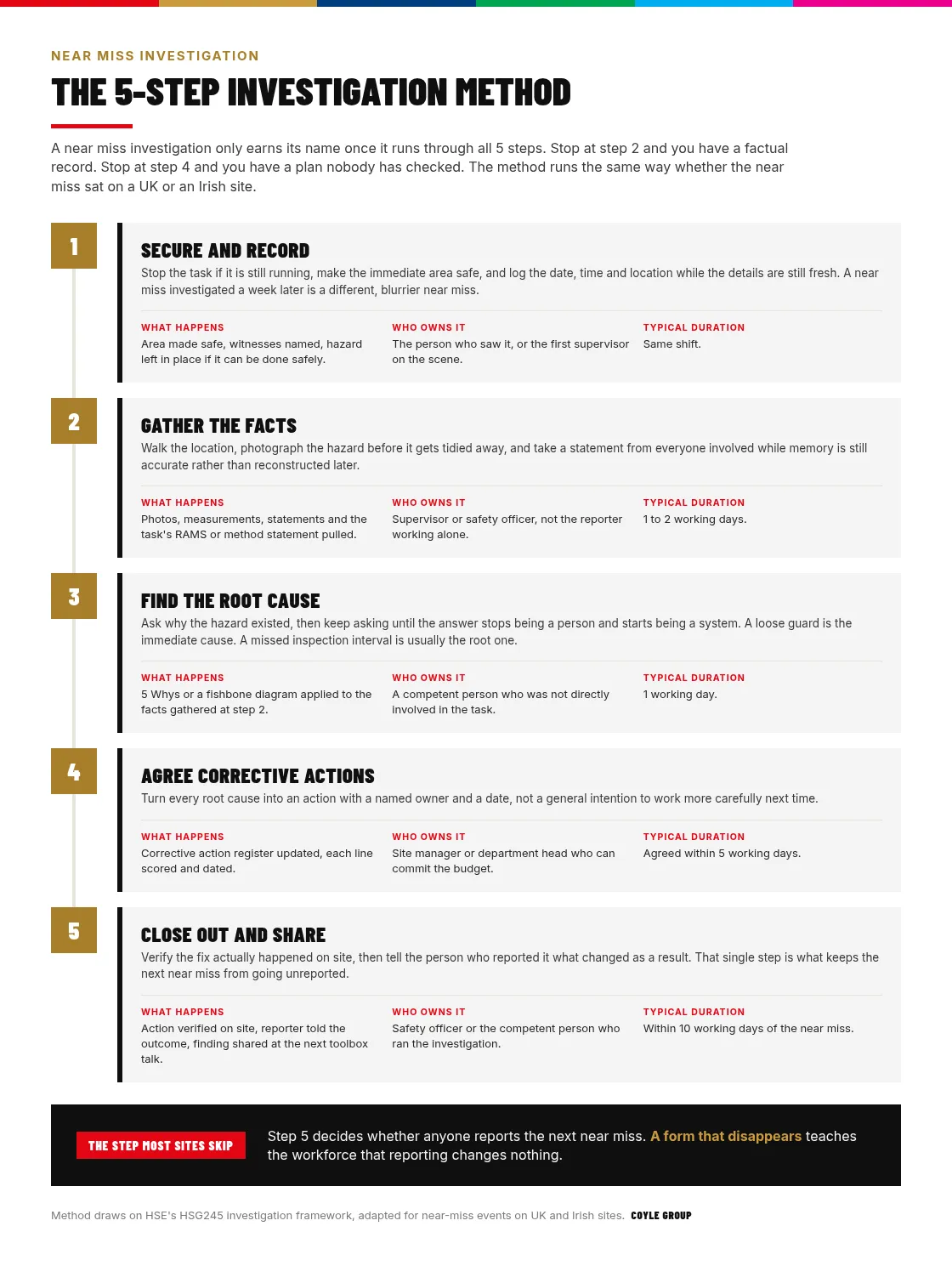
- Secure and record. Stop the task if it is still running, make the immediate area safe, and log the date, time, location and the names of everyone involved while the details are still fresh. This step usually takes minutes, not hours, and happens the same shift.
- Gather the facts. Walk the location, photograph the hazard before it gets tidied away, and take a statement from everyone involved. Pull the task’s RAMS or method statement so the written plan can be compared against what actually happened. Budget 1 to 2 working days.
- Find the root cause. Apply a structured tool, the 5 Whys or a fishbone diagram, to the facts gathered at step 2, ideally run by a competent person who was not directly involved in the task. This is usually a 1-day exercise once the facts exist.
- Agree corrective actions. Turn every root cause into an action with a named owner and a date, not a general instruction to be more careful. A site manager or department head who can commit the budget should sign off the register within 5 working days.
- Close out and share. Verify the fix actually happened on site, tell the person who reported it what changed, and share the finding at the next toolbox talk. Aim to close this out within 10 working days of the original event.
The step most sites skip is the last one. A near miss that gets investigated in private and never fed back to the person who raised it teaches the workforce exactly the wrong lesson, that reporting is a dead end rather than something that changes the site.
Root Cause Tools Worth Using, and When
Root cause tools only earn their keep once the facts are gathered. Used before that, on assumptions rather than evidence, they produce a confident-sounding answer that happens to be wrong, which is worse than no answer at all because it closes the investigation on the wrong fix.
The 5 Whys is the simplest tool and the right starting point for most near misses. Ask why the hazard existed, then ask why again against the answer, typically 5 times, until the chain stops at something structural, a missed inspection, an unclear permit, a training gap, rather than at an individual’s momentary lapse. A fishbone, or Ishikawa, diagram suits near misses with several contributing factors at once, sorting causes into categories such as people, equipment, process and environment so the investigation does not fixate on the first plausible cause it finds. A bowtie diagram is worth the extra time on higher-consequence near misses, because it maps the barriers that were supposed to prevent the event on one side and the barriers that were supposed to limit the consequences on the other, showing exactly which control failed rather than just that one did.
Whichever tool is used, the output should be the same: a root cause stated clearly enough that a different person could read it and know exactly what to fix. “Operator error” is not a root cause. “No written procedure existed for isolating this machine before the guard is removed” is one. A competent person who understands both the task and the tool is what turns a root cause session from a guessing exercise into a defensible finding, which matters as much for an internal investigation as it does for one that also has to satisfy an inspector.
Closing the Loop With the Person Who Reported It
The single biggest lever on near miss reporting rates is not the form, the app or the toolbox talk script. It is whether the person who reported the last one saw anything happen as a result. Workers judge a reporting system by its outcomes, not its intentions, and a hazard that gets reported, investigated and never mentioned again reads as proof that reporting does not matter.
Closing the loop means 3 concrete things, done in sequence. First, verify on site that the corrective action from step 4 actually happened, rather than trusting that it was actioned because it is marked complete on a spreadsheet. Second, tell the person who raised the near miss what changed, specifically, not with a generic thank-you. Third, share the finding more broadly, at a toolbox talk or a team briefing, so the same hazard gets fixed everywhere it exists rather than only where it was first spotted. This feedback loop is also where behaviour-based safety work earns its keep, because a workforce that sees its reports acted on is a workforce that keeps reporting the small things before they become big ones.
Carrying out near miss investigations but not sure the findings are closing the loop properly? Book a compliance consultation and we will review your last 12 months of reports.
Book a Compliance Consultation
Build that verification step into the investigation process itself, rather than leaving it as a nice-to-have once the paperwork is filed.
Making Near Miss Investigation Part of How the Site Runs
A near miss investigation only pays off if it is run the same way every time, on a schedule the site actually keeps to, rather than as a one-off exercise after a particularly close call. Track the near miss reporting rate itself, not just the number of corrective actions closed, since a rate that is falling usually means confidence in the process is falling with it rather than that hazards have genuinely disappeared. Track the average time from report to closed-out fix, since a growing backlog is the earliest sign that step 5 is being skipped. And review near misses together with accidents and dangerous occurrences on a single register, inside a wider safety management system, so a pattern spanning several small events is visible before it produces a serious one.
We run this exact 5-step method for clients across Ireland and the UK, scored and closed out by a CMIOSH-chartered team rather than left to a form nobody owns. If you want your near miss investigation process tested against what an inspector or an insurer would actually expect to see, book a compliance consultation and we will start with your last 12 months of reports.
Frequently Asked Questions (FAQs): Near Miss Investigation
These are the questions safety managers and site leads ask us most often when they are building or reviewing a near miss investigation process.
What is a near miss in health and safety?
A near miss is an event that did not cause injury, ill health or damage but easily could have done, such as a dropped tool that lands clear of a worker or a vehicle that stops just short of a pedestrian crossing point. Coyle Group treats a near miss as a free lesson. The hazard that nearly caused harm is still there, and the only difference between that event and a reportable accident was timing, position or luck, none of which a safety system should rely on.
What is the difference between a near miss and a dangerous occurrence?
A near miss is a broad internal safety term for any close call, logged however an organisation chooses. A dangerous occurrence is narrower and set in law. In Great Britain it means an event listed in Schedule 2 of RIDDOR, such as the failure of a load-bearing part of lifting equipment. In Ireland it means an event listed in Schedule 15 of the General Application Regulations. Most near misses Coyle Group reviews are not dangerous occurrences, but every dangerous occurrence started as one.
Do all near misses have to be reported to the HSE or the HSA?
No. Only the specific events listed as dangerous occurrences carry a statutory reporting duty to HSE in Great Britain or the HSA in Ireland, and Irish reports are due within 10 working days of the event. Every other near miss still deserves an internal report and a proportionate investigation, because it is evidence of a hazard the site has not yet controlled, even though no regulator needs to see the paperwork.
What is the 5 Whys technique and when should it be used in a near miss investigation?
The 5 Whys is a root cause tool that asks why an event happened, then asks why again against each answer, typically 5 times, until the chain stops at a system failure rather than a person. Coyle Group applies it at step 3 of an investigation, once the facts from step 2 are gathered, never as a substitute for gathering them. Used too early, on assumptions instead of facts, it produces a confident answer that is simply wrong.
How long should a near miss investigation take?
The timeline depends on the hazard's severity, not a fixed rule. Coyle Group typically secures and records a near miss within the same shift, gathers the facts within 1 to 2 working days, and agrees corrective actions within 5 working days of the event. Closing the loop with the reporter, verifying the fix and sharing the finding, usually follows within 10 working days, so the person who raised it sees the outcome while it still feels relevant.
Why do so many near misses go uninvestigated?
Three reasons recur across the sites Coyle Group visits. Nobody owns the report once it is filed, so it sits in a folder. The investigation gets treated as a blame exercise, so people stop reporting the smaller events that would otherwise surface a pattern. Or the loop never closes, so the workforce learns that reporting changes nothing. Fixing the third problem usually fixes the first 2, because a visible fix is what gives a report somewhere to go.