RIDDOR: What UK Employers Must Report & 10/15-Day Deadlines

RIDDOR is an acronym for the Reporting of Injuries, Diseases, and Dangerous Occurrences Regulations 2013. Compliance with these Regulations is essential for employers in the United Kingdom.
These regulations require employers, the self-employed, and people in control of work premises (a responsible person) to report workplace accidents, occupational diseases, and specified dangerous occurrences (near misses) to the relevant regulatory authority. RIDDOR seeks to keep workers and the general public informed about workplace health and safety risks. It also aims to provide regulators with data to identify and tackle problems. RIDDOR’s purpose is to protect workers and the public by ensuring that employers, the self-employed, and the responsible person comply with the law.
RIDDOR is not about paperwork for its own sake. Every report feeds a national picture of where people are being hurt at work, and that picture is what drives inspections, prosecutions, and better guidance across whole industries. For an employer, getting it right is a legal duty; getting it wrong can mean an investigation, a fine, or worse. This guide walks through what you have to report, how to report it, the deadlines that apply, and the practical steps that keep you on the right side of the law.
What Is Reportable Under RIDDOR
Not every workplace incident triggers a report. RIDDOR sets specific thresholds, and knowing them saves you from both over-reporting and, more seriously, missing something you were legally required to file. The Regulations require reporting of the following:
- Deaths and injuries caused by workplace accidents: any work-related death, and any injury that keeps a worker away from their normal duties for more than seven consecutive days.
- Specified injuries to workers: fractures (other than to fingers, thumbs, and toes), amputations, loss of sight, crush injuries, serious burns, and other injuries listed in the Regulations.
- Occupational diseases: conditions likely to have been caused or made worse by work, such as occupational dermatitis, carpal tunnel syndrome, hand-arm vibration syndrome, and occupational asthma.
- Carcinogens, mutagens, and biological agents where exposure is linked to a reportable disease.
- Dangerous occurrences (near misses with no injury), such as:
- failure of load-bearing parts of lifting equipment
- equipment contacting overhead power lines
- accidental release of any substance that could injure a person
- Gas incidents: accidental gas leakage, incomplete combustion, or insufficient removal of gas combustion exhaust products.
How to Report to the HSE
Reporting is straightforward once you know the route, and having a set process means nothing gets missed in the confusion that often follows an incident. Follow these steps whenever a reportable event occurs:
- Confirm the incident is reportable. Check it against the categories above before you file, because not every accident meets the threshold.
- Report the most serious cases by phone first. Fatal and specified major incidents must be reported without delay on the HSE incident line (0345 300 9923) during office hours.
- Complete the online form. Most reports are made through the HSE reporting portal, where the form is submitted and a copy is sent back for your records.
- Keep your own record. Whoever files the report, the responsible person keeps the duty, so log every report and store it with your safety records.
Set up a simple internal route so a supervisor always knows to flag a reportable event. Good record keeping is far easier when you build reporting into a wider safe system of work rather than treating each incident as a one-off.
RIDDOR Time Limits (10 and 15 Days)
The clock matters as much as the report itself, and the deadline you are working to depends on the type of incident. Missing a deadline is itself a breach, so it pays to know which window applies before the pressure of an incident hits.
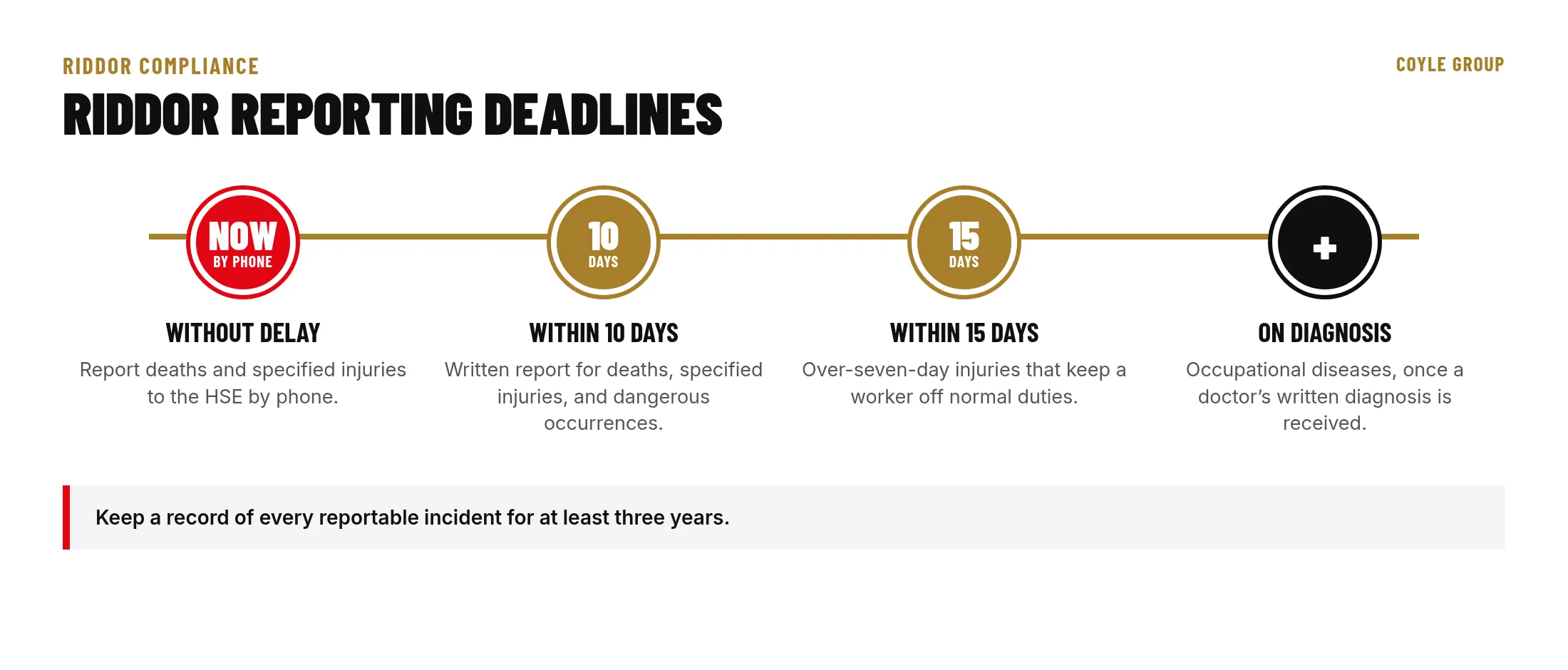
- Deaths and specified injuries: report the incident without delay by telephone, then follow up with a written report within 10 days.
- Dangerous occurrences: report within 10 days.
- Over-seven-day injuries: report within 15 days of the accident.
- Occupational diseases: report as soon as a doctor’s written diagnosis is received.
You must also keep a record of any reportable incident for at least three years.
Compliance Steps for Employers
Reporting is only one part of a wider duty of care. The Health and Safety Executive sets out a broader checklist that turns RIDDOR from a reactive form-filling exercise into part of how a well-run business protects its people. Work through the steps below, and reporting becomes the natural end of a system rather than a scramble after the fact.
- Appoint a competent person to help you manage health and safety in your business
- Prepare a health and safety policy
- Carry out a risk assessment
- Consult your workers
- Provide information and training (tell your workers their health and safety duties)
- Provide suitable workplace facilities (toilets, washbasins, and other welfare facilities workers need)
- Have appropriate first aid kits, train workers, and appoint first aiders
- Display the health and safety law poster or give workers an equivalent leaflet
- Get employers’ liability insurance for your business
- Understand the law (the Health and Safety at Work Act 1974, including RIDDOR)
- Report specified injuries, near misses, and work-related illnesses to the HSE
Where you are tracking these duties across a project, a risk register keeps every action and owner in one place so nothing slips through the net.
When to Train Employees on RIDDOR
The crucial time for companies to take note of RIDDOR is when their employees first enter the company. Employers with more than 250 employees have a legal obligation to arrange a RIDDOR induction with their recruits within 28 days of starting the job.
In practice, the right moment to train depends on the size and setup of your organisation:
- Within 28 days of starting — employers with more than 250 employees must arrange a RIDDOR induction with new recruits by law.
- At induction or the first safety briefing — smaller companies can cover RIDDOR when a new employee starts their job.
- At a formal meeting early in employment — larger organisations may prefer a structured session at the start of the role.
- Whenever the rules or your risks change — refresh training when regulations, equipment, or your risk profile shift.
When new employees join your company, they need to understand what RIDDOR stands for and how it applies to your workplace. If you are unaware of RIDDOR, you may unwittingly put one of your employees in physical danger, and you may also put yourself and your business in legal danger.
The precise time you should make employees aware of the dangers of serious incidents and accidents varies between small and large companies. If you represent a smaller company, you may reference RIDDOR as part of a safety briefing when a new employee starts their job. For larger organisations, it might be best to hold a formal meeting at the start of their employment. In either situation, employees should comply with any policy and make sure that they follow any safety warnings given on site.
Outside of the workplace, many people say “no harm, no foul.” With RIDDOR that is not always the case. The obligation to report can apply even when no injury occurs, which is why every workplace accident should be logged and reviewed. Treat training as an ongoing duty rather than a one-off induction task: the people who witness an incident are usually the first to know it happened, so they need to recognise a reportable event and know who to tell. Knowing how to follow the process and file a report is just as important as preventing the incident in the first place.
The Importance of Reporting Dangerous Incidents
As the regulations on recording incidents increase in the UK, so does the pressure to remind people of reporting. Whether you are a construction worker, doctor, police officer, or firefighter, this legislation is important for your safety.
Employers in the UK now must prompt their employees to report any potentially dangerous conditions under legislation such as the Health and Safety at Work Act 1974. These regulations have worked for the better by protecting employees from harm.
Industry and government reviews have, at times, discovered significant under-reporting of reportable RIDDOR incidents, for example in the Rail Safety and Standards Board review of Network Rail in 2011. Where this kind of under-reporting is intentional or the result of defective systems and processes, it can result in prosecution.
The workplace has seen significant health and safety regulation changes over the past several decades, and this has only increased in recent years as the UK makes efforts to improve workplace safety. With recent changes to health and safety laws, employers must remind employees of their rights. This duty is only likely to increase with time.
Reporting Infectious Diseases
Certain work-related infections are reportable under RIDDOR, including cases where a worker is diagnosed with a disease attributed to a biological agent they were exposed to at work. During public health events such as a pandemic, the HSE issues specific guidance on when a diagnosis is reportable. To stay on top of it, keep an open dialogue with your insurer about changes to your risk profile, ensure your premises are properly ventilated, and follow current public health guidance and any advice from your trade or industry body.
Making RIDDOR Part of How You Work
RIDDOR comes down to three things: knowing which incidents are reportable, filing them with the HSE inside the deadlines, and keeping the records to prove you did. The employers who find it painless are the ones who have stopped treating it as a form to fill in after something goes wrong and instead built reporting into their everyday safety routine, from induction training through to a clear internal route for flagging events. Get those foundations right and compliance stops being a source of anxiety.
If you are unsure whether an incident is reportable, or you want a system that catches these duties before they become breaches, get expert compliance support. Coyle Group’s safety consulting service helps UK organisations put RIDDOR reporting, risk assessments, and training on a footing that protects both your people and your business.
Frequently Asked Questions (FAQs): RIDDOR
Still weighing up what RIDDOR means for your business? These are the questions UK employers ask most often about what to report, who is responsible, and the deadlines that apply.
What does RIDDOR stand for?
RIDDOR stands for the Reporting of Injuries, Diseases and Dangerous Occurrences Regulations 2013. It is the UK law that sets out which workplace incidents must be reported to the Health and Safety Executive (HSE).
What is the purpose of RIDDOR?
The purpose of RIDDOR is to give the HSE and local authorities the data they need to identify where and how serious risks arise. That evidence lets regulators investigate serious incidents, target inspections, and improve workplace safety across industries.
What must employers report under RIDDOR?
Employers must report work-related deaths, specified injuries, injuries that keep a worker off their normal duties for more than seven days, certain occupational diseases, dangerous occurrences (near misses such as the failure of lifting equipment), and gas incidents.
Who is responsible for reporting to the HSE?
The responsible person must report. This is usually the employer, the self-employed person, or whoever is in control of the premises where the work is carried out. Employees themselves do not make RIDDOR reports, though they should tell their employer about any reportable incident.
What are the time limits for reporting under RIDDOR?
Deaths and specified injuries must be reported without delay and followed up in writing within 10 days. Dangerous occurrences must be reported within 10 days, over-seven-day injuries within 15 days, and occupational diseases as soon as a doctor's written diagnosis is received.
Do near misses have to be reported under RIDDOR?
Yes. Certain near misses, called dangerous occurrences, are reportable even when no one is hurt. Examples include the failure of load-bearing parts of lifting equipment and the accidental release of a substance that could cause injury.
How long must RIDDOR records be kept?
You must keep a record of any reportable death, injury, disease, or dangerous occurrence for at least three years from the date the record was made.