Construction Safety Lessons from Other Sectors

Construction is a high-risk industry that encompasses a wide range of alteration and repair activities. As a result, construction workers are exposed to various risks, including falling from rooftops, unprotected machinery, being struck by heavy construction equipment, electrocutions, silica dust, and asbestos.
Construction sites are hazardous environments in which to work. Thousands of individuals are harmed on building sites every year, and the persistent injury profile is what makes cross-sector borrowing so useful: agriculture and healthcare have already tested controls at scale for the same hazards construction still fights day to day.
Adapting proven controls to your site?
Coyle Group’s CMIOSH-chartered advisors help UK and Ireland construction leads map lessons from agriculture and healthcare into the existing toolbox talks, induction pack and supervisor walks, so each borrowed control lands with a named owner and a review date.
Get Cross-Sector Support
Importance of Safety Lessons in the Construction Sector
Safety is critical to completing your project on time and within budget. Downtime is costly, and so is replacing workers who cannot perform their duties due to an accident. Claims for workers’ compensation and lawsuits push insurance premiums up, and a poor safety record narrows the tender list every year the pattern repeats.
1. Public Safety is Protected on Construction Sites
Safety on construction sites protects your staff and the public. Construction sites are typically located in high-traffic regions where a dropped object or an uncontrolled boundary is a public hazard, not just a site one.
2. Workplace Safety Reduces Workplace Accidents
According to HSE figures, construction accounts for one of the largest shares of work-related fatal injuries in Britain. The four most common causes of accidental deaths and injuries are falls, being struck by an object, electrocution, and being caught between equipment. Every one of those has a documented control set already in production in another sector.
3. Reduce the Time and Money Lost Following an Accident
Work is halted when an accident results in injury or death. Accidents on the job site raise the overall cost of your project, and often carry an insurance-premium consequence into the following year. Our guide to the true cost of workplace accidents walks through how the direct-versus-indirect ratio actually lands on a construction P&L.
Cross-sector borrowing works because the mechanism is usually the same, only the branding changes. A guarded shaft on a farm and a guarded rebar bender on site are the same control against the same hazard, and adopting the proven version saves the years spent inventing a bespoke one.
Safety Lessons from Other Sectors
Two sectors carry the most reusable lessons. Agriculture is highly regulated, physically demanding and machinery-dense, which maps directly onto the plant and PPE side of a construction site. Healthcare is fatigue-conscious, communications-disciplined and manual-handling-heavy, which maps onto the human-factors side. Between them, ten controls transfer cleanly, and each one lands better when the site’s risk assessment and method statement already has a place for them rather than treating them as a bolt-on.
The Agricultural Sector
1. Appropriate Clothing
In agriculture, loose clothes are a common cause of harm. Wear close-fitting clothing; button cuffs and tuck shirts in; avoid wearing a tie while working and remove any loose jewellery. Wear long hair under a cap or head covering.
Construction application: loose clothes, jewellery, ties, and cuffs should be avoided when working on a construction site, and the same rule should be enforced at induction rather than after an incident.
2. PTO Safety Recommendations
PTO drives (power take-off) are extremely dangerous. Key rules:
- A PTO shaft should never be stepped on
- Replace PTO guards if they are not covering the shaft and u-joints properly
- Before exiting the tractor seat, ALWAYS disengage the PTO, turn the tractor off, and remove the key
- While the shaft is spinning, NEVER grasp a PTO guard
Construction application: the PTO in any machines used on construction sites should be guarded, and a missing guard is a stop-work event, not a paperwork one. HSE’s power take-off guidance sets the same duty of care against the same rotating-shaft hazard.
3. Preparedness for Emergencies
Every member of a farm family, as well as hired workers, should be trained in first aid and CPR.
Construction application: employers should train workers in first aid and CPR. First aid boxes should be provided and emergency numbers made visible on every level of the site.
4. Field Services
Always use a two-way radio or mobile phone. Someone should call you if you do not call back within 10 minutes. Never clean equipment clogs while the machine is running.
Construction application: a walkie-talkie or mobile phone should be with every worker on site, and lone tasks should have a named check-in contact and a return time.
5. Fire
Fire prevention recommendations: keep ignition sources away from flammable materials; regularly test fire and smoke alarm systems (at least once a year); keep dust and oil off motors; inspect wiring; choose a suitable fire extinguisher; invite the local fire department to check access routes at least twice a year.
The Health Sector
1. Limit Shift Durations
According to research, medical residents who are acutely or chronically tired are more prone to make mistakes.
Construction application: workers on 24-hour cover should have their consecutive shift length reduced. Workers should take at least 5 hours of rest between shifts on safety-critical work.
2. Effective Communication
Train hospital workers to work together efficiently using evidence-based techniques (TeamSTEPPS).
Construction application: employers should adopt a structured toolbox talk and handover script so the next crew inherits hazards, not just the tools.
3. Wear Comfortable Dress That Will Not Restrict Movement
Healthcare personnel are at increased risk of back pain due to physical demands.
Construction application: kit choices should be assessed for range of motion during induction, not left to the individual worker’s preference.
4. Implement Appropriate Training to Prevent Injuries
Research has found that nurses are far more likely to suffer a neck or back injury on the job, and the cost of treating work-related musculoskeletal injuries across healthcare runs into the hundreds of billions.
Construction application: appropriate manual-handling training must be given to all workers before they are allowed on a construction site, and refreshed rather than treated as a one-off induction session.
5. Ensure All Employees Are Trained in Fire Safety
Medical workers are exposed to combustible gases and chemicals requiring regular fire safety training.
Construction application: fire training must be given to any worker in the construction sector. Sharp and hazardous waste should be disposed of properly each day, mirroring healthcare’s sharps discipline.
6. Get Enough Sleep Between Shifts
Shift workers are particularly at risk of injury due to excessive drowsiness.
Construction application: workers should take enough rest and sleep between shifts, with roster rules enforced by the site manager rather than left to individual judgement at the end of a long day.
7. Monitor Personnel Safety Procedures Regularly
The presence of senior management on the site can help prevent further problems with proper safety procedures.
Construction application: a visible senior presence on the site is worth more than a monthly audit report. Diarise the walk, do not delegate it.
None of these controls is exotic, and none of them requires bespoke tooling. Each has been running at scale in another UK-regulated sector for years and is defensible on an HSE inspection because the reasoning behind it is documented in the source sector’s own guidance.
Ten Lessons at a Glance
The controls above land better when a supervisor can see them side by side, mapped from source sector to construction application. The matrix below is the shortlist we hand to UK construction leads before they build the next quarter’s safety plan.
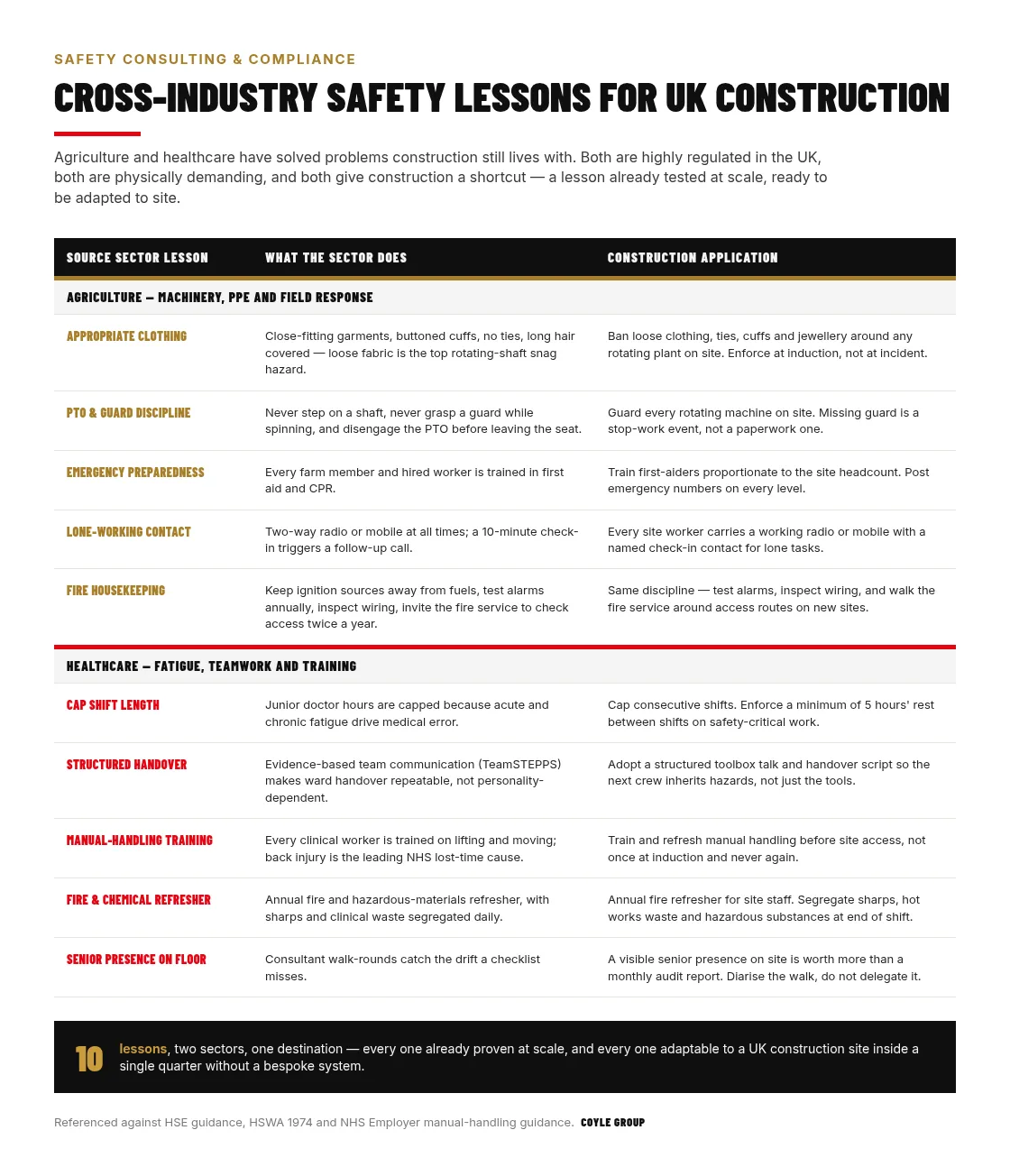
None of the ten is contentious in its home sector, and adopting them on a construction site rarely fails on the safety case; they fail when they are launched as an initiative and never revisited. Building them into the site’s standard toolbox talk cycle, the induction pack and the supervisor’s daily walk is what stops the drift.
Read against a site’s risk register, the matrix also gives supervisors a language for why a control was borrowed rather than invented, which is what an inspector usually asks first.
How Do You Get Site Buy-In for Cross-Sector Safety Controls?
The controls above rarely fail on the safety case. They fail on the shop floor, because a supervisor introducing “how they do it in agriculture” gets the reaction any borrowed idea gets when it lands without context. Buy-in depends on how the change is rolled out, not on the technical case, and the sites that get it right tend to share three habits.
The first is to lead with the hazard, not the source sector. Telling a worker “we are guarding this shaft because a spinning shaft caught a farmhand’s sleeve last year” gives them the reasoning, while telling them “we are copying agriculture” sounds like a management fad. The second is to name the person on site who owns the control, so the discipline has a face rather than a memo. The third is to fold the new control into the existing toolbox talk cycle rather than launching it as a separate initiative, because separate initiatives are what get quietly dropped when the next quarter’s programme lands.
Adopted this way, the ten controls stop being borrowings and become how the site works, which shows the culture has actually moved and not just the paperwork.
Which Industries Have the Best Safety Records in the UK?
HSE’s annual injury statistics rank sectors by fatal-injury rate per hundred thousand workers, and the pattern is stable year to year. Agriculture, forestry and fishing consistently sit at the top of the rate table, followed by waste and recycling, then construction, then manufacturing. Office-based sectors and finance sit at the bottom, largely because the underlying hazard profile is different rather than because their safety management is inherently better.
Two things follow from that ranking. The first is that construction has more in common with agriculture and waste than with the sectors it usually benchmarks against, so borrowing from them is a closer analogue than borrowing from a low-hazard sector that has simply never had to test the controls. The second is that healthcare’s record on non-fatal musculoskeletal injury and shift-fatigue management is what makes it the right source for the human-factors half of a construction safety plan, even though its overall fatal-injury rate is lower, because the underlying hazards it manages are more similar than the aggregate number suggests.
The aim is not to copy the sector with the best headline number, but to copy the sector that has already had to solve the specific hazard you are looking at, which is why cross-sector borrowing beats generic best-practice benchmarking almost every time.
How Coyle Group can help
Coyle Group’s CMIOSH-chartered advisors map proven cross-sector controls into your existing toolbox talk cycle, induction pack and supervisor walk, so each one lands with a named owner and a review date rather than as a one-off initiative.
Adapt These Controls To Your Site
Putting These Lessons Into Practice
Borrowing these lessons works best alongside solid safety training and an honest look at the compliance challenges employers face on site. Each control needs a named owner, a date it appears in the training pack, and a review point on the calendar, or it will drift back to how work was done before.
The Health and Safety Authority’s guidance on construction site duties sets the same expectation from an Irish regulatory reference point: duty-holders are expected to apply controls proportionate to the hazard, not to invent bespoke systems where a proven one already exists, which is why cross-sector borrowing is legally defensible.
If any of the ten cross-sector controls above are missing from your site’s current toolbox talk cycle, book a compliance consultation and we will map them into your existing safety plan rather than replace it.
Frequently Asked Questions
Why is construction a high-risk industry?
Construction exposes workers to falls from height, moving plant and machinery, electrocution, silica dust, and asbestos. This combination means it consistently accounts for one of the largest shares of work-related fatal injuries in Britain each year, alongside agriculture and waste. The variety of hazards on any given site is what makes borrowing controls from other sectors so useful in practice.
What can construction learn from other sectors?
A great deal. Agriculture offers lessons on machine guarding, appropriate clothing and lone-worker check-ins, while healthcare shows the value of managing fatigue, capping shift length, and using structured team communication. Both sectors are UK-regulated, physically demanding and evidence-based, so the practices transfer to a construction site with modest adaptation rather than a bespoke system.
How do you cut accidents on a construction site?
Design the hazard out first, then guard what is left, then train and supervise around what cannot be removed. Cap consecutive shifts, run a structured toolbox handover, put a working radio or mobile on every lone worker, and treat missing guards as a stop-work event. None of these is exotic. They are the controls agriculture and healthcare already run at scale.
What safety lessons from agriculture apply to construction?
Five carry directly onto site: ban loose clothing, ties and cuffs near rotating plant; guard every PTO shaft and treat a missing guard as a stop-work event; train and equip first-aiders in proportion to headcount; give every lone worker a two-way radio or mobile with a named check-in contact; and enforce fire housekeeping including alarm tests, wiring inspections and access checks with the local fire service.
What safety lessons from healthcare apply to construction?
Five carry directly onto site: cap consecutive shifts and enforce a minimum rest period between them; adopt a structured toolbox handover so the next crew inherits hazards not just tools; run refresher manual-handling training rather than a one-off induction session; run an annual fire and hazardous-materials refresher; and keep a visible senior presence on the floor rather than delegating the walk to a monthly audit.
Are cross-sector safety lessons legally recognised in the UK?
The Health and Safety at Work etc. Act 1974 and MHSWR 1999 set outcome-based duties on the employer rather than sector-specific method statements. HSE explicitly encourages borrowing proven controls from analogous hazards elsewhere when the risk profile matches, provided the control is suitable and sufficient for the site's activities. Cross-sector adoption is standard practice on a competent risk assessment.