HSE RECRUITMENT · JOB DESCRIPTIONS
Safety Officer Job Description Template for Wind, Utilities and Construction
A safety officer job description template built the way we brief our own talent pool: one base role, plus the industry add-on block your site actually needs. Need the role filled rather than just written up? We can have a matched officer on site within 48 hours.

Most safety officer job description templates online are written for no industry in particular, which is exactly the problem. A single generic document cannot tell a wind-farm candidate they need GWO Sea Survival, or tell a substation candidate they need an ESB Networks safety rules induction, so hiring managers either leave the certificates vague or copy a different template for every site. This safety officer job description template takes a different approach: one base role, used for every placement, and one industry add-on block, swapped in for the site the officer is actually going to.
The base below covers role purpose, reporting line, key responsibilities, and the qualification route every safety officer needs regardless of sector. The 4 add-on blocks that follow name the extra duties and certificates for wind, utilities and electric, power generation, and construction and data centres. This is the same structure we use to brief our own talent pool before a placement goes out, so a job description built from it is one our officers already recognise.
The base, every role
The Base Safety Officer Job Description
Every safety officer job description we write starts from this base, regardless of sector. Copy it as written, then attach one industry add-on block below.
Role Purpose and Reporting Line
The safety officer owns day-to-day health, safety, and compliance oversight on the assigned site or project, in line with the client's safety management system and the regulations the project sits under.
Reports to a SHEQ Manager or, on smaller contracts, directly to the project lead. Escalates any finding that cannot be closed at site level.
Key Responsibilities
- Maintain a visible daily presence across all active work areas.
- Develop and review RAMS, Method Statements, and Lift Plans specific to the tasks running on site.
- Record and report incidents and near misses, and support the subsequent investigation.
- Deliver toolbox talks and inductions for new starters and subcontractors.
- Maintain the site's permit-to-work register and hold stop-work authority where a control is missing.
Qualifications and Experience
- NEBOSH National General Certificate as the floor, NEBOSH Construction Certificate for site-based construction roles, NEBOSH Diploma for senior posts.
- IOSH membership at the grade the role calls for: TechIOSH for junior appointments, GradIOSH for working-towards-chartered status, CMIOSH for senior and advisory roles.
- Current Safe Pass (Ireland) or CSCS card (Great Britain), plus working-at-height and first aid as a baseline.
- Named, verifiable project history in a comparable role and sector.
Competencies
- Communicates plainly with site crews and with senior management without changing the message.
- Writes documentation that holds up when a regulator, client, or insurer reviews it.
- Holds a line under schedule pressure rather than waving a control through to protect a deadline.
Need the role filled, not just written up? Hire a safety officer in 48 hours and skip the search entirely.
Hire a safety officer in 48 hours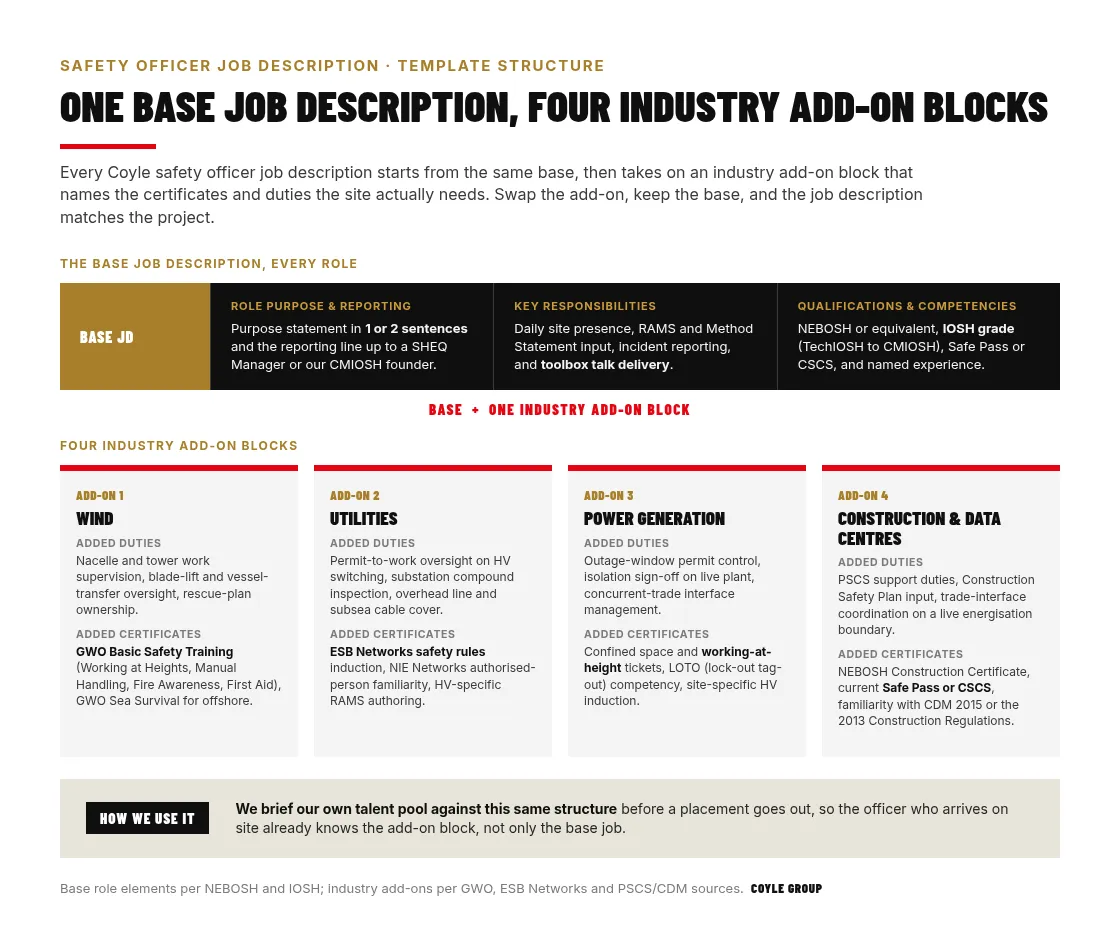
Match the add-on to the site
4 Industry Add-On Blocks
Attach one block to the base above. Each one names the extra duties and the certificates that site actually requires, not a generic "relevant qualifications" line. For the full placement picture on any of these sites, our wind energy, utilities and electric, and construction and engineering pages cover the sector in full.
Wind
Added responsibilities
- Supervise working-at-height access to the nacelle, hub, and tower, including rescue-plan readiness for every climb.
- Oversee blade-lift and vessel-transfer operations alongside the lift supervisor and crane coordinator.
- Own the turbine-specific permit-to-work and isolation procedure before any commissioning or maintenance task starts.
Added certificates
- GWO Basic Safety Training: Working at Heights, Manual Handling, Fire Awareness, and First Aid.
- GWO Sea Survival, required for offshore deployment.
- IRATA rope access, where the project calls for it.
Utilities and Electric
Added responsibilities
- Hold the permit-to-work register for HV switching, live-line work, and substation access.
- Inspect the substation compound for earthing, edge-protection, and exclusion-zone compliance.
- Review RAMS and lift plans for overhead line, transmission corridor, and subsea cable activity.
Added certificates
- Induction on ESB Networks safety rules, or the equivalent NIE Networks or EirGrid rule book for the project.
- Authorised-person status where the client's permit-to-work regime requires it.
- Working knowledge of General Application Regulation 42 for lifting operations.
Power Generation
Added responsibilities
- Control the outage-window permit schedule across concurrent mechanical, electrical, and instrumentation trades.
- Sign off isolations on live plant before any contractor begins work inside the boundary.
- Manage the interface between the operator's own personnel and the outage contractor's crews.
Added certificates
- Confined-space entry and working-at-height tickets, current and site-verified.
- Lock-out tag-out (LOTO) competency, demonstrated rather than assumed from a certificate alone.
- Site-specific HV induction, refreshed for each outage if the plant has changed since the last one.
Construction and Data Centres
Added responsibilities
- Support the PSCS in Ireland, or the principal contractor under CDM 2015 in Great Britain, on day-to-day compliance.
- Feed Construction Safety Plan updates as the programme and trade sequencing change.
- Coordinate the trade interface around the point where electrical services go live mid-build, a recurring data centre hazard.
Added certificates
- NEBOSH Construction Certificate, or the General Certificate plus documented construction-sector experience.
- Current Safe Pass (Ireland) or CSCS card (Great Britain).
- Familiarity with the 2013 Construction Regulations or CDM 2015, matched to the project's jurisdiction.
Writing it correctly
Getting the Wording Right
Contract vs. Permanent Wording
The duties and qualifications sections rarely change between a contract and a permanent role. What changes is the term and the employment wording.
| Section of the job description | Contract role | Permanent role |
|---|---|---|
| Duties and qualifications | Same base and add-on block | Same base and add-on block |
| Term | States the assignment length: days to weeks for a defined outage, months to years for a phased build | Open-ended |
| Employer of record | Named, so the candidate knows who carries payroll, insurance, and notice-period obligations | The client, as direct employer from day one |
| Typical roles | Site-level safety officers, where most of the demand behind this template sits | Senior SHEQ leadership, transferring to the client on a commission basis once the appointment is confirmed |
What Hiring Managers Get Wrong
-
Generic qualifications
"Relevant safety qualifications required" does not tell a candidate they need GWO Sea Survival offshore or a current Safe Pass on a construction site. The shortlist fills with people who look right on paper and then need weeks of on-site orientation.
-
Blurred contract and permanent wording
Mixing both in the same posting creates a dispute over notice periods and employer-of-record responsibility after an offer has already gone out.
-
No expiry dates on certificates
Asking for a certificate without asking for its expiry date is how an out-of-date GWO or Safe Pass card ends up on site.
How We Use This Structure
We brief our own talent pool against the exact base-plus-add-on structure on this page before a placement goes out. Every officer we put forward has already been screened against the certificates in the relevant add-on block, not matched on a generic job title. That is why a role built from this template is faster for us to fill.
If a role does not fit neatly into one of the 4 add-on blocks, for example a mixed outage and construction programme, brief us directly and we will build the combined specification rather than forcing it into a single category.
Written the job description and ready to brief it to candidates? Hire a safety officer in 48 hours and we will match it against our talent pool today.
Hire a safety officer in 48 hoursQuestions about the template
Safety Officer Job Description Questions Answered
What should a safety officer job description include as a minimum?
A role purpose statement in 1 or 2 sentences, the reporting line (typically up to a SHEQ Manager or, on smaller contracts, directly to project leadership), key responsibilities covering site presence, RAMS and Method Statement input, incident reporting, and toolbox talk delivery, and a qualifications section setting the NEBOSH or equivalent baseline plus the IOSH grade expected. Everything beyond that is the industry add-on, not the base.
Do I need a different job description for every industry, or can I use one template?
Use one base template and attach the industry add-on block that matches the site. A generic safety officer job description with a single line reading "relevant certifications required" does not tell a wind-farm candidate they need GWO Sea Survival, or tell a substation candidate they need ESB Networks safety rules induction. The base stays identical across every role; only the add-on changes.
What is the difference between a contract and a permanent safety officer job description?
The duties and qualifications sections are usually identical. What changes is the term and reporting wording: a contract job description states the assignment length (days to weeks for a defined outage, or months to years for a phased build) and names the employer of record, while a permanent job description states an open-ended term with the client as the direct employer. Senior SHEQ leadership roles are more often written as permanent placements; site-level officer roles are more often written as contract assignments.
Should the job description require NEBOSH, IOSH, or both?
Both, at different points in the sentence. NEBOSH (National Examination Board in Occupational Safety and Health) is the qualification route: General Certificate as the floor, Construction Certificate for site-based construction roles, and the NEBOSH Diploma for senior posts. IOSH (Institution of Occupational Safety and Health) is the membership grade that qualification and experience unlock: TechIOSH, then GradIOSH, then Chartered status (CMIOSH) for the most senior appointments. A job description that asks only for "IOSH membership" without naming the qualification route will under-specify the role.
Do GWO certificates expire, and should the job description state a renewal period?
Yes. GWO Basic Safety Training modules are valid for a fixed period before refresher training is required, and the exact window is set in the current Global Wind Organisation standard rather than fixed indefinitely. State in the job description that certificates must be in-date at the point of mobilisation, not simply held at some point in the candidate's career, and ask for the certificate dates as part of the application rather than taking a verbal confirmation.
What is the most common mistake hiring managers make with this job description?
Writing the qualifications section generically and leaving the industry add-on out entirely. A job description that lists "safety qualifications as required" instead of naming GWO, ESB Networks safety rules, or Safe Pass and CSCS by name attracts candidates who look right on paper and then need weeks of on-site orientation before they can work unsupervised. The second most common mistake is blurring contract and permanent wording in the same posting, which creates a dispute over notice periods and employer-of-record responsibility later.
How quickly can Coyle Group fill a role once this job description is set?
Once the brief and industry add-on are confirmed, we match against our talent pool of 100+ degree-qualified safety officers and typically have a matched candidate on site within 48 hours. Our management team is available the same day a brief comes in, and every candidate put forward has already been screened against the certificates named in the relevant add-on block.
Related reading
Before You Hire Against This Job Description
Health and Safety Recruitment
A 6-point hiring checklist and current Irish and UK pay bands for safety roles.
What a Safety Engineer Does
Where the safety engineer role sits apart from the generalist safety officer.
Outsourcing Safety Resources
When contract supply beats a direct hire for project-shaped safety work.
Safety Officer Interview Questions
35 scored questions to test candidates against the duties in this job description.
CMIOSH · 48-hour deployment
From Job Description to Officer on Site
Use the template above to brief the role, or send us the industry and site details directly. Hire a safety officer in 48 hours, matched from our talent pool against the exact base and add-on categories this page is built on.
Hire a safety officer in 48 hours