35 Safety Officer Interview Questions with Scoring Guide

Site safety officer interview questions work best when they are fixed before the first candidate walks in. A site manager who improvises tends to hire the best talker, and the best talker is not always the person who will stop a lift when the wind picks up. This guide gives hiring managers, project managers and HR leads in energy, utilities, wind, construction and data centres 35 questions to ask.
The questions are grouped by competency, with what a strong answer includes, the red flags to listen for and a simple 0 to 3 scale you can adapt. The legal questions cover both Ireland and Great Britain, because the law you test on depends on where the site is.
Short of candidates to put in front of your panel? Hire a safety officer in 48 hours from a pool of more than 100 qualified officers.
Hire A Safety Officer In 48 Hours
Scoring Safety Officer Interview Answers on a 0 to 3 Scale
Start with the role, then the safety officer interview questions. Write the duties down using our job description template, pick the competencies the post depends on and agree the scoring scale with everyone on the panel before the first interview. The scale for these site safety officer interview questions is a suggested method, and you should adjust it to your own site and sector.
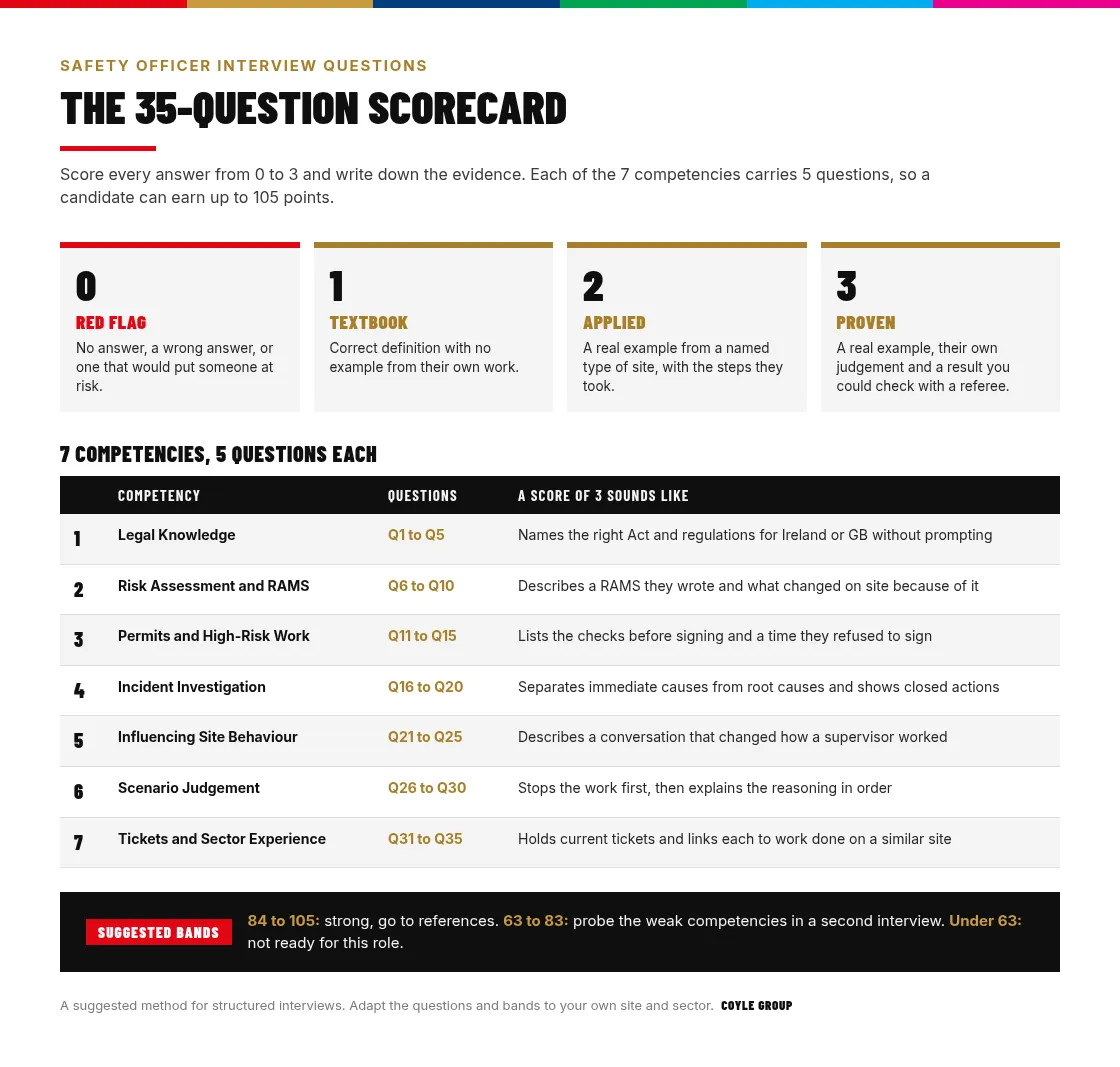
Score each answer as soon as the candidate finishes it. A 0 is a wrong or unsafe answer, a 1 is a correct textbook answer, a 2 is a real example from a named type of site with the steps taken, and a 3 adds the candidate’s own judgement and a result a referee could confirm. Add the scores at the end. A total of 84 or more out of 105 is a strong result, 63 to 83 deserves a second interview on the weaker competencies, and anything lower suggests the candidate is not ready for this role.
Keep notes of what the candidate actually said, because memory favours the last person interviewed. Have each panel member score independently and compare afterwards, and the gaps between scores will show you where the evidence was thin.
Legal Knowledge Questions for Ireland and Great Britain
Legal knowledge is the quickest competency to check, and the one candidates most often over-claim. Ask the questions that match the jurisdiction of the site, and ask follow-ups until the candidate gives a regulation or section number they could actually find.
- Which legislation sets the duties of employers and employees on this site, and what does it require of you?
- In Ireland, what does section 19 of the Safety, Health and Welfare at Work Act 2005 require, and how does it link to the safety statement under section 20?
- In Great Britain, what do the Health and Safety at Work etc. Act 1974 and the Construction (Design and Management) Regulations 2015 require of a principal contractor?
- When must a contractor in Ireland appoint a safety officer in writing under the Safety, Health and Welfare at Work (Construction) Regulations 2013, and what are that officer’s duties?
- Which incidents on this project must be reported to the regulator, to whom, and by when?
A strong answer names the right law for the site without prompting and explains what it means in practice. For question 4, a good candidate knows that regulation 26 applies to contractors with more than 20 persons under direct control on a construction site, or 30 persons engaged in construction work, and that the safety officer advises on and supervises compliance. For GB questions, a good candidate knows that CDM 2015 requires anyone appointing a contractor to take reasonable steps to confirm that the contractor has the skills, knowledge, experience and organisational capability for the job.
Red flags include mixing up Irish and GB law, citing the 1974 Act on an Irish site, and describing legislation only as “the rules” with no section or regulation attached. A candidate who cannot say who the regulator is, the Health and Safety Authority in Ireland or the Health and Safety Executive in Great Britain, has not worked in that regime for long.
Risk Assessment and RAMS Questions
Risk assessment and method statements are the safety officer’s daily paperwork, so a candidate should be able to talk about them from experience. Our RAMS guide sets out what a sound document contains, and these questions test whether the candidate has used one on a live job.
- Walk us through the last RAMS you wrote or reviewed. Which hazards did you find, and what changed on site because of it?
- How do you decide whether a contractor’s RAMS is adequate, and what makes you send one back?
- Give an example of a hazard, the risk it created and the control measure you chose, from work you supervised.
- How do you apply the hierarchy of control when you cannot eliminate the hazard?
- How do you check that the RAMS is followed once work starts, and what do you do when the site has changed since it was written?
A strong answer is specific. The candidate names the task, the hazards, the controls and the person who briefed the crew, and explains how they checked the work against the document. They also describe a time they sent a RAMS back and what the contractor changed.
Red flags include describing RAMS as a document to collect, praising generic templates, and saying personal protective equipment (PPE) is the first control for most hazards. A candidate who has never rejected a RAMS has probably never read one closely.
Permit to Work and High-Risk Activity Questions
Permits cover the work most likely to kill someone, such as hot work, confined spaces, electrical isolation, lifting and work at height. These questions matter most for utilities, power generation, wind and data centre fit-out, where permit systems are strict and clients audit them.
- Which permits have you issued, authorised or audited, and on what type of site?
- What do you check on the ground before you sign a permit, and what makes you refuse?
- How do you manage simultaneous operations where 2 permitted activities affect each other?
- Describe a lifting operation you oversaw. Who was appointed, what did the lifting plan cover, and what stopped the lift?
- How do you control a permit at shift handover and at closure?
A strong answer describes a physical walk-through: isolation points checked, atmosphere tested, barriers in place, the crew briefed and the permit signed only when the area matched the paperwork. The best candidates volunteer a time they refused a permit and how the project manager reacted.
Red flags include signing permits from the cabin, treating the permit as a formality, and no clear view on who can authorise what. Be cautious about any candidate who describes closing every permit in 1 batch after the shift.
Incident Investigation and Reporting Questions
Investigation shows how a candidate thinks once something has already gone wrong. Our near miss investigation guide covers the method in detail, and these questions check whether the candidate has used one.
- Tell us about the last incident or near miss you investigated. What happened, and what did you find?
- How do you separate immediate causes from root causes, and which method do you use?
- Who do you interview, in what order, and how do you keep the questions from turning into blame?
- How do you decide whether an incident is reportable, and who do you notify?
- How do you confirm that corrective actions were closed and that they worked?
A strong answer starts with the facts, moves through the causes in order and ends with actions that have an owner and a date. The candidate can explain why a root cause such as an unclear handover sits behind an immediate cause such as a missed isolation. They can also say what changed on site 3 months later. Where reporting is concerned, they know the thresholds, and our RIDDOR guide is a useful reference for GB sites.
Red flags include stopping at “operator error”, describing an investigation that finished with retraining and nothing else, and an inability to say how they check that an action was completed. Be wary of a candidate who has never closed an investigation with a change to the site’s own procedures.
Influencing Site Behaviour and Supervisors
A safety officer has no power to hire or fire the crew, so the job runs on influence. Supervisors set the pace on site, and a candidate who cannot work with them will spend the contract writing reports nobody acts on.
- A supervisor tells you the programme cannot afford a toolbox talk today. What do you do?
- How do you give corrective feedback to an experienced tradesperson who has worked the same way for 20 years?
- How do you build working relationships with subcontractor supervisors in your first week on a new site?
- Tell us about a time you were overruled on a safety call. What happened next?
- How do you run a briefing so that the crew remembers it an hour later?
A strong answer describes a real conversation, with the words the candidate used, the supervisor’s reaction and what changed afterwards. Good candidates talk about learning the work, walking the site with supervisors and raising problems early. They are willing to escalate when needed and clear about how.
Red flags include answers about “enforcing the rules” with no mention of conversation, a habit of issuing disciplinary threats and stories where the candidate was never challenged. A candidate who says they have never been overruled has either not worked on a busy programme or is not telling the whole story.
Scenario Questions That Test Judgement
Scenarios put the candidate on the spot, which is the closest an interview gets to a real shift. Give the details, ask for the first 5 minutes of action, then ask what they would do after that. Ask the same scenarios of every candidate so the scores can be compared.
- You see an operative on a scaffold with a missing toe board while the crane driver waits to lift over that area. What do you do in the next 5 minutes?
- A project manager asks you to backdate a permit so a delayed task can finish on programme. How do you respond?
- A subcontractor’s RAMS arrives at 7am for work starting at 8am. What happens next?
- Two operatives report a near miss 3 days late and ask you not to log it. What do you do?
- Wind speed rises during a crane lift and the crew wants to finish the lift. What do you do, and who do you tell?
A strong answer stops the work first, secures the area, then explains the reasoning in order and names the people who must hear about it. For question 27, the candidate refuses to backdate and offers the project manager another way to recover the time. For question 29, the near miss is logged, and the candidate treats the late report as information about how the crew sees reporting.
Red flags include hesitating about whether to stop work, suggesting the safety officer’s job is to report upwards only, and answers that jump straight to paperwork. A candidate who is quick to blame operatives in every scenario will find site relationships hard.
Tickets, Qualifications and Sector Experience Questions
Check tickets and sector experience last. A card proves a course was attended on a given date, and the earlier questions show whether the candidate can apply what the course taught. These questions also confirm that the candidate can work on your sites from day 1.
- Which site cards and tickets do you hold, such as Safe Pass in Ireland or a CSCS card in Great Britain, and when does each expire?
- Which health and safety qualification do you hold, and how do you keep your knowledge current? Our safety education guide explains the main routes.
- Which of your recent sites matches ours in sector, size and hazards, and what was different about it?
- What have you done on live or energised sites, such as electrical isolation, outage work or confined spaces?
- Who can we speak to for references on your last 2 assignments?
A strong answer gives exact tickets with dates, links each one to work done on a similar site and offers referees without hesitation. In wind, the candidate also mentions sector training such as GWO Basic Safety Training, and in utilities they describe isolation and access procedures with real detail.
Red flags include tickets that have lapsed, qualifications that cannot be checked and a career history with unexplained gaps between assignments. A candidate who cannot name a referee from a recent site has usually left on poor terms, and the reference call will tell you why.
Interviews booked and no shortlist yet? Hire a safety officer in 48 hours and put a candidate matched to your site in front of your panel.
Hire A Safety Officer In 48 Hours
Once the scores are in, the decision comes down to how you weigh them against the programme.
Turning Interview Scores into a Hiring Decision
Add up each candidate’s scores and look at the pattern as well as the total. A candidate with 80 points who scored 0 on permits is a bigger risk on a utilities outage than one with 75 points and no gaps. For hard-to-fill roles, our health and safety recruitment guide explains how sourcing works, and our day rate guide helps you check the pay you are offering against the market. If the scores point to a strong candidate for a short programme, our guide to contract or permanent hiring helps you decide how to engage them.
Call the referees before you make an offer, and ask them the same competency questions you asked the candidate. A referee who confirms the examples gives you far more confidence than any score. If you need a safety officer on site while the process runs, we can help. We have supplied safety professionals since 1999, our founder Gavin Coyle is a Chartered Member of IOSH (CMIOSH), and we have a talent pool of more than 100 safety officers across tier-one industries. Hire a safety officer in 48 hours and interview candidates matched to your site.
Frequently Asked Questions (FAQs): Safety Officer Interview Questions
These are the questions hiring managers ask Coyle Group most often when they prepare to interview a site safety officer.
How many questions should a site safety officer interview include?
Most interviews have time for 12 to 15 questions, so choose 2 from each of the 7 competencies rather than asking all 35. Keep the same questions for every candidate and score each answer straight away. Coyle Group suggests holding the scenario questions for a second round if the first interview leaves 2 candidates close.
Should the questions differ for Ireland and Great Britain?
Yes, for the legal competency. Irish sites run under the Safety, Health and Welfare at Work Act 2005 and the Construction Regulations 2013, while Great Britain uses the Health and Safety at Work etc. Act 1974 and CDM 2015. Coyle Group places safety officers in both countries and recommends asking each candidate about the law that applies to your site.
How do you score answers in a safety officer interview?
Score each answer from 0 to 3. A 0 is a wrong or unsafe answer, a 1 is a textbook definition, a 2 is a real example with the steps taken, and a 3 adds the candidate's own judgement and a result a referee could confirm. Coyle Group suggests adding the scores and probing weak competencies in a second round.
What are the biggest red flags in a safety officer interview?
Watch for candidates who describe only what the regulations say, cannot name a task they stopped, blame workers for every incident, or agree to sign a permit under programme pressure. Coyle Group also treats vague tickets with no expiry dates, and references the candidate cannot supply, as reasons to pause.
Which qualifications should a site safety officer hold?
Both Irish and GB law ask for a competent person, which turns on training, experience and knowledge. No single named certificate is prescribed. Coyle Group advises employers to ask for a recognised health and safety qualification, current site tickets and experience of the sector, then test all 3 with scenario questions.
How quickly can Coyle Group supply safety officers to interview?
Coyle Group can deploy a contract safety officer from its pool of more than 100 safety officers within 48 hours once the scope is confirmed. For a permanent search, the timeline depends on the sector, tickets and location, and a short call to agree the role comes first so the interview questions match the work.