Outsourcing Safety Resources: Benefits, Costs & Pitfalls

Outsourcing is a big deal in the corporate world because of the potential benefits it comes with. If outsourcing is done rightly, it can give your organisation the leverage it needs to succeed in your industry. Whether you are a big construction company, a green energy provider, a manufacturing company or a small business, outsourcing comes with immense benefits for your organisation. However, business owners and employees need to be careful, because if you outsource to incompetent hands you might not achieve your organisational goals.
One of the reasons companies take outsourcing seriously is that it allows them to focus on other core business tasks while professional contractors handle other aspects of their operations. Over time, outsourcing has proven to help business owners meet deadlines and perform important organisational functions. If you are considering outsourcing safety for your project, it could be a step in the right direction.
Reasons to Outsource Safety Resources
Bringing in specialist safety support does more than tick a compliance box. It changes how confidently you can plan, staff and run a project from start to finish. The reasons below are the ones our clients across construction, energy and manufacturing raise most often when they weigh up the decision.
Ensures safety regulation compliance
One of the perks of outsourcing safety resources for your project is compliance. Many safety consultants are strong advocates for workplace safety compliance. They will also help you set up a safety management system so compliance is built into how you work rather than bolted on afterwards. Outsourcing your safety concerns to a professional is therefore a great way to make sure you meet your legal duties, whether that is the Health and Safety at Work etc. Act 1974 and its regulations in Great Britain, or the Safety, Health and Welfare at Work Act 2005 in Ireland.
When you outsource to a safety consultant, they use their experience and training to make sure you meet the standards the HSE in Great Britain and the HSA in Ireland expect. Since safety is a priority for the consultant, all requirements and regulations will be thoroughly checked to see whether there is a need for an upgrade.
Establish employee safety
While your project is underway, one of the things you need to prioritise is employee safety. When your employees are safe, completing your project becomes more feasible. Outsourcing safety ensures that your staff can rest assured knowing they do not have to concern themselves with researching ways to keep safe, because there is a team whose primary task is to do this.
With a professional safety consulting team, the risk of your employees getting injured or putting their lives at risk is reduced.
Reduces risk in the workplace
When working on a project, the last thing you need is to incur any risk, because you might have to spend more money. Outsourcing safety resources might be your best move to reduce the chances of encountering risks while you work towards your project’s goals. A consultant will usually start with a structured risk assessment to surface those risks before they become incidents.
With non-compliance, your company and reputation face a potential threat, which might be a huge financial burden for you. Additionally, you will avoid the legal hazards of not operating within the safety law.
Taken together, these reasons explain why so many organisations treat outsourced safety as an investment rather than an overhead. The next question is how that choice compares with building the same capability in-house.
In-House vs Outsourced Safety Management
The real question for most managers is not whether safety matters, but whether to build the capability in-house or bring it in. Both models work. The right one depends on the size, risk profile and duration of your project.
- In-house safety. A permanent hire gives you someone embedded in the culture, on site every day, and fully accountable. The trade-off is cost and cover: salary, recruitment, training, holiday and sickness cover, and the management time to keep them productive. On a single project, that capacity can sit idle between peaks.
- Outsourced safety. A consultant or contract professional gives you senior competence exactly when you need it, scaled up for a busy phase and down when the risk falls. You pay for output rather than headcount, and you avoid the long tail of employment costs. The trade-off is that outsourced staff need clear briefs and management.
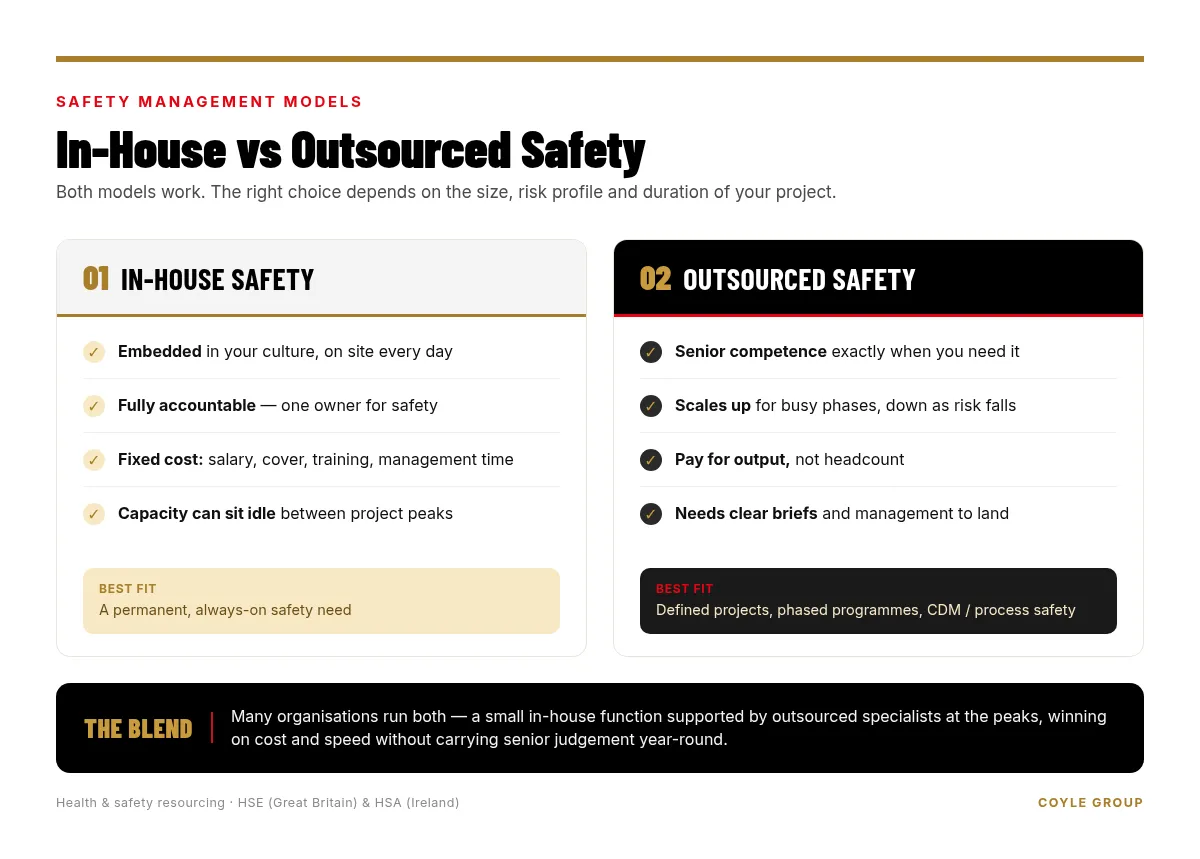
For a defined project, a phased programme or a specialist requirement such as CDM or process safety, outsourcing usually wins on both cost and speed. For a permanent, always-on need, an in-house hire often makes more sense. Many organisations run a blend: a small in-house function supported by outsourced specialists at the peaks. If you do decide to build in-house, our guide to creating a high-performing safety team covers the traits that matter most.
The Cost and ROI of Outsourcing Safety
The headline day rate is only part of the picture. To judge the return on outsourcing health and safety, weigh it against the true cost of the alternative:
- The fully loaded cost of an in-house hire, not just the salary.
- The cost of getting compliance wrong: HSE or HSA enforcement, fees for intervention, civil claims, insurance loading and lost tender opportunities.
- The value of avoided downtime, because an incident stops a site far more expensively than a consultant’s fee.
Framed that way, outsourcing safety management is rarely the cheap option, but it is often the one with the strongest return, because you buy senior judgement without carrying it year-round.
Common Mistakes to Avoid When Outsourcing
Outsourcing safety works well, but only when it is set up properly. Most of the problems we see stem from a handful of avoidable assumptions rather than from the model itself. Watch for the three mistakes below before you hand over responsibility.
Assuming you do not need managers after outsourcing
One of the mistakes business owners make is assuming that their independent safety contractors do not need managers. Even though some of them are experts at managing their internal processes, remember that their overall actions can make or mar your project. Do not undermine the value of having managers cater to your business or project.
Looking for cheap work
Another mistake to avoid is thinking that cheap work will bring the best hands. If you bring in a safety consultant on cheaper wages who is not good at what they do, you are putting the lives of many people at risk. If you want the right hands to ensure safety for your project or workplace, ensure your rates and compensation are slightly above the market rate.
Assuming they will instantly adapt to your culture
No matter how good an outsourced staff member might be, they might not instantly conform to your work culture. Do not be in a hurry to expect changes when they come on board.
Avoiding these pitfalls comes down to clear briefs, fair rates and realistic expectations from day one. Get those right and outsourced safety becomes a genuine extension of your team.
Making Outsourced Safety Resources Work
It is important to mention that while you begin to outsource safety resources for your project, you should get ready to provide a solid safety training strategy for your in-house staff. This will help you prevent common mistakes and increase the success rate of your project. If you decide a permanent hire is the better fit, our guide to health and safety recruitment covers what to screen for.
Have you considered outsourcing safety resources for your project? If you need help on how to go about this, book a free consultation with our team.
Frequently Asked Questions
How much does it cost to outsource health and safety?
The cost of outsourcing health and safety varies with the size, risk profile and duration of your project, and is usually charged as a day rate or a retained monthly fee. To judge value, compare that figure against the fully loaded cost of an in-house safety officer, including salary, recruitment, training, holiday and sickness cover. For most defined projects, outsourcing buys senior competence at the peaks without carrying a permanent salary year-round.
Should a small business outsource health and safety?
For many small businesses, outsourcing health and safety is the practical choice because the workload rarely justifies a full-time hire. A retained consultant keeps you compliant with the HSE in Great Britain or the HSA in Ireland, handles risk assessments and reviews your arrangements as the business grows. You gain qualified support and expertise only when you need it, rather than an ongoing salary.
In-house or outsourced safety, which is better?
Both models work, and the right one depends on the size, risk profile and duration of your project. A permanent in-house hire suits an always-on need and embeds someone in your culture on site every day, while outsourcing suits defined projects, phased programmes or specialist requirements such as CDM or process safety. Many organisations run a blend: a small in-house function supported by outsourced specialists during busy phases.
What does a health and safety consultant do?
A health and safety consultant reviews your workplace against current regulations, carries out risk assessments, writes safety policies and advises on the practical steps needed to protect your staff. They make sure you meet the standards the HSE in Great Britain and the HSA in Ireland expect, and they help you close any gaps before they become incidents or enforcement issues. Their goal is to keep your project compliant and your people safe.
When should you hire a safety consultant instead of a full-time safety officer?
Hire a safety consultant when your need is temporary, project-based or specialist, such as a single construction phase or a CDM requirement, where a permanent salary would sit idle between peaks. Choose a full-time safety officer when you have a continuous, site-wide need that justifies someone embedded in the team every day. If you are unsure, start with outsourced support and review the arrangement as your workload settles.
Is outsourcing health and safety compliant with the HSE and HSA?
Yes. You can appoint an external consultant as your competent person under the Health and Safety at Work etc. Act 1974 in Great Britain and the Safety, Health and Welfare at Work Act 2005 in Ireland. Legal duty for safety still rests with you as the employer, so you keep managers in place to oversee the arrangement and act on the consultant's advice. Used this way, outsourcing is a fully compliant route to meeting your obligations.