UTILITIES & ELECTRIC · RAMS
Substation Maintenance RAMS: What Auditors Look For
A substation maintenance RAMS gets rejected for the same handful of gaps every time: a generic isolation point, an unnamed test instrument, or an approach distance copied from the wrong job. We review and author substation maintenance RAMS for HV work across Ireland and the UK, and this guide sets out exactly what we check before a crew goes near live equipment.
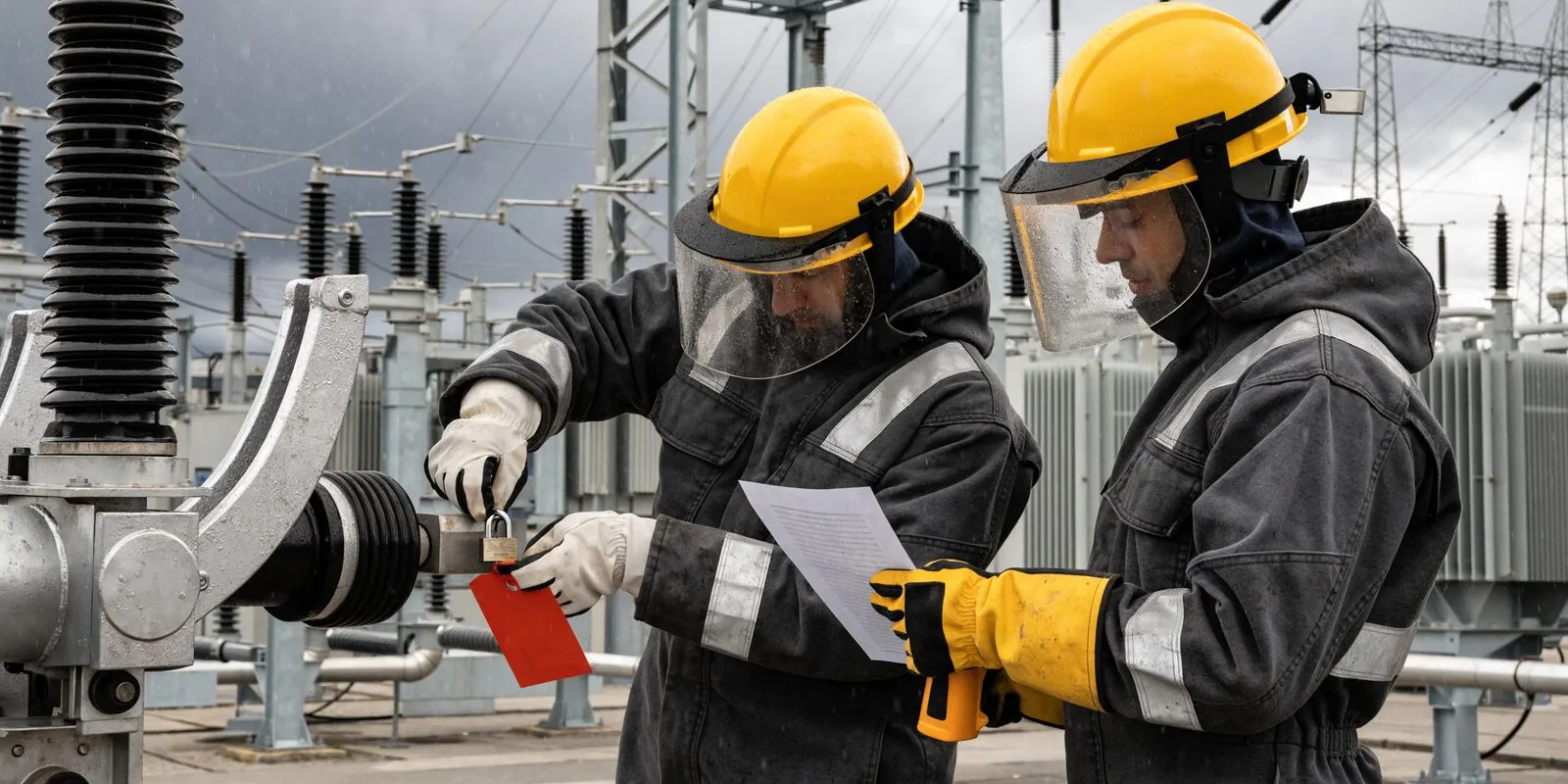
A substation maintenance RAMS (risk assessment and method statement) has to prove something a generic method statement cannot. It has to show that the crew understands exactly how this piece of HV equipment gets isolated, proved dead, and made safe to work on today, not on a job like it. Coyle Group writes and reviews substation maintenance RAMS for HV and EHV sites across Ireland and the UK, and the same 6 fields come back short every time: the isolation point, the test instrument, the approach distance, the confined space and gas plan, the height and lifting arrangement, and the name against the authorisation level the task needs.
This guide sets out what an auditor, a principal contractor's safety adviser, or a network control engineer checks in a substation maintenance RAMS before signing off a day's work, and where Irish and UK duties differ. It stays on what changes once a task moves inside a live HV compound, not on how to build a RAMS pack generally.
Need a substation maintenance RAMS checked before a shutdown starts? Request a utilities safety consultation with our chartered team.
Request A Utilities Safety ConsultationBefore anyone touches the switchgear
Isolation And Switching: The Safety Document That Proves It
Both jurisdictions require equipment to be isolated and held dead before work starts. The RAMS has to name how that precaution is held, not just state that it exists.
| Duty | Ireland | Great Britain |
|---|---|---|
| Switch off and isolate | Regulation 85, General Application Regulations 2007 | Regulation 13, Electricity at Work Regulations 1989 |
| Precautions once dead | Regulation 86: make dead, prevent re-energisation, restrict live work to an authorised person | Regulation 13: adequate precautions to stop dead equipment becoming live again while work goes on |
| Substation-specific rules | Regulation 91, covered in the HSA's own guide to Part 3 | Network operator safety rules, modelled on the Energy Networks Association's Model Distribution Safety Rules |
The safety document that governs the switching
Many network operators formalise isolation through one of these documents, and client frameworks such as ESB Networks' own safety rules mirror them.
Permit-to-Work
Work on equipment made dead and held dead for the duration of the task.
Sanction-for-Test
Equipment made live again briefly, for example to test a protection relay.
Limitation-of-Access
A full permit is not appropriate, but verbal instruction alone is not enough.
Caution Notice
Fixed at the point of isolation, warning people not to interfere with the equipment.
What a reviewer sends back
A RAMS that names "lock-out tag-out" without saying which document governs the switching, who issued it, and who is authorised to cancel it.
Proving dead: a step, not an assumption
Name the approved voltage-indicating device and the proving unit used to test it.
Test the device on the proving unit immediately before use, prove the equipment dead, then test the device again.
Apply circuit main earths, then any local earths at the point of work.
Remove earths in the reverse order, written explicitly into the RAMS rather than worked out on the day.
When dead is not the answer
Approach Distances And Arc Flash
Regulation 14 of the Electricity at Work Regulations 1989 only allows work on or near a live conductor when all 3 conditions below are met. That test is why live diagnostic work, such as checking a protection relay under a Sanction-for-Test, is planned as a distinct activity in the RAMS rather than folded into the isolation section.
It is unreasonable in all the circumstances for the conductor to be dead.
It is reasonable in all the circumstances to be at work on or near it while live.
Suitable precautions, including PPE where necessary, are taken to prevent injury.
Why we do not publish a single approach-distance table
Minimum approach distances and arc-flash incident energy scale with voltage, fault level, and the specific switchgear on site. They are set in the network operator's own safety rules, not in a single Irish or UK regulation. HSE's HSG85 sets the framework for deciding safe working practices around live equipment, but the distance itself comes from the client's rules for that voltage and that site.
The RAMS must cite: which safety rules document it works to, and the distance that applies there. Never a figure carried over from a different project.
Below ground and inside the tank
Confined Spaces, Cable Basements, And SF6
Cable basements, cable ducts, and transformer pits sit inside most substation compounds. Treat them as confined spaces until a specific assessment says otherwise. SF6 switchgear then adds a gas-handling duty alongside the electrical isolation, not inside it.
Confined spaces
- Great Britain
- Confined Spaces Regulations 1997: no entry unless the work cannot reasonably be done another way, then a safe system of work and emergency arrangements.
- Ireland
- No equivalent named instrument. The duty sits inside the general risk assessment requirement of the Safety, Health and Welfare at Work Act 2005.
The RAMS must contain
- Atmosphere testing before entry
- Continuous monitoring where the risk is ongoing
- A rescue plan that works from outside the space, not one that needs a second person to enter
SF6-insulated switchgear
- The legal duty
- The EU F-Gas Regulation requires operators to have SF6 equipment leak-checked at set intervals and to keep records of the gas on site.
- Personal certification
- Not required for the people carrying out SF6 leak-checking, unlike refrigerant engineers.
The RAMS must still name
- Who is competent on the gas-handling side
- The ventilation plan for a confined switch room
- What happens if a leak is found mid-task, as a section separate from the switching plan
The checklist in one view
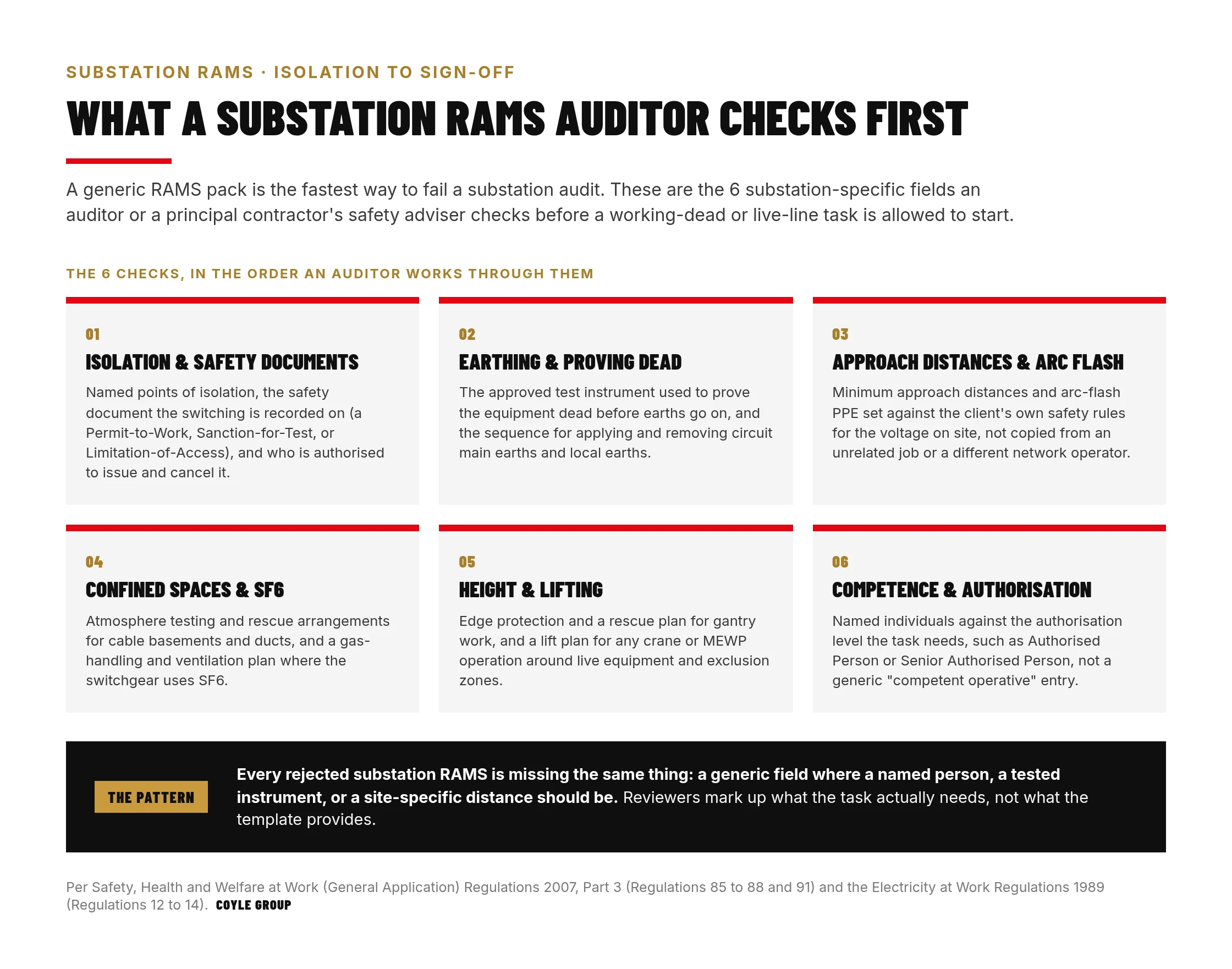
The 6 Checks In The Order We Work Through Them
Gantries, towers and the lift
Working At Height, Lifting, And Emergency Rescue On Gantries
Busbar gantries, structure-mounted disconnectors, and overhead terminations put work at height on top of an electrical hazard. The RAMS has to plan the 2 together, not in separate documents that never reference each other.
Height and rescue
- Edge protection and a fall-restraint or fall-arrest system come first.
- The rescue plan says how an injured person is brought down from that specific structure.
- It uses the equipment actually on site, inside a time that matters.
Lifting near live equipment
- Crane and MEWP lifts, such as placing a transformer bushing or circuit breaker tank, fall under General Application Regulation 42 in Ireland.
- The lift plan covers the exclusion zone around live conductors as well as the working load limit.
- It sits as its own RAMS section, not a line inside the main method statement.
The recurring failure we find on review
A rescue plan that reads well on paper but assumes equipment nobody on the crew carries. A dry run before the task starts is meant to catch exactly that.
When the lift and the isolation interact
For example, earthing a crane boom working near overhead conductors. The RAMS should say explicitly which document takes precedence if the 2 plans conflict on site.
The name on the signature line
Competence And Authorisation Levels
| Jurisdiction | Who can do the work |
|---|---|
| Ireland | Regulation 74, General Application Regulations 2007: an "authorised person", competent for the specific duty and appointed by the employer to carry it out. |
| Great Britain | Network operators' own safety rules: commonly Authorised Person, then Senior Authorised Person, who personally supervises higher-risk operations such as switching on busbars. |
The question an auditor is asking
Does this specific person hold the specific authorisation the task requires? "A qualified electrician" does not answer it.
On a construction-stage substation project in Ireland, that authorisation sits inside a wider statutory structure. Our guide to PSCS appointment covers who coordinates RAMS across every contractor on site, and our guide to PSDP duties covers the design-stage decisions, such as where isolation points and earthing facilities are built into the layout, that make the maintenance RAMS easier or harder to write later.
What Chartered Oversight Looks Like On HV Sites
A national rollout, not a single site
What We Changed Across 63 Substations
One of our H&S advisors held the safety advisory role across 63 substations in Ireland. 2 of the 5 critical gaps found were directly about the RAMS and lift-plan documents the field crews were working from.
- The client's procedures had grown too long and too numerous to read on site, so we built a shorter working template with the detailed procedures moved into an appendix.
- The existing Lift Plan was found deficient for transformer placement work, so we drafted a national Lift Plan under General Application Regulation 42.
The full account, including the edge-protection and permit-to-work findings, sits in our 63-substation case study.
Fall protection on live HV equipment is its own recurring finding. Our HV transformer case study covers the horizontal lifeline system we piloted and then rolled out nationally after a consultant spotted technicians working at height without adequate fall protection, and our guide to power plant hazards sets isolation and arc-flash risk inside the wider generation-site picture.
Want a second opinion before your next switching programme starts? Talk to a chartered safety specialist about reviewing your substation maintenance RAMS.
What clients say
A Fresh Pair Of Chartered Eyes
“A fresh pair of eyes: he will often spot the potential for hazard.”
“Gavin has supplied competent EHS personnel… we want to go further, making all our plants safer.”
“Gavin is always a phone call away and has always provided a professional and supportive service… on many occasions at very short notice and outside of business hours.”
Questions about substation RAMS
Frequently Asked Questions
What makes a substation maintenance RAMS different from a general RAMS?
A general RAMS plans a task. A substation maintenance RAMS also has to plan the electrical state of the equipment around that task: how it gets isolated, who proves it dead, what safety document records the switching, and what happens if someone needs rescuing from height or from a confined space while it is in that state. Coyle Group writes and reviews these packs for HV sites, and the rejections almost always trace back to one of those electrical-state fields being generic rather than named for the day.
What safety document do you need before isolating substation equipment?
It depends on the work. A Permit-to-Work is issued for work on equipment that has been made dead and is held dead for the duration of the task. A Sanction-for-Test is issued where the equipment needs to be made live again briefly, for example to test a protection relay. A Limitation-of-Access covers work where a full permit is not appropriate but verbal instruction alone is not enough. Coyle Group names the correct document type in the RAMS rather than defaulting to the one a template happens to include.
Do you need a confined space entry plan for a cable basement?
Treat any cable basement, duct or pit as a confined space until a specific assessment says otherwise, because the risk comes from an enclosed or restricted space combined with a foreseeable hazard such as a poor atmosphere, not from the size of the room. In Great Britain this sits under the Confined Spaces Regulations 1997. Irish law does not carry a named confined-space statutory instrument in the same form, so the duty runs through the general risk assessment requirement in the Safety, Health and Welfare at Work Act 2005. Either way, Coyle Group expects atmosphere testing and a rescue plan in the RAMS before anyone enters.
How is SF6 handling different from standard electrical isolation?
SF6-insulated switchgear adds a gas-handling duty on top of the electrical isolation. The EU F-Gas Regulation requires operators of equipment containing SF6 to have it leak-checked at set intervals and to keep records, although the people carrying out that leak-checking do not need a personal F-Gas certification in the way refrigerant handling does. Coyle Group still expects the RAMS to name who is competent to work on the gas system and what happens if a leak is found mid-task, separately from the electrical isolation plan.
Who can sign off a substation RAMS in Ireland compared with the UK?
Both regimes use the same underlying idea under a different label. Under Part 3 of Ireland's General Application Regulations 2007, the work is confined to an "authorised person", someone competent and appointed by the employer for that specific duty. Great Britain's electricity network operators run their own authorisation ladder, typically Authorised Person and Senior Authorised Person, under their own safety rules alongside the Electricity at Work Regulations 1989. Coyle Group checks the RAMS names someone who actually holds the authorisation level the task needs, in either jurisdiction, rather than a job title alone.
What is the most common reason a substation RAMS gets rejected?
A generic field where a named person, a tested instrument, or a site-specific distance should be. Reviewers are not looking for extra pages. They are looking for the 6 checks in our auditor checklist above answered for this site, on this day, for this piece of equipment. Coyle Group builds substation maintenance RAMS around those 6 fields first and writes the rest of the method statement around them.
How quickly can Coyle Group review or write a substation maintenance RAMS before a shutdown?
It depends on the scope, but a single-task RAMS review usually turns around faster than a multi-contractor pack written from scratch. Coyle Group scopes the work on the first call and agrees a date that lands before your switching programme starts, not after. Request a utilities safety consultation and tell us the shutdown date.
CMIOSH · 48-hour mobilisation
Getting Your Substation RAMS Signed Off First Time
A substation maintenance RAMS that names the isolation document, the test instrument, the approach distance, and the person authorised to sign it clears review the first time. Request a utilities safety consultation and we will review your next pack, or write it with you, before your switching programme starts.
Request A Utilities Safety Consultation