RAMS Template: Where to Get One and How to Finish It

If you searched for a RAMS template, you almost certainly want a file you can open and fill in today. Free templates exist for both Ireland and the UK, and the download links are in the boxes below. For the surrounding method, our RAMS guide walks through the risk assessment and method statement side by side.
The template is only half the job. Every free RAMS template hands you a structure and stops, and the fields it leaves blank are the ones a principal contractor rejects the document on. We write and review these packs for tier-one operators in wind, utilities and construction, and the layout is rarely the problem.
Where to Get a Free RAMS Template
Two documents cover most of what an Irish or UK contractor needs. Download whichever fits your jurisdiction, since both are free.
Ireland
The HSA interactive template
Produced with the Construction Safety Partnership Advisory Committee and structured as 3 steps across 8 sections. The closest thing to a national standard format, which matters when a client’s H&S advisor reviews 40 subcontractor submissions a month and recognises the shape of this one. Mirrored on BeSmart.ie.
Download from hsa.ie →
United Kingdom
The HSE risk assessment template
Covers the risk assessment half properly, with completed examples for several trades. It does not carry a method statement section, so pair it with your own sequence-of-work document to make a full RAMS pack.
Download from hse.gov.uk →
Both files open in software the office already has, so nothing needs to be installed before you start editing. The HSA version is distributed as an interactive document and is mirrored on BeSmart.ie, and the HSE version ships with worked examples across several trades. Neither carries a licence key or a version watermark, so a downloaded copy is yours to rename, edit and re-issue against every job as often as you need. Both agencies update the parent pages linked above rather than the file URLs, so those links stay live when either template is refreshed.
A free template is not a compliance product
If a vendor is charging you for a RAMS template, you are paying for formatting. The HSA and HSE templates above are better documents than most of the paid alternatives.
What a RAMS Template Actually Gives You
A template is a filing structure. Expect it to pre-print the cover and revision control, the task description headings, a hazard and control table with likelihood and severity columns, a section for the sequence of work, and a sign-off block. If you are not sure how the two halves of the pack relate to each other, our guide to risk assessments and method statements sets them side by side with a worked example and a 5 by 5 scoring matrix.
The structure gives you consistency. It does not give you the content, which has to come from the site.
The 6 Fields No Template Can Fill In
Six site-specific fields decide whether a RAMS is accepted, and no template on the internet can pre-fill them. Reviewers mark these up when the pack comes back for revision, and we work through them before a document leaves the office.
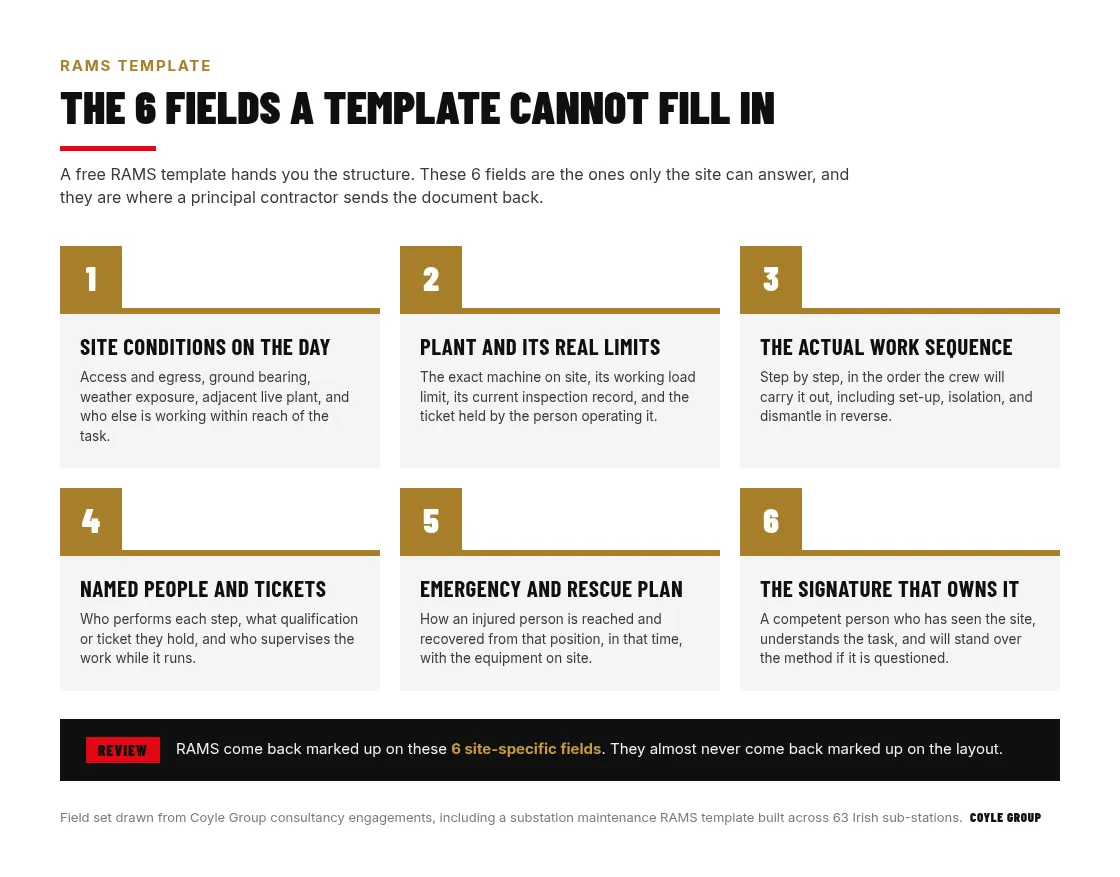
Work through these before you submit anything.
- Site conditions on the day. Access and egress, ground bearing, weather exposure, adjacent live plant, and who else is working within reach of the task.
- Plant and its real limits. Name the exact machine on site, its working load limit, its current inspection record, and the ticket held by whoever is operating it. “A telehandler” is not specific enough, and loads go over limit when this field is left generic.
- The actual work sequence. Step by step, in the order the crew will carry it out, including set-up, isolation and dismantle in reverse. This is the section that turns a risk assessment into a safe system of work.
- Named people and tickets. Who performs each step, what qualification they hold, and who supervises while the work runs. “A competent operative” does not meet the requirement.
- Emergency and rescue arrangements. How an injured person is reached and recovered from that position, in that time, with the equipment actually on site. On height and confined space work this is the most commonly missing field in the whole pack, and we treat it separately in our guide to the height regulations.
- The signature that owns it. A competent person who has seen the site, understands the task, and will stand over the method if it is questioned after an incident.
Once you have scored the hazards, the residual ratings need to be tracked across the project rather than sit in a single document. That is what a risk register is for.
What We Changed Across 63 Sub-Stations
In the first half of 2021 one of our H&S advisors held the safety advisory role across 63 sub-stations in Ireland and identified 5 critical compliance gaps. All 5 were closed inside 6 months. Two of them are directly about templates.
The first was length. The client’s procedures had grown too long and too numerous for crews to read on site. We built a new sub-station maintenance RAMS template with the detailed procedures moved into an appendix, so the working document a fitter picks up is short enough to use.
The second was lifting. The programme’s Lift Plans were deficient against Regulation 42 of the Safety, Health and Welfare at Work (General Application) Regulations 2007, headed “Work equipment for lifting loads”, so our advisor drafted a detailed national Lift Plan to sit alongside the RAMS. The full account is in the sub-station case study.
A template can be the wrong length as well as the wrong content
A 40-page RAMS that nobody opens is a worse control than a 4-page one the crew actually follows. Put the reference procedures in an appendix and keep the working document short.
When the Panel Does Not Fit Through the Door
On a 9-turbine wind farm project in Northern Ireland in 2017, our Safety Officer discovered that the Farm Control Unit and SCADA system would not fit through the control room door. No RAMS template contains that field.
He built a replica panel on site, trialled several portable lifting solutions with the hire company, risk-assessed the chosen method dynamically and signed it off. The lift was then executed against the RAMS and Lift Plan without incident. He also identified the underlying design flaw and had the door on a sister site redesigned for direct pallet-truck access, which removed the problem rather than managing it. The SCADA case study has the detail.
A template gives you a place to record the method. Deciding the method is the actual work.
Who Is Competent to Write RAMS
There is no licence. The legal test is competence: enough training, knowledge and experience of both the task and the conditions to identify the real hazards and specify controls that hold up. Under Regulation 3 of the Management of Health and Safety at Work Regulations 1999 a UK employer must make a suitable and sufficient assessment, and competence is what “suitable and sufficient” tests.
In practice the split runs like this:
- Routine, well-understood tasks. Written by the site manager or supervisor who knows the job.
- High-consequence work. A chartered practitioner takes the pen, because clients are more likely to challenge the method and the consequences of getting it wrong are not recoverable. Lifting operations, confined space entry, live electrical work and anything at height sit here.
Our founder Gavin Coyle is a Chartered Member of IOSH, and on that class of work the chartered signature is what makes the document defensible.
A RAMS Checklist Before You Issue It
Run this before the document leaves your office. It takes 10 minutes and catches most of what comes back.
- Does the task description match the work actually scoped, including the bits added since the tender?
- Is every hazard on the site present in the assessment, including the ones created by other trades working nearby?
- Are the controls specific enough to buy or book? “Suitable edge protection” is not; “double guard-rail and toe-board to all open edges” is.
- Is the sequence written in the order the crew will do it, with set-up and dismantle included?
- Is every item of plant named, with its limits and inspection status?
- Is every person named or role-defined, with the qualification each one holds?
- Are the emergency and rescue arrangements specific to this position and this site?
- Do the residual risk ratings drop once the controls are applied, and are the high scores gone?
- Are the regulations cited correctly for the jurisdiction you are working in?
- Has a competent person who has seen the site signed it, and is the revision number current?
If the document clears the 10 points above, it is ready to issue. If any answer is uncertain, hold the pack, close the gap on site, and re-check that line before you send it. Ten minutes on the checklist saves a rejection cycle that usually costs a week.
Getting the Site-Specific Half Right
Download the HSA template. It is free, well built and the right place to start. The blank fields are the real work.
Where the consequences justify it, our people develop and review RAMS, Risk Assessments and Lift Plans as a service rather than pulling them from a template library. Coyle Group has delivered over 1 million hours of safety work across wind, utilities, construction and data centre programmes, and our chartered practitioners write documents that clients accept and inspectors can follow. If you want the site-specific half done properly, talk to us about compliance support, or about RAMS authoring across a whole programme.
Frequently Asked Questions (FAQs): RAMS Templates
These are the questions site managers and newly appointed safety officers ask us most often when they have been handed a blank RAMS template and a deadline.
Where can I get a free RAMS template?
In Ireland, the Health and Safety Authority publishes a free <a href="https://www.hsa.ie/publications_and_forms/publications/construction/risk_assessment_method_statement_rams_interactive_template/">Risk Assessment Method Statement (RAMS) interactive template</a>, developed with the Construction Safety Partnership. It is broken into 3 steps and 8 sections and is available on hsa.ie and through BeSmart.ie. In the UK, the Health and Safety Executive publishes a free risk assessment template with worked examples, though it covers the risk assessment half rather than the full RAMS pack. Both are credible starting documents and neither costs anything.
Is there a RAMS template in Word or Excel?
Yes. The HSA template is distributed as an editable document, and the HSE risk assessment template is available in editable form as well. Format matters far less than most people expect. A reviewer is looking at whether the hazards, controls, sequence and sign-off match the site in front of them, and that content reads the same in Word, Excel or a PDF.
What qualifications do you need to write RAMS?
There is no licence or mandatory qualification to write a RAMS. The legal test is competence: the person preparing it needs enough training, knowledge and experience of both the task and the site conditions to identify the hazards and specify controls that will actually work. In practice a site manager or supervisor writes routine RAMS and a chartered practitioner is brought in for high-consequence work such as lifting operations, confined space entry or live electrical work, where a client is more likely to challenge the method.
Can I write my own risk assessment?
Yes, and for most tasks you should, because you know the site and a template author does not. The duty to assess risk sits on the employer, so writing it in-house is the normal position rather than the exception. What you cannot do is submit a generic document with the hazards left as the template author wrote them, because that is the version that gets rejected or, worse, gets somebody hurt.
Is the same RAMS template valid in Ireland and the UK?
The structure carries across, but the citations do not. An Irish RAMS refers to the Safety, Health and Welfare at Work Act 2005 and the General Application Regulations 2007, while a UK one refers to the Health and Safety at Work etc. Act 1974 and the Management of Health and Safety at Work Regulations 1999, with CDM 2015 on construction work. If you operate on both sides of the border, keep two citation blocks and swap them rather than trusting one template to cover both.
How long should a RAMS be?
Short enough that the crew doing the work will read it before they start. We have seen the opposite failure often enough to treat length as a safety issue in its own right. Across a 63 sub-station programme in Ireland, one of the 5 critical gaps our advisor closed was that the client's procedures had grown too long and too numerous to be practical on site. The fix was a purpose-built template with the detailed procedures moved into an appendix, so the working document stayed usable.
Who signs off a RAMS?
A competent person on the contractor's side signs to say the method is safe and will be followed, and on most projects the principal contractor or client H&S advisor reviews and accepts it before work starts. Reviewing is not the same as owning it. The contractor carrying out the work keeps the duty even after a client has accepted the document.