How to Build a Safety-First Workplace Culture
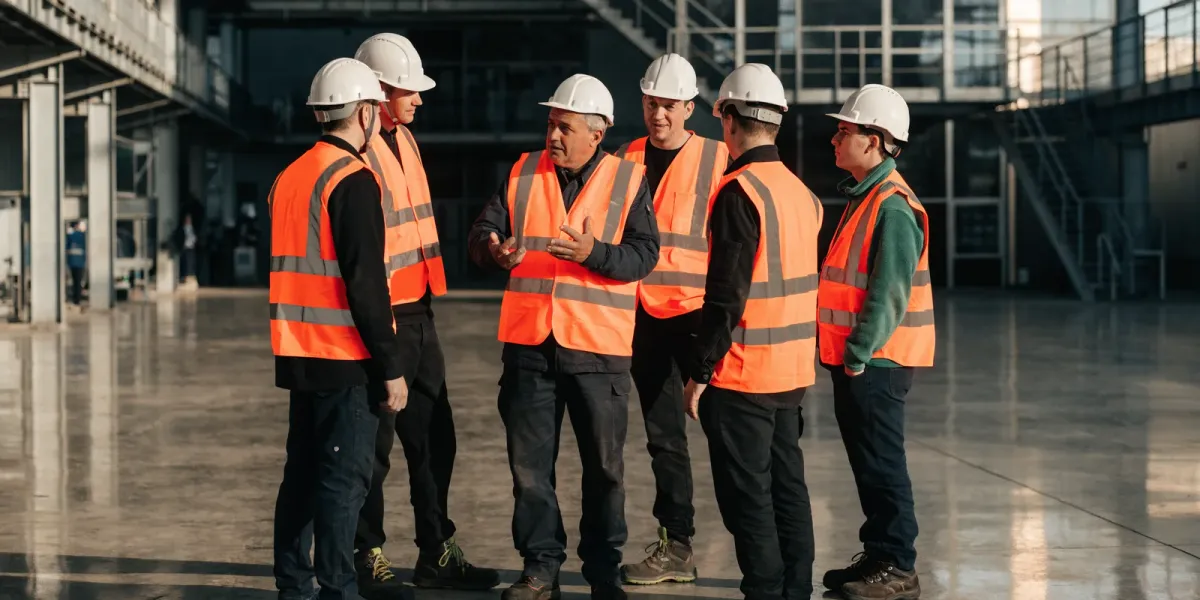
Most weekly safety meetings follow the same pattern. People nod, agree to work harder and pass the message on, then once the meeting ends everyone gets back to their station and back to hitting the numbers. When an issue does come up, it gets a quick word and the day moves on. A plan on its own will not fix that, because a team’s effectiveness reflects the attitude and behaviour of the leadership that creates and executes the plan.
We are all subject to having good days and bad days. What we can control is our preparation, being proactive where possible and reactive when we have to be. Building a Safety First corporate culture is one of the strongest themes we see across our own client work, and it starts with that preparation rather than with the meeting itself.
Turning Safety-First into a daily habit?
Coyle Group’s CMIOSH-chartered team helps UK and Ireland leadership build the visible walks, review cadence and named accountability that turn a Safety-First poster into how the site is actually run.
Talk To A Chartered Advisor
Start With Leadership
Culture starts with the decision makers agreeing that a healthy, safe environment for everyone is the goal, and holding that line when pace or margin push back. Ensuring that hiring, monitoring and distribution all understand the same goals is what turns a stated value into an operating one.
We set goals with a timeline to follow up, and celebrate the milestones publicly as they are achieved. Public celebration matters because it tells the room that the goal was real, not a slide. Leaders who miss that step end up with a Safety-First poster and a production-first floor, which is how a positive safety culture quietly turns into two cultures reporting into the same organisation chart.
The practical test of leadership commitment is not the policy folder, it is the moment a director is asked to accept a slower schedule to fix a hazard properly. If the answer is yes visibly and repeatedly, the floor sees the answer, and the culture starts to move.
Win the Production Floor
The production floor is where the biggest impact can be made. This is where the majority of the workforce spends its day, this is where the incidents happen, and this is where a stated culture either survives contact with reality or does not. If leadership secures buy-in here, it changes the experience of the most people, immediately.
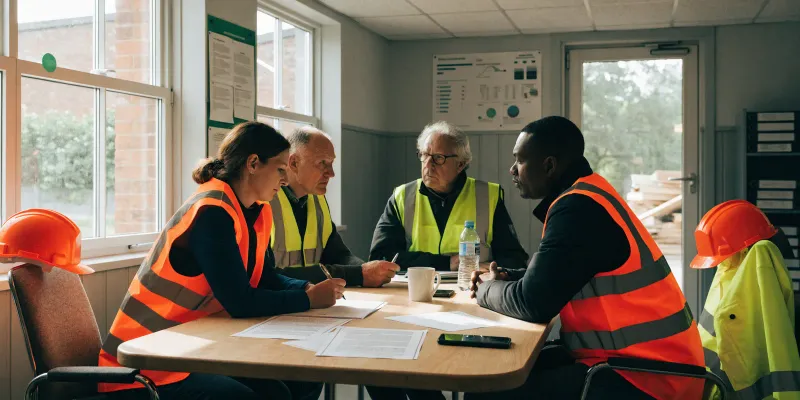
Buy-in here is not a head nod. Workers need to be genuinely invested in safety being a load-bearing part of how the work gets done, not an interruption to it. That happens when supervisors visibly stop unsafe work themselves, when floor teams see near-miss reports turn into actual changes, and when the person who raised a concern is thanked rather than questioned. HSE guidance on director leadership makes the same point at a regulatory level: leaders getting out onto the floor is the intervention that reliably shifts perception faster than anything else.
Once the production floor stops watching to see whether leaders mean it, and starts assuming they do, the ratio of hazards raised to hazards observed changes measurably. That ratio is one of the earliest leading indicators worth tracking, because it moves before the injury count does.
Recognise & Reward Safe Behaviour
When safety and health are discussed, most people put their best foot forward for a short period of time. Turning that spike into a steady state means recognising the workers who behave safely as consistently as the ones who deliver on time. Recognition has to be timely, specific, and visible, or it reads as a slogan rather than a reward.
Companies that turn this into a discipline share the cost saving that a safer environment produces back with the team, at year-end review, in monthly meetings and in the way bonuses are actually calculated. The Health and Safety at Work etc. Act 1974 obliges the employer to provide the arrangements; nothing in the Act says those arrangements have to be joyless, and the ones that produce durable behaviour usually are not.
Reward the behaviour you want repeated, and repeat it publicly enough that the room understands what the standard actually is. Behaviour that goes unrewarded quietly regresses, no matter how strong the launch event was.
Make Safety a Habit
Reinforcing the expectation means applying what we do inside our own facilities to our vendors, our customers and our supply chain as well. A safe working environment is the minimum standard, not the target to aim for, so a product safety expectation and a supplier safety expectation are what stop the culture drifting the moment it leaves the boundary of the site.
Every associate, from the floor up, needs to understand what management has put into health and safety. Informal and formal rules have to support safe and healthy work practices, and the strategic plan has to show a strong pro-safety value system. Everyone from the first day of orientation up to the CEO has to understand and be able to explain those values. This is the discipline the risk assessment framework is built to serve, applying the same value system consistently across every task the business runs.
As a management team, from leads and floor supervisors to human resources and board members, we must establish a Safety First corporate culture. Setting up a competent safety team is what makes that discipline sustainable, and repeating these values consistently is what develops the working culture. That repetition builds the attitude of doing the right thing at all times, even when no one is looking, and it is what turns a policy folder into how the site is actually run.
The Seven Behaviours Leaders Have to Repeat
Culture is not a poster or a launch event; it is a small number of leadership behaviours repeated until the workforce assumes they will keep happening. The seven below are the ones that hold up across every UK client we have worked with, and each one is repeatable at every level of the organisation.
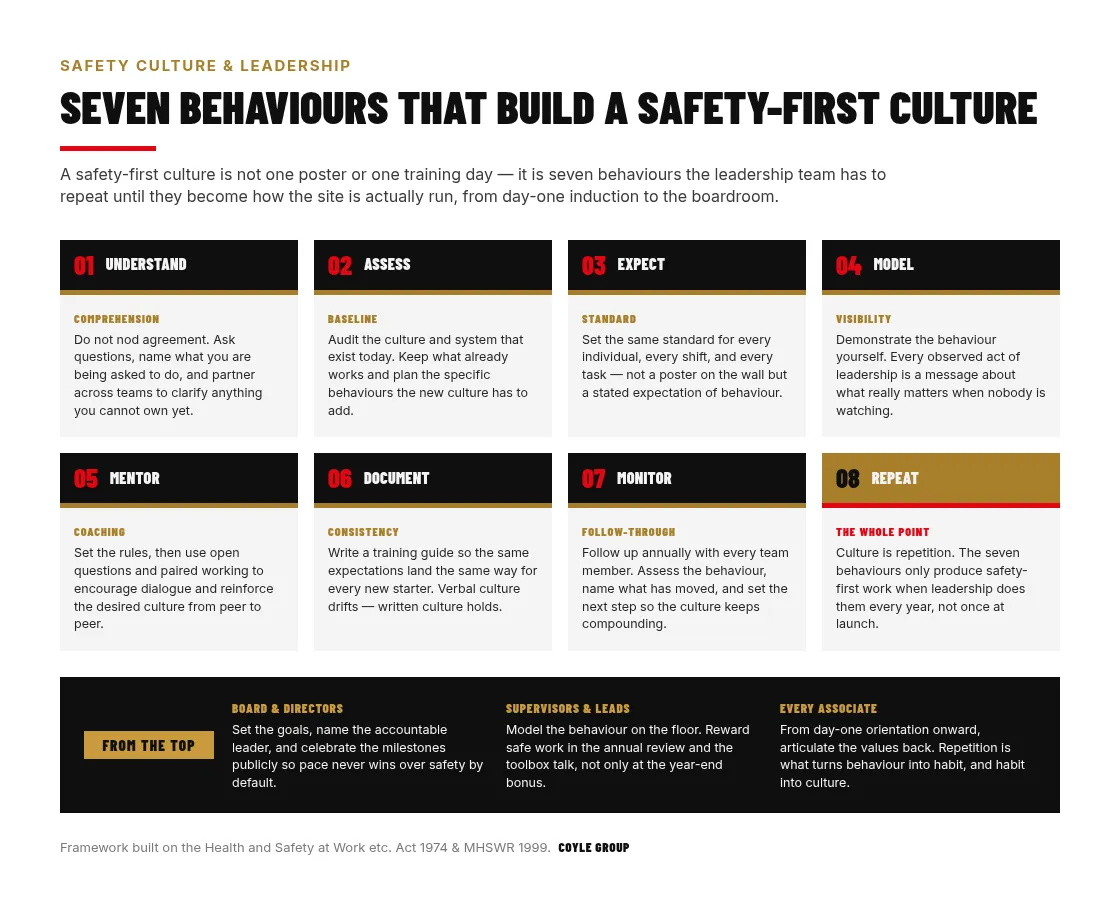
Work them in order. Understand and Assess pin the baseline, Expect and Model set the standard visibly, Mentor and Document distribute it, and Monitor is what keeps it from decaying between reviews. Repeat is the point of the exercise, because a culture that fires once at induction and never again is what a Safety-First policy without a Safety-First operation looks like.
The seven are not a checklist you complete once and move on from. Directors who treat them as a one-off end up rebuilding the same culture three years later, while directors who treat them as the ongoing routine of leadership rarely do.
What Are the Common Barriers to a Safety-First Culture?
The barriers are rarely technical. Almost every UK site we walk into already has the policy folder, the induction slides and the toolbox talk cycle on paper. What holds the culture back is the gap between what leadership says on Monday and what production is measured on for the rest of the week.
Four barriers show up more than the rest. The first is a schedule-first bonus structure that quietly rewards the wrong behaviour on the floor, so supervisors are stuck picking between the number the board watches and the standard the poster claims. The second is a near-miss reporting process that punishes the reporter, whether by extra paperwork, a follow-up interview that reads as an interrogation, or the report sitting open for months. The third is a supervisor layer that has never been trained to stop unsafe work in the moment, because nobody wants to be the person who called the shutdown. The fourth is a leadership team that turns up for the launch event and never returns, which the floor reads as the real message.
Naming the barrier before you plan the fix is what stops another poster campaign becoming the next thing that quietly gets ignored.
How Do You Sustain a Safety Culture During Growth or Change?
Growth is where safety cultures usually crack, because the routines that carried a 40-person site do not survive doubling headcount, opening a second location, or absorbing an acquisition. New hires arrive without the shared assumptions the founding team took years to build, and the induction pack is asked to do a job it was never designed for.
The controls that sustain the culture through change are boring on purpose. Keep the accountable director named on every site, even the new ones. Run the same visible leadership walk cadence at every location rather than letting the smaller site fall off the schedule. Refresh the toolbox talk pack on the same rhythm across the whole business so a worker moving between sites sees the same standard on both. And measure the leading indicators, including near-miss reporting rate, close-out time and unsafe-act observations, per site rather than just as an aggregate, so a site drifting from the norm shows up early rather than at the end of a quarter.
Change is when a Safety-First culture proves it was operating rather than performing. If the routines only worked when the founders were in the room, the culture never really moved from the launch slide onto the floor.
How Coyle Group can help
We help UK and Ireland leadership teams turn Safety-First from a poster into an operating standard, with the visible walks, review cadence and named accountability that keep the seven behaviours repeated long after the launch push.
Embed A Safety-First Culture
Where To Start This Quarter
If any of the seven above are missing from how your leadership team actually spends its week, the highest-return move is not another poster or another training day, it is naming the accountable director and diarising the walks, the reviews and the recognition until they become non-negotiable. Most of the work of a Safety-First culture is repetition, and repetition needs a calendar behind it.
We help UK and Ireland leadership teams turn safety commitments into visible behaviours from the boardroom to the production floor, with the goals, timeline and accountability that keep them going once the launch push is over. If your programme has gaps in any of the seven behaviours above, get expert RAMS & compliance support and start from a documented baseline rather than a guess.
Frequently Asked Questions
What is a Safety-First workplace culture?
A Safety-First workplace culture is one where the safe way to do the job is also the default way to do the job. It is set from the top through visible leadership, reinforced by supervisors on the floor, and reflected in decisions that put people ahead of pace or margin when the two are genuinely in tension.
How long does it take to build a strong safety culture?
For the underlying habits and reporting behaviours to shift, expect 18 to 36 months of sustained effort, not a launch event. The first 6 months focus on getting leaders visible, systems credible and near-miss reporting trusted. Deeper cultural change, workers stopping unsafe work without prompting, takes longer, and only survives if leaders keep behaving the same way once the initiative is out of fashion.
How do you measure safety culture?
The most reliable measures combine perception surveys, leading indicators (near-miss reporting rate, close-out speed, quality of toolbox talks) and lagging indicators (RIDDOR-reportable incidents, lost-time frequency). Our Safety Culture Survey benchmarks all three against comparable UK employers so the score points at what to change, not just what score you got.
Who is responsible for safety culture in a UK workplace?
The employer holds the legal duty under the Health and Safety at Work etc. Act 1974, and it cannot be delegated by hiring a safety officer. Directors set the tone, managers own it operationally in their own areas, and every employee has a duty under section 7 to take reasonable care and co-operate with the arrangements the employer has put in place. Culture is what those duties actually look like on a Tuesday afternoon.
What is the difference between safety culture and safety climate?
Safety culture is the underlying set of shared assumptions and behaviours a workforce holds about risk, which changes over years. Safety climate is the temperature reading of those beliefs at a given moment, usually captured through a perception survey. Climate moves quickly after an incident or a leadership change, culture does not. You use climate readings to steer the culture, not to replace it.
What are the leading indicators of a Safety-First culture?
Near-miss reporting rate per hundred workers, the average close-out time on those reports, toolbox-talk attendance, unsafe-act observations recorded during visible leadership walks, and the share of risk assessments reviewed on time. Leading indicators are the ones that move before an injury does. Tracking them is what MHSWR 1999 regulation 5 asks for anyway, and what turns a policy folder into a live management system.