Heinrich Triangle: 1-29-300 Ratio & Domino Theory

An early 20th century innovator studying accident causation, Herbert Heinrich came to conclusions that still impact our approach today. His studies showed that among the 27,000 cases he reviewed, 88 percent of accidents on the job were committed or influenced by co-workers, 10 percent were caused by unsafe conditions, and 2 percent were simply unavoidable.
Heinrich also observed that for every accident with a major injury in the workplace, there were on average 29 accidents with minor injuries, and a further 300 accidents that caused no injury. Today we translate that to 1 lost time recordable accident, 29 first aid attended accidents, and 300 near misses. To some people, Heinrich’s work lends itself to the idea of a behaviour based safety theory, which proposes that most accidents (95%) are caused by unsafe acts initiated by human factors. This philosophy reinforced management’s idea that workers were the cause of accidents.
Despite the results of his theory, Heinrich, in his 1931 book, Industrial Accident Prevention, A Scientific Approach, postulated that regardless of the human interaction associated with the behaviour of accidents, management and companies should not solely focus on the workers’ responsibility in accidents. Heinrich stated, “No matter how strongly the statistical records emphasise personal faults or how imperatively the need for educational activity is shown, no safety procedure is complete or satisfactory that does not provide for the correction or elimination of physical hazards.”
Based on the day and age in which Heinrich conducted his research, a lot of his findings have been discounted today by some professionals. But it did in fact lay the foundation for much of what has worked its way into place in today’s work climate. Heinrich’s work led to the fact that companies and management have an obligation to establish for their employees a safe environment from which to start working, and that employees have a responsibility to work in a safe manner.
Auditing your own accident data?
Coyle Group’s CMIOSH-chartered team benchmarks your near-miss ratio against Heinrich, Bird, and modern practice, and tells you where the reporting culture is thin.
Book A Ratio Review
The Accident Triangle (1-29-300)
Heinrich’s best known idea is the accident triangle, sometimes called the safety triangle or the Heinrich ratio. He plotted injuries by severity and found a consistent shape:
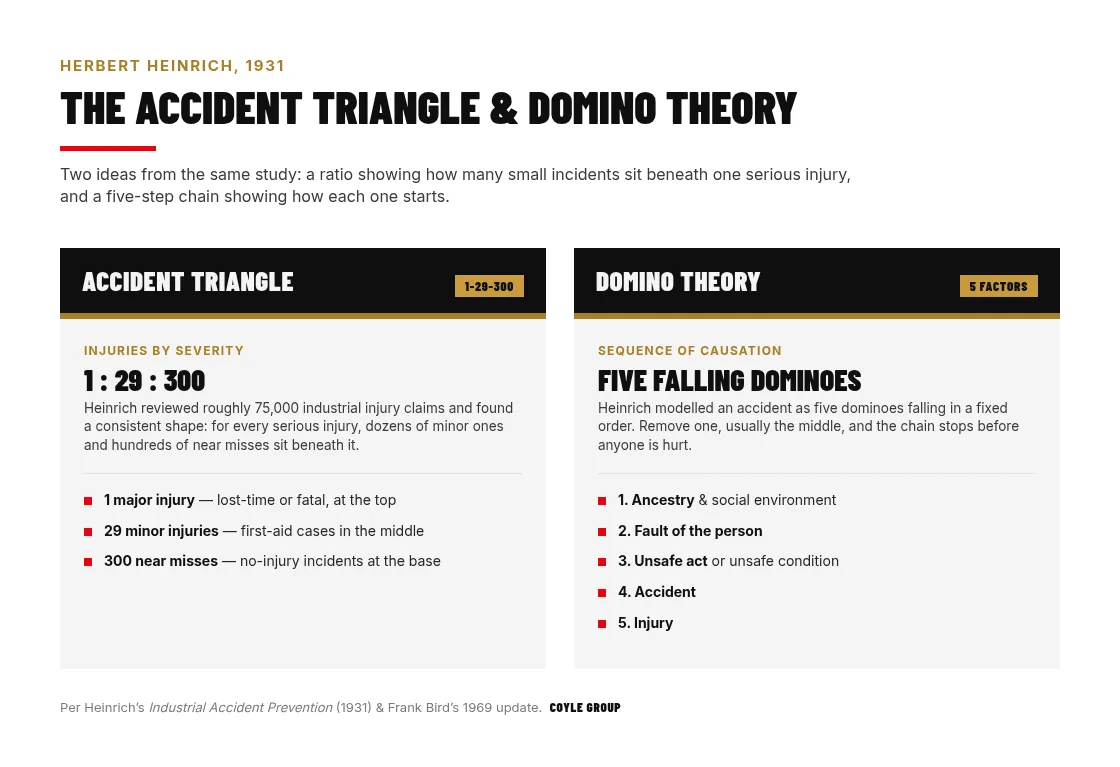
- 1 major injury at the top (a lost-time or serious injury)
- 29 minor injuries in the middle (first-aid cases)
- 300 no-injury incidents at the base (near misses)
The lesson is not the exact numbers but the shape. Serious injuries are rare, but they sit on top of a large base of minor incidents and near misses that share the same causes. If you record and act on the 300 near misses at the bottom, you cut down the events that feed the top of the triangle. That is why a strong near-miss reporting culture is one of the most reliable ways to prevent a serious workplace accident before it happens.
A lost-time injury at the top of the triangle usually also carries a legal duty: employers must report certain workplace injuries, diseases, and dangerous occurrences to the HSE under RIDDOR, which is a useful trigger point for deciding what counts as your “1” when you start building your own ratio.
The Domino Theory
Heinrich associated his concept with dominoes. His Domino theory states these five factors:
- Ancestry: negative character traits can lead to inherited or acquired traits. This leads to,
- Fault of person: whether from inherited or acquired traits, the person can or will work in an unsafe manner. This then leads to,
- Unsafe acts: these acts are performed by the person themselves. The person, by association of the first two causes, will tend to act in an unsafe manner, usually in association with a mechanical or physical item. This leads to,
- Accident: these occur from the person engaging in an activity that leads to an object falling or moving. The accident then leads to an,
- Injury: which is the condition a person is left in upon involvement in an accident. This may lead to lost time, a recordable, or a near miss in the workplace.
The practical value of the model is that you do not have to remove every domino. Take out the middle one, the unsafe act or unsafe condition, and the chain stops before it reaches the injury. That is exactly what a well-planned risk assessment sets out to do: it identifies the unsafe act or condition domino before it has the chance to fall.
Modern Critiques: Bird’s Triangle and Behaviour-Based Safety
Heinrich’s work is nearly a century old, and later researchers have refined it. In 1969 Frank Bird analysed a much larger set of incidents, around 1.7 million reports from 297 companies, and produced his own ratio: 1 serious injury to 10 minor injuries to 30 property-damage incidents to 600 near misses, often written as 1-10-30-600. Bird’s version put more weight on property damage and near misses as early warnings, and it is the shape most modern safety programmes lean on.
Critics also challenge Heinrich’s claim that 88 percent of accidents come down to unsafe acts by workers. That figure came from supervisor reports of the day and reflects the thinking of its time. A 2018 workplace study of more than 25,000 establishments found the ratio does not hold at a fixed rate across industries. Modern safety science argues that most serious events stem from latent failures in design, management, and systems rather than a single careless worker.
This is also where behaviour-based safety fits in. It still has a place in a modern safety programme, but it works best when it sits on top of sound engineering controls and a strong reporting culture, not in place of them. Treating behaviour as the whole story is the same mistake Heinrich himself warned against.
Putting the Ratio to Work on Your Own Site
The numbers matter less than what you do with them. Start by logging every near miss, first-aid case, and lost-time injury for a set period, then look at the shape rather than the exact figures. A wide, healthy base of reported near misses with very few serious injuries at the top is a sign your reporting culture is working. A base that looks thin, or a triangle that has gone flat and boxy, usually means near misses are not being reported, not that they are not happening.
When we run an accident investigation for a client, the first question is always whether the near misses and first-aid cases that led up to the event were ever logged. More often than not, the warning signs were there in the data long before the serious injury occurred.
How Coyle Group can help
We audit your accident, first-aid, and near-miss logs against Heinrich’s 1-29-300 and Bird’s 1-10-30-600 ratios, then map the fixes that flatten the base of your triangle, signed off by a CMIOSH-chartered advisor.
Request A Chartered Investigator
The Sensible Takeaway
The sensible takeaway is the one Heinrich himself made: never stop at blaming the worker. Fix the physical hazard, strengthen the system, and treat every near miss as a free lesson. Coyle Group audits sites across the UK and Ireland against that same principle: near-miss data and physical hazards together. If you want a second set of eyes on where your own numbers stand, get expert RAMS & compliance support from our team.
Frequently Asked Questions
What is the Heinrich triangle?
The Heinrich triangle is a 1931 workplace safety model showing that for every serious or lost-time injury there are roughly 29 minor injuries and 300 near misses beneath it. Herbert Heinrich plotted the shape from around 75,000 industrial injury claims. The point is that a large base of near misses sits under every serious event, so acting on the small ones helps prevent the big one.
What is the domino theory of accident causation?
Herbert Heinrich's domino theory describes an accident as the last in a line of five falling dominoes: ancestry and social environment, fault of the person, an unsafe act or condition, the accident itself, and the resulting injury. Remove one domino, usually the unsafe act or condition, and the sequence stops before anyone is hurt.
How do you calculate the Heinrich triangle ratio?
You don't calculate Heinrich's original 1-29-300 figures; they came from his own claims data. To build your own ratio, log every lost-time injury, first-aid case, and near miss over a set period (a quarter or a year works well), then compare the counts. Most sites find a similar shape, a wide base of near misses under a small number of serious events, even if the exact numbers differ from Heinrich's.
What is Frank Bird's accident triangle?
Frank Bird updated Heinrich's model in 1969 using a larger data set of around 1.7 million incident reports from 297 companies. His ratio runs 1 serious injury to 10 minor injuries to 30 property-damage incidents to 600 near misses, commonly written as 1-10-30-600. Bird's version gives more weight to property damage and near misses as warning signs, and it is the shape many modern safety programmes now use.
Is Heinrich's accident triangle still valid?
The exact 1-29-300 numbers are treated with caution today, and researchers such as Frank Bird produced their own ratios from larger data sets. The underlying idea still holds: near misses are early warnings, and organisations that investigate them tend to have fewer serious injuries. Modern practice pairs it with a stronger focus on physical hazards and systems, not just worker behaviour.
What is a key criticism of Heinrich's safety pyramid?
The main criticism is that the fixed 1-29-300 ratio was drawn from supervisor accident reports of the 1920s and does not hold at a stable rate across every industry or workplace. Critics also note it can be used to blame frontline workers rather than fix the physical hazards and management systems behind an accident, and that near misses are usually under-reported, which skews the base of the triangle.