Accident Prevention Programmes: The 3 E's of Safety

Today’s workplace has grown substantially since the 1800’s. Among the advancements, one of the greatest improvements has come in accident prevention and safety. Previously manufacturers had an endless supply of people to fill and refill positions, people were often considered a cheap commodity.
If a man went down on the job, he would be carted off, and replaced. There were no programmes to prevent accidents, and no set compensation standards to ensure that the injured worker would be compensated. There was little concern shown overall by employers for the injured workers.
Something that triggered an increased interest in assuring worker safety and prevention were the conditions surrounding, and including World War I, and World War II. These events created severe labour shortages. All able bodied skilled persons during these times were either on the front lines, or in manufacturing factories. Both efforts supported the war. Since labour was scarce, the law of supply and demand put a greater value on the worker, and thus made protecting the interests of those workers quite significant. This management style set a precedent that has become more relevant in today’s economic world, protecting your employees is a must in a competitive international environment.
Three E’s of Safety
To make a real difference on the people it was designed to protect, a proper accident prevention programme started with engineering, education and enforcement. Engineering the environment to focus on safety needs. Educating employees from the top to the bottom, and manoeuvring within the parameters of the safety rules. Lastly, the commitment from the organisation to set fair rules, in a safe manner, and enforce these rules with safety at the forefront. Together they are what a working safety programme is made of, and each one is worth taking on its own terms.
Engineering: Design the Hazard Out
Engineering a process, product or piece of equipment to a simple, safe and less dangerous state can decrease the potential for hazards that are present in current states. Ergonomic styling, removing redundant steps, and raising loads to a manageable position are examples of small but positive engineering steps that can be made.
Engineering sits at the top of the hierarchy of control for a reason: it protects everyone on the floor without asking anyone to remember anything. A guard cannot have an off day. This is also the E that a risk assessment is supposed to drive, because the assessment is where the chance to eliminate or substitute the hazard is either taken or quietly passed over in favour of PPE.
Education: Make Safe Work the Default
Education explains in the best terms to the employees, who, what, where, when, why and how the rules, and processes are to be applied. Training, assessments, and onboarding of associates must be worded to relay the legal consequences to the worker, company and customers in a manner that is intelligible and unmistakable to the audience that it is designed for.
Getting the level right matters more than the volume. A day of generic content satisfies nobody, while a short, task-specific session on the machine someone actually runs changes behaviour the same shift. Our note on minimum safety training sets out what UK and Irish employers have to provide before any of this becomes a question of good practice.
Enforcement: Make the Rules Stick, Fairly
Enforcement creates a fair check and balance system. The environment is established, and people are held accountable. All members of the organisation must comply, 100% of the time. A safety team must be established, not to just enforce, but to be a constant partner for every employee. Working to create safe zones in the environments, by performing a Kaizen, or simplifying the work space with a 5-S programme that lays out in no uncertain terms the design of the work space, and its intended use.
With enforcement it’s important to specifically note to everyone, that the team’s job isn’t to point fingers, but to consistently, on a daily basis create a positive work environment for all to work in safely. Rotating team members every six or 12 months is ideal for any team, by putting fresh eyes on the floor. Enforcement that lands as blame is the fastest way to stop hearing about near misses, which is why it belongs inside a positive safety culture rather than beside one.
None of the three works alone. Engineered guarding that nobody was trained to use, or training that nobody enforces, fails at exactly the same point, which is why the weakest of the three sets the ceiling for everything else you do.
Three E’s or Five E’s? Where the Other Two Come From
Search for this subject and you will find sources counting five E’s rather than three. The extra two are not a competing model. They are the same three with the surrounding conditions named, and the lists differ because the field they came from differs: road safety, public health and occupational safety each added the E that mattered most to them.
The two that recur most often are worth borrowing:
- Evaluation. Measuring whether any of it worked, using leading indicators such as near misses reported and assessments reviewed on time rather than waiting for the injury count to tell you. This is the E most programmes are missing, and it maps to the review duty in regulation 5 of the Management of Health and Safety at Work Regulations 1999.
- Encouragement. Recognising the behaviour you want instead of only sanctioning the behaviour you do not. Reporting rates rise when the first person to flag a problem is thanked rather than questioned, and reporting rates are the raw material for everything else.
Other versions substitute economic incentives, meaning insurance and procurement pressure, or emergency response, meaning what happens in the minutes after control fails. Both are real, and both sit outside the three E’s in the sense that neither prevents the first accident.
The practical answer is that three is the structure and five is the reminder. If you already run engineering, education and enforcement properly, adding evaluation is the change that pays; adding encouragement is what keeps evaluation honest. If any of the original three is weak, the extra E’s will not compensate for it.
How to Build an Accident Prevention Programme
The three E’s still hold, but a modern UK programme is built around the duties set out in the Health and Safety at Work etc. Act 1974 and the Management of Health and Safety at Work Regulations 1999. Use these steps as a practical framework:
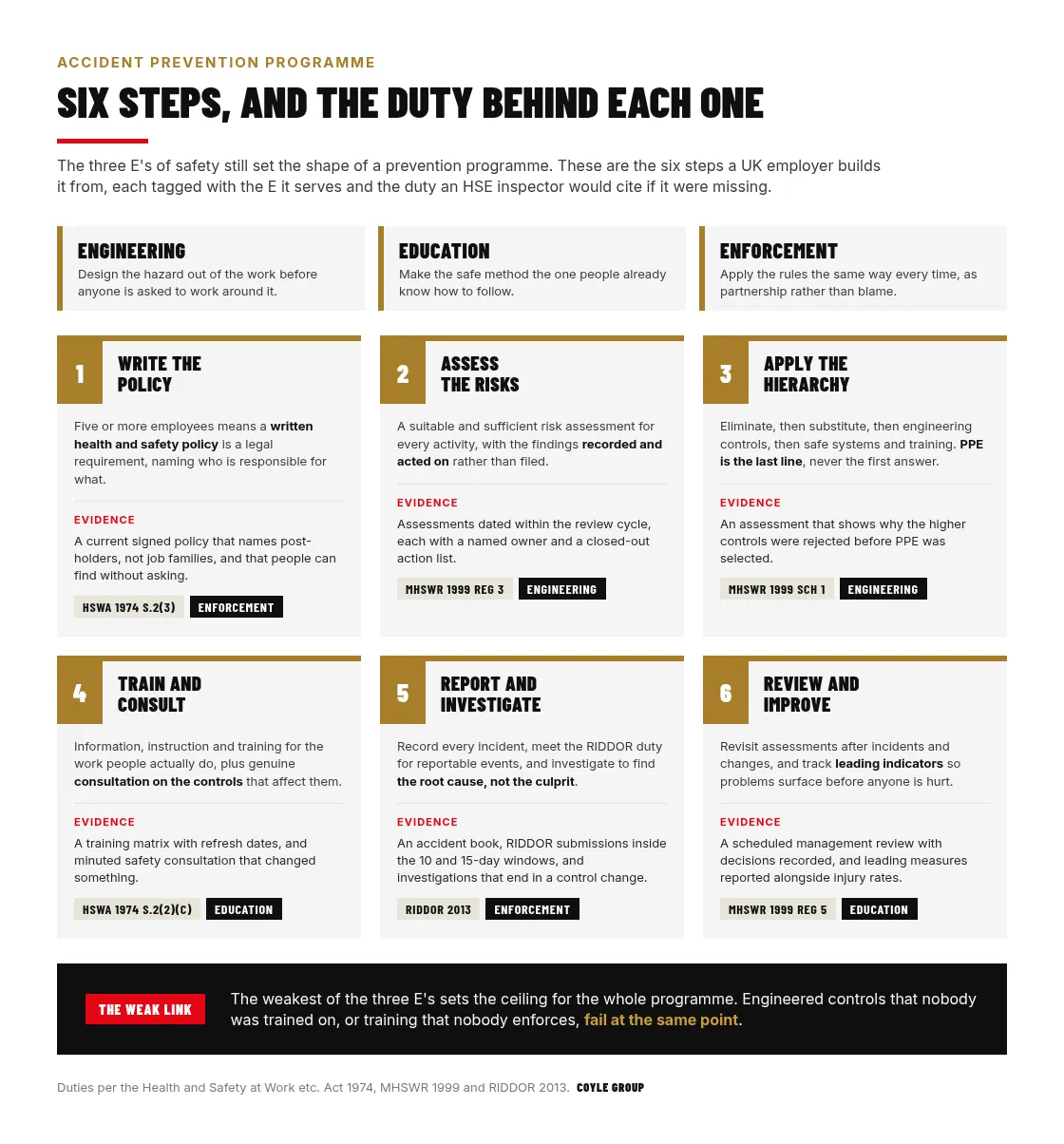
- Write a health and safety policy. Any business with five or more employees must have a written policy setting out who is responsible for what and how safety is managed.
- Assess the risks. Run suitable and sufficient risk assessments for each activity, then record and act on the findings.
- Apply the hierarchy of control. Eliminate the hazard first, then substitute, then use engineering controls, then safe systems of work and training, with PPE as the last line of defence.
- Train and consult your people. Give staff the information and training they need, and consult them on the risks and controls that affect their work.
- Report and investigate. Record incidents, meet your RIDDOR duties for reportable events, and use an accident investigation to find the root cause rather than someone to blame.
- Review and improve. Revisit assessments after incidents or changes, and track leading indicators so problems surface before someone is hurt.
Costing this properly matters too: read our guide to the true cost of workplace accidents and the theories behind accident causation to understand where prevention pays off.
Work the six in order rather than picking the easy ones. Steps 1 and 2 are what an inspector asks for first, and steps 5 and 6 are what turn a programme from a fixed document into something that gets better each year.
Results
The results from these programmes are beneficial to both the employees and the company. Sending people home in the same shape they came to work in is always a great thing. The overall savings from potential compensation and medical attention, goes back into the bottom line, and benefit the employees and the company at the year-end review. A safe company is a successful company in so many ways.
The scale of the prize is not abstract. HSE data on fatal injuries records 126 workers killed in work-related accidents in Great Britain in 2025/26, and the non-fatal count runs into the hundreds of thousands. Behind each of those numbers is a family, and for the employer a claim that Citizens Advice will help the injured worker bring.
If your programme has gaps in any of the six steps above, we can close them with you. Get expert RAMS & compliance support and start from a documented baseline rather than a guess.
Frequently Asked Questions
What are the 3 E's of accident prevention?
Engineering the environment, educating employees at every level, and enforcing the rules consistently. Engineering removes or guards the hazard; education makes safe work the default behaviour; enforcement gives both a backbone by making the rules stick, fairly and predictably. The three are a set rather than a menu, because the weakest of them caps how well the other two can work.
What is the most common workplace accident?
Slips, trips and falls on the same level are the most commonly reported non-fatal workplace accident in Great Britain, followed by handling, lifting or carrying, and being struck by a moving object. The pattern holds across offices, warehouses and sites, which is why walkway condition and manual handling controls repay attention before more exotic hazards do.
What accidents need to be reported at work?
Every accident goes in your accident book. A narrower set must also go to the HSE under RIDDOR: work-related deaths, specified injuries such as fractures and amputations, injuries keeping a worker off normal duties for more than seven days, certain occupational diseases, and dangerous occurrences where nobody was hurt. Deaths and specified injuries are reported without delay.
What are the three most common types of injuries in the workplace?
Sprains and strains, fractures, and superficial injuries such as cuts and bruises account for the bulk of reported workplace injuries in Great Britain. They map closely onto the three commonest accident kinds: slips and trips produce the fractures, handling and lifting produce the sprains, and being struck by an object produces the cuts. Control those three routes and most of your injury count goes with them.
Who is responsible for preventing accidents at work?
The employer holds the legal duty under the Health and Safety at Work etc. Act 1974, and it cannot be delegated away by appointing a safety officer. Managers own it operationally in their own areas, and every employee has a duty under section 7 to take reasonable care and co-operate with the arrangements their employer has put in place.
What are the five E's of accident prevention?
The three E's of engineering, education and enforcement, plus evaluation and encouragement. Evaluation means measuring whether the programme works, using leading indicators rather than the injury count. Encouragement means recognising the behaviour you want instead of only sanctioning the behaviour you do not. Some versions swap in economic incentives or emergency response instead. Three is the structure and five is the reminder: the extra E's will not compensate for a weak one of the original three.
Why do accident prevention programmes fail?
They usually fail for one of 3 reasons: the engineering controls are treated as optional, training is delivered once and never refreshed, or enforcement lands as blame rather than partnership. A programme that gets any two of those right and the third wrong will still under-perform, because the weakest of the 3 E's sets the ceiling.
How does accident prevention pay back financially?
The direct saving is on compensation and medical spend, but the bigger number is usually indirect: lost production, investigation time, temporary cover, insurance premium creep, and reputational damage on tenders. A worked prevention programme returns real money to the bottom line and reduces the volatility of that number year on year.