Safety Auditing Explained: Why Regular Audits Matter
The workplace today is varied and diverse. Varied in its populace, and diverse in its demands. An associate may cross over from a set of rules in one work station, to a second work station with a different set of compliance rules. Encompassing everything that an individual might encounter on a daily basis requires multiple sets of audits, walks, and evaluations. These concerns for safety are not new to the workplace.
The Code of Hammurabi, circa 2,000 B.C., illustrated concern in handling injuries and gave instructions for caring for infected people. Ramses II, circa 1,500 B.C., created a medical service and required daily bathing for his labourers, in the hope of efficiently constructing the pyramid that bears his name.
As civilisation advanced, so did governments’ concerns for the well-being of its workers, and the impact on its people. In Roman times, safety and health concerns were engineered into projects such as sewage and ventilation. In 1567 Philippus Aureolus’s treatise on Miners’ Sickness and other Miners’ Diseases covered the effects of metallurgy and the exposure in the handling of substances such as mercury. Finally, in the early 1700s, Bernardino Ramazzini, in his Discourse on the Diseases of Workers, concluded that there are parallels between a worker’s diseases and their occupation.
Each step, every record of facts, and method of improvement has been made with good intentions to be of benefit to the worker and ensure the welfare of the organisation. Modern health and safety auditing is the direct descendant of that instinct: proof, not just intent, that workers go home in the same condition they arrived in.
Is a Health and Safety Audit a Legal Requirement?
No single clause in UK law names a health and safety audit as a mandatory document. What the Health and Safety at Work etc. Act 1974 does require is a management system that actually controls risk, and HSE’s guidance on the plan-do-check-act cycle treats auditing as the formal check stage: the point where a board tests whether the system it has on paper is the system its site actually runs. Larger organisations are expected to have “formal procedures for auditing and reporting health and safety performance,” with unrestricted board access to both internal and external auditors.
In practice that makes a health and safety audit a soft requirement rather than a hard one. Nothing in statute fines you for skipping it, but an enforcement visit that finds a system nobody has ever checked lands very differently to one backed by a paper trail of annual, independent reviews.
What a Third-Party Safety Audit Covers
A thorough safety audit is more than a walk round with a clipboard. When we audit a site, we work through a consistent checklist so nothing gets missed, and we group it the same way HSE’s own check stage does: the paperwork side and the floor side of the same question.
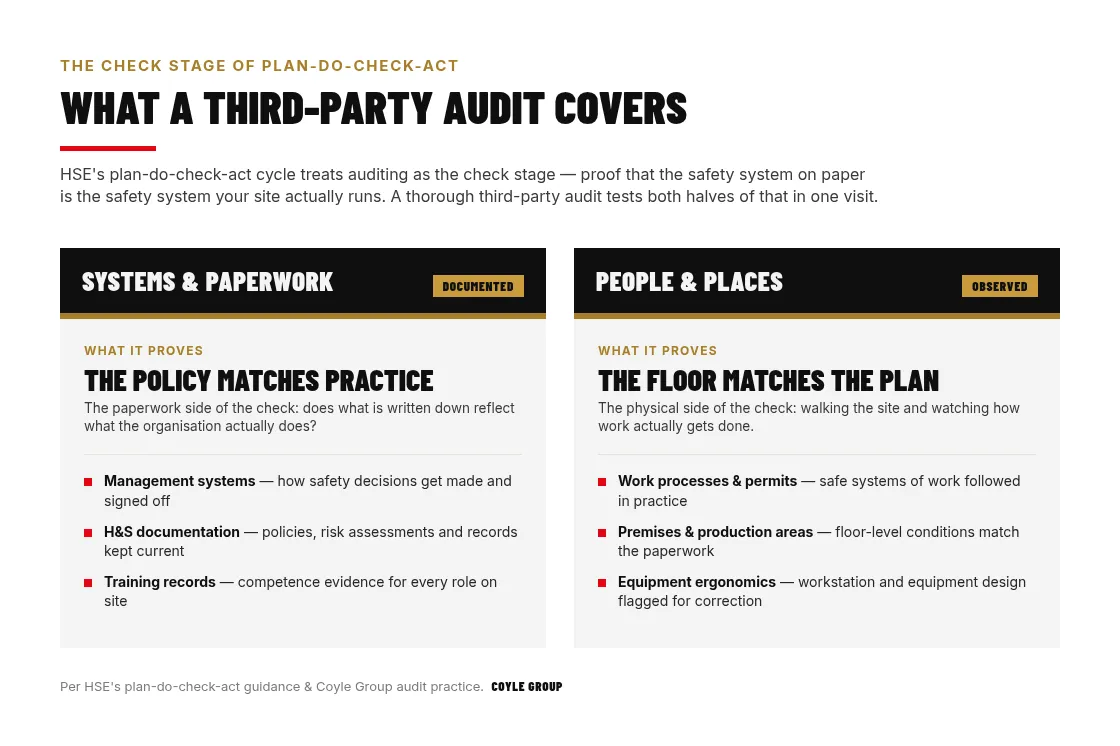
Management systems and how safety decisions get made
This is the governance layer: who owns safety, what they are allowed to spend, how a hazard raised on the floor reaches someone with the authority to fix it, and how quickly that happens. An auditor traces a handful of real decisions backwards to see whether the route on your organisation chart is the route the business actually uses. It matters because almost every other failing on this list is downstream of it, and because HSE’s guidance for directors expects safety to be managed with the same rigour as finance rather than delegated and forgotten. Where this layer is weak, corrective actions get raised repeatedly and closed out slowly, which is exactly the pattern an enforcement visit picks up on.
Health and safety documentation and record keeping
This covers your policy, your risk assessments, method statements, COSHH assessments, maintenance and inspection records, and the accident and near-miss log. The audit checks two separate things: that the documents exist and are current, and that they describe the work as it is actually done rather than as it was done when the file was created. It is needed because documentation is the only evidence you will have after an incident, and a risk assessment that names a hazard without a control behind it actively works against you in court. Once you employ five or more people, recording the significant findings of your risk assessment stops being good practice and becomes a legal duty.
Training records and competence
Records prove who was trained, on what, by whom and when; competence is the harder question of whether they can actually do the task safely today. A good audit samples both, pairing the certificate on file with a short conversation on the floor, and pays particular attention to refresher dates, agency and contractor staff, and anyone recently moved to a new task. This matters because the duty under the Health and Safety at Work etc. Act is to provide adequate training and supervision, not to hold certificates, and an expired ticket is one of the fastest findings for an inspector to evidence. Gaps here also explain a large share of incidents involving new starters and people covering unfamiliar work.
Work processes, permits and safe systems of work
Here the audit follows the higher-risk tasks end to end: hot works, work at height, confined space entry, isolation and lock-off, lifting operations, and anything covered by a permit. The auditor watches the task being carried out, then compares what happened against the method statement and the permit that authorised it. This is where the difference between a written system and a working one usually shows up, because informal shortcuts accumulate quietly wherever the documented method is slower than the practical one. It is needed because these are the tasks that produce the fatal and life-changing injuries, and because the permit system is what protects the people working near the task as well as the person doing it.
The premises, production areas and offices
This is the physical walk: guarding on machinery, condition of walkways and stairs, storage and racking, lighting, ventilation, fire escape routes and extinguishers, welfare facilities, traffic routes and pedestrian segregation. Offices get the same attention as production areas, because display screen work, trailing cables and blocked exits sit in a genuine legal duty rather than a nice-to-have. The reason for covering it in a formal audit rather than leaving it to weekly walks is that familiar surroundings stop being visible to the people in them every day. An outside pair of eyes on the same route will reliably find things your own team has been stepping over for months.
The ergonomic design of equipment and workstations
This looks at how equipment, benches, seating, screens and manual handling tasks fit the people using them: reach distances, working heights, repetitive movements, load weights and how often they are lifted. It rarely produces a dramatic finding, which is precisely why it gets skipped. It belongs in the audit because musculoskeletal disorders are among the largest causes of work-related ill health and sickness absence in Great Britain, and the fixes, such as a lifting aid, a rotated task or an adjustable bench, are usually cheap compared with a long absence or a civil claim. Getting it right also removes the awkward postures and rushed movements that cause the sudden injuries covered elsewhere on this checklist.
The point of the checklist is repeatability. Running the same audit each time means you can measure progress rather than just tick boxes. It also makes clear who owns each action, which ties back to the wider question of safety accountability across the business. Where an audit turns up a hazard the checklist did not anticipate, the finding belongs in your risk register rather than a report nobody reopens. Many firms fold their audit findings into a broader safety management system so corrective actions get tracked through to completion.
How Often to Audit, and What It Costs
With so many safety standards demanding paperwork, it is easy to conclude that a site already has too many audits. It does not work that way: the auditor is responsible for evaluating the entire organisation, and a formal third-party audit does not need to run constantly to earn its keep. Once a year is the working baseline for most sites, tightened up for higher-risk operations or in the months after a major change to plant, process or headcount.
What should run continuously underneath that annual review is the informal layer: internal safety walks, self-assessments and near-miss reporting. You can never really have too many walks or audits, as long as the outcome is preventing an injury. A lot of companies have associates report “near misses” as a separate category, tracking the potential for accidents and injuries without waiting for a recordable incident to document a deficiency, which is exactly what validates the need for the walks and audits in between formal reviews.
Preparation eats less time than most people expect. The University of Cambridge’s audit guidance puts desk-based prep at half a day and the on-site portion at up to a full day per department, which is roughly what we see on UK sites of a similar size.
Living and Breathing
The best audit programme, administered by a health and safety professional, operates as a system that is in all ways living and breathing. Every associate must be able to access it and feel comfortable contributing to it. You can audit a facility daily, but if there is no buy-in from the team, if no one feels they can give back in a preventative manner, then all the walks in the world will not be effective. Communication both ways, allowing associates to give feedback at any time and relaying pertinent information back to the team, is what keeps an audit programme living and breathing rather than a folder nobody opens.
Coyle Group audits sites across the UK and Ireland against the same six-point checklist covered above: book a compliance consultation and we will tell you exactly where you stand.
Frequently Asked Questions
What is auditing in health and safety?
A health and safety audit is a structured, evidence-based check of how well your management system controls risk in practice, not just on paper. It combines document review, a walk of the premises and conversations with staff, then rates performance against a consistent checklist so you know exactly where the gaps are and who owns the fix.
Is it a legal requirement to have a health and safety audit?
There is no standalone statutory duty in the UK to commission a health and safety audit. What the Health and Safety at Work etc. Act 1974 does require is a management system that genuinely controls risk, and HSE guidance recommends periodic audits of that system as part of the plan-do-check-act cycle, so skipping one still carries real practical risk.
How often should you carry out a safety audit?
There is no single legal interval, but most workplaces benefit from a formal third-party audit once a year, backed by regular internal safety walks and self-inspections in between. Higher-risk sites and those going through change should audit more often.
What does a health and safety audit cover?
A thorough audit reviews management systems, documentation, training records, work processes, the premises and the ergonomics of equipment, then summarises overall performance in one snapshot. Repeating the same checklist each time is what turns a one-off review into a measurable programme.
What is a near miss?
A near miss is an unplanned event that did not cause injury or damage but easily could have. Recording near misses as a separate category lets you spot accident potential and act before someone gets hurt.
How much does a health and safety audit cost?
Costs vary with site size and complexity, but a third-party audit for a single-site UK business typically runs from roughly £600 to £1,200, covering the site visit and the written report. Multi-site organisations, or those needing a full management-system review, should expect a higher, scoped quote.
How long does a health and safety audit take?
Most single-site UK audits take about a day and a half in total: half a day of preparation and document review beforehand, then up to a full day on-site walking the building, watching how tasks are done and talking with staff. Larger, multi-site organisations should plan for longer, spread across more than one visit.