Who Is Responsible for Health and Safety at Work? HSWA 1974

Working in a safe and compliant environment is everyone’s right. But who can actually be held accountable for creating that kind of environment? Under UK law, the answer is not one person or one team. It is a shared duty split between employers, employees, and the Health and Safety Executive (HSE), each with distinct legal obligations under the Health and Safety at Work etc. Act 1974 (HSWA).
That split matters most when something goes wrong. After an incident the question is rarely whether the work was unsafe, but who was supposed to have prevented it, and the answer decides who the HSE prosecutes, who pays compensation, and in the worst cases who goes to prison. This guide sets out what each party owes under HSWA, the regulations sitting beneath it, and what happens to employers who fall short.
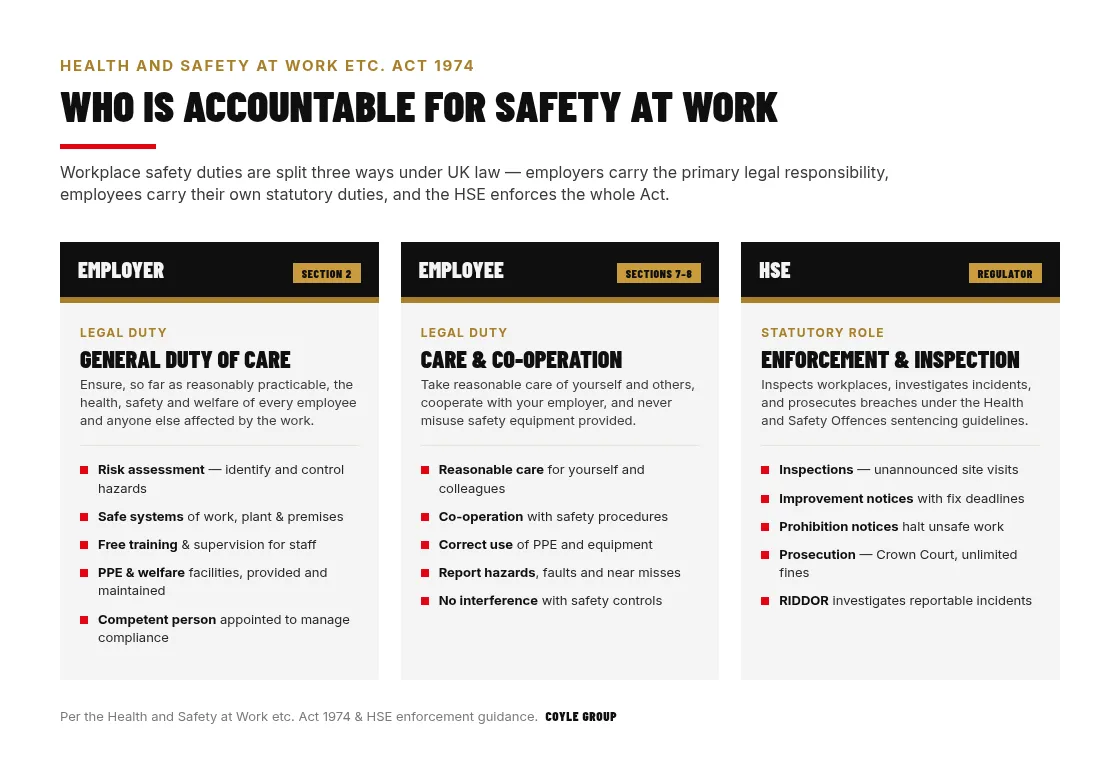
Those three sets of duties overlap rather than sitting neatly side by side, and that is where most of the confusion starts. An employer cannot discharge its duty by writing a policy nobody follows, and an employee cannot fall back on “nobody told me” when the training was offered and ignored. The sections below take each duty holder in turn.
Who Is Accountable for Workplace Safety?
HSWA names three parties, and each carries obligations the others cannot discharge on their behalf. This is what the Act asks of each of them in practice.
1. Employers
Employers carry the primary responsibility for workplace safety. Section 2 of HSWA places a general duty on every employer to ensure, so far as is reasonably practicable, the health, safety and welfare of employees and anyone else affected by the work. In practice, this includes:
- Identifying and assessing potential hazards and risks
- Implementing safety procedures and protocols
- Providing safety training and education to employees, free of charge
- Providing and maintaining safety equipment and protective gear
- Conducting regular safety inspections and audits
- Investigating and addressing safety concerns and complaints
2. Employees
While employers carry the primary duty, employees have their own statutory obligations under sections 7 and 8 of HSWA. This includes:
- Taking reasonable care of their own health and safety and that of others
- Cooperating with their employer on safety procedures and protocols
- Using safety equipment and protective gear correctly
- Reporting safety concerns, faults, and near misses without delay
- Never intentionally or recklessly interfering with equipment provided for safety
3. The Health and Safety Executive
The HSE is Great Britain’s independent regulator for workplace health and safety. Its responsibilities include:
- Inspecting workplaces, often unannounced, to check compliance
- Investigating incidents and reportable injuries under RIDDOR
- Issuing improvement notices (a deadline to fix a breach) and prohibition notices (an immediate stop on unsafe work)
- Bringing prosecutions for serious or persistent breaches
- Publishing guidance and standards employers and employees are expected to follow
Read together, the three sets of duties are designed to leave no gap: the employer builds the system, the employee works within it, and the HSE checks that both are holding up their end. Where serious accidents happen, it is usually because one of the three assumed another party had it covered.
The Law Behind Workplace Safety
Those duties do not all live in one document. UK safety law works in three layers: an Act that sets the general duties, regulations that make them specific, and further rules written for individual industries. Knowing which layer applies to your work is what turns a broad legal duty into a list of things you actually have to do. Where that mapping is not obvious, our legal advice line exists to answer exactly that question.
1. The Health and Safety at Work etc. Act 1974
The Health and Safety at Work etc. Act 1974 is the primary piece of legislation covering occupational health and safety in Great Britain. It sets out the general duties on employers, employees and the self-employed, and gives the HSE its enforcement powers. Rather than listing every hazard, the Act works on a “reasonably practicable” test, weighing the risk against the cost and effort of controlling it.
2. Regulations Made Under HSWA
The Act is supported by a body of specific regulations that employers must also comply with. Key examples include the Management of Health and Safety at Work Regulations 1999, which requires a written risk assessment for any organisation with five or more employees, the Construction (Design and Management) Regulations 2015, and the Control of Substances Hazardous to Health (COSHH) Regulations 2002.
3. Industry-Specific Regulations
Beyond the general framework, industry-specific regulations address the hazards particular to a sector. The CDM Regulations 2015 set out duties for the construction industry covering planning, fall protection and the use of personal protective equipment. Healthcare has specific rules on bloodborne pathogens and infection control, while sectors such as manufacturing and energy carry their own regulations on machinery guarding and hazardous material handling.
The practical effect is that no employer can rely on the Act alone. You need the general duty, the regulations that apply to every workplace, and the sector rules that apply to yours, because the HSE will enforce against all three. Working out which of them bite on your operation is the first task in any compliance review.
What Happens When Employers Get It Wrong
Falling short is rarely a single penalty. The consequences arrive in a predictable order: the regulator first, the civil courts second, and the market last. The third tends to cost the most and lasts the longest.
1. Enforcement and Fines
The HSE can issue improvement and prohibition notices, and bring prosecutions through the courts. In the Crown Court, fines under HSWA are unlimited, and the Health and Safety Offences sentencing guidelines scale penalties to the seriousness of the breach and the turnover of the organisation. A single serious incident at a large employer can run into millions of pounds once sentencing guidelines are applied.
2. Civil Liability and Compensation
When an employer fails to comply with its safety duties and an employee is injured as a result, the employer can also face a civil claim for compensation, typically covering medical costs, lost earnings, and pain and suffering. In the most serious cases, where a death results from gross failures in the duty of care, this can escalate to prosecution and imprisonment for corporate or individual manslaughter.
3. Reputational Damage
Workplace safety incidents attract attention from the media, regulators, and increasingly social media, creating a crisis that can damage an employer’s reputation, cost customers, and make it harder to attract and retain staff long after any fine is paid.
Safety Is a Shared Responsibility
Workplace safety law exists to prevent occupational injuries and ill health, and every party named in HSWA has a part to play in making that happen. Failure to comply can bring fines, civil liability, and reputational damage that outlasts the incident itself. Meeting these duties consistently is one of the biggest compliance challenges employers face, particularly as a business grows and more sites, contractors, and shift patterns enter the picture.
Coyle Group audits sites across the UK and Ireland against the same statutory checklist we have described here, covering employer, employee and regulator duties in one review. If you are not sure where your organisation stands under HSWA 1974, book a compliance consultation and we will tell you exactly what needs fixing, and in what order.
Frequently Asked Questions
Who is legally responsible for health and safety at work?
Employers hold the primary legal responsibility under the Health and Safety at Work etc. Act 1974, and must ensure the health, safety and welfare of employees so far as is reasonably practicable. Employees have their own duties too: to take reasonable care of themselves and others, and to cooperate with their employer's safety arrangements. The Health and Safety Executive enforces both sides.
Is health and safety the employer's or the employee's responsibility?
Both, though the burden is not equal. Employers must assess risks, provide training, equipment and safe systems of work. Employees must follow those systems, use the protective equipment provided, and report hazards as they arise. The Health and Safety Executive oversees compliance and can prosecute employers who fall short of their duties.
Who has the most responsibility for safety and health in the workplace?
Employers carry the greatest share of responsibility, because the Health and Safety at Work etc. Act 1974 places the general duty of care on them, not on individual staff. That said, no single party is solely accountable: managers who control the work, employees who follow procedures, and the HSE as regulator all hold distinct legal duties under the same Act.
Is HR responsible for health and safety?
Not legally, in most organisations. The Health and Safety at Work etc. Act 1974 puts the legal duty on the employer, meaning the business itself and its directors, not the HR department. In practice, HR teams often administer safety policies, training records and incident reporting on the employer's behalf, but accountability for compliance sits with senior management.
Who do I complain about office health and safety in the UK?
Raise the concern with your employer first, ideally in writing, so there is a record. If it goes unresolved, you can report it to the Health and Safety Executive or your local authority environmental health team, depending on the sector. Both bodies can investigate and take enforcement action, including improvement notices, if your employer is breaching its duties.
What are the 5 responsibilities of employers?
Under the Health and Safety at Work etc. Act 1974, employers must provide a safe workplace, plant and systems of work, ensure the safe use, handling and storage of substances, give employees the information, training and supervision they need, maintain safe access and egress, and provide adequate welfare facilities. All five duties apply so far as is reasonably practicable.