UK HSE Safety Culture Maturity Model for Irish and UK Sites
Every site has a safety culture, and the safety culture maturity model is the most widely cited way to describe how developed it is. The version used across Britain and Ireland came out of a Health and Safety Executive (HSE) project in 2000. It puts an organisation on a ladder of 5 levels, and it gives managers a concrete question to ask: what would it take to reach the next level?
This guide covers where the model came from, what each level looks like on a real site, how to judge where your own organisation sits and what moves it up. It also covers the model’s limits and how our own Coyle Approach combines it with a second framework from the United States. We cite the original report throughout, so none of it rests on opinion.
Curious where your own organisation sits on the ladder? Take the free Safety Culture Survey and get an individual report by email in minutes.
Take The Free Safety Culture Survey
Where the HSE Safety Culture Maturity Model Came From
The model is documented in HSE Offshore Technology Report OTO 2000/049, titled Safety Culture Maturity Model and written by Dr Mark Fleming of The Keil Centre. HSE lists it under its further guidance on organisational culture, and the bibliographic record names the Health and Safety Executive as the sponsor and The Keil Centre in Edinburgh as the research organisation.
A paper by Keil Centre psychologist Ronny Lardner, Mark Fleming and Phil Joyner of bp, published through the Institution of Chemical Engineers, gives the background. The model came from a joint project funded by the HSE and the UK offshore oil industry. Its authors based it on the capability maturity model, a concept first developed at the Software Engineering Institute to improve how software is built, and they drew its components from the safety culture features in HSE guidance HSG48, Reducing Error and Influencing Behaviour.
The report describes the first version as a draft. The authors tested it by interviewing safety experts, operational managers, safety representatives and frontline staff in the offshore industry, and the model has since been applied well beyond oil and gas. Its origin matters, because it explains both the model’s strengths and the limits we cover later in this guide.
What the Model Measures Across 10 Elements
The model grades an organisation on 10 elements of safety culture, and each element can sit at a different level. The report lists them as visible management commitment, safety communication, the balance between productivity and safety, learning organisation, health and safety resources, participation in safety, shared perceptions about safety, trust between management and frontline staff, industrial relations and job satisfaction, and safety training.
The list shows what the authors meant by culture. Only 1 of the 10 elements is about training and 1 is about resources, while the rest concern how people communicate, whom they trust and how decisions get made when production and safety pull in different directions. HSE’s own organisational culture guidance draws the same conclusion: the largest influences on safety culture are management commitment and style, employee involvement, training and competence, communication, compliance with procedures and organisational learning.
The 5 levels run from Emerging to Continually Improving, and the report says organisations progress through them in sequence by building on the strengths of the previous level and removing its weaknesses. Its advice is that an organisation should not attempt to jump or skip a level. The sections below put a working description on each one.
What Each Level Looks Like on a Real Site
The report names the levels and the actions that link them, and the descriptions of site behaviour below are our reading of those names from 25+ years of working on construction, energy and utilities sites. They are a practical aid, and HSE does not word them this way. The ladder below sets them side by side.
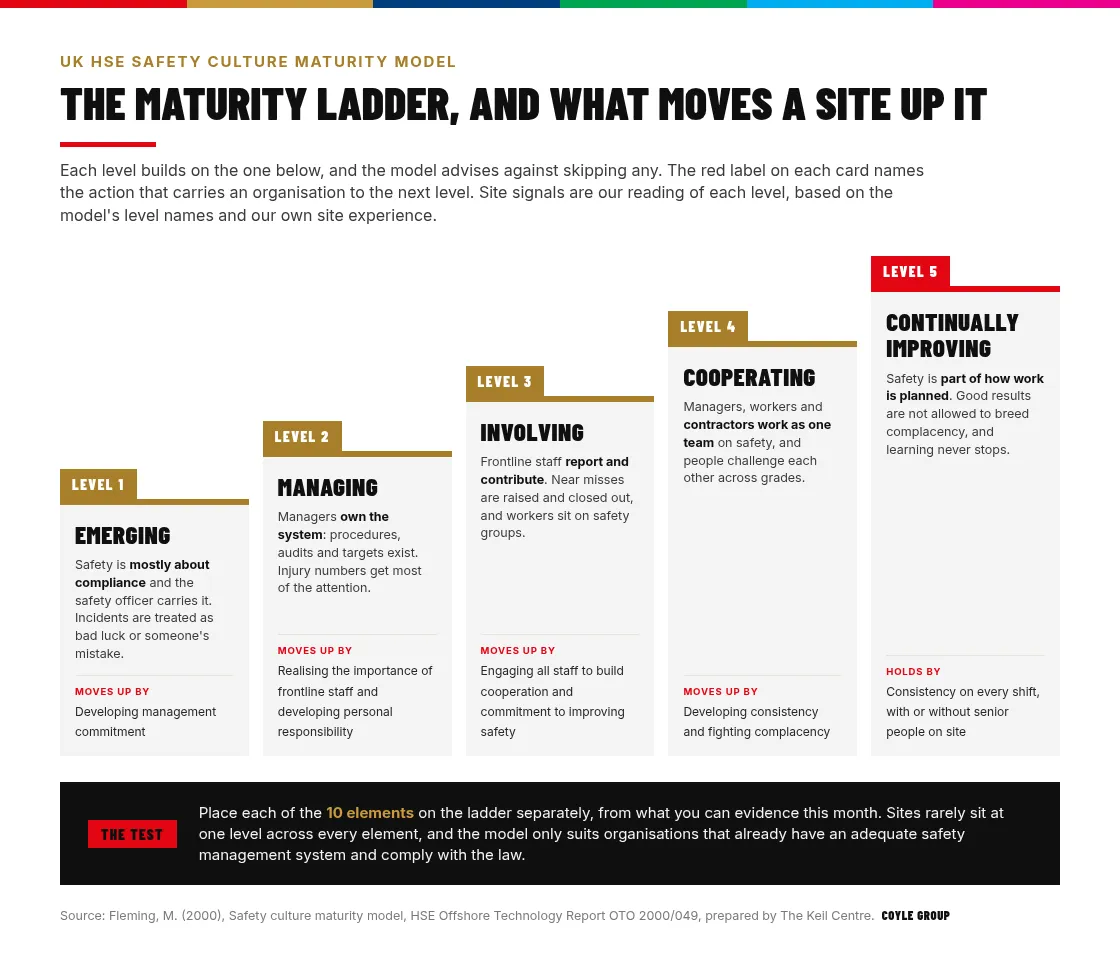
At the Emerging level, safety is mostly about compliance and one person carries it. The safety officer writes the paperwork, managers see safety as a cost, and an incident is put down to bad luck or to the individual involved. At the Managing level, managers have taken ownership of the system. Procedures, audits and targets exist, and attention concentrates on injury numbers, which are a lagging measure.
At the Involving level, the workforce contributes. Near misses are reported and closed out, supervisors listen to the people doing the work, and workers sit on safety groups with real influence. At the Cooperating level, managers, workers and contractors treat safety as shared work, and people challenge each other across grades without fear of the reaction.
At the Continually Improving level, safety is part of how work is planned and no longer a separate activity. Good results do not breed complacency, and the organisation keeps looking for the next improvement. The 5 level names, in order, are Emerging, Managing, Involving, Cooperating and Continually Improving, and most sites we visit contain more than 1 of them at once.
How to Judge Where Your Organisation Sits
Start with evidence you can collect this month, and place each of the 10 elements on the ladder separately. Four sources give the clearest picture on a construction or energy site: how incidents and near misses are reported, how supervisors behave under programme pressure, how much workers are involved in decisions, and how contractors are managed.
On incident reporting, count the reports and then check what happened next. A low near-miss count alongside a steady injury count usually points to under-reporting, and a pile of reports with no close-out suggests an organisation sitting at the Managing level. On supervisor behaviour, watch a controlled work activity when the schedule slips. A supervisor who holds the control and absorbs the delay is showing visible commitment, while one who waives it is showing the real priority.
Worker involvement is the third test. Ask whether hazard ideas come from the people doing the task and whether anything changed because of them. Contractor management is the fourth. A site that briefs its contractors, includes them in toolbox talks and treats their reports the same as employee reports is moving towards cooperation, and a site that treats them as outsiders is not.
The HSE advises that measurement is only a starting point, and that senior managers should be ready to have their own perceptions and behaviours examined and challenged. It also says a good starting place is to measure the existing culture with a safety climate tool or by talking to the workforce, in proportion to the hazards. A published case shows why that matters. The Keil Centre ran the model at bp’s Dalmeny and Hound Point asset in late 2000, involving about 75 staff, which was roughly 75% of the workforce and included 25 contractor personnel. Most elements sat at the Involving level and were moving towards Cooperating, but the craft and marine teams rated maturity lower than management did. Without that spread, the improvement actions would have been one-size-fits-all.
What Moves an Organisation Up a Level
The report names one change that links each pair of levels, and each is a different kind of work. To move from Emerging to Managing, an organisation has to develop management commitment. From Managing to Involving, it has to realise the importance of frontline staff and develop personal responsibility. From Involving to Cooperating, it has to engage all staff to build cooperation and commitment to improving safety. From Cooperating to Continually Improving, it has to develop consistency and fight complacency.
Most of these transitions start with leaders. Developing management commitment, and later consistency, is the kind of work a leadership workshop is built to practise.
These actions explain why the same initiative succeeds on one site and fails on another. The Lardner, Fleming and Joyner paper notes that identical behavioural safety initiatives worked on one installation and failed at a technically similar site elsewhere in the same organisation. A technique that suits an Involving site, such as peer observation, will not rescue an Emerging site where managers have not yet committed.
The first Dalmeny actions were practical. After the assessment, staff designed their own near-miss reporting system, which produced about 3 reports a day within 3 months and led to unsafe conditions that had existed for years being corrected. They also restored face-to-face communication between managers and shift teams, closed out reported issues consistently and gave more recognition to people who contributed. Our guide to positive safety culture lists 5 indicators you can check on a walk-around, and each one maps to the actions above.
Where the missing piece is observation and feedback on behaviour, a structured programme helps. Our explainer on behaviour-based safety sets out how such a programme works, and our breakdown of the ABC model covers the principles underneath it. Both assume the organisation has already reached a level where workers are willing to take part.
Does the HSE Model Apply in Ireland?
Yes, with the caveat that the model is a UK publication and the legal framework differs. The Health and Safety Authority (HSA) describes safety culture as “the way we do things around here” and explains it through 3 aspects: how people feel, what people do and what the organisation has. Its safety culture guidance says repeated studies show management commitment and management style are significant, which matches the HSE position closely.
We have not found a separate maturity ladder published by the HSA. Irish employers therefore use the HSE model as a reference, and in our experience that works because the 10 elements describe behaviour that any site can observe. A weak near-miss system or a supervisor who waives a control looks the same in Cork as it does in Cardiff.
Legal duties still need to be read against the right jurisdiction. The HSE model assumes an organisation that complies with health and safety law, and for Irish sites that means the Safety, Health and Welfare at Work Act 2005 and its regulations. If you want the legal basics checked first, our health and safety audit checklist is a sensible starting point before any culture assessment.
Limits of the HSE Model
The model has 3 limits worth knowing. First, the report is explicit that the model is only relevant to organisations that already have an adequate safety management system, where technical failures are not causing most accidents and the company complies with health and safety law. An organisation failing those basics needs them fixed before a culture exercise adds value.
Second, the model started as a draft built for the offshore oil and gas industry. Its descriptions travel well to construction, energy and utilities, but a small contractor with a crew of 8 will read some of the 10 elements differently from a major operator with thousands of staff.
Third, a level is a judgement call. Assessors can place the same element a level apart, and managers tend to rate their own culture higher than the workforce does, as the Dalmeny case showed. HSE adds that any set of measurements is only a starting point and that the useful step is acting on the findings and feeding them back to employees. A culture change process, it says, can take several years.
How the Coyle Approach Combines Two Models
Gavin Coyle’s white paper, The Coyle Approach: Defining and Measuring Safety Culture, integrates the UK HSE model with the US S-CAT Safety Climate Assessment Tool maturity model. The S-CAT model describes 5 levels of its own: Inattentive, Reactive, Compliant, Proactive and Exemplary. The white paper also keeps the actions between levels, which cover developing a management committee, realising the importance of the frontline, engaging all staff and building consistency.
We combine the two because each covers ground the other handles lightly. The HSE model gives a detailed view of 10 elements, and the S-CAT model gives a plain-language scale that a site manager can place themselves on in minutes. The white paper also refines question wording so each answer points to a specific action. This is the framing we mean by safety culture and development: where you sit today, and the one change that moves you on.
The free Safety Culture Survey puts this into practice. We do not repeat its mechanics here, but in short it takes about 5 minutes and scores your answers against both frameworks. It then emails an individual report. If the report points to gaps that need outside help, our safety consulting team can run a company-wide assessment across levels, sites and contractors.
Know the levels but not your own result? Take the free Safety Culture Survey and see which element holds your organisation back.
Take The Free Safety Culture Survey
One survey result is a starting point, and the next move is to compare it with what you see on site.
Placing Your Own Site on the Ladder
The HSE safety culture maturity model earns its place because it turns a vague word into something a manager can check. Pick your weakest 3 elements, gather evidence from incident reporting, supervisor behaviour, worker involvement and contractor management, and agree the one change that would move each up a level. Then repeat the exercise in 6 to 12 months, because culture moves slowly and measurement only helps when it is repeated.
Coyle Group was founded in 1999, Gavin Coyle holds CMIOSH, and we have more than 25 years of safety work behind the way we read culture on site. If you want a starting position before that exercise, Take the free Safety Culture Survey.
Frequently Asked Questions (FAQs): Safety Culture Maturity Model
These are the questions Irish and UK employers ask Coyle Group when they first meet the HSE safety culture maturity model.
What is the HSE safety culture maturity model?
It is a framework published by the UK Health and Safety Executive in 2000 as Offshore Technology Report OTO 2000/049. It describes 5 levels of safety culture maturity across 10 elements, from Emerging to Continually Improving. Coyle Group uses it as one of 2 frameworks behind the Coyle Approach, alongside the US S-CAT model.
Who developed the safety culture maturity model?
Dr Mark Fleming of The Keil Centre wrote the report, which the Health and Safety Executive sponsored with funding from the UK offshore oil industry. It drew on the capability maturity model concept from software engineering and on the safety culture features listed in HSE guidance HSG48. Coyle Group cites the original report so clients can read the source themselves.
What are the 5 levels of safety culture maturity?
In order they are Emerging, Managing, Involving, Cooperating and Continually Improving. The model proposes that organisations move through them in sequence by building on the strengths of the previous level and removing its weaknesses. Coyle Group advises clients to treat each level as a description of behaviour on site and not as a grade.
Does the model apply in Ireland?
Yes. The Health and Safety Authority describes safety culture as the way we do things around here and does not publish a separate maturity ladder that Coyle Group has found, so Irish employers use the HSE model as a practical reference. Irish law differs from UK law, but the behaviours the model describes, such as involvement and leadership, apply on both sides of the border.
How long does it take to move up a level?
There is no fixed timescale. The Health and Safety Executive states that a culture change process can take several years, and that repeating measurements helps track progress. Coyle Group tells clients to expect each move to depend on one specific change, such as visible management commitment or worker involvement, and not on a single campaign or poster.
How is the Coyle Approach different from the HSE model?
The Coyle Approach, set out in a white paper by Gavin Coyle, combines the UK HSE model with the US S-CAT model and refines the question wording to produce clearer actions. Coyle Group's free Safety Culture Survey scores your answers against both frameworks and sends an individual report by email, so you can see where your organisation sits within minutes.