Safety Leadership Workshop: Behaviours, Vocabulary, KPIs
A safety leadership workshop is a working session where the people who run a project learn, and practise, the behaviours that decide whether safety rules get followed on site. Most tier-one employers in Irish and UK energy, utilities, wind and construction already have the procedures. What varies is how directors, project managers and supervisors act when a programme slips, a permit is late or a worker raises a concern.
This guide sets out what a safety leadership workshop covers, who should attend, and how we structure one around 3 modules: behaviours, vocabulary and KPIs. It also covers the legal duties that sit with directors in Ireland and Great Britain, how to prepare, and how to tell afterwards whether the session changed anything.
Want to see where leadership behaviour is weakest before you plan a session? Take the free Safety Culture Survey and use the results to set the agenda.
Take The Free Safety Culture Survey
What Does a Safety Leadership Workshop Cover?
A good safety leadership workshop covers 3 areas, and each one produces something a leader can use the following morning. The first is behaviour: what leaders visibly do on site and how workers read it. The second is vocabulary: the words a project uses for hazards, risks and mistakes. The third is measurement: which KPIs leaders review, and who owns them.
These are the areas where leadership shows up in daily work, and they are also where most programmes have gaps. HSE’s guidance on safety culture says that an organisation’s culture can have as big an influence on safety outcomes as the safety management system itself. Procedures describe what should happen, and leadership behaviour decides what does.
Our consulting team treats leadership safety workshops as part of a wider safety consulting engagement, so the content is built from the client’s own survey results, incident data and site scenarios. The sections below set out what each module contains and where it fits.
Who Should Attend a Safety Leadership Workshop?
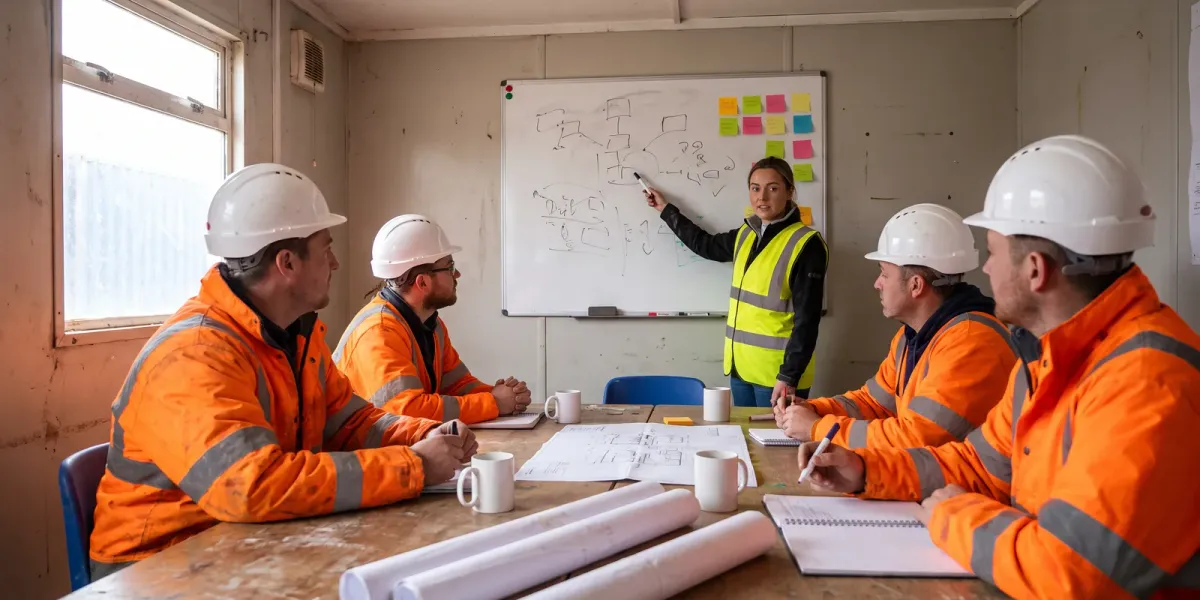
The people who set priorities and the people who pass them on should attend together. In practice that means directors or the project’s senior leadership, project and contracts managers, site managers and supervisors. A workshop attended only by site supervisors teaches them to carry a message their own leaders may contradict, and a workshop attended only by directors never reaches the place where the behaviour happens.
Mixed groups are harder to run and worth the effort. A supervisor who hears a director describe how they want bad news delivered changes what they report. A director who hears a supervisor explain why a stop-work call feels risky learns what a delay really costs the person making the call. Both conversations happen far less often in a normal week than they should.
Safety officers and advisers belong in the room as well. They are the people who will support the new behaviours on site afterwards, and they see the gap between what leaders say and what workers experience more clearly than anyone else. Our guide to building a high-performing safety team covers the role they play once the workshop ends.
How We Structure a Safety Leadership Workshop
Our format starts before the day itself and finishes after it. A baseline comes first, built from Safety Culture Survey results and recent leading and lagging indicators. The 3 modules follow, each built around a practical exercise, and a re-measure closes the loop. The survey is built on the Coyle Approach, the safety culture methodology set out in Gavin Coyle’s white paper, so the results map directly to the behaviours the workshop practises.
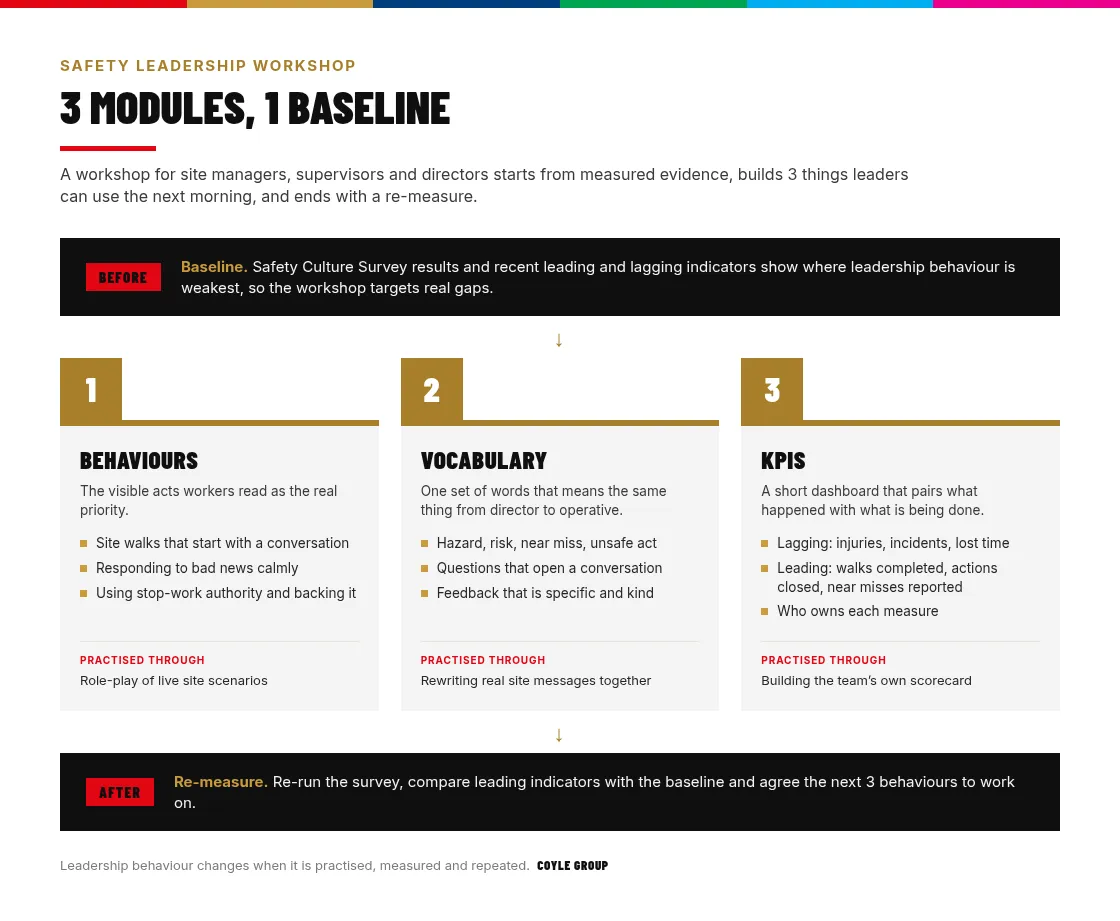
Each module ends with something the group produces. The behaviours module ends with a short list of site actions leaders commit to. The vocabulary module ends with the wording the project will use in toolbox talks, permits and incident reports. The KPI module ends with a scorecard the leadership team will review every month.
Attendees leave with outputs they own. That matters because the workshop is only the start: a leadership team that takes the scorecard, the commitments and the shared wording back to site has something concrete to hold itself to.
Visible Safety Leadership Behaviours That Workers Notice
Workers decide what a project values by watching what its leaders do under pressure. The behaviour module focuses on 3 moments where that judgement gets made, because each one is frequent enough to practise and visible enough to shape the culture.
Site walks that start with a conversation
A leader’s site walk is only useful if the conversation is honest. Walks that follow a fixed route and end with a list of housekeeping faults teach workers to tidy up before a visitor arrives. Walks that start by asking a crew what is difficult about today’s task produce real information about the work.
We practise this with short role-plays. One person plays the leader, another plays a team member part way through a task, and the group watches for what gets asked, what gets heard and what gets fixed. The most useful habit is closing the loop: when a leader promises to sort a problem, the crew sees it sorted. Our guide to behaviour-based safety explains how observation and feedback work once those walks are routine.
How leaders respond to bad news
The first 30 seconds of a leader’s response decide whether the next problem gets reported. A near miss, a missed inspection or a mistake that nearly became an incident reaches leadership only when the person who made it expects a fair hearing. If the response is blame or irritation, the next report goes unmade.
The workshop rehearses that response with realistic scenarios: a supervisor admits a permit was signed before the isolation was confirmed, a worker reports a colleague bypassed a guard, a subcontractor flags that a programme date cannot be met safely. Participants practise thanking the person, asking what happened and agreeing the fix before discussing any consequence. A positive safety culture depends on this behaviour more than any poster or campaign.
Stopping work and backing the call
Stop-work authority only exists if workers believe a stop will be backed. Most organisations have a policy that says anyone can stop a job. Workers judge the policy by what happened the last time someone used it, and a single dismissive reaction from a manager can undo a year of toolbox talks.
The workshop asks leaders to describe the last time work was stopped on their project and how it was received. Then the group agrees what a visible, proportionate response looks like, including how a manager reacts on the day and how the stop is acknowledged in front of the crew afterwards. A leader who thanks the person who stopped the job, in front of the team, teaches more about stop-work authority than any procedure.
Building a Shared Safety Vocabulary
A shared vocabulary means a director, a supervisor and an operative use the same words to mean the same thing. It sounds minor and it causes more trouble than most leaders expect. When a hazard, a risk and an incident get used interchangeably, reports become hard to compare, and when a “near miss” means 3 different things on 3 different crews, the numbers on a dashboard mean little.
The vocabulary module settles the terms the project uses. It covers hazard, risk, near miss, unsafe act and unsafe condition, and it fixes the sentence a leader uses to open a conversation about each. It also covers the words used for feedback. “You were unsafe” ends a conversation, while “tell me how you decided to do the job that way” starts one.
The group rewrites real messages from the project, such as a toolbox talk script, a permit briefing or an incident summary, in plain, consistent language. Our guide to accountability for safety is a useful reference for the duty-holder terms that should stay exact. Once the wording is agreed, supervisors use it on site and the same language appears in every report.
Leading and Lagging Indicators for Leaders
Leaders need leading and lagging indicators side by side, because each answers a different question. Lagging indicators, such as injuries, incidents and lost time, record what has already happened. Leading indicators, such as site walks completed, actions closed on time and near misses reported, record the activity that is meant to prevent the next event. HSE’s guide to process safety indicators, written for senior managers and safety professionals, sets out a step-by-step method for building a measurement system that gives assurance of control over major hazard risks.
A dashboard of lagging figures alone arrives too late to change a decision. A dashboard of leading figures alone can show plenty of activity with no evidence of effect. The KPI module builds a short scorecard that pairs the two, with every measure given a named owner and a review date.
A rising near-miss count is a good example of why leaders need training to read the numbers. It often means workers trust the reporting system, which is a healthy sign, yet an untrained leadership team can read it as a decline in performance and respond by discouraging reports. The workshop teaches leaders to interpret each measure before they act on it.
What the Law Expects of Directors and Senior Managers
Directors and senior managers can be prosecuted personally when a company commits a health and safety offence. In Ireland, section 80 of the Safety, Health and Welfare at Work Act 2005 makes a director, manager or similar officer guilty of an offence where the company’s offence was authorised or consented to by that person, or attributable to their connivance or neglect. The section also presumes that a director’s involvement existed until the contrary is proved.
The position in Great Britain is similar. Section 37 of the Health and Safety at Work etc. Act 1974 applies the same test of consent, connivance or neglect to a director, manager, secretary or similar officer of a body corporate. The 2 regimes use the same test, so a leadership team working across both jurisdictions can apply a single standard.
HSE’s leadership guidance, Leading health and safety at work (INDG417), is written for directors, governors, trustees and officers of organisations of all sizes. It uses a Plan, Do, Check, Act approach, which is a useful frame for a workshop agenda. A workshop gives leaders practical habits that make neglect far less likely, and legal questions still go to a lawyer.
How to Prepare for a Safety Leadership Workshop
Preparation starts with a baseline. Before anyone books a room, collect 2 kinds of evidence: what workers say about leadership behaviour, and what the site data shows. The first comes from the Safety Culture Survey, which scores a workforce’s answers against the Coyle Approach and shows where leadership behaviour is weakest. The second comes from incident, near-miss and inspection records for the last 12 months. Placing the results on the maturity model shows which leadership behaviours the next level depends on.
The gap between the 2 sets of evidence is often where the best workshop content sits. A site with a low injury count and a survey result showing that workers do not report mistakes has a leadership problem the lagging figures hide. A site with high reporting and low confidence that actions will be closed has a different gap, and it needs a different session.
Then agree what a good result looks like. Choose 3 behaviours the leadership team will commit to, 2 or 3 leading indicators they will review monthly, and a date for the re-measure. Our guide to sustainable leadership is a helpful read for directors who want to think about how personal habits shape what the rest of the organisation does.
How to Tell Whether a Safety Leadership Workshop Worked
The only reliable way to tell is to compare the same measures before and after. Attendance sheets and feedback forms show that a session ran and that people enjoyed it. They say little about behaviour, so they are poor evidence of whether anything changed on site.
Re-run the Safety Culture Survey after a few months and compare the leadership results with the baseline. Then check whether the leading indicators moved: more site walks completed, quicker closure of actions, a rise in near-miss reports. A rise in near-miss reports in the first months is usually a good sign, because it means workers expect a fair hearing.
Ask the people who were not in the room. A supervisor who says that a director now asks what is getting in the way before asking why a task is late is describing a real change. Collect a handful of these accounts alongside the scorecard, and the evidence is stronger than either source alone.
Need a baseline to compare against after the session? Take the free Safety Culture Survey today and keep the results as your starting point.
Take The Free Safety Culture Survey
A baseline gives a workshop something to be measured against, and it gives the leadership team a starting point they can talk about openly.
Turning a Safety Leadership Workshop Into Lasting Site Behaviour
A safety leadership workshop pays off when the behaviours, the vocabulary and the scorecard go back to site with the people who attended. Coyle Group was founded in 1999, Gavin Coyle holds CMIOSH, and our team has delivered more than 1M hours of safety work, so we know how quickly a good session fades when nothing is measured afterwards. The baseline, the 3 modules and the re-measure exist to prevent that.
Start with the evidence, agree 3 behaviours the leadership team will commit to, and review a short scorecard every month. When you are ready to see where your leadership behaviour stands today, Take the free Safety Culture Survey.
Frequently Asked Questions (FAQs): Safety Leadership Workshop
These are the questions directors, project managers and site leaders ask Coyle Group when they are weighing up a safety leadership workshop.
What is a safety leadership workshop?
A safety leadership workshop is a facilitated session where directors, managers and supervisors practise the behaviours that shape site safety, such as walking the site, responding to bad news and backing a stop-work call. Coyle Group builds each session around live site scenarios, a shared vocabulary and a small set of leading and lagging KPIs.
Who should attend a safety leadership workshop?
The people who set priorities and the people who pass them on. That means directors, project managers, site managers and supervisors, ideally together, so each level hears the same message and sees the others practise it. Coyle Group also recommends including the safety lead, who can then support the new behaviours on site afterwards.
How long does a safety leadership workshop take?
Length depends on the number of attendees, the sites involved and how much baseline data exists. Coyle Group scopes each session after reviewing Safety Culture Survey results and recent incident and near-miss data, then agrees the format with the client. A single focused session suits a project team, while a multi-site organisation may need a short series.
Are directors personally liable for workplace safety?
They can be. Section 80 of the Safety, Health and Welfare at Work Act 2005 in Ireland and section 37 of the Health and Safety at Work etc. Act 1974 in Great Britain allow directors and managers to be prosecuted alongside the company where an offence is linked to their consent, connivance or neglect. Coyle Group treats this as the reason leadership behaviour belongs on the board agenda.
What is the difference between leading and lagging safety indicators?
Lagging indicators count outcomes that have already happened, such as injuries, incidents and lost time. Leading indicators track the activity that prevents them, such as site walks completed, actions closed on time and near misses reported. Coyle Group recommends leaders review both together, because lagging figures alone arrive too late to change a decision.
How do you measure whether a safety leadership workshop worked?
Compare the same measures before and after. Coyle Group suggests re-running the Safety Culture Survey, then checking whether leading indicators such as walks completed and near-miss reports have risen and whether workers report that leaders respond differently. A short change in survey scores, backed by changes in site activity, is stronger evidence than attendance sheets or feedback forms.
Can Coyle Group run a safety leadership workshop for our site team?
Yes. Leadership safety workshops are part of Coyle Group's consulting services, led by Gavin Coyle, CMIOSH, who founded the company in 1999. The usual starting point is the free Safety Culture Survey, whose results show where leadership behaviour is weakest and give the workshop a clear agenda before anyone books a room.