Working at Heights Regulations for Wind Turbines (IE, UK)
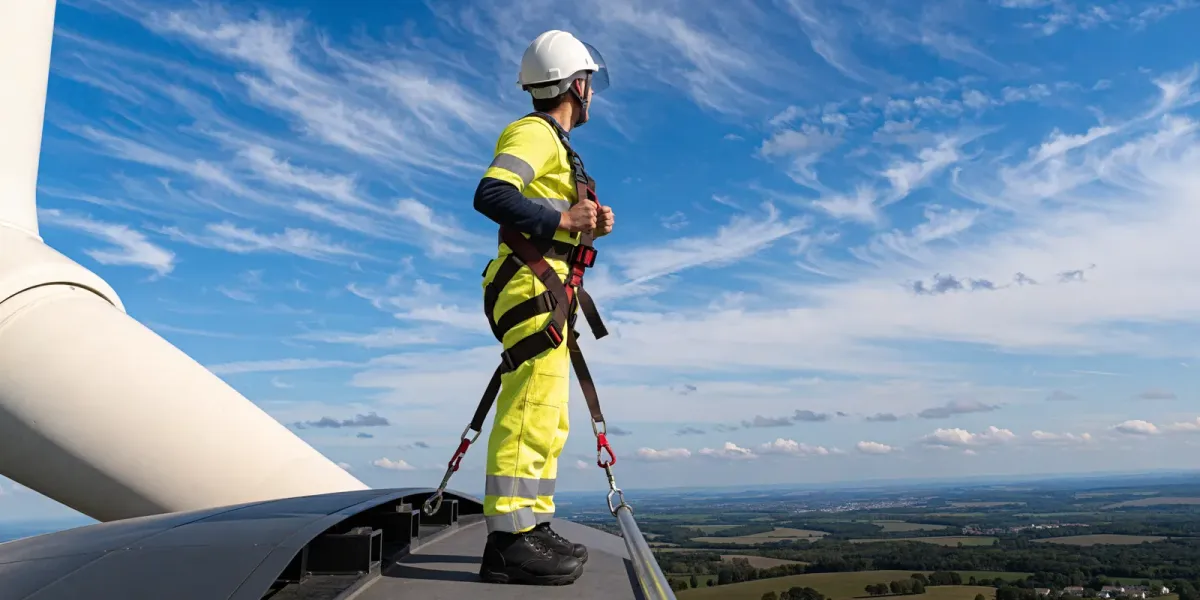
Working at heights regulations apply to a wind turbine exactly as they do to a building site, but the machine adds conditions that no general guide anticipates: a fixed ladder that can run past 100 metres, a nacelle roof exposed to the weather, a blade that has to be reached on ropes, and in the offshore case a boat transfer onto a platform in a swell. Every one of those tasks is work at height, and each carries its own fall hazard.
The legal duties are the same across the sector, but the practical answers differ from zone to zone and from one turbine model to the next. This guide sets out which working at heights regulations govern wind work in Ireland, the UK and the EU, then walks the turbine from the tower base to the blade tip and the offshore transition piece, covering access, fall arrest and rescue at each stage.
Planning climbs, a blade campaign or an offshore construction window? Talk to a wind-sector safety specialist and our chartered team will help you test the access and rescue plan against the turbine you are actually working on.
Talk To A Wind-Sector Safety Specialist
Which Working at Heights Regulations Apply to Wind Turbines?
No regulation in Ireland, Great Britain or the EU is written specifically for turbine climbing. The general work at height duties apply, and the manufacturer’s documentation fills in the turbine detail. Our general working at height guide covers the regime in full, so this section only picks out what matters for wind.
In Ireland, Part 4 of the General Application Regulations 2007 (Regulations 94 to 119) governs work at height, supported by the Health and Safety Authority’s work at height guidance. Wind farm construction also falls under the Safety, Health and Welfare at Work (Construction) Regulations 2013, which brings in the Project Supervisor roles.
In Great Britain, the Work at Height Regulations 2005 apply, and the HSE’s work at height pages set out the avoid, prevent, minimise hierarchy. Regulation 4 requires work at height to be planned, supervised and carried out safely, and it states that the planning includes emergencies and rescue. It also requires that work happens only when the weather does not jeopardise safety, a duty that matters on an exposed nacelle roof.
At EU level, the duties flow from the Framework Directive 89/391/EEC and the Work Equipment Directive 2009/104/EC, which set minimum requirements for work at height and are the reason Irish and Continental rules look alike. Turbines themselves are machinery under Directive 2006/42/EC, and the standard EN 50308 sets protective measures for the design, operation and maintenance of wind turbines. The practical effect is a 2-layer system: statute sets the duty, and the manual and standards set the method.
Because every turbine type differs, working at heights regulations are only the starting point for the access plan, and the next sections take each zone in turn.
Tower Ladders and Fall-Arrest Systems
The tower ladder is where most climbing happens, and on a modern machine it can run well over 100 metres. The standard control is a guided-type fall arrester running on a rail or wire fixed to the ladder, attached to the front point of a full-body harness. The arrester travels with the climber and locks on a fall, so the person falls a short distance only.
The harness, connector, arrester and rail form one system. Equipment standards give the benchmarks: EN 361 for full-body harnesses, EN 362 for connectors and EN 353-1 for guided type fall arresters on a rigid anchor line. Mixing a rail from one manufacturer with an arrester from another voids the compatibility the manufacturer tested. Rest platforms break the climb into stages and give a place to recover, and the best practice is that the climbing sequence and rescue method are agreed before the first technician leaves the ground.
Fixed ladders and platforms carry their own checks. Rails, rungs and anchor points need inspecting against the manufacturer’s schedule, and harnesses and connectors need a pre-use check plus a documented thorough examination. In Ireland, Part 4 of the General Application Regulations requires work equipment for work at height to be inspected by a competent person, and in Great Britain Schedule 5 of the Work at Height Regulations sets requirements for personal fall protection systems.
The ladder is where fatigue and complacency show up, since technicians climb it every day. A climb that tires the legs also tires the hands, which is why rest platforms and a limit on loads carried on the ladder belong in the plan. Tools and parts go up by the service lift or by hoist wherever possible, which leaves the climber’s hands free for the ladder itself.
Fall arrest on the ladder is only the first of 7 separate controls, and the next section covers the machine’s mechanical access routes.
Service Lifts, Nacelle Access and Roof Hoisting
Many turbines have a service lift in the tower, which reduces climbing and keeps tools off the ladder. A lift that carries people is lifting equipment, so it needs a thorough examination, 6 months being the interval for equipment that lifts persons under both the Irish General Application Regulations 2007 and the Lifting Operations and Lifting Equipment Regulations 1998 in Great Britain. The manufacturer’s manual states whether a harness must be worn in the lift, and the lift must have a tested emergency lowering route so a stalled car does not trap a technician.
At the top of the tower, the technician enters the nacelle through a hatch. An open hatch is a fall opening, so it needs a guard or a closing procedure, and the floor openings inside the nacelle need the same treatment. Fixed anchor points inside the nacelle give a place to clip on before the hatch is opened, which means the technician is attached before the hazard appears.
The nacelle roof is the most exposed zone. Roof work calls for a double lanyard (or a lanyard with an energy absorber) clipped to rated anchors, usually to EN 795, and the manufacturer’s wind-speed limit for roof access has to be checked against the live conditions before the roof hatch is opened. Hoisting loads through a roof hatch or with a nacelle crane adds a lifting plan and a banksman function to the work, because a dropped object is a hazard to anyone at the base.
Every task at the nacelle should begin with an agreed rescue plan, since a technician who falls from a roof edge will be arrested above the nacelle floor and may be hard to reach.
Hub and Blade Access: Rope Access and Platforms
The hub is a confined, awkward zone: the spinner, the pitch system and the blade roots are reached by hatch and ladder, and the rotor may be turned or locked. Before anyone enters, the rotor lock must be verified and the isolation applied, because a rotor that moves while a person is inside the hub adds crush to the fall hazard. Short lanyards and fixed hub anchor points limit the fall distance.
The blade exterior is reached in 1 of 2 ways. Rope access uses 2 independent lines, a working line and a safety line, with the technician trained and assessed to a recognised rope access scheme and equipment to EN 12841. An access platform or cradle suspended from the nacelle gives a stable working surface for longer repairs, but it adds its own equipment, anchors and examination duties.
Rope access teams need a competent supervisor and a rescue capability on the nacelle roof, with a second trained technician ready to lower or raise a casualty. The weather window is narrow for blade work, since wind, rain and lightning all stop work and the duty under regulation 4 of the Work at Height Regulations 2005 to stop in unsafe weather applies directly.
Blade repair campaigns often involve contractors working alongside the turbine owner’s technicians, so the plan has to name who supervises, who rescues and how the teams communicate, a coordination problem Coyle Group sees on most blade campaigns.
Offshore Transfer and Transition Piece Access
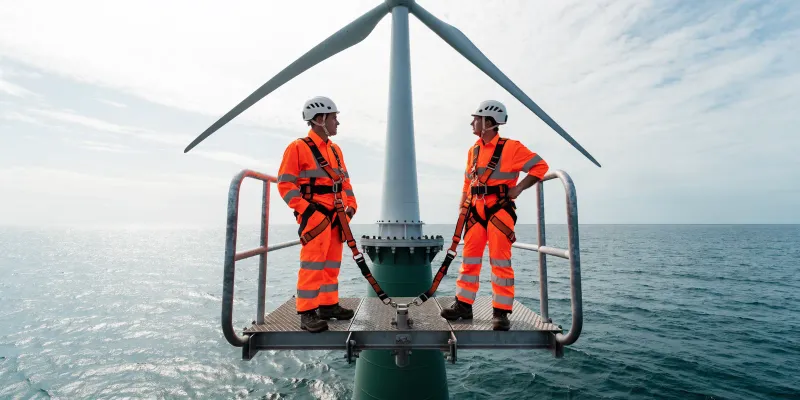
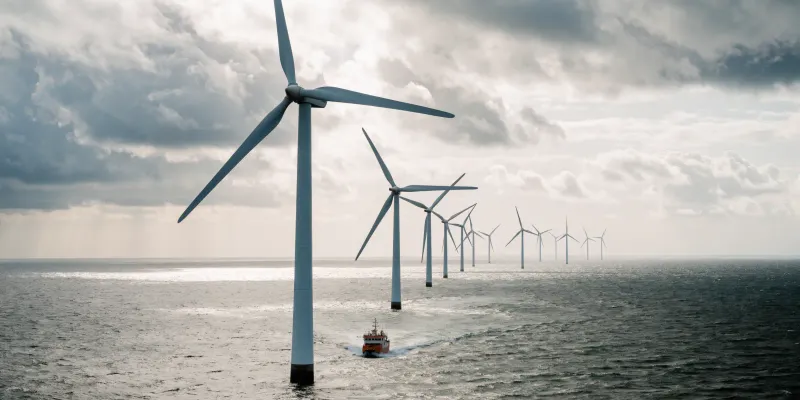
Offshore, the fall hazard starts before the tower. Moving from a crew transfer vessel to the transition piece involves a boarding ladder or a motion-compensated gangway, and a fall here means a drop into the sea as well as onto a hard surface. Harness use, a lifejacket and sea survival kit work together, and the transfer happens only inside the weather and sea-state limits set in the project plan.
In Great Britain the HSE regulates health and safety on offshore wind farms, and the Work at Height Regulations 2005 apply on the structure itself. Ireland’s first sites are still in development, and our update on offshore wind projects shows where this planning will be needed first, from the Phase One consents to the turbine installation windows.
Rescue offshore is slower. A casualty on a transition piece or in the water may depend on the vessel crew, a standby vessel or a helicopter, and the plan must say which and how long it takes. The Global Offshore Wind Health and Safety Organisation, G+, publishes good practice guidelines for the sector, which project plans commonly reference alongside the statutory duties.
Offshore access therefore adds the sea to the fall hazard and the distance to the rescue, which makes the rescue method the first thing to settle rather than the last.
Mapping Fall Hazards from Tower Base to Blade Tip
A whole turbine is best treated as 7 zones, each with its own hazard, control and rescue method. The infographic lays them out side by side, so a planner can see at a glance where the fall protection changes and where the rescue method has to change with it.
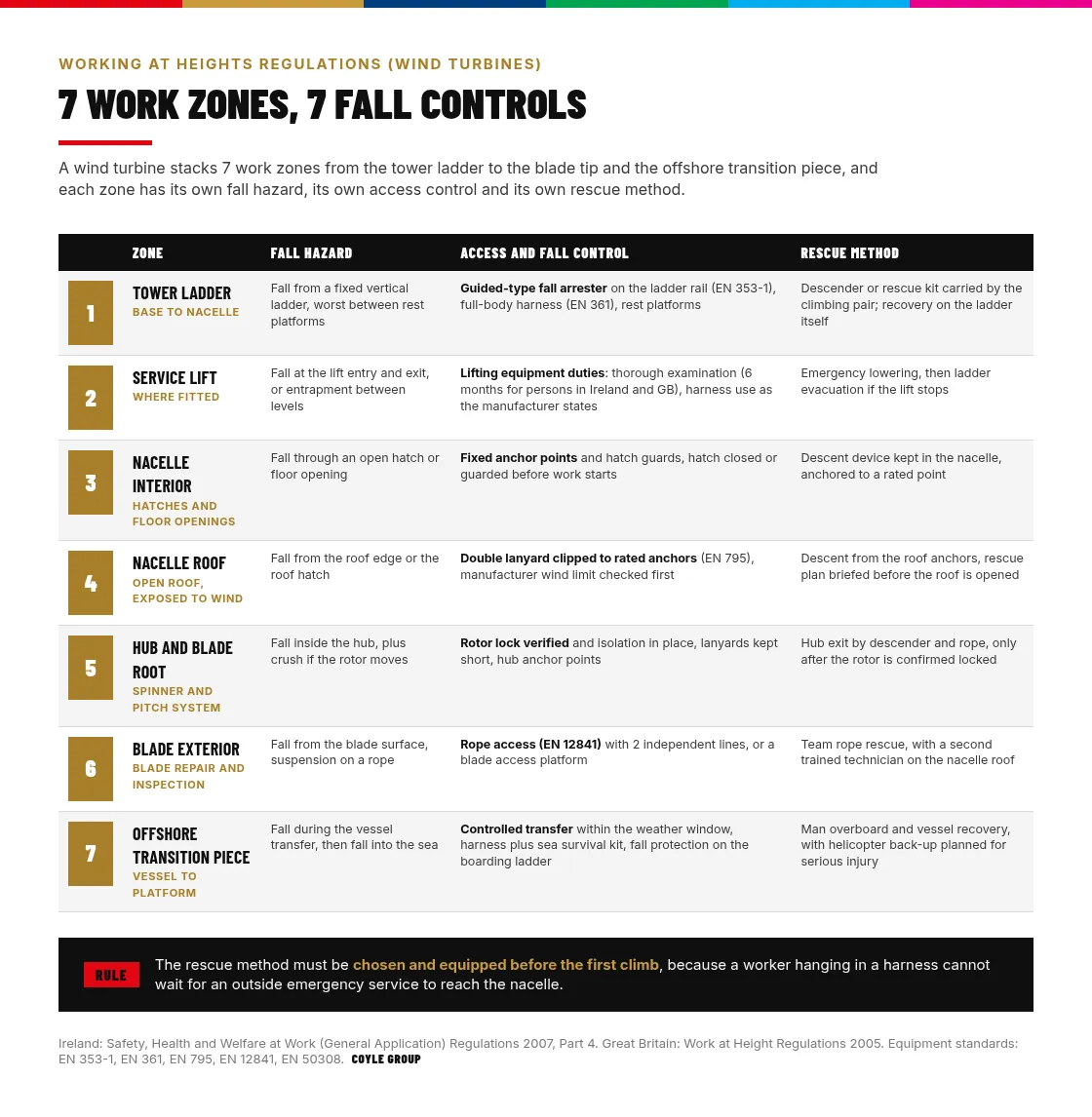
The pattern across the zones is consistent. Each has an attached or arrested position as the default, a manufacturer-specified anchor, and a rescue method that does not depend on outside help. When a task crosses 2 zones, for example a climb from the ladder to the nacelle roof, the technician must be protected through the whole transition with no unprotected moment between anchors.
That is why a single risk assessment for the turbine is not enough. A site plan that covers the ladder and the roof but omits the hub or the blade leaves a gap in exactly the places where rescue is hardest, and the plan has to follow the technician from the ground to the last anchor.
How Is a Casualty Rescued from a Wind Turbine?
A casualty is rescued by a trained team using a pre-positioned descent device or rescue kit, anchored to a rated point and used to lower the person to the ground or to a safe platform. The method differs by zone: on the tower ladder the casualty is recovered on the ladder, in the nacelle the casualty is lowered through the floor hatch, and on a blade the rope team carries out a rope rescue.
The reason this matters is suspension trauma. A person who falls and is held in a harness can lose consciousness, and prolonged suspension restricts circulation and can become life threatening. The HSE work at height guidance makes the point that a fall arrest system is only safe if the casualty can be recovered quickly. In Great Britain, that planning duty sits in regulation 4(2) of the Work at Height Regulations 2005, and in Ireland the same expectation follows from the duty to plan work at height under the General Application Regulations.
An effective turbine rescue plan names 4 things: the recovery method for each zone, the kit stored on the turbine, the people trained to use it, and the target time. Crews should rehearse it on the actual turbine as well as on a training tower, because anchor positions, hatch sizes and nacelle layout vary by model. Where the rescue relies on a second technician, the lone worker rules matter, since a person working alone cannot be rescued by anyone.
Equipment for rescue follows standards as well: EN 341 for descent devices and EN 1496 for rescue lifting devices, and the kit needs the same inspection regime as the harnesses.
A rescue plan is only credible when it has been tested against the real turbine and the real conditions, so rehearsal belongs in the programme before the campaign starts.
Which Training and Competence Do Turbine Technicians Need?
Turbine technicians need documented competence in working at height and rescue before they climb. The industry baseline is GWO Basic Safety Training, whose Working at Heights module teaches PPE use, climbing and basic rescue, and our guide to GWO training covers the full standard and its validity periods. Rope access technicians hold a recognised rope access qualification on top of that.
Training proves a person can use the equipment, but it does not tell them how this turbine works. A site induction and a model-specific briefing cover the anchors, the rescue kit, the hatches and the manufacturer’s limits, and the competence check should be recorded. Regulation 4 of the Work at Height Regulations 2005 requires supervision, and the Irish regulations require that work at height is carried out by competent people, so supervisors need to be competent in the same work they oversee.
Because wind projects often scale quickly, the practical problem is finding enough competent people at short notice. Our experience of contract safety officers in the wind sector is that the gap shows up when a campaign starts, and a safety officer who already holds the working at height and rescue credentials removes it before it becomes a delay.
Competence therefore has 3 layers, the certificate, the site briefing and the supervision on the day, and all 3 need to be in place before a climb is authorised.
Planning, Inspection and Supervision of Turbine Work at Height
Good turbine work at height planning starts with the manufacturer’s manual and the site’s rescue plan, then moves to the task method statement and the permit. The plan should state the weather limits, the equipment to be used, the inspection status of each item, the rescue method and who is in charge. Permits that gate roof access, hub entry and blade work keep the controls tied to the task.
Equipment inspection is a legal duty and a practical one. Harnesses, lanyards, arresters and descent devices need a pre-use check by the user and a periodic thorough examination by a competent person, with records kept. A single item past its date can invalidate the whole system, because the harness, connector and arrester are only safe as a set.
Supervision matters most when the work is repetitive. A technician who climbs the same turbine every week can stop noticing the hatch left open or the lanyard not clipped, which is why a short toolbox talk and a buddy check before each climb earn their time. The same applies to contractors who arrive for a single campaign and have never seen the turbine.
Coyle Group has completed over 1 million hours of safety work on projects in Finland, Northern Ireland, the UK, Spain, Germany and Ireland, and its wind safety officers work to one simple rule: no climb starts until the rescue plan has been read out and agreed by the people who would carry it out.
Already holding a method statement and want the rescue and access arrangements checked before mobilisation? Talk to a wind-sector safety specialist and we will review the plan zone by zone.
Talk To A Wind-Sector Safety Specialist
That review is most useful before the campaign is programmed, while kit, training and staffing can still change.
Turning Turbine Fall Rules into a Plan That Holds Up
Working at heights regulations give the duty, but the turbine decides how it is met. The general rules are the same in Ireland, Great Britain and the EU: avoid work at height where possible, prevent falls, minimise the distance and consequences, and plan for rescue. The turbine adds 7 zones, each needing its own access control, its own anchor and its own recovery method, and the plan that holds up is the one that follows the technician through all of them.
The 3 points that decide whether a plan works are consistent. Rescue is planned before the climb, equipment is a compatible and inspected set, and competence covers the certificate, the site briefing and the supervision. Where a project cannot cover those from its own team, a chartered adviser or a specialist officer closes the gap faster than carrying it through the programme. If you are scoping an upcoming campaign, talk to a wind-sector safety specialist and we will start from the zone where your rescue plan is weakest.
Frequently Asked Questions (FAQs): Working at Height on Wind Turbines
These are the questions wind farm managers, turbine technicians and HSE leads put to Coyle Group most often when planning climbs, rescues and offshore access.
Is there a specific law for working at height on wind turbines?
No. Ireland applies Part 4 of the General Application Regulations 2007, and Great Britain applies the Work at Height Regulations 2005, to turbines in the same way as to any other structure. The turbine manufacturer's manual and standards such as EN 50308 then set the detailed access and protection requirements. Coyle Group treats the manual and the statutory duty as 2 layers that must both be satisfied.
What fall protection is used on a turbine tower ladder?
Most tower ladders use a guided-type fall arrester running on a steel rail or wire, attached to the front point of a full-body harness, with rest platforms at set intervals. The arrester, rail and harness must be a compatible set from the manufacturer. Coyle Group safety officers check that the arrester matches the rail fitted to that turbine type before any climb is authorised.
How is a casualty rescued from a wind turbine nacelle?
The usual method is a descent device or rescue kit anchored to a rated point in the nacelle or on the roof, used by a trained technician to lower the casualty to the ground or to a safe platform. Rescue kit and trained people must be on the turbine before work starts. Coyle Group reviews rescue arrangements as part of every wind method statement.
Why is suspension trauma such a concern on turbines?
A worker who falls and is held in a harness can lose consciousness, and prolonged suspension can restrict circulation and become life threatening. On a turbine, outside emergency services may be a long way off and a long climb away. Coyle Group therefore asks for a rescue time target in the plan, with the method, kit and trained people named before the climb starts.
Do offshore wind farms fall under the same regulations?
The same general duties apply, with extra requirements for vessel transfer, sea survival and distance from rescue. In Ireland the General Application Regulations and project safety plans apply, while in Great Britain the Health and Safety Executive regulates offshore renewables. Coyle Group matches offshore safety officers to the transfer method and weather windows of each project.
Does GWO training replace a site-specific rescue plan?
No. GWO Basic Safety Training in Working at Heights proves a technician can use PPE, climb and perform a basic rescue, but it does not cover the particular turbine, anchors or kit on site. A site-specific plan is still needed for each turbine model. Coyle Group checks both the training record and the site plan before mobilisation.