GWO Training for Offshore Wind: 5 Modules, 24 Months
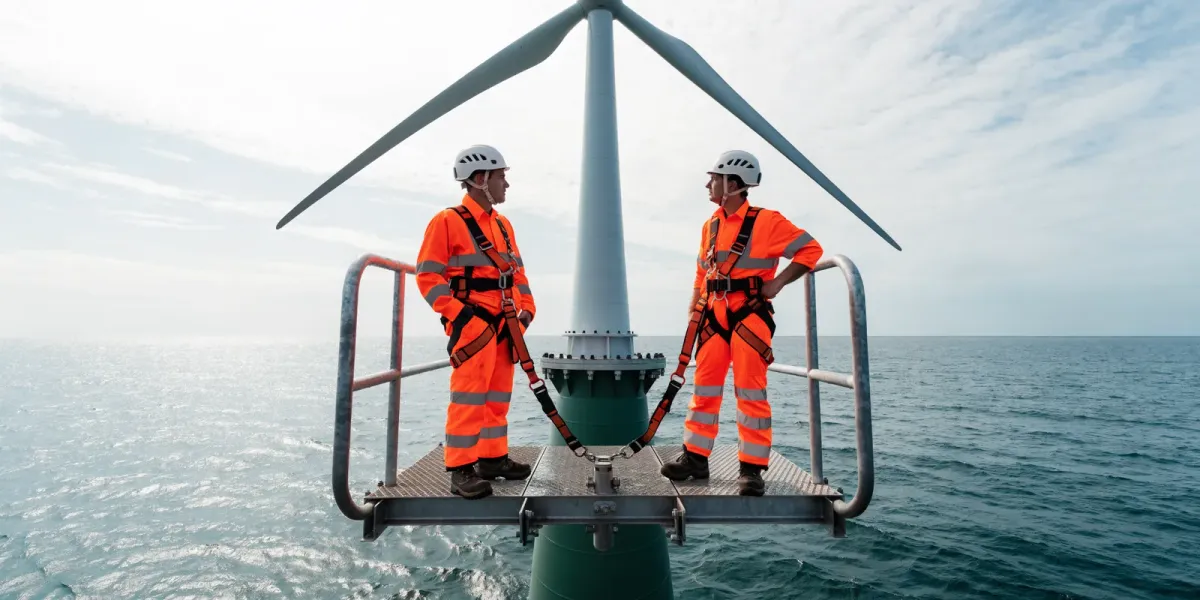
GWO training is the safety standard that turbine owners, manufacturers and contractors expect every worker to hold before they climb a tower or step onto a transition piece. It is set by the Global Wind Organisation, a body of wind industry companies, and delivered by certified training providers. For an offshore wind package, the question is rarely whether a crew needs GWO training. It is which modules each person needs, whether the records are still in date, and how that lines up with the mobilisation programme.
The standards changed in March 2026, and a crew list that was compliant a year ago may now show the wrong module or the wrong expiry. This guide sets out the modules, the validity periods, the 2026 changes and the record checks that matter most when the work is offshore, for employers and safety officers in Ireland and the UK.
Crewing an offshore wind package and unsure whether the safety cover meets GWO expectations? Talk to a wind-sector safety specialist and Coyle Group will check the modules against your scope.
Talk To A Wind-Sector Safety Specialist
What Does GWO Certification Mean?
A GWO certificate shows that a worker completed a specific course, delivered by a GWO-certified training provider, against a published Global Wind Organisation standard. The provider uploads the result to WINDA, the industry training records database, so an employer can verify the record without relying on a paper card. It does the same job on a wind farm that Safe Pass and CSCS do for construction site training, with one difference: the standards come from GWO member companies, which write the learning objectives around the hazards their own technicians face.
The standards are not statute. Employers normally apply them through contract terms, turbine owner requirements and site entry rules, which is why a missing module can stop a worker boarding a vessel even though no regulator has asked for it. The legal duty underneath sits in the Safety, Health and Welfare at Work Act 2005 in Ireland and the Health and Safety at Work etc. Act 1974 in Great Britain, which require employers to provide competent training. GWO records are the evidence most wind sites accept that the duty has been met.
The 5 Basic Safety Training Modules
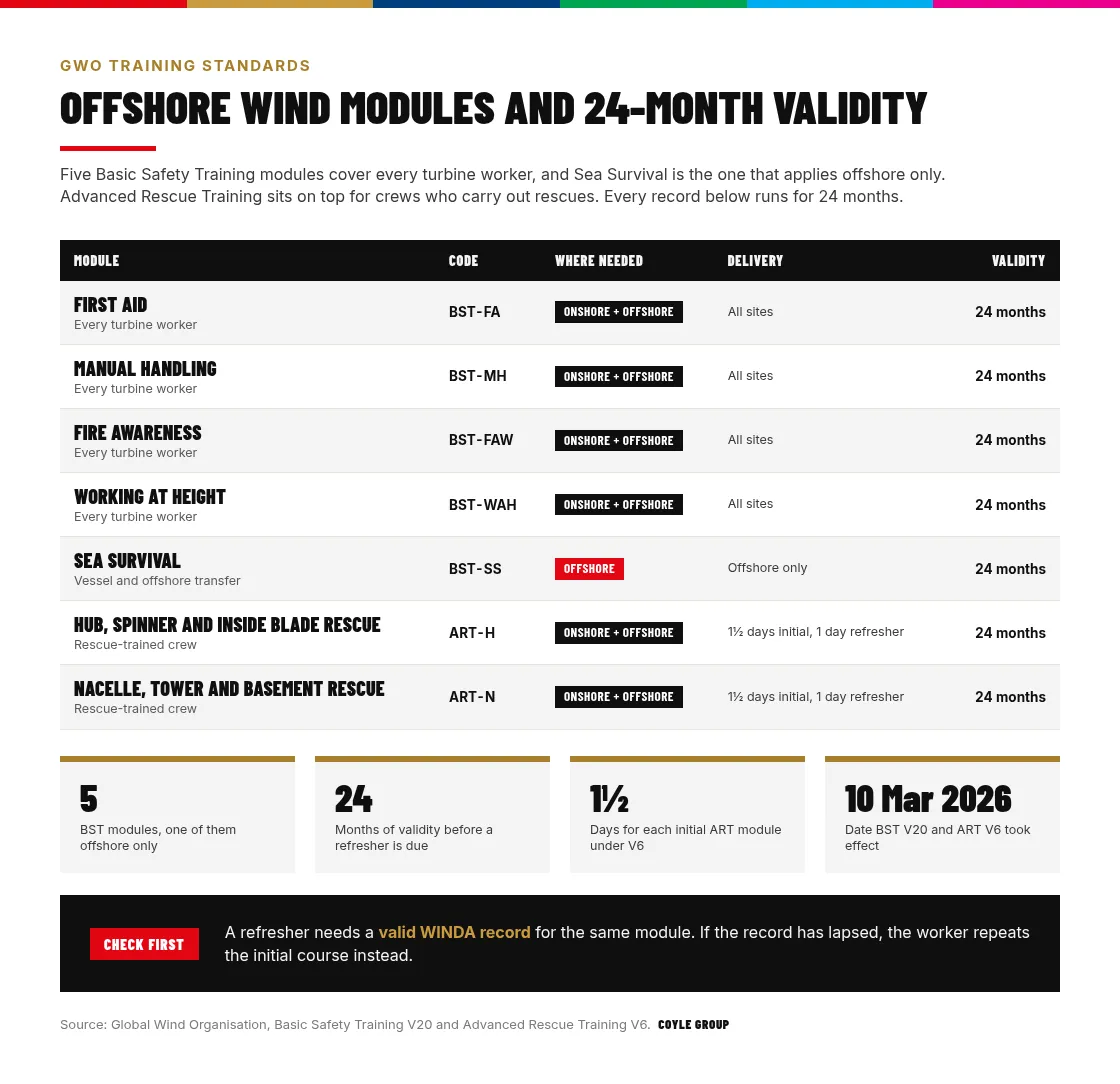
Basic Safety Training, usually shortened to BST, is the entry point. It has 5 modules: First Aid, Manual Handling, Fire Awareness, Working at Height and Sea Survival. The aim is that every participant can look after themselves and others, and can evacuate, rescue and give first aid to a casualty in a remote turbine environment.
First Aid teaches workers to recognise life-threatening situations and give safe first aid until a casualty can be handed to the next level of care. Manual Handling reduces the risk of musculoskeletal injury during the lifting, carrying and tool work that fills a technician’s day. Fire Awareness covers fire prevention, evacuation and the use of handheld extinguishers on an initial fire. Working at Height covers the use of personal protective equipment, safe work at height and basic rescue from height inside a turbine.
Sea Survival is the offshore module. It covers safe behaviour in every stage of an offshore operation from shore to vessel or turbine and back, including emergencies in an offshore wind environment. Onshore workers can hold the other 4 modules without it. Anyone who will transfer by vessel needs all 5.
The Working at Height module is the one with the closest tie to the lifting and fall-arrest duties on a wind farm. Our guide to height regulations sets out the general legal framework in Ireland and the UK, and the GWO module is the wind-specific training that sits on top of it. How those duties apply on the tower ladder, nacelle roof and blade is set out in our guide to turbine height work.
How Long Is a GWO Certificate Valid For?
Every GWO module record is valid for 24 months. That applies to each of the 5 BST modules and to the Advanced Rescue Training modules. The clock runs from the date the course is completed, and each module has its own expiry date, so a worker with 5 BST records has 5 dates to track rather than one.
A refresher is the shorter course a worker takes to renew a module that is still in date. It needs a valid WINDA record for the same module. If the 24 months have passed, the worker repeats the initial course instead, which takes longer and costs more days away from site. For an offshore programme with fixed vessel slots, that difference can move a mobilisation by several days.
The practical habit is to track expiry by module and by date, and to book the refresher well before the record lapses. Booking 8 to 12 weeks ahead leaves room for a provider course date to fall into a gap in the programme.
What Changed in the March 2026 Standards
GWO updated 8 training standards with effect from 10 March 2026, and the outgoing versions had a transition period that ended on 10 September 2026. Two of the updates matter most for offshore crews: BST moved to version 20, and Advanced Rescue Training moved to version 6.
The BST update removed the combined Working at Height and Manual Handling module, so the two now stand as separate modules. It also introduced a Sea Survival lesson on Walk-to-Work, the safe transfer from a vessel using a motion-compensated gangway. GWO says this closes a previously identified gap in training for motion-compensated gangway systems used in offshore transfers. Each module also now has a practical refresher built around workplace scenarios, in a shorter time frame than before.
ART V6 folded Single Rescuer skills into both the initial and refresher modules, so there is no separate Single Rescuer course to book. Each initial ART module runs for 1½ days and each refresher for 1 day. Providers also report that completing an ART refresher no longer renews Working at Height or Manual Handling records, so those expiry dates need checking on their own in WINDA.
Basic Technical Training and Advanced Rescue Training
Basic Technical Training, or BTT, is a separate standard aimed at technicians. Under version 11 it has modules for mechanical, electrical, hydraulic and bolt tightening work, two installation modules, and a Hazardous Energies Basic Safety module. GWO states plainly that BTT does not make a participant a trained person who can carry out that work unsupervised. It prepares them for the company-specific training that follows. Combined delivery of the two installation modules runs for 16 hours, or 2 full days.
Advanced Rescue Training, or ART, is for crews who carry out rescues rather than just survive until help arrives. It splits into ART-H, covering the hub, spinner and inside the blade, and ART-N, covering the nacelle, tower and basement. A rescue plan on a wind farm is only as good as the people named in it, and ART is the training that backs those names. The same point applies when a wind farm RAMS names a rescue team, because the RAMS is checked on site against the training records of the people listed.
Neither standard replaces BST. A technician with BTT but no in-date BST modules still cannot climb or transfer to an offshore turbine on most sites, and a rescue team member with ART needs the BST records that sit beneath it.
How Long Does GWO Training Take?
GWO sets the learning objectives and minimum content, and certified providers set their own timetable within that, so the days vary by provider and by whether the course is initial or refresher. A four-module BST programme without Sea Survival typically runs for 4 days at a provider, and adding Sea Survival adds a fifth day. A worker coming back for refreshers will usually spend fewer days than that.
The simplest way to plan is to ask the provider for the exact day count for each module and each delegate, rather than assuming a standard package. A crew list with a mix of initial and refresher modules can produce a very different number of training days from one headcount to the next. Price follows the same logic: it depends on the provider, the number of modules and whether the course is initial or refresher, so get a written quote per delegate before building it into a budget.
Checking GWO Records in WINDA
WINDA is the GWO training records database. Training providers upload records after a course, participants can log in to see the status and validity of their own training, and employers can verify the current training status of the people they plan to deploy. Every participant registers once and gets a unique ID, which stays with them for the length of their career.
For a project lead, the check takes minutes and removes most of the risk. Before a worker is added to a mobilisation, confirm the module list against the role, check each expiry date against the full programme dates and not the start date alone, and confirm that Sea Survival is in date for anyone who will transfer offshore. A certificate that expires on week 3 of a 6-week campaign is a problem on day 1 of the campaign.
Employers building a safety team from outside the sector face the same check. People who move from other heavy industries often bring strong site experience and no GWO records at all. Our piece on transferable skills covers how those moves work, and the first step is almost always a set of BST modules.
What GWO Training Means for Offshore Wind in Ireland
Ireland’s offshore wind pipeline is moving from consent into construction planning, and the training demand follows it. The offshore wind projects in the Phase One group will need technicians, vessel crews and safety officers who hold in-date GWO records long before the first turbine is installed. Marine and installation contractors will ask for them at tender stage.
For Irish contractors coming from onshore wind, civil works or power generation, the gap is usually Sea Survival and the Walk-to-Work content. Onshore climbers already hold the other 4 BST modules. For contractors working across both jurisdictions, the standards are the same on either side of the Irish Sea, which makes GWO records one of the few safety credentials that travel without a conversion step.
Work at height in Ireland is also governed by the Work at Height regulations in the General Application Regulations 2007, and the HSA publishes work at height guidance for employers. A GWO Working at Height record answers the competence question for turbine work specifically, and the general regulations still apply to the rest of the site.
What Coyle Group Checks Before Placing a Safety Officer
Coyle Group was founded in 1999 and has more than 25 years in contract safety, with Gavin Coyle CMIOSH leading the work. The talent pool holds 100+ safety officers, and the team has recorded 1M+ hours of safety work across wind, utilities and engineering sites. For wind placements, the first screen is the training record.
Before a contract safety officer is put forward for an offshore wind scope, Coyle Group checks the 5 BST modules, the expiry date of each, and whether the role needs ART for rescue planning. The check runs against the programme dates for the whole campaign, which catches the module that would lapse in the middle of the work. A safety officer can then be deployed within 48 hours of the scope being confirmed.
Already holding a crew list with module expiry dates that look tight? Talk to a wind-sector safety specialist and Coyle Group will test the dates against the programme before the vessel slot is fixed.
Talk To A Wind-Sector Safety Specialist
An early conversation is most useful while refresher dates can still be moved.
Planning Offshore Crews Around the 24-Month Cycle
The offshore crews that mobilise without delay are the ones whose records were checked before the programme was locked. That means mapping each role to its modules, listing the expiry date of every record, and booking refreshers while the matching WINDA record is still valid. It also means treating Sea Survival and the new Walk-to-Work content as a separate line on the checklist for anyone who has only worked onshore.
GWO training is a planning input as much as a compliance item. A single expired module can pull a technician off a vessel manifest, and the replacement has to be found, checked and inducted at short notice. If the next offshore package needs a safety officer whose records are already verified, talk to a wind-sector safety specialist and Coyle Group will start from the modules and dates that matter for your scope.
Frequently Asked Questions (FAQs): GWO Training
These are the questions employers, project leads and safety officers ask most often when they are checking GWO training against an offshore wind crew list.
What does GWO certification mean?
GWO certification means a worker has completed a course delivered by a GWO-certified training provider to a Global Wind Organisation standard, and the result is recorded in WINDA. It proves a common baseline of safety knowledge across turbine owners and contractors. It does not replace a site induction or turbine-specific competence. Coyle Group checks the WINDA record for each module before a safety officer is put forward.
How long is GWO training valid for?
GWO Basic Safety Training modules and Advanced Rescue Training modules are each valid for 24 months from the date of completion. When a module lapses, the worker has to repeat the initial course rather than the shorter refresher. Coyle Group diarises the expiry date of every module on a placement, so a certificate never runs out in the middle of an offshore campaign.
Do offshore wind workers need Sea Survival as well as the other BST modules?
Yes. Sea Survival is the fifth BST module and applies to anyone who transfers from shore to a vessel or turbine, or works offshore. Onshore technicians can complete the other 4 modules without it. Since the March 2026 update, Sea Survival also covers safe transfer on motion-compensated Walk-to-Work gangways. Coyle Group confirms Sea Survival is in date for every offshore placement.
Is GWO training a legal requirement in Ireland or the UK?
GWO standards are written by GWO member companies, and employers normally enforce them through contract terms and site entry rules. The legal duty in Ireland sits under the Safety, Health and Welfare at Work Act 2005, and in Great Britain under the Health and Safety at Work etc. Act 1974, to provide competent training. Coyle Group treats GWO records as the accepted evidence of that competence on wind sites.
What is the difference between BST, BTT and ART?
Basic Safety Training covers survival and emergency skills for anyone working in a turbine. Basic Technical Training gives technicians a foundation in mechanical, electrical, hydraulic, bolt tightening and installation tasks, under supervision. Advanced Rescue Training teaches crews to rescue a casualty from the hub, nacelle or tower. Coyle Group safety officers hold BST as standard, with ART added where the role includes rescue planning.
What happens if a GWO refresher is booked after the certificate has expired?
A refresher requires a valid WINDA record for the matching module, so once the 24 months have passed the worker must complete the full initial course instead. That costs more days off site and can delay a mobilisation. Coyle Group flags expiry dates early on every placement, so the refresher is booked while the record is still valid and the offshore programme keeps its dates.
Does Coyle Group deliver GWO training courses?
No. Coyle Group does not run GWO courses, which have to be delivered by providers certified by GWO. Coyle Group supplies chartered wind safety officers who already hold in-date GWO records, and checks those records in WINDA before placement. That removes the training lead time from a mobilisation and lets a project start with a verified safety officer within 48 hours.