Contract vs Permanent Safety Officer: 8 Factors (IE, UK)

Choosing between a contract vs permanent safety officer looks like a pay question, and it is closer to a programme question. The right answer depends on how long the site needs cover, how quickly the officer has to start, and how much site knowledge the role must build up.
This guide gives employers, project directors and site managers in Ireland and the UK a framework for deciding how to fill a single safety officer role. It sets out 8 factors, the employment status rules that apply on each side of the Irish Sea, and the hybrid models that suit mixed cases.
Short of site cover while you weigh up the contract question? Hire a safety officer in 48 hours and decide the longer-term model with a safety officer already on site.
Hire A Safety Officer In 48 Hours
When Does a Contract Safety Officer Win?
A contract safety officer wins when the need has a clear end date or a sharp peak. Examples are a construction programme of 9 months, a turbine overhaul, a substation outage or a commissioning phase, where the workload rises quickly and falls once the work is signed off.
Speed is the second reason. A contractor can usually start within days, while a permanent recruitment process takes months once advertising, interviews, references and a notice period are counted. We deploy contract safety officers from a talent pool of more than 100 within 48 hours, and that speed matters most when a site cannot legally or practically open without cover.
Budget follows from both points. The employer pays for the days worked and carries no cost after the contract ends. The day rate is higher than the daily equivalent of a salary, and our guide to day rates sets out the figures and the arithmetic behind that premium. Contract cover is a good fit whenever the programme, and not the calendar year, defines the need.
When Does a Permanent Safety Officer Win?
A permanent safety officer wins when the need continues year after year and the role depends on accumulated knowledge. An operating plant, a long-running portfolio of sites or a data centre campus with phased fit-out all fit this description. The officer learns the permit-to-work system, the contractors, the plant history and the people, and that knowledge improves every inspection and every conversation on site.
Permanent hires also suit employers building an in-house safety function. The salary line is fixed, the officer can be developed through qualifications and chartered status, and the relationship with the workforce builds over time. Our guide to safety recruitment explains how employers structure that search.
The cost of waiting is the main risk. A permanent search can take several months, and the site needs cover in the meantime. Employers who choose permanent for the right reasons still tend to bridge the gap with contract cover.
8 Factors That Decide the Contract or Permanent Question
Most roles give mixed answers on a contract vs permanent safety officer decision, which is why a scoring method works better than a rule of thumb. The matrix below sets out 8 factors, with the conditions under which each model wins.
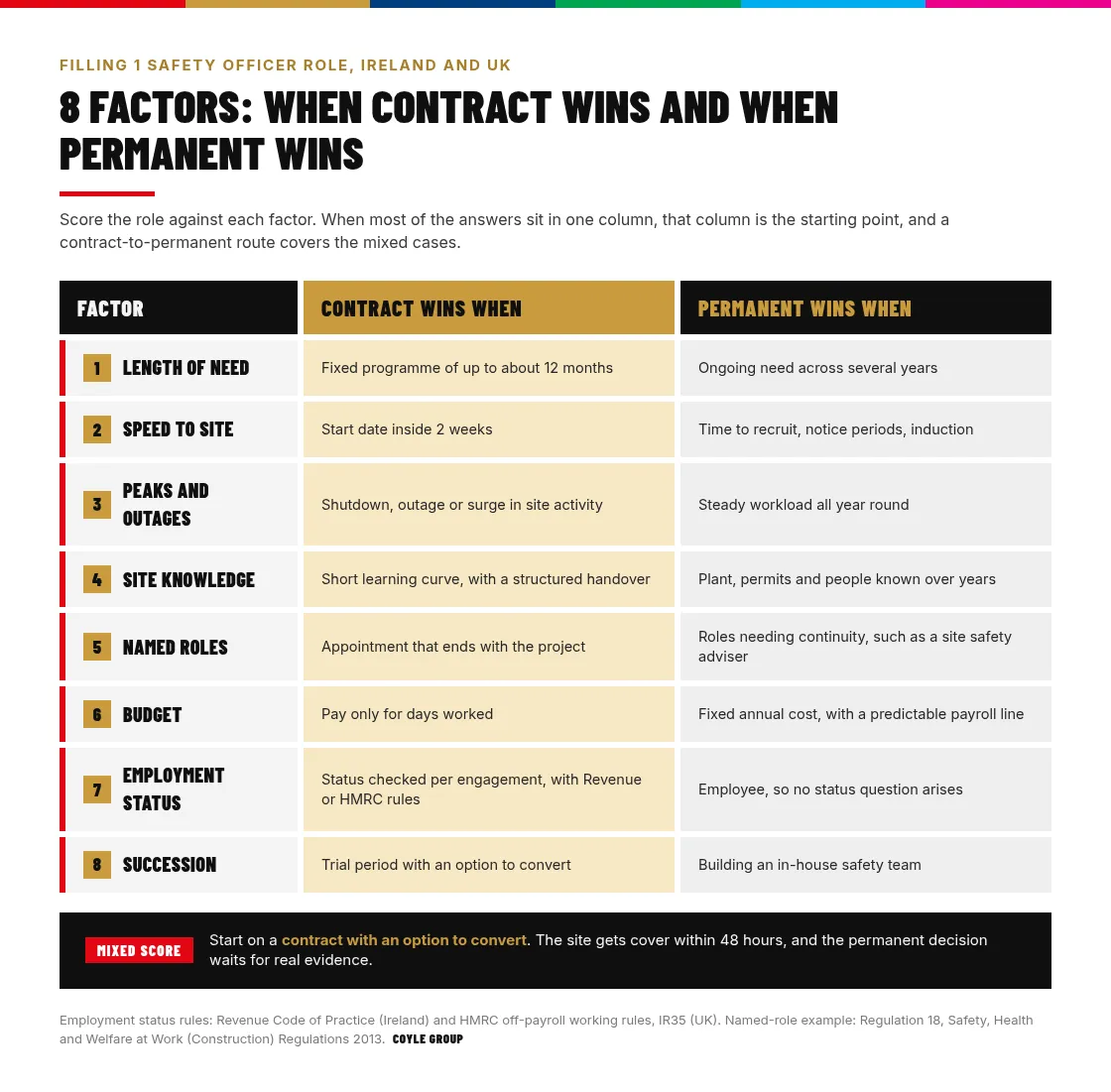
To use it, answer each factor for the specific role and see where most answers fall. A role with a 10-month programme, a start date in 3 weeks and an outage in month 6 scores strongly for contract. A role on an operating plant with steady activity and a long horizon scores strongly for permanent. A split score is a signal to use a hybrid model, which later sections cover.
The factors that cause the most disagreement in practice are site knowledge, named roles and employment status, so the next sections take those in turn.
How Does Project Length Change the Answer?
Project length is the factor that moves a contract vs permanent safety officer decision most. Under about 12 months, a contract almost always costs less than the recruitment time and notice period of a permanent hire. Beyond 2 to 3 years, the cumulative day-rate premium on a contract usually exceeds the cost of a salary, employer social insurance and recruitment fees.
The awkward range is the 12 to 24 month programme, where the right answer depends on how certain the end date is. Programmes slip, and a contract that ends at month 12 on a project that runs to month 18 creates a gap in cover at a busy time. Building an extension clause into the contract reduces that risk.
Phase matters as much as length. The early groundworks phase of a project needs a different officer profile from commissioning, and a contract officer can be matched to each phase. Where the work changes character, replacing the officer at the phase boundary can be an advantage. Our guide to outsourcing safety resources covers the wider question of in-house and outsourced cover across a whole safety function.
Site Knowledge and Continuity of Named Roles
Site knowledge is the strongest argument for permanent hiring, and the argument is easy to overstate. A permanent officer knows the plant history, the contractors and the unwritten habits of the site, but a good contract officer reaches the same working knowledge quickly when the handover is structured. Employers should make the handover a defined task, covering permits, open actions, inspection records, contractor performance and emergency arrangements.
Named statutory roles need more care. In Ireland, Regulation 6 of the Construction Regulations 2013 requires the client to appoint a Project Supervisor for the Construction Stage (PSCS) in writing before construction work starts, and the same regulation allows an appointment to be made, terminated, changed or renewed. Regulation 18 adds that the PSCS must appoint a full-time competent safety adviser where more than 100 people are normally on site at any one time.
A contract officer can hold a named role for the life of a project. The provisions ask for continuity, so each change of appointee needs a written record and a handover. A contract that covers the full construction stage with an extension clause meets that need, and a short contract that expires mid-stage does not. Our safety engineer guide explains how engineering-led roles differ from officer roles when the appointment is being written.
Budget Certainty and Total Cost
Permanent salaries give predictable monthly cost, and contracts give cost that follows the programme. Neither is cheaper in every case, and the comparison only makes sense over the whole engagement. An employer should count recruitment time, onboarding, employer contributions, holiday and sickness cover on the permanent side, and the day rate multiplied by days actually needed on the contract side.
A useful test is utilisation. If the site needs the officer on 220 or more days a year, every year, a permanent salary is likely to be cheaper. If the site needs the officer for 120 days, 3 months, or only during outages, a contract avoids paying for idle time. The calculation is simple once the real number of days is known, and the figures in that day rate guide are a starting point for it.
Budget certainty can be improved on the contract side. A fixed-term contract with an agreed day rate and a capped number of days gives the finance team a known ceiling, and an option to extend gives the project team flexibility.
Employment Status: Revenue in Ireland and IR35 in the UK
Employment status is where a cheap-looking contract can become an expensive mistake. The rules differ on each side of the Irish Sea, and the label on the contract settles neither.
In Ireland, Revenue, the Department of Social Protection and the Workplace Relations Commission publish a joint Code of Practice on determining employment status, which Revenue’s guidance describes as a five-step framework. A safety officer who works to the client’s direction, on set hours, with the client’s equipment and with no financial risk may be an employee whatever the paperwork says.
In the UK, the off-payroll working rules, known as IR35, apply when a worker provides services through their own intermediary, usually a limited company, and would have been an employee if engaged directly. HMRC’s guidance says the client is responsible for the status decision in most cases, except where the client is a small business, in which case the intermediary decides. The rules apply contract by contract, and a client covered by them must produce a status determination statement with reasons.
The practical advice is the same in both countries. Take tax advice before engaging a safety officer directly, and check each engagement on its facts. Engaging through a specialist agency that carries the status responsibility moves part of that burden, and a permanent hire removes the question altogether.
Contract-to-Permanent and Hybrid Models
Contract-to-permanent covers the cases where the factors split. The site starts the officer on a contract, assesses fit over 3 to 6 months, and converts the officer to a permanent post if the work continues. The employer gets cover now and evidence before committing to a salary, and the officer sees the site, the team and the culture before accepting.
The conversion terms need agreeing at the start. That means the notice period, any conversion fee, the salary band on conversion and what happens to accrued experience. Putting these in writing at the start avoids a difficult conversation after 6 months, and it protects the relationship with the officer as well.
A hybrid model suits larger employers. A permanent safety lead holds the system, the contractor relationships and the records, and contract officers add capacity at peaks and new phases. The lead is not stretched, the contract officers arrive within 48 hours, and the headcount follows the workload. Our safety consulting team supports employers who want an independent view on where the permanent lead should sit.
Writing the Role Before Choosing the Contract Type
The contract type matters less than a clear definition of the role. Before advertising or briefing a recruiter, write down the scope, the tickets and certifications, the sector experience, the reporting line, and the start and end dates. A well-structured job description template turns that into a document either route can use.
The same document makes the comparison honest. A role that needs outage experience for 5 months looks like a contract once it is written down, and a role that needs permit-to-work ownership across 3 sites looks permanent. Writing it first avoids choosing the contract type by default or by habit. It also gives the panel a fixed scope to test against, and our interview questions guide turns that scope into a scored interview for either route.
Tier-one employers also test the contract route against their own approvals. Many have supplier onboarding, site inductions and competency checks that take days, and starting those early keeps a 48-hour deployment on track. We supply contract safety officers to clients including ESB, Energia, Suir Engineering and Kirby Engineering, and in our experience the sites that move fastest are those with the induction paperwork ready before the officer is named.
Scored the role and found the answer is contract, or a mix? Hire a safety officer in 48 hours from a talent pool of more than 100.
Hire A Safety Officer In 48 Hours
A short call to confirm scope, tickets and start date is usually enough to move from a scored role to a shortlist.
Matching the Contract Type to the Programme
The contract vs permanent safety officer decision comes down to the programme. Contract wins for fixed durations, outages, urgent starts and uncertain budgets, and permanent wins for ongoing need, deep site knowledge and an in-house safety function. A mixed score points to contract-to-permanent or a hybrid team, and the employment status rules in Ireland and the UK apply whichever route is chosen.
Coyle Group was founded in 1999, Gavin Coyle holds CMIOSH, and our team has delivered more than 1M hours of safety cover. When the answer for your role is contract or a trial period, Hire a safety officer in 48 hours.
Frequently Asked Questions (FAQs): Contract vs Permanent Safety Officer
These are the questions employers and project teams put to Coyle Group when they are deciding how to fill a single safety officer role.
Is a contract or permanent safety officer better for a short project?
A contract safety officer is usually the better fit for a project of up to about 12 months, because the employer pays for the days the site needs cover and has no obligation after handover. Coyle Group suggests matching the contract end date to the programme, with an extension clause for slippage, so the role does not lapse while work is still live.
How quickly can a contract safety officer start compared with a permanent hire?
Coyle Group can deploy a contract safety officer from its pool of more than 100 safety officers within 48 hours once the scope, site and tickets are confirmed. A permanent hire involves advertising, interviews, references and a notice period, which commonly runs to several months. That gap is why many sites cover the role on contract while a permanent search runs.
Do IR35 rules apply to contract safety officers in the UK?
They can. The off-payroll working rules apply when a safety officer provides services through their own limited company and would have been an employee if engaged directly. For most medium and large private sector clients, the client decides the worker's employment status for tax and issues a status determination statement. Coyle Group advises UK employers to check each engagement separately.
Is a contract safety officer self-employed in Ireland?
Not automatically. Revenue, the Department of Social Protection and the Workplace Relations Commission publish a joint Code of Practice on employment status, and the real working relationship carries more weight than the contract label. Coyle Group recommends that an employer takes tax advice before engaging a safety officer directly, and checks each engagement against the Code.
Can a contract safety officer be converted to permanent?
Yes. Contract-to-permanent is a common route when a site wants proof of fit before committing to a salary. Coyle Group agrees the conversion terms with the client and the safety officer at the start, including any notice period or fee, so both sides know the position. It suits roles where the programme may extend beyond the original scope.
What happens to site knowledge when a contract safety officer leaves?
Site knowledge leaves with the person unless it is written down. Coyle Group recommends a structured handover covering the permit system, open actions, inspection records, contractor performance and the emergency arrangements, and a short overlap with the replacement where the programme allows. A permanent officer builds the same knowledge, but the handover still matters on the day they leave.
Does a hybrid of contract and permanent safety officers work?
Yes, and many tier-one employers run it. A permanent safety lead holds the system and the relationships, while contract officers add capacity for outages, peaks and new phases. Coyle Group supplies the contract officers within 48 hours, so the permanent lead is not stretched across more work than 1 person can cover safely.