Working at Heights Regulations: Poles, Towers, Substations
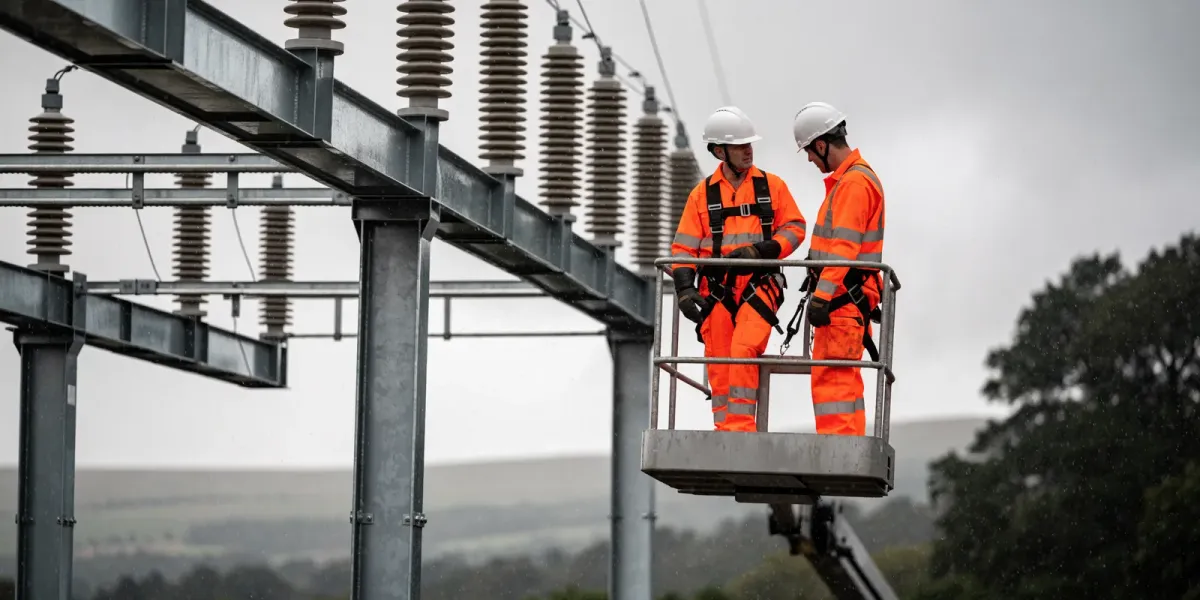
Working at heights regulations read the same on paper for a utility as for a roofing contractor, but they play out very differently on a network. A lineworker on a wood pole, a climber on a steel lattice tower and a technician on a substation gantry each face a fall risk, and each also works within reach of energised conductors that can kill without a fall at all.
That combination is why a generic work at height procedure fails on utilities sites. The access method that is safest for a roof is often unavailable or dangerous on a pole, and a rescue that works at 3 metres on a scaffold does not work 20 metres up a tower with no second person nearby. This guide sets out how the duties apply to each network asset, in Ireland and Great Britain, and what a plan that survives an inspection contains.
Planning work on poles, towers or substations and want the access and rescue plan checked? Request a utilities safety consultation and Coyle Group will review it against the asset list.
Request A Utilities Safety Consultation
What the Law Requires Before Anyone Leaves the Ground
Both jurisdictions build on the same hierarchy: avoid work at height where possible, prevent falls where it cannot be avoided, and minimise the distance and consequences of any fall that remains. Our guide to the general height regulations covers that hierarchy in full for Ireland and the UK, so this post does not repeat it. Working at heights regulations change in practice when the structure is part of an electricity network.
In Ireland, Part 4 of the General Application Regulations 2007 (S.I. 299/2007, regs 94 to 119) governs work at height, and Part 3 covers electricity, including substations in reg 91, outdoor transformers and switchgear in reg 92 and overhead lines in reg 93. In Great Britain, the Work at Height Regulations 2005 sit beside the Electricity at Work Regulations 1989. A utilities task is therefore always covered by 2 sets of rules, and the plan has to answer both before the permit is issued.
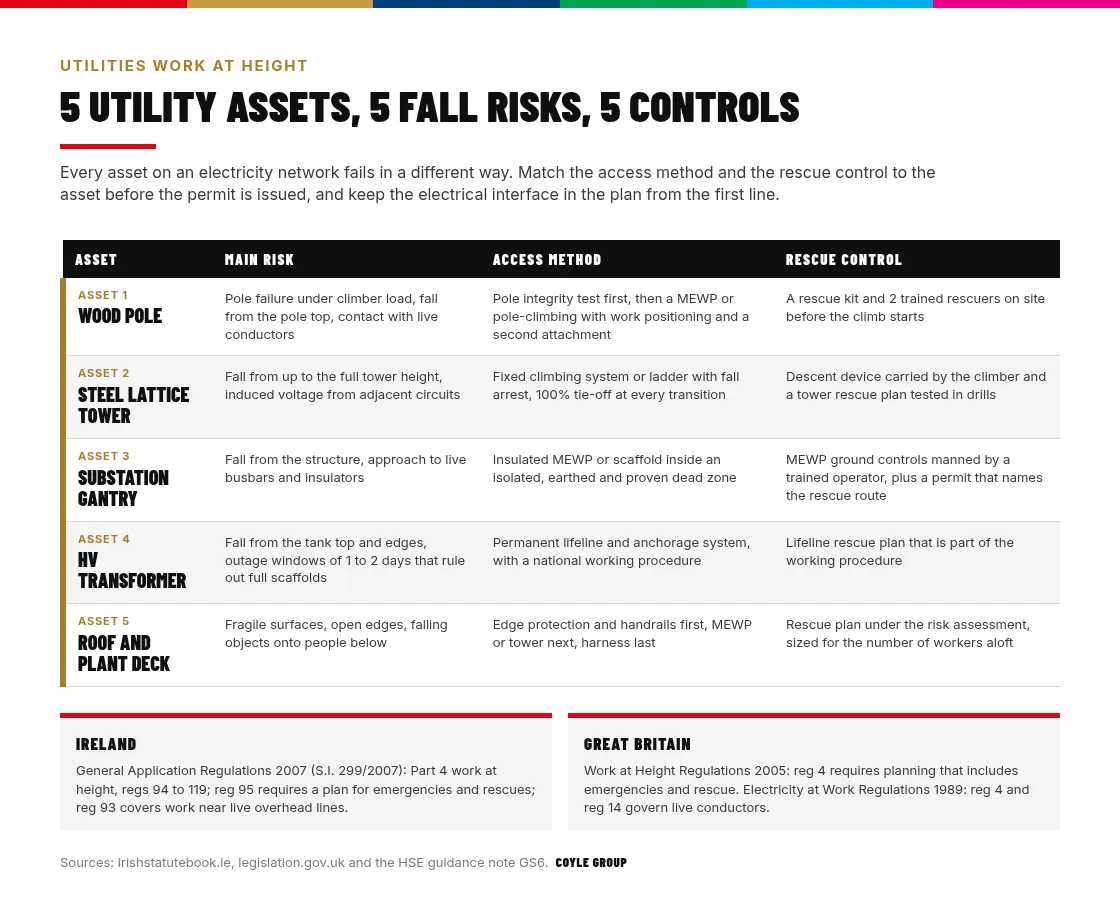
The table above is the shape of the rest of this guide. Each asset type gets its own access method and rescue control, and the legal duty stays constant across all of them.
Wood Poles: Test the Pole Before the Climb
A wood pole looks like the simplest asset on the network, which is the reason it catches people out. Decay is often hidden at or just below ground level, so a pole that appears sound can fail under the load of a climber and tools. The first control is a pole integrity assessment, recorded and attached to the permit, before anyone puts weight on it.
Where the assessment is doubtful, the access method changes rather than the risk being accepted. A MEWP removes the load from the pole, and pole supports or stays can stabilise it where a MEWP cannot reach. Where climbing is accepted, work positioning with a second attachment point is the baseline, so the lineworker is never relying on a single device as they move around the pole top. Part 4 of the Irish regulations and reg 7 of the GB regulations both require equipment selection to follow the hierarchy, which means collective protection first and personal protection after.
Weather matters more on a pole than almost anywhere else. Reg 97 of the Irish General Application Regulations 2007 and reg 4(3) of the Work at Height Regulations 2005 both require work at height to stop when conditions put people at risk. Wind, ice and wet timber all reduce grip and increase the chance of a fall, and the stop decision belongs in the permit, written before anyone climbs the pole.
Steel Lattice Towers and Fixed Climbing Systems
Towers add height. A fall from a lattice tower is a fall of tens of metres, so the controls have to prevent the fall rather than rely on arresting it. The preferred method is a fixed climbing system or ladder with a fall-arrest rail, so the climber is attached from the first rung. Where only a conventional ladder or structure is available, 100% tie-off with twin lanyards at every transition keeps one connection live while the other moves.
Lattice towers also bring electrical hazards that are easy to miss. A de-energised circuit on a double-circuit tower may sit a few metres from a live one, and induced voltage can build up on the structure itself. The plan needs to identify which circuits are live, which are isolated and earthed, and where the climber can safely work, before the first climb starts.
Fitness and competence matter here more than on any other asset. A tower climb is physically demanding, and the person at the top may be a long way from help. Climbers need current training, a recorded medical fitness check and a buddy system, so someone on the ground always knows who is aloft and for how long. That ground person is also the first link in the rescue chain, which is the subject of a later section.
Substation Gantries, Structures and HV Plant
Substations compress the fall hazard and the electrical hazard into the same few metres. Gantries, busbar supports, isolator structures and transformer tops all require work at height next to equipment that may still be live if the isolation boundary is wrong. In Ireland, reg 91(2) requires that only an authorised person, or someone acting with consent or under supervision, can enter any part of a substation where there may be danger, which gives the permit system a legal anchor.
Access methods for a substation start with the isolation. Once the work zone is isolated, proved dead and earthed, a scaffold or tower can be used inside it. Where isolation is not practicable, an insulated MEWP operated by a trained person is the common alternative, with strict limits on where the platform can travel. Our substation RAMS guidance on substation RAMS sets out how the permit, isolation and access method are documented together.
HV transformers show why a one-size method fails. On a case where network technicians were working on ageing HV transformers without fall protection, Coyle Group’s consultant joined a station working group because there was no off-the-shelf system for the older units. The outage windows were 1 to 2 days, so full scaffolding was rarely practical, and anchor points away from leading edges were limited. The result is described in the HV transformers case study: a nationwide lifeline system, a rescue plan and a national working procedure. The same pattern applied across 63 substations where Coyle Group advised on critical risks across live Irish sites.
MEWPs Near Live Overhead Lines
A MEWP is often the safest way to reach an asset, and it is also the most common way for a platform to meet a live conductor. The boom can reach further than the operator expects, the cab can sway in wind, and the ground controls can be operated by someone who cannot see the line. Where a MEWP is used near overhead lines, the line owner needs to be contacted before work starts, and the clearance distance should come from them.
In Great Britain, HSE guidance note GS6 sets out how to avoid danger from overhead power lines, and it directs people to the line owner for isolation or advice before work starts. In Ireland, reg 93(2) of the General Application Regulations 2007 requires anyone in control of a place of work to make sure that work near live overhead lines does not start until the line is isolated, diverted, or adequately protected with barriers and warnings. The ESB Networks public safety pages give the operator’s own guidance for people working near its network.
Practical controls include a banksman positioned to watch the line, a physical limit on boom travel, goal posts or tiger tails marking the exclusion zone, and a stop-work trigger if the platform drifts into it. Insulated platforms reduce risk but do not remove it, and the operator needs to know the rating of the insulation they are using. The platform should have a harness anchorage and a worker should stay clipped on, since a sudden stop or ejection from the basket is a fall as well as an electrical event.
Rescue From Poles and Towers
Rescue is where many otherwise sound plans fall apart. Reg 95(1)(b)(iii) of the Irish regulations requires a plan for emergencies and rescues, and reg 4(2) of the GB Work at Height Regulations 2005 makes rescue part of planning. A plan that says “call the emergency services” does not meet either duty on a pole or tower, because an unconscious worker suspended in a harness faces suspension trauma within minutes and a fire crew may be too far away.
A usable plan names who rescues, with what equipment, and in what time. For a pole, that is usually a second trained lineworker on the ground with a rescue kit and a descent device, rehearsed rather than written. For a tower, it is a trained rescue team or a climber-rescuer pair, with the descent device carried up with the climber. Reg 109 of the Irish regulations requires users of personal fall protection systems, and the people assisting them, to be trained in immediate rescue procedures, which makes drills a legal expectation as well as good practice.
The same plan has to deal with the electrical side of rescue. A rescuer cannot go up to a casualty near a conductor that may still be live, so the plan states how the circuit is made safe first and who confirms it. Where that adds time, the working method needs to change so that the casualty is never left waiting on a confirmation that should have been in place before the climb.
Permits, Isolation and the Electrical Interface
The electrical interface is where the 2 sets of duties meet. In Great Britain, reg 4 of the Electricity at Work Regulations 1989 requires work on or near electrical systems to be carried out so as to prevent danger, and reg 14 sets the conditions under which anyone may work on or near live conductors. In Ireland, Part 3 of the General Application Regulations 2007 carries the equivalent duties. Neither set of duties is waived because the worker is also at height, and working at heights regulations never replace the electrical rules.
A permit for a utilities task at height should therefore answer 5 questions in one document: what is isolated and earthed, what remains live and how far it is from the work position, which access method is approved, who is the named rescuer, and what weather limit applies. Our guide to the wider power plant hazards shows how the same permit logic works on generation sites, and the approach in our CCGT outage safety guide applies where a network asset sits inside a station.
Contractor interfaces add a further layer. Where more than 1 contractor works on the same site, the Irish Construction Regulations 2013 can require a Project Supervisor Construction Stage, and our PSCS guide explains the triggers. A permit system that works for 1 crew can break down when 3 crews share one substation, so the controlling party needs to be named before the first crew arrives.
Competence and Cover for Work at Height on Utilities Assets
Competence is the control that sits under all the others, and working at heights regulations in both countries assume it. A pole assessor, a tower climber, a MEWP operator and a rescuer each need current training, and the records should be on site and checked by someone qualified to read them. Coyle Group, founded in 1999 and led by Gavin Coyle CMIOSH, has more than 25 years of safety delivery and over 1 million hours worked across projects, including work for ESB and Energia.
On outage windows and short network projects, the gap is usually in the oversight of this competence. A contract safety officer who already knows HV plant can check permits against the isolation, challenge an access method that does not suit the asset and run the rescue drill before work begins. Coyle Group holds a talent pool of more than 100 safety officers and can place one within 48 hours, matched to the asset type rather than to general industrial experience.
Short of HV-experienced safety cover for an upcoming outage or network project? Request a utilities safety consultation and Coyle Group will scope it against your asset list.
Request A Utilities Safety Consultation
That conversation works best before the programme is fixed, while the access method and rescue arrangement can still change.
Building a Work at Height Plan That Survives Inspection
An inspector from the Health and Safety Authority in Ireland or the HSE in Great Britain will ask the same 4 questions on a utilities site: was the fall avoided, was the access method suited to the asset, who rescues and how fast, and how was the electrical interface controlled. A plan that answers them asset by asset, with named people and recorded checks, is the plan that stands up. The HSA work at height pages set out what Irish inspectors expect to see.
Most failures trace back to one of 3 gaps: a pole or structure that was assumed sound, a rescue that was written but never rehearsed, or an isolation that was stated but not proved. Closing those gaps costs little compared with the time lost after an incident. If you want the plan reviewed by a chartered team before the next climb, Request a utilities safety consultation and Coyle Group will start with the asset that carries the highest risk.
Frequently Asked Questions (FAQs): Working at Heights Regulations for Utilities
These are the questions utility operators and contractors raise most often when working at heights regulations meet poles, towers, substations and live overhead lines.
Do working at heights regulations apply to utility linesworkers?
Yes. In Ireland, Part 4 of the General Application Regulations 2007 applies to every employer whose people work at height, and in Great Britain the Work at Height Regulations 2005 do the same. Neither contains an exemption for network operators or their contractors. Coyle Group treats the general duties as the baseline and adds asset-specific controls for poles, towers and substations on top.
What is the minimum safe distance for working near overhead power lines?
There is no single figure that fits every line. Safe clearance depends on the voltage, the type of structure and the equipment being used, so the line owner sets it. HSE guidance note GS6 in Great Britain and ESB Networks guidance in Ireland both direct people to contact the owner before work starts. Coyle Group builds that contact into the permit, so the clearance is agreed in writing.
Is a rescue plan a legal requirement for work at height?
Yes, in both jurisdictions. Reg 95(1)(b)(iii) of the Irish General Application Regulations 2007 requires a plan for emergencies and rescues, and reg 4(2) of the Work at Height Regulations 2005 makes rescue part of the planning duty in Great Britain. Coyle Group checks that the plan names the rescuers, the equipment and the time target, rather than only stating that a plan exists.
Can a worker climb a wood pole without testing it first?
No. A wood pole can look sound and still be unable to carry a climber, because decay often sits at or below ground level. A pole integrity assessment before the climb, or a MEWP or pole support that removes the load from the pole, is the accepted control. Coyle Group asks to see the pole assessment record attached to the permit before climbing starts.
Who is responsible for work at height on a substation site?
Responsibility is shared. The employer of the people at height owns the work at height duties, while the person in control of the site or plant owns the isolation, access and permit arrangements. In Ireland, reg 93(2) of the General Application Regulations 2007 places duties on anyone in control of a place of work near live overhead lines. Coyle Group maps these roles in the RAMS.
How quickly can Coyle Group supply a safety officer for utilities work at height?
Coyle Group can typically place a contract safety officer within 48 hours of the scope being confirmed. The talent pool holds more than 100 safety officers, and Coyle Group matches on HV, substation and work at height experience rather than general site cover. That matters on outage windows, where there is no time for a new officer to learn the asset.