WIND · RAMS
Wind Farm RAMS: The 6 Fields Irish and UK Sites Check First
A wind farm RAMS gets sent back for the same few gaps: a wind limit nobody can trace to a duty chart, a lift plan written for a different crane, or a rescue plan that never reaches the nacelle. We review and write wind farm RAMS for onshore and offshore projects across Ireland, the UK and the EU, and this guide sets out what we check before the first lift.
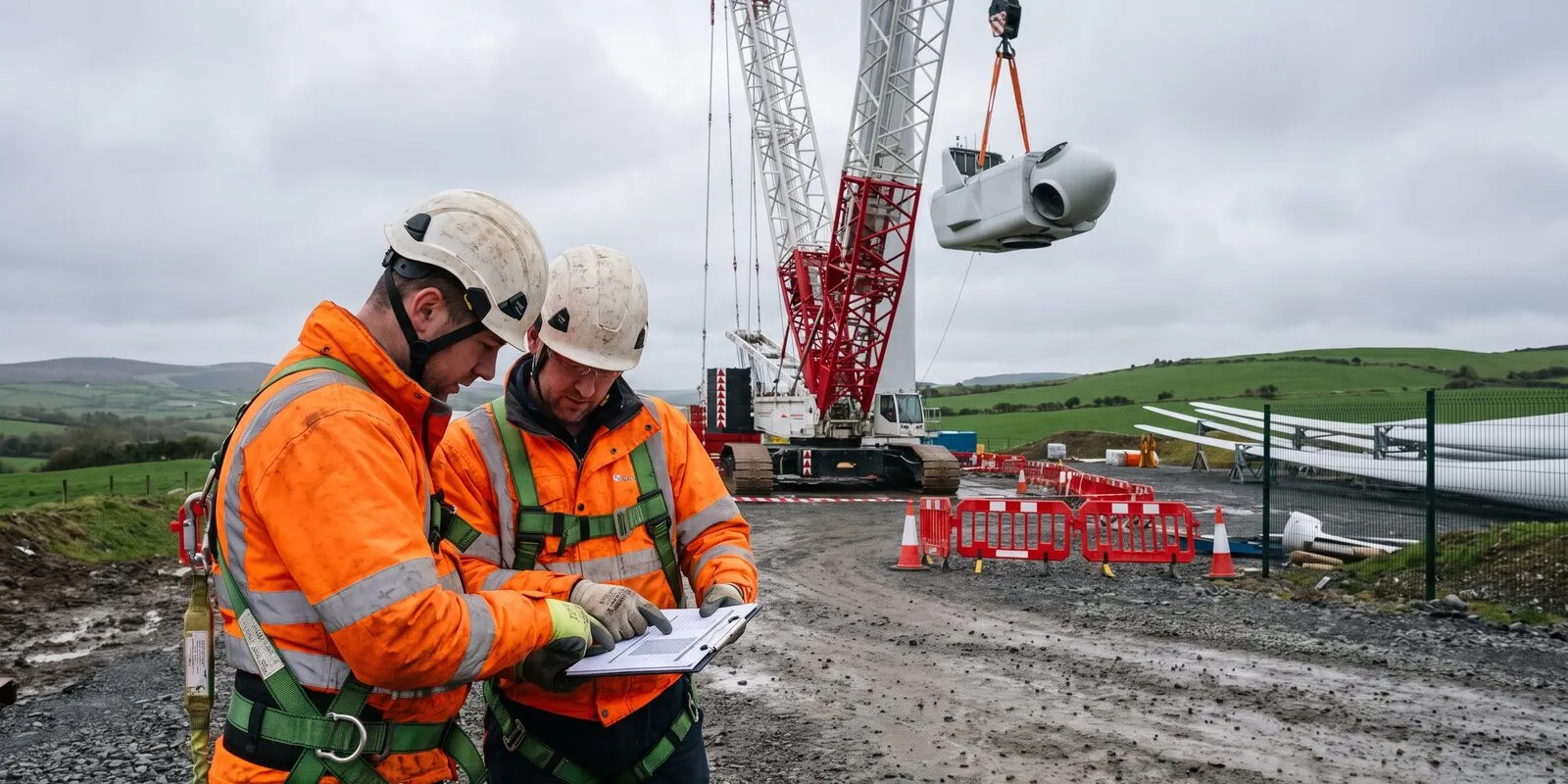
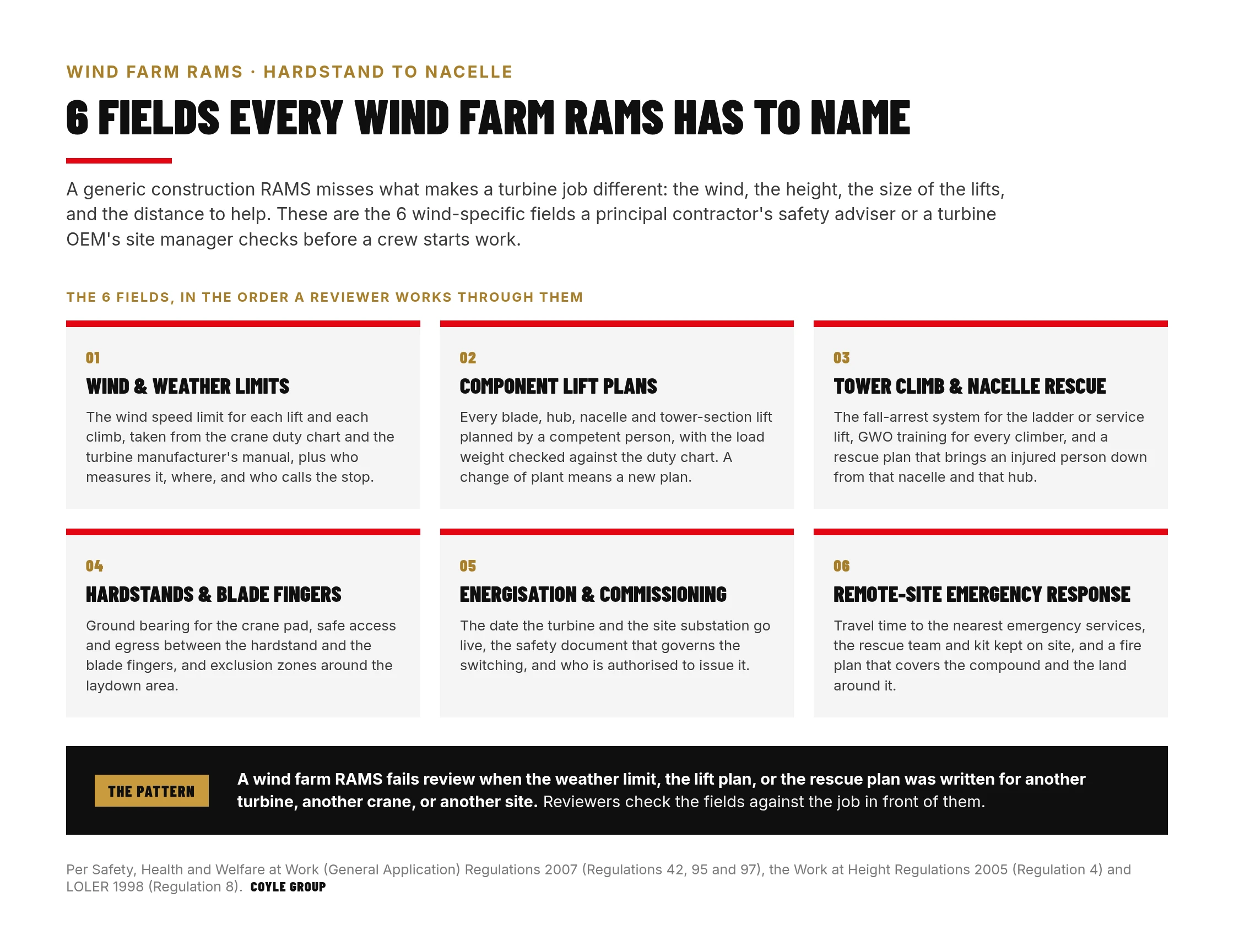
A wind farm RAMS (risk assessment and method statement) has to plan for things a standard construction pack rarely meets. The work happens at hub height above a hardstand, the heaviest lifts swing in open wind, and the nearest ambulance can be a long drive down a forestry track. Coyle Group places safety officers on wind farms in Northern Ireland, Scotland and Finland. When we review a contractor's RAMS, the same 6 fields come back short. They are the wind limit, the lift plan, the climb and rescue plan, the hardstand layout, the energisation plan, and the emergency response.
This guide sets out what a principal contractor's safety adviser, a PSCS, or a turbine manufacturer's site manager checks in a wind farm RAMS before work starts. It covers where Irish, British and Northern Irish duties line up, and it uses 4 real wind projects to show what each gap looks like on site.
Need a wind farm RAMS checked before the cranes arrive on site? Talk to a wind-sector safety specialist on our chartered team.
Talk To A Wind-Sector Safety SpecialistStart with the turbine
What Makes A Wind Farm RAMS Different
The structure of a wind farm RAMS is the same as any other: hazards, risk ratings, controls, then the step-by-step method. Our RAMS guide covers that general process. What changes on a wind farm is the content of 4 activities that most construction RAMS treat as routine.
| Activity | A typical construction RAMS | What a wind farm RAMS adds |
|---|---|---|
| Lifting | A lift plan for the crane on site and the heaviest load. | A separate plan per component (blade, hub, nacelle, tower section), each with its own wind limit from the crane duty chart and the turbine manufacturer's instructions. |
| Working at height | Scaffold, edge protection, MEWPs. | Climbing the tower ladder or service lift, working in the nacelle and hub, and a rescue plan for each of those positions. |
| Ground and access | Site roads and a laydown area. | Crane pads and hardstands built to a bearing capacity, blade fingers at different levels, and abnormal-load deliveries. |
| Emergency response | Call the emergency services and meet them at the gate. | A rescue team and kit kept on site, because the turbine may be a long drive from the nearest station and help cannot climb it quickly. |
The regulations behind each field
Method statements are not named in Irish legislation. The HSA's RAMS guidance explains that the duty comes from Sections 8 and 19 of the Safety, Health and Welfare at Work Act 2005, which require safe systems of work and a risk assessment. The specific wind-farm duties then sit in these regulations.
| Duty | Ireland | Great Britain | Northern Ireland |
|---|---|---|---|
| Plan every lift | Regulation 42, General Application Regulations 2007 | Regulation 8, LOLER 1998 | LOLER (Northern Ireland) 1999 |
| Plan rescue from height | Regulation 95(1)(b)(iii): a plan for emergencies and rescues | Regulation 4(2), Work at Height Regulations 2005 | Work at Height Regulations (Northern Ireland) 2005 |
| Stop for weather | Regulation 97: work at height only when the weather does not put employees at risk | Regulation 4(3), Work at Height Regulations 2005 | Work at Height Regulations (Northern Ireland) 2005 |
| Coordinate contractors | PSCS and the safety and health plan, Construction Regulations 2013 | Principal contractor and the construction phase plan, CDM 2015 | CDM (Northern Ireland) 2016 |
Fields 01 and 02
Wind Limits And Component Lift Plans
Turbine components are long, light for their size, and catch the wind. A blade behaves very differently on the hook from a tower section of the same weight. Each component needs its own lift plan, and each lift plan needs its own wind limit.
Tower sections
Heavy and compact. The plan covers bolting crews working inside the section at the flange as it lands.
Nacelle
Usually the heaviest single lift. The plan confirms the crane configuration and the load weight against the duty chart.
Hub
Lifted on its own or as part of a rotor. The plan names who works in the hub during the connection.
Blades
Large sail area. Tag lines, a lower wind limit and a clear exclusion zone under the swing path.
Why we do not publish a single wind speed figure
The wind limit depends on the crane, its configuration, the component, and the height of the lift. It comes from the crane manufacturer's duty chart and the turbine manufacturer's lifting instructions for that job. The law in both jurisdictions only says the lift must be properly planned and that work at height stops when the weather puts people at risk.
The RAMS must state: the limit for each lift, the source document it comes from, where the wind is measured (ground level or hub height), and the name of the person who stops the job.
What happens when the plant changes on the day
On a wind farm in Finland, a site team swapped the planned rigging crane for a telehandler to speed up a ballast move. The load was 12.5 tonnes and the telehandler's duty chart allowed 12. Our safety officer raised it, the work continued, and the telehandler tipped forward as the load became dynamic. Our Finland case study covers the time-out for safety that followed. A change of plant is a new lift, and it needs a new plan.
Field 03
Tower Climbing, Nacelle Access, And Rescue
Both Irish and British law say that planning work at height includes planning for emergencies and rescue. On a turbine, that means a plan for every position a person works in: the ladder, the platforms, the nacelle, and the hub. Our guide to working at heights regulations covers the general duties in more detail.
The climb
- The fall-arrest system on the ladder, or the service lift and its inspection record.
- Who climbs, in what order, and how many people are in the tower at once.
- GWO Basic Safety Training for every climber: First Aid, Manual Handling, Fire Awareness and Working at Height, plus Sea Survival offshore.
- The weather and wind limit for climbing, which can differ from the lift limit.
The rescue
- The rescue and descent kit kept in the nacelle, and who checks it.
- At least 2 people on the crew trained to use it on that turbine model.
- How a casualty is moved out of the hub and through the nacelle hatch.
- The time the rescue takes, tested in a drill before work starts.
The recurring failure we find on review
A rescue plan that says "call the emergency services". Fire and ambulance crews will not usually climb a turbine quickly, so the plan has to work with the people and equipment already on site.
The checklist at a glance
The 6 Fields In The Order We Review Them
Field 04
Hardstands, Laydown Areas, And Blade Fingers
The hardstand is the tested area built to take the crane and the transport. The blade fingers are where the blades are stored before the lift. When the 2 sit at different levels, offloading and installation become a work at height problem on the ground.
Those are the figures from a trial run on Evishagaran Wind Farm in Northern Ireland, where our safety officer found that more than half the blade fingers had no safe access or egress. Reshaping the ground was not possible, so a local scaffolding company built a bespoke access solution at each location, backed by a full risk assessment and daily toolbox talks. Our Evishagaran case study covers the full fix.
The RAMS must contain
- The design bearing capacity of the crane pad, and who confirmed it before the crane tracked on.
- The level difference between hardstand and blade fingers at each turbine location, with the access method for each.
- Exclusion zones around the laydown area and under every lift path.
- A note that any temporary access structure, such as scaffold, is itself risk-assessed.
Field 05
Energisation, Commissioning, And The Site Substation
A wind farm stops being a construction site in stages. Once the substation and the first turbines are live, every later task happens beside energised equipment, and the RAMS has to say so.
State the energisation date for the substation and for each turbine, and which tasks in the RAMS fall after it.
Name the safety document that governs switching and isolation once equipment is live, and the authorised person who issues it.
Plan the installation of control equipment, such as SCADA panels, as a lift in its own right.
Write the hand-over from construction to operations into the RAMS, so the crew knows whose rules apply on which day.
A substation door that was too small
On a 9-turbine wind farm in County Antrim, the Farm Control Unit and SCADA system would not fit through the substation control room door. Our safety officer built a replica of the panel, trialled portable lifting options with the hire company, and the lift went ahead exactly as set out in the RAMS and lift plan. Our SCADA lift case study covers it in full, and our guide to substation maintenance RAMS covers the isolation and switching side of substation work.
Field 06
Emergency Response On A Remote Wind Farm
Wind farms are built where the wind is, which is rarely close to a hospital or a fire station. The emergency section of the RAMS has to work for the time it takes help to arrive.
Onshore
- Access
- The route for emergency vehicles from the public road to each turbine, with a grid reference or what3words location for every base.
- On site
- First aiders and rescue kit at each working location, and a vehicle that can carry a casualty out on the site tracks.
- Fire
- Fire precautions for the compound, fuel stores and welfare units, and for anything on neighbouring land that could spread to the site.
Offshore
- Transfer
- The vessel or helicopter transfer method, and the sea state and wind limits for each.
- On the turbine
- A crew able to carry out the rescue without outside help, with GWO Sea Survival in date.
- Evacuation
- How a casualty reaches shore, and how long it takes in the worst weather the job allows.
A fire that started next door
Near Douglas West Wind Farm in Scotland, our safety officer smelt burning on a site walk and traced it to a re-igniting pile of wood ash in a neighbouring yard that was already charring a stack of pallets. The yard owners were contacted out of hours, the pile was spread and damped down with a water tanker, and the ash was kept damp until it stopped smouldering. Our Douglas West case study sets out the full response. The RAMS fire plan has to look past the site boundary.
The names on the document
Who Writes And Coordinates The Wind Farm RAMS
Each contractor writes the RAMS for its own work. On a wind farm, that can mean a civils contractor, a crane company, an electrical contractor and the turbine manufacturer's installation team all working on the same hardstand. Someone has to make those documents fit together.
| Jurisdiction | Who coordinates the RAMS across contractors |
|---|---|
| Ireland | The PSCS develops the safety and health plan under the Construction Regulations 2013 and coordinates the contractors' RAMS against it. |
| Great Britain | The principal contractor plans, manages and coordinates the construction phase under CDM 2015, including the construction phase plan. |
| Northern Ireland | The same principal contractor model under CDM (Northern Ireland) 2016. |
The question a reviewer is asking
When the crane company's lift plan and the turbine manufacturer's installation method disagree on a wind limit, which document wins? The RAMS should answer that before anyone asks on the day.
Our guide to PSCS duties covers the Irish coordination role in more detail. For the wider picture, our article on Irish offshore wind covers the projects now moving into construction.
What Chartered Oversight Looks Like On Wind Sites
Not sure your lift plans and rescue plan would survive a principal contractor's review? Talk to a wind-sector safety specialist before the first turbine goes up.
What clients say
A Fresh Pair Of Chartered Eyes
“A fresh pair of eyes: he will often spot the potential for hazard.”
“Gavin has supplied competent EHS personnel… we want to go further, making all our plants safer.”
“Gavin is always a phone call away and has always provided a professional and supportive service… on many occasions at very short notice and outside of business hours.”
Questions about wind farm RAMS
Frequently Asked Questions
What should a wind farm RAMS include?
A wind farm RAMS needs everything a standard RAMS has, plus 6 wind-specific fields: wind and weather limits, component lift plans, tower climb and nacelle rescue, hardstand and blade finger access, energisation and commissioning, and remote-site emergency response. Coyle Group reviews each of those 6 fields against the turbine, the crane and the site on the day, because those are the fields reviewers send back most often.
Is there a legal maximum wind speed for crane lifts on a wind farm?
No single regulation in Ireland or the UK sets a single figure. The law requires lifts to be properly planned and work at height to stop when the weather puts people at risk. The working limit comes from the crane manufacturer's duty chart and the turbine manufacturer's lifting instructions for that component. Coyle Group expects the RAMS to quote that limit, name who measures the wind and where, and name who has the authority to stop the lift.
Can we use a free RAMS template for wind turbine work?
A free template is a reasonable starting structure, and the HSA publishes one for Irish construction work. It will not contain the wind-specific fields a turbine job needs, such as nacelle rescue, blade finger access or the crane wind limit. Coyle Group uses a template for layout and then writes those fields for the specific turbine model, crane and site, which is what a reviewer is checking.
Do the RAMS rules differ between Ireland, Great Britain and Northern Ireland?
The core duties match closely, but the legislation and duty holders differ. Ireland uses the General Application Regulations 2007 and the Construction Regulations 2013, with a PSCS coordinating contractors. Great Britain uses the Work at Height Regulations 2005, LOLER 1998 and CDM 2015, with a principal contractor. Northern Ireland has its own versions of all 3. Coyle Group writes the RAMS to cite the regime that applies to the site.
Who needs GWO training on a wind farm?
Turbine owners and manufacturers commonly require GWO Basic Safety Training for anyone who climbs a turbine or works inside it. The modules cover First Aid, Manual Handling, Fire Awareness and Working at Height, with Sea Survival added for offshore work. Coyle Group checks the RAMS names who holds which modules and when each certificate expires, so the crew list matches the climb plan.
How often should a wind farm RAMS be reviewed?
Review it whenever the job changes: a different crane, a new component, a change in ground conditions, or a new phase such as moving from erection to commissioning. The HSA describes a RAMS as a live working document. On our Finland project, a switch from a rigging crane to a telehandler was exactly the kind of change that should have triggered a new plan. Coyle Group reviews RAMS at each of those points.
How quickly can Coyle Group review a wind farm RAMS or put a safety officer on site?
Coyle Group scopes a RAMS review on the first call and agrees a date that lands before your lift or commissioning programme starts. Where the site also needs a wind-specialist safety officer to run the plan day to day, we mobilise within 48 hours across Ireland, the UK and the EU. Talk to a wind-sector safety specialist and tell us your first lift date.
CMIOSH · 48-hour mobilisation
Getting Your Wind Farm RAMS Signed Off Before The First Lift
A wind farm RAMS that names the wind limit, the lift plan for each component, the rescue plan for each position and the people authorised to run them clears review the first time. Talk to a wind-sector safety specialist and we will review your pack, or write it with you, before the cranes arrive.
Talk To A Wind-Sector Safety Specialist