Safety Officer Salary in Ireland: 2026 Pay and Day Rates
Safety officer salary figures in Ireland look straightforward until two job adverts for the same title differ by €20,000. The gap comes from experience, sector, location and whether the post is permanent or a contract, and it widens once a day rate enters the conversation. Employers budgeting for site cover and safety officers weighing a permanent post against contracting both need the same numbers laid out in one place.
This guide sets out the 2026 safety officer salary ranges for Ireland, shows the daily cost that sits behind each one, and compares them with UK contract day rates. Every figure is a sourced range with a date, and none of it is a Coyle Group rate card.
Need site cover while you work out the budget? Hire a safety officer in 48 hours and price the role against your actual programme.
Hire A Safety Officer In 48 Hours
How Much Do Safety Officers Earn in Ireland?
Safety officers in Ireland typically earn between €41,000 and €74,000 a year, and the published average is €55,517. That average comes from 787 salaries on Indeed Ireland, last updated on 12 October 2026, with a typical range of €41,454 to €74,350 depending on experience, location and the hiring company.
Recruiter data lands in the same place. Morgan McKinley’s 2026 salary guide gives an average of €45,000 to €60,000 for a health and safety officer in Dublin, and its manager range of €70,000 to €100,000 shows where the career goes next. Our own guide to health and safety recruitment uses the same bands for early-career and experienced hires, so the picture is consistent across sources.
Official earnings statistics are broader than any single occupation. The Central Statistics Office publishes earnings and labour costs data for the whole economy, which helps employers judge how a safety officer salary compares with other site roles, but it does not break pay down by safety job title. Job-board and recruiter data fills that gap, with the caveat that advertised pay reflects asking prices rather than settled offers.
Safety Officer Salary by Experience Level
Experience is the strongest single driver of a safety officer salary in Ireland. Morgan McKinley’s 2026 figures for Dublin, filtered to engineering and construction, show safety officers with 0 to 3 years at €35,000 to €50,000, those with 3 to 5 years at €45,000 to €60,000, and those with 5 or more years at €55,000 to €75,000. Health and safety managers start higher and climb further: €65,000 to €90,000 at 0 to 3 years, €70,000 to €100,000 at 3 to 5 years, and €80,000 to €110,000 beyond that.
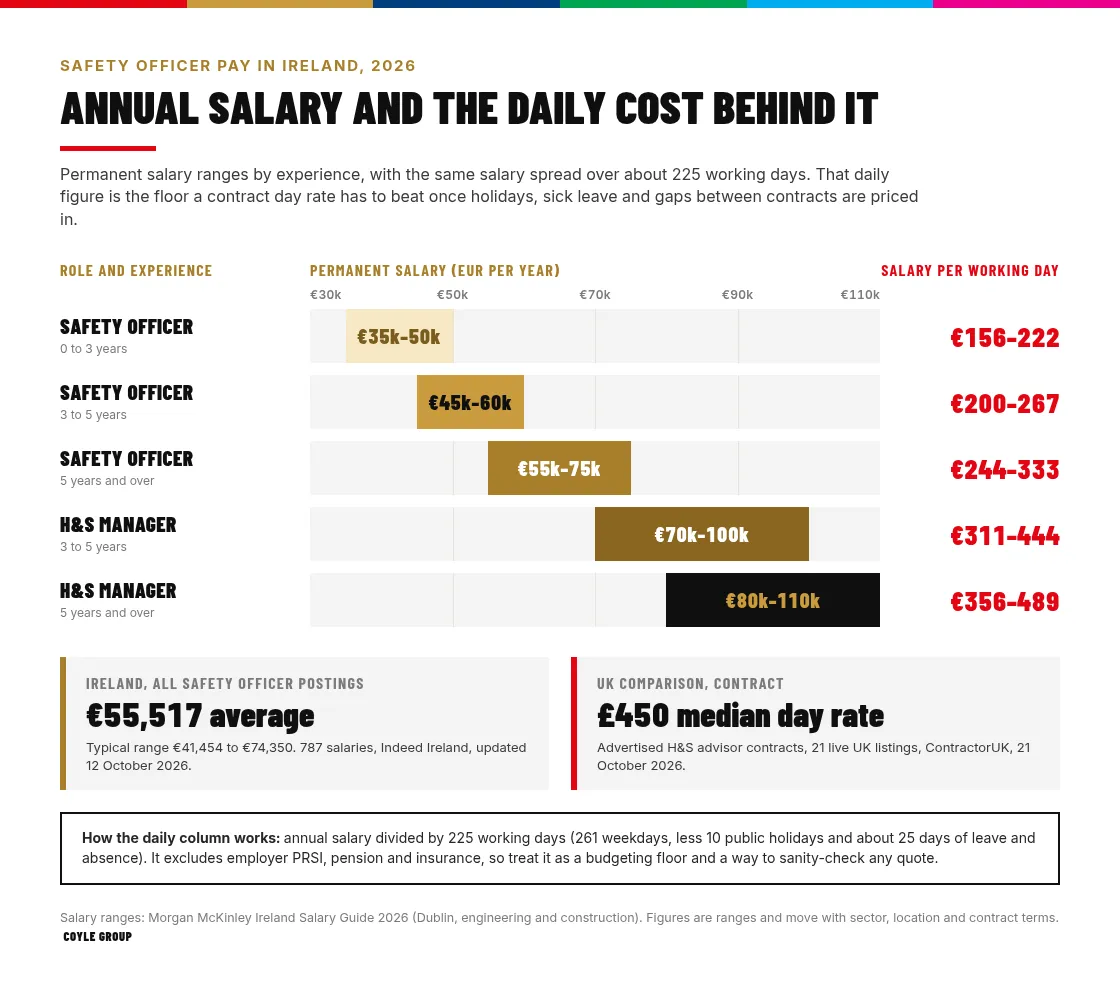
The chart adds a second column that most salary guides leave out: the salary per working day. It divides each annual range by 225 working days, which is 261 weekdays less 10 public holidays and about 25 days of leave and absence. A safety officer on €55,000 therefore costs an employer about €244 for each day worked, before employer PRSI, pension and insurance are added.
That daily figure matters because it is the number a contractor’s day rate gets compared against. A rate below it only works for a contractor who is never between assignments, and a rate well above it needs a reason such as shift premiums, urgency or scarce tickets. The career progression ladder explains how an officer moves up these bands, and the next section covers what moves the number sideways.
What Moves a Safety Officer Salary Beyond Experience?
Location is the first factor. Indeed’s Irish city averages for safety officers run from €63,525 in South Dublin and €61,156 in Wicklow to €57,561 in Dublin, €55,674 in Cork, €52,345 in Limerick and €52,040 in Waterford. A smaller town can sit lower still: the average for Nenagh, County Tipperary is €46,909. Those are job-board averages, so they indicate direction and do not form a pay scale.
Sector is the second. Public bodies publish scales, and a recent Dublin City Council advertisement for an Executive Health and Safety Officer listed a scale from €57,909 up to €76,887 at the maximum. Private employers in energy, utilities, data centres and pharma often pay for specific experience such as permit-to-work systems, high-voltage awareness or outage work, which is why two officers with the same years served can sit in different bands.
Qualifications and chartered status come third. A degree-level qualification and Chartered membership of IOSH (CMIOSH) open senior and manager roles more than they lift an officer-level salary directly. Our guide to the best safety jobs sets out the UK role ladder, and the Irish picture follows the same logic: the credential matters most when an employer needs someone to sign off safety decisions.
What Is the Difference Between a Safety Officer and an HSE Officer?
In practice the two titles describe the same kind of role, and the pay ranges overlap. “HSE officer” adds environment to health and safety, so it usually appears in sectors such as energy, utilities and process plants, where environmental permits sit alongside safety. “Safety officer” is the common site-level title in construction and engineering.
The acronym causes confusion in salary searches because the Health Service Executive is also called the HSE. Searches for “HSE pay scales” often return health service grades for nurses and administrators, which have nothing to do with a site safety officer. Anyone benchmarking pay should search on the job title and the sector, and check that the advert describes site safety duties.
Seniority is the better guide than the title. An officer inspects, inducts, coordinates permits and reports, an advisor builds systems and audits them, and a manager owns the function and the budget. The three sit at different points on the ladder above, and the salary follows the level of responsibility.
Safety Officer Day Rates: What Contractors Charge
Ireland has no public benchmark for safety officer day rates. Our searches of 2026 salary and contracting guides from Irish recruiters found day-rate tables for other disciplines but none for health and safety, so any Irish figure quoted without a source should be treated with care.
The UK is better documented. ContractorUK’s day-rate tracker reports a median advertised day rate of £450 for health and safety advisor contracts, computed from 21 live UK listings on 21 October 2026. Advertised rates are asking prices, so they work as a guide to the market. The spread above that median is wide, because specialist, outage and interim senior roles command a premium over general advisor cover.
UK and Irish day rates differ, because the markets, currencies and tax treatment differ. It is still useful as a comparison point for Irish employers, since many contract safety officers work on both sides of the Irish Sea and the same project can recruit from both pools.
Converting a Safety Officer Salary Into a Day Rate
The most reliable method for setting an Irish day rate is arithmetic. Take the permanent salary for the role, divide by about 225 working days, and treat the result as the floor. A role paying €60,000 gives about €267 per day, and a role paying €75,000 gives about €333.
A contractor then adds what a permanent employee receives through the payroll: paid holidays, sick pay, pension contributions, insurance and the gaps between assignments. Those costs are real, which is why a contract day rate above the daily salary equivalent is normal and does not mean the contractor is being overpaid.
A worked illustration shows the scale. A day rate of €300 across 225 working days comes to €67,500 a year, against a €55,000 salary. The €12,500 difference has to cover the contractor’s own benefits and downtime, and a few weeks without work would narrow it quickly. Employers should therefore compare total annual cost, including recruitment time and onboarding, after comparing the whole picture rather than a day rate against a salary line.
Contractor or Employee: Employment Status in Ireland
Employment status decides who carries the tax and employment-law obligations, and the label in the contract does not settle it. Revenue, the Department of Social Protection and the Workplace Relations Commission publish a joint Code of Practice on determining employment status, which Revenue’s employment status guidance describes as a five-step decision framework. The Code was reviewed and updated in November 2024 after the Supreme Court judgement in the Karshan case.
The practical point for a safety officer is that working under a client’s direction, on fixed hours, with the client’s equipment and no financial risk looks like employment, whatever the paperwork says. Genuine self-employment looks different: the contractor controls how the work is done, supplies their own tools and bears commercial risk.
Employers engaging a safety officer directly should take advice before treating anyone as self-employed. Using an agency or an employer-of-record arrangement moves part of that burden, which is one reason clients choose outsourcing safety resources for time-limited projects.
What Pushes a Day Rate Higher?
Several factors lift a contract rate above the salary-derived floor. Outage and shutdown work compresses the timetable and brings long shifts, and employers will pay more for an officer who has already seen a turbine inspection or a substation outage. Coyle Group has supplied contract safety officers on outage and construction work for clients including ESB, Energia, Suir Engineering and Kirby Engineering, and in our experience a close match to the plant carries more weight than the headline rate.
Location and logistics come next. A site that needs travel, accommodation or night work prices that into the rate, and so does a start date inside a week. Scarcity matters too: certain tickets, sector experience or chartered status shrink the pool and raise what an employer needs to offer.
Duration works in the other direction. A 12-month engagement gives the contractor continuity, which can bring the rate down, while a 3-week emergency cover assignment carries a premium for the disruption. For official UK context, the Office for National Statistics publishes the Annual Survey of Hours and Earnings, which is the standard source for occupation-level earnings in Great Britain.
UK Safety Officer Salaries and Day Rates for Comparison
UK permanent pay sits in a similar shape. Our guides to the UK market give health and safety advisors at £30,000 to £45,000 and health, safety and environmental managers at £45,000 to £65,000 and above, with early-career roles from about £24,000 to £40,000. Those ranges were written for UK employers and are in sterling, so they should stay in sterling when compared with Irish figures.
The difference between jurisdictions shows up most clearly in contracts. UK advertised day rates are visible on job boards, so contractors can see the market median, while Irish rates are negotiated privately. That visibility is why UK rate data helps Irish employers set expectations, even though the two markets do not move together.
For an employer hiring across both countries, the cleanest approach is to price each role in its own market and currency, using the local salary range and local employment-status rules. Coyle Group places safety officers in Ireland and the UK, and the same candidate can sometimes cover both, which simplifies cover for multi-site programmes.
Permanent Hire or Contract Cover: Budgeting for Safety Officers
A permanent hire suits a continuing need. The salary is predictable, the officer learns the site, and the employer builds safety knowledge in-house, but recruitment can take months and a vacancy leaves the site exposed in the meantime. A well-written job description template shortens the search by fixing the scope, tickets and reporting line before the advert goes out.
Contract cover suits a defined project, an outage, a peak in site activity or a gap while a permanent search runs. The day rate is higher than the daily salary equivalent, but the employer pays only for days worked, and the officer starts quickly. The right choice depends on how long the need lasts and what a missing safety officer would cost the programme.
Many employers combine the two, using contract cover to start immediately and converting the best performer to permanent once the scope settles. Our guide to contract or permanent safety officers sets out the 8 factors behind that choice. Budgeting is simplest when the role, duration and sector tickets are fixed first, because those three decisions set the salary range and the rate more than any other input.
Costed the role and still have a start date to hit? Hire a safety officer in 48 hours from a pool of more than 100 qualified officers.
Hire A Safety Officer In 48 Hours
A short call to confirm scope, tickets and start date is usually enough to move from budget to shortlist.
Pricing a Safety Officer Role Against Your Programme
A realistic safety officer salary budget starts with the experience level the site needs, then adjusts for location, sector and whether the post is permanent or contract. For Ireland in 2026 that means ranges of about €35,000 to €75,000 for officers and €65,000 to €110,000 for managers, with a daily floor of roughly €156 to €489 derived from those salaries.
Day rates sit above the floor by an amount that depends on shift patterns, urgency and scarcity, and the only reliable way to price them is against a specific role. Coyle Group was founded in 1999, Gavin Coyle holds CMIOSH, and the team has delivered more than 1M hours of safety cover, which means pricing conversations start from real assignments. If the budget is settled and the site needs cover now, Hire a safety officer in 48 hours.
Frequently Asked Questions (FAQs): Safety Officer Salary in Ireland
These are the pay questions employers and safety officers ask Coyle Group most often when a permanent hire is being weighed against contract cover.
How much does a safety officer earn in Ireland?
Most safety officer salaries in Ireland fall between €41,000 and €74,000, with an Indeed average of €55,517 across 787 salaries reported to 12 October 2026. Morgan McKinley's 2026 guide puts officers with 0 to 3 years at €35,000 to €50,000 and those with 5 or more years at €55,000 to €75,000. Coyle Group treats these as ranges because sector and location move the figure.
What is a typical safety officer day rate in Ireland?
There is no published benchmark for Irish safety officer day rates, so any single figure should be treated with caution. A useful floor is annual salary divided by about 225 working days, which turns €55,000 into roughly €244 per day before employer costs. Coyle Group agrees assignment rates with each client, because outage work, shift patterns and location change what a role is worth.
Do contract safety officers earn more than permanent staff?
A contractor's day rate is usually higher than the daily equivalent of a permanent salary, but the contractor also covers their own holidays, sick days, pension and gaps between assignments. Over a full year the gap is often narrower than the headline rate suggests. Coyle Group advises safety officers to compare total annual income, and employers to compare total cost across the whole engagement.
Is a contract safety officer self-employed in Ireland?
Not automatically. Revenue, the Department of Social Protection and the Workplace Relations Commission apply a joint Code of Practice with a five-step framework, and the reality of the working relationship counts as much as the contract wording. A safety officer who works under direction, on set hours, with the client's equipment may be treated as an employee. Coyle Group suggests employers take tax advice before engaging anyone directly.
Do safety officers earn more in Ireland than in the UK?
Pay is quoted in different currencies and the labour markets differ, so a direct comparison needs care. Advertised UK health and safety advisor contracts show a median day rate of £450, while Irish permanent officer salaries run from about €35,000 to €75,000 by experience. Coyle Group places safety officers in both jurisdictions and compares like for like roles, sectors and shift patterns before advising on rates.
Does chartered status raise a safety officer's pay?
Chartered membership of IOSH, known as CMIOSH, generally supports moves into senior and manager roles, where Morgan McKinley's 2026 ranges are higher: €70,000 to €100,000 for managers with 3 to 5 years. It does not guarantee a set premium on an officer role. Gavin Coyle holds CMIOSH, and Coyle Group matches chartered candidates to clients who specifically ask for that level of oversight.
How quickly can Coyle Group supply a contract safety officer?
Coyle Group can deploy a contract safety officer from its pool of more than 100 safety officers within 48 hours once the scope is confirmed. Speed depends on the site, the sector tickets required and the start date, so a short call to confirm the role comes first. That lets an employer price cover against a real programme while a permanent search runs.