Minimum Safety Training: UK vs Ireland Construction
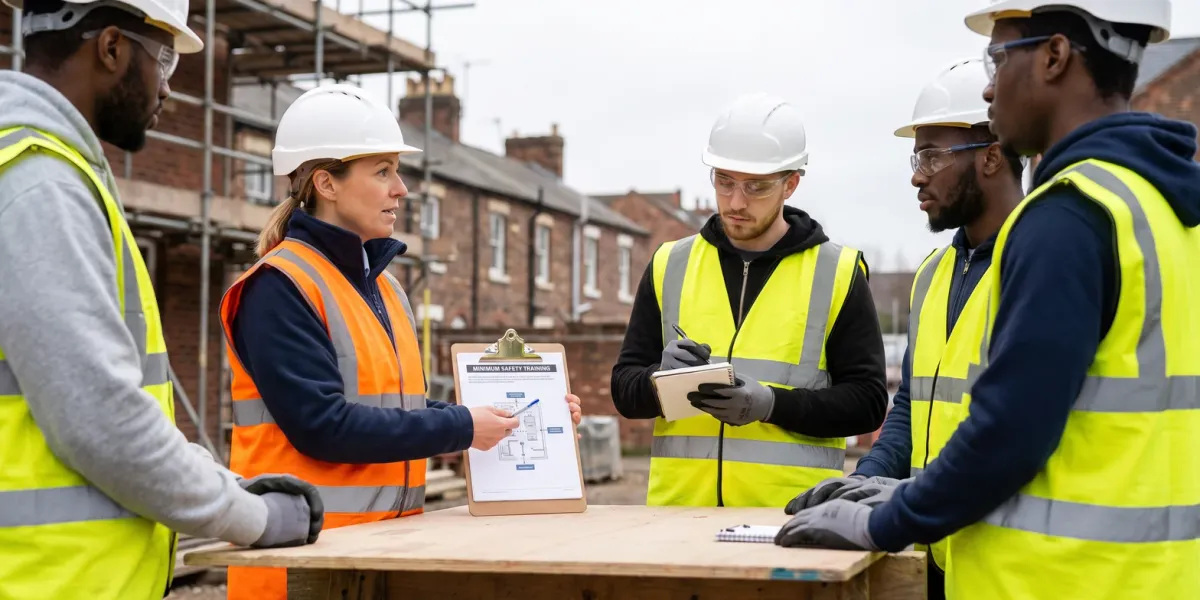
Despite taking every precaution and ensuring that workers have received extensive health and safety training, there will always be some workplaces that are extremely hazardous in terms of the potential for accidents.
The construction and demolition sector is one example of a place of work that falls under this category and is frequently named among the top ten most dangerous jobs.
Construction workers frequently suffer injuries on the job. A single wrong step could cause someone to fall to their death. As a result, employers and employees must do all they can to reduce the risk of injury on the job.
In practice, the two jurisdictions take different routes to the same goal. In the Republic of Ireland the baseline is the Safe Pass card, while in the UK site access usually hinges on holding a valid CSCS card alongside the role-specific training set out below.
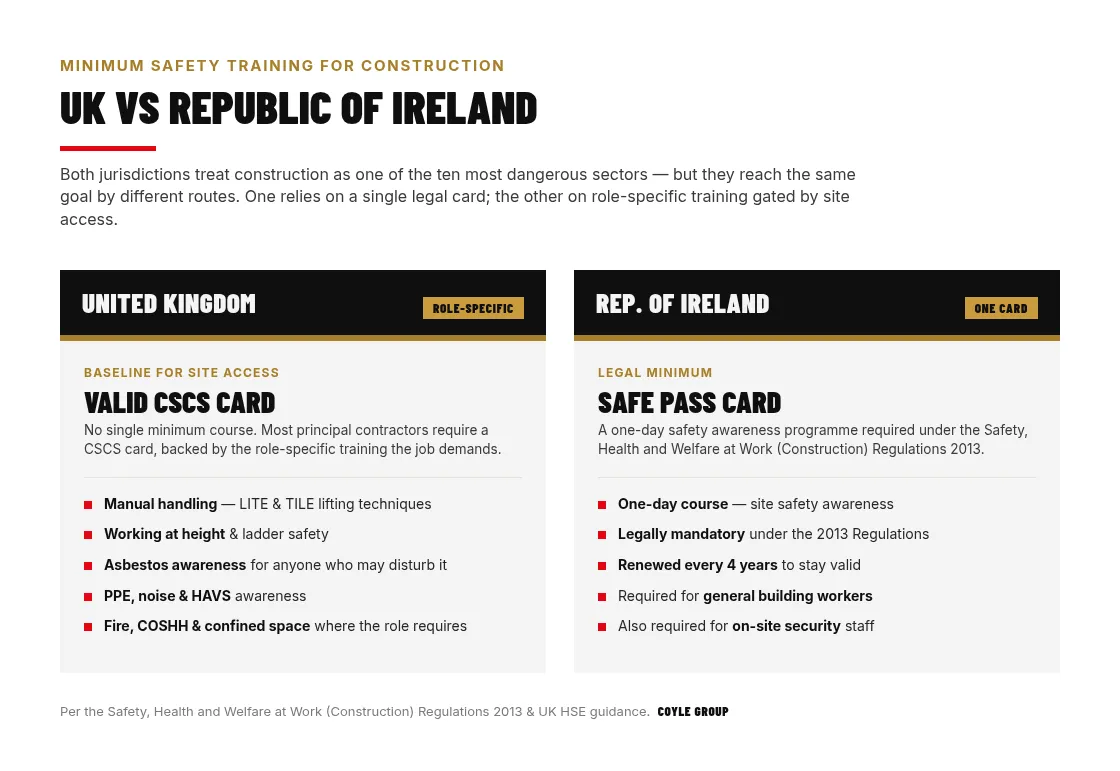
Safety Training Required by a Construction Worker in the UK
As an employer, before employing a person to work on a construction site, there is safety training that they must undergo before working.
- Manual Handling Training: safe handling of objects including LITE and TILE lifting techniques
- Asbestos Awareness Training: for anyone who works with asbestos or might come into contact with it at work
- Working at Heights Training: legal requirements for both employers and employees working at height
- Ladder Safety Training: how to choose, set up, and use a ladder properly and perform pre-checks
- PPE (Personal Protective Equipment) Training: proper wearing and caring for PPE
- Noise Awareness Training: recognising noise at work and avoiding exposure, specifically for construction and industrial workers
- Construction Fire Awareness Training: fire prevention, fire extinguisher use, fire sign recognition, emergency procedures, and safe evacuation
- Hand Arm Vibration Awareness (HAVS) Training: effects of hand-arm vibration, who is at risk, and how to prevent dangerous exposure
- Confined Space Training: recognising risks in poorly ventilated confined spaces
- CDM Regulations Training: planning, managing, and ensuring everyone’s safety on a construction site (CPD accredited, IOSH approved)
- Mental Health in Construction Training: IIRSM-approved; raises awareness about mental illness in the construction industry
- Environmental Awareness Training: CPD accredited and IOSH approved; Environmental Protection Act 1990 and Environment Act 1995
- Appointed Person Training in First Aid: the role of the First Aid Appointed Person within an organisation
- Refresher Training in First Aid at Work: online First Aid at Work training for workplace first responders
- Banksman Essentials Training: IIRSM-approved; limiting the chance of accident during large truck manoeuvres
- COSHH Training: keeping employees safe from toxins, chemicals, fumes, dust, and biological agents
- Eye Protection Training: detecting hazards, using proper PPE, providing first aid, and managing risks
- LOLER Training: Lifting Operations and Lifting Equipment Regulations 1998; minimising accidents during lifting
- PUWER Training: IOSH-approved and CPD accredited; working safely with work equipment
- Electrical Safety Training: practical tips for operating safely around electricity and electrical appliances
The exact courses a worker needs depend on their role and the hazards present on the particular site, so no two job cards look quite the same. A competent risk assessment identifies which of these apply before work starts, which is the same principle that shapes the minimum requirement across the Republic of Ireland.
Safety Training Required by a Construction Worker in the Republic of Ireland
In addition to specialised training, all construction workers are required by law to take Safe Pass Training. This is the minimum training required of a construction worker in the Republic of Ireland.
What is a Safe Pass?
Safe Pass is a one-day construction worker safety awareness training programme run by SOLAS. Its goals: improve awareness levels in the construction sector and ensure all construction employees can contribute to the avoidance of accidents and illness on the job.
Safe Pass, or Safety Awareness Programmes, are required under the Safety, Health and Welfare at Work (Construction) Regulations 2013.
Required for:
- Craftsmen and building workers in general
- Individuals performing on-site security work
Why Do I Need a Safe Pass?
The Safe Pass programme is required to educate construction employees about the dangers they face on the job so that they do not endanger themselves or their coworkers.
Training Before Any Construction Work Begins
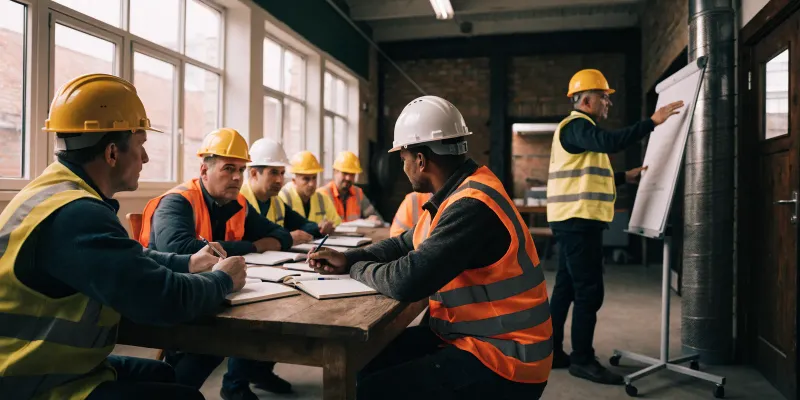
It is important that before anyone is allowed to work on a construction site, he or she must take training programmes. Regular training allows employees to renew their understanding of construction health and safety procedures, reducing the risk of serious injuries.
Common Misconceptions About Minimum Safety Training
Beyond the jurisdiction-specific cards, a few myths about the minimum requirement come up on almost every site. Here is how it actually works in practice across the UK and the Republic of Ireland.
”There is one basic course that covers every worker”
There is no single “basic” course that covers every worker. In the Republic of Ireland the baseline is the one-day Safe Pass, while in the UK the effective minimum is a valid CSCS card plus a site induction. Sitting underneath that, the core courses most workers meet first are manual handling, working at height, asbestos awareness, and PPE, because those hazards appear on nearly every site. The rest of the role-specific courses listed above build on that foundation once a risk assessment identifies which apply.
”Workers can refuse mandatory training with no consequences”
They cannot, at least not without losing access to the work. Where training is required by law, employees have their own duties: under the Health and Safety at Work etc. Act 1974 in the UK and the Safety, Health and Welfare at Work Act 2005 in the Republic of Ireland, workers must cooperate with their employer and take reasonable care for their own safety and that of others. Refusing training that is a legal condition of the work usually means losing site access, and it can lead to disciplinary action because the employer cannot lawfully let an untrained worker onto a hazardous site.
”Once you are trained, you are certified for good”
Certification does not last forever. Refresher periods depend on the course and the jurisdiction rather than one fixed date. A Safe Pass card in the Republic of Ireland must be renewed every four years, and CSCS cards in the UK are typically valid for up to five years before retesting. Many role-specific courses, such as manual handling or first aid, are refreshed every two to three years to keep certification current. The safest approach is to track each worker’s expiry dates and book renewals before they lapse, so no one drops off site access.
The Minimum Depends on Where You Work
The minimum requirement comes down to where the work happens. In the Republic of Ireland it is the one-day Safe Pass; in the UK it is a valid CSCS card alongside the role-specific courses each site’s hazards demand. Either way, training is a legal duty on employers and workers alike, and certification lapses on a schedule rather than lasting for good. The practical task is knowing which courses apply to each role and tracking renewal dates before anyone loses site access.
For a broader look at your safety training options, and the safety lessons construction can borrow from other sectors, explore our resources. Coyle Group’s safety consulting and CDM advisory services can help you meet your duties on site.
Frequently Asked Questions
What is a Safe Pass?
Safe Pass is a one-day construction worker safety awareness training programme required in the Republic of Ireland under the Safety, Health and Welfare at Work (Construction) Regulations 2013. It aims to improve awareness levels in the construction sector and ensure all construction employees can contribute to the avoidance of accidents and illness.
Is Safe Pass mandatory?
Yes. In the Republic of Ireland, Safe Pass is a legal requirement under the Safety, Health and Welfare at Work (Construction) Regulations 2013. Most construction workers must hold a valid Safe Pass card to work on site, and the card is renewed every four years.
What is a CSCS card?
A CSCS (Construction Skills Certification Scheme) card proves that a worker holds the training and qualifications for the job they do on a UK construction site. While not a legal requirement in itself, most UK principal contractors require a valid CSCS card for site access.
How long does a Safe Pass card last and how often do you renew it?
A Safe Pass card is valid for four years from the date of issue. To keep working on site in the Republic of Ireland, you must complete the one-day Safe Pass programme again before the card expires. There is no shorter refresher option, so plan the renewal course ahead of the expiry date to avoid losing site access.
Do you need a CSCS card to work on a UK construction site?
A CSCS card is not a legal requirement in its own right, but most principal contractors and clients in the UK will not grant site access without one. In practice this makes a valid CSCS card the effective minimum for working on the majority of UK sites. The card you need depends on your role and the qualifications you hold.
What training do you need to work at height?
Working at height calls for role-specific training that covers the legal duties on both employers and employees, safe use of access equipment, and how to select and inspect the right equipment for the task. Where ladders are used, ladder safety training covers correct set-up and pre-use checks. The Work at Height Regulations require the risk to be assessed and the work planned before anyone goes up.
Is manual handling training a legal requirement in construction?
Yes. Employers must provide manual handling training where workers carry out lifting or handling tasks that carry a risk of injury, which covers most construction roles. The training teaches safe techniques such as the LITE and TILE assessment methods so workers can reduce the strain on their backs and joints. It is one of the most common courses because manual handling injuries are widespread across the sector.